QUIRK REPORTS — OFFICIAL CASE FILE
Case Number: QR-2026-99093
🗞️ TOYS, TERROR AND A VERY CHATTY CORPSE: THE POLTERGEIST THAT HELD NORTH LONDON HOSTAGE FOR THIRTEEN MONTHS
Classification: Poltergeist / Possible Entity Attachment / Physical Manifestation
Date of Event: August 1977 – September 1978
Location: Enfield, North London, England
Primary Witness: Margaret Hodge (name changed)
Filed by: Fox Quirk, Founder & Senior Reporter, Quirk Reports
This report is based on documented paranormal accounts. Names and identifying details have been changed to protect those involved.
SECTION ONE: WITNESS STATEMENT
On the evening of 30 August 1977, Margaret Hodge — thirty-six years old, recently separated, and raising four children alone in a semi-detached council house in Enfield — had every reason to expect an ordinary night. She had sent her children to bed. She had not sent for poltergeists. The poltergeist, apparently, had not been consulted on this arrangement.
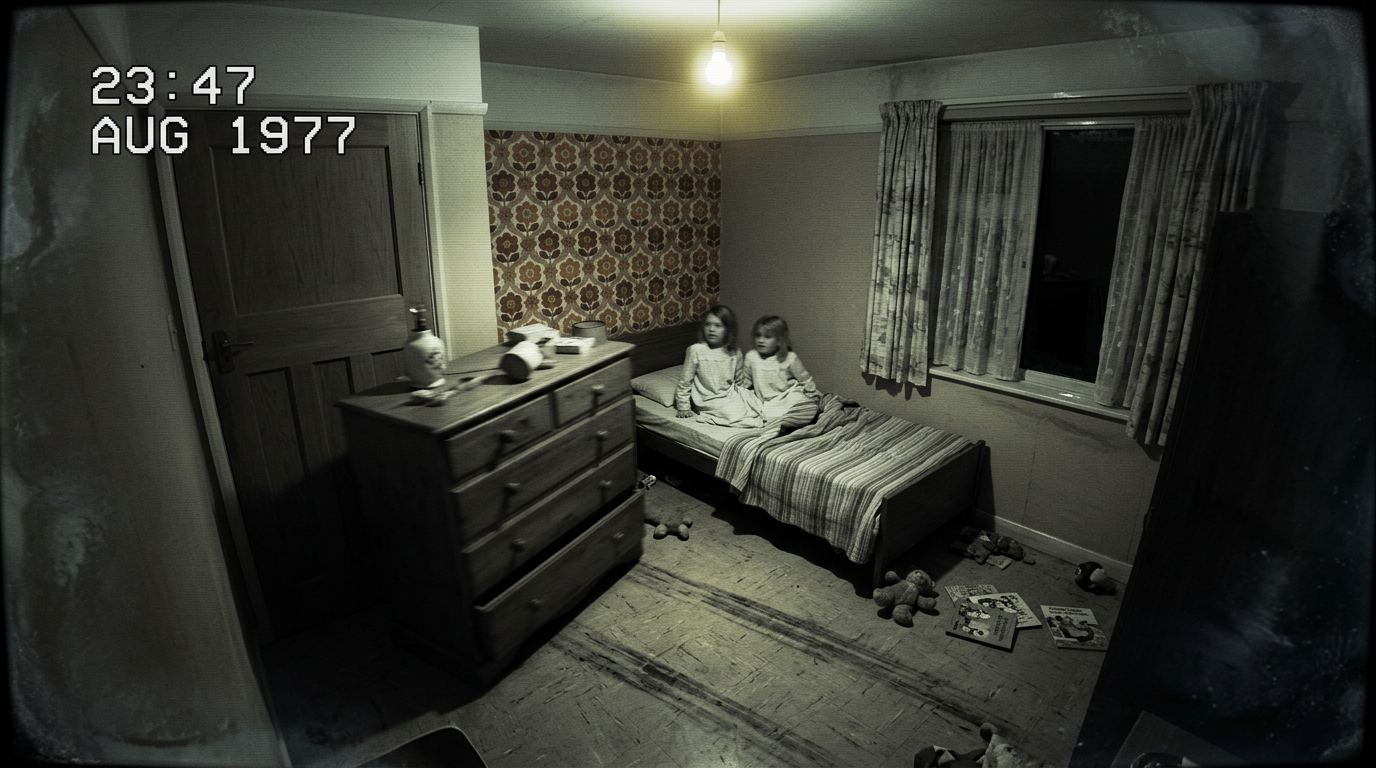
At approximately nine-thirty, her eleven-year-old daughter Janet and seven-year-old son Peter descended the stairs pale-faced, reporting that their beds were moving. Margaret sent them back up. Roughly twenty minutes later, she heard it herself: a rhythmic shuffling from the floor above, followed by four sharp, deliberate knocks. She went upstairs to find her children huddled on Janet's bed, staring at a heavy chest of drawers that had migrated two feet across the floor, coming to rest firmly against the bedroom door. Margaret pushed it back. It moved again. She pushed harder. It moved again — this time with enough force that she could not shift it at all.
Margaret collected her children and crossed the street to her neighbours, the Nottingham family. Vic Nottingham, described by those who knew him as a large and thoroughly sceptical man, accompanied Margaret back into the house, walked into the bedroom, and heard the knocking himself. He found nothing. He left promptly and advised calling the police.
A female police constable arrived within the hour. She stood in the living room and watched a chair slide four feet across the floor, unassisted. She recorded the incident in her official log and noted she had no explanation for what she had seen. It was, as it turned out, merely the opening act.
The Society for Psychical Research dispatched two investigators — referred to here as David Reeves and Alan Morris — within days. What followed was one of the most intensive paranormal investigations ever conducted on British soil. Over the subsequent months, the activity escalated with alarming consistency. Marbles and Lego bricks were hurled around rooms with force sufficient to leave red marks on walls. Small fires broke out spontaneously around the house and extinguished themselves without assistance. A water puddle appeared on a sealed concrete floor with no proximate pipework. A neighbour reported seeing Janet suspended horizontally in mid-air behind an upstairs window — an account later seemingly corroborated by a photograph taken by a Daily Mirror photographer, which showed the girl at an angle and height that defied simple explanation and defied resolution of the debate surrounding it for decades.
Then came the voice.
In late 1977, Janet began producing a deep, rasping, guttural growl entirely inconsistent with the physiology of an eleven-year-old girl. Laryngologists who examined her determined the voice was being produced using the false vocal cords — a technique both painful and physiologically impossible to sustain consciously for more than seconds. Janet produced it for hours.
The voice called itself Bill. It claimed to have lived in the house, and to have died there, in the downstairs armchair, from a haemorrhage behind the eyes. Subsequent research by investigators located historical records consistent with this claim. A man matching the description had died in the house before the Hodge family's arrival. His son, contacted years later, listened to recordings of the voice and stated that it sounded like his father.
When speaking as Bill, Janet appeared to have no memory of what had been said once the voice ceased. She would return to herself disoriented and frightened, rubbing her throat. On one recorded occasion lasting over an hour, with Janet's eyes closed and her body rigid, the voice described rooms and episodes from the previous occupant's life in detail that neither Janet nor her family could have possessed.
Sceptical voices were present throughout. Several investigators observed Janet and her older sister Claire apparently fabricating phenomena — throwing objects themselves, bending spoons when they believed they were unobserved. Janet later acknowledged this in interview, explaining that under sustained pressure and the fear of disbelief, they had occasionally manufactured incidents when nothing was occurring. This admission was used extensively to dismiss the case. Investigator Reeves responded, with evident frustration, that periodic fabrication by children under exceptional duress did not account for the hundreds of incidents witnessed by police officers, social workers, journalists, and investigators with no professional stake in a supernatural conclusion.
A BBC News crew recorded audio of the voice. One journalist who spent a night in the property declined to return and refused to discuss what he had experienced.
Margaret Hodge endured all of it. She chain-smoked. She made tea. She answered the same questions, from an unending stream of investigators and reporters, hundreds of times. She had not believed in ghosts before 1977. She had no prior interest in the paranormal. She wanted, as she made clear on multiple occasions, only for her children to sleep safely and for the knocking to stop.
By the spring of 1978, the activity had begun to ebb. By September of that year, the house was quiet. The investigation, spanning just over thirteen months, had generated more than fifteen hundred documented incidents and an archive of recordings, photographs, and testimony that remains open to this day at the Society for Psychical Research.
"Something genuinely strange had occurred in that house — something she couldn't explain and didn't feel the need to explain. She had lived inside it. The theories of outsiders seemed beside the point." — Janet Hodge, in later life.
SECTION TWO: EVIDENCE
Physical Evidence
- Chest of drawers moved against bedroom door with force sufficient to resist an adult woman pushing back
- Impact marks on walls from hurled marbles and Lego bricks
- Unexplained water pooling on sealed concrete floor
- Spontaneous small fires, self-extinguishing
- Overturned kitchen table; all cupboard doors found open
- A book appearing in the house confirmed to belong to a family living several streets away
Photographic and Audio Evidence
- Daily Mirror photograph appearing to show Janet suspended horizontally at an implausible angle from her bed
- BBC News audio recordings of the voice identified as Bill
- Extensive audio recordings made by SPR investigators during voice sessions
Corroborating Witness Testimony
- Attending police constable's official log noting unexplained chair movement
- Vic Nottingham (neighbour): heard knocking, found no cause
- SPR investigators Reeves and Morris: over fifteen hundred documented incidents across the investigation period
- Social workers and journalists on record as witnesses
- Deceased former resident's son: identified the recorded voice as resembling his father's
Notable Caveats
- Janet and Claire observed on separate occasions apparently faking phenomena
- Janet herself acknowledged fabrication in later interview
- No single piece of physical evidence is conclusive in isolation
SECTION THREE: FOX'S ANALYSIS
Right. Let's get into it.
I've covered a lot of ground in my years at Quirk Reports. I've interviewed men who've seen Bigfoot and women who've had their garden gnomes rearranged by unknown forces at three in the morning. I have sat across a kitchen table from a retired postman who was absolutely certain that a dimensional rift had opened in his airing cupboard. I keep an open mind. It's part of the job. What I don't do is get rattled easily.
The Enfield case rattles me. And I'm a fox who's been probed by extraterrestrials — my threshold for 'unsettling' is considerably higher than most.
Let's start with what I know as a reporter. The best stories have multiple independent sources, physical evidence, and at least one reluctant witness — someone who didn't want to believe what they were seeing. Enfield has all three in abundance. You've got a police officer, on record, in an official log, describing a chair moving across a room by itself. You've got a construction worker, the very archetype of a man who does not believe in things he cannot hit with a spanner, walking out of that bedroom pale and fast. You've got journalists arriving as sceptics and leaving as something considerably more complicated. When the people who came to debunk start going quiet, I sit up straighter.
Now — and I want to be fair here — the fabrication admissions are significant. They are. Kids faking phenomena is not nothing. But here's the thing: it actually increases my overall confidence in the case rather than destroying it. Let me explain. If Janet and Claire had maintained a perfectly consistent, unimpeachable account across thirteen months of scrutiny, with no slip-ups, no caught moments, no admissions — that would smell like a rehearsed performance. Real, messy, frightened children sometimes do silly things under pressure. The fabrication explains some incidents. It does not explain a police officer's official log entry. It does not explain a laryngologist's report on false vocal cord usage. It does not explain a dead man's son identifying his father's voice on a tape recording. You could say the case has holes — but I'd say the case has character. There's a difference.
The voice is the element I keep returning to. As a reporter, I know a source worth following when I hear one — and whatever was coming out of that eleven-year-old girl's throat, it was doing its homework. Specific details. Verifiable history. A deceased man's son, approached independently years later, saying that yes, that sounds like him. I've heard a lot of explanations for what Janet was doing. None of them fully close the file.
I'll be honest: part of me wonders if Bill was trying to get a message out and just couldn't find a better method. I've had editors like that. Communication style alarming, information technically accurate, everyone in the room deeply uncomfortable. You could say the whole thing really knocked the family for a loop. Four times, in fact, if we're being precise about the original incident. I apologise for nothing.
The sceptical reading is that this is a case of two imaginative, stressed children in a difficult domestic situation, amplified by investigators who wanted to find something, and journalists who wanted to print something. There's merit in that reading. There genuinely is. The problem is that it requires you to dismiss the police constable, the neighbour, the SPR investigators, the laryngologists, the BBC crew, the journalist who never went back, and a photograph that nobody has ever satisfactorily explained. That's a lot of inconvenient furniture to shove out of the room. Seems like something in that house had practice at exactly that, so perhaps it wouldn't be so hard after all.
Margaret Hodge is the person I keep thinking about. No prior interest in the paranormal. No evident motive for fabrication. A woman who simply endured what was happening, answered every question put to her, and held four children together through thirteen months of absolute chaos. Her stoicism is, to my mind, one of