QUIRK REPORTS
Official Case Report — Filed by Fox Quirk, Founder & Senior Investigator
This report is based on documented paranormal accounts. Names and identifying details have been changed to protect those involved.
CASE HEADER
Case Number: QR-2026-48852
Classification: Paranormal Encounter — Time Slip / Temporal Echo Event
Date of Event: Summer 1992 (approximately mid-August; estimated 15:30 local time)
Location: Château de Chambord, Loire Valley, France — Principal Courtyard
Witnesses: The Hartley Family (Geoffrey, Marion, Sophie, Daniel)
THE AFTERNOON THAT EXISTED TWICE:
A British Family's Holiday Walk Through a French Château Becomes a Journey into the Wrong Century
WITNESS STATEMENT
In the summer of 1992, Geoffrey and Marion Hartley drove their two teenage children — Sophie, fifteen, and Daniel, seventeen — through the Loire Valley on a family holiday, based out of a rented farmhouse near Blois. On their fourth day, they visited the Château de Chambord, arriving just after two in the afternoon and purchasing tickets at the gate like any ordinary family on an ordinary August day.
Chambord is not an ordinary building. Conceived by Francis I as a monument to royal ambition on a near-deranged scale — 440 rooms, 365 fireplaces, a double-helix staircase attributed in legend to Leonardo da Vinci — it tends to make ordinary days feel briefly inadequate. The Hartleys moved through the principal rooms, Daniel fascinated by the famous staircase, Marion photographing everything, Geoffrey consulting his guidebook. Sophie, as teenagers on family holidays have done since time immemorial, was bored within twenty minutes.
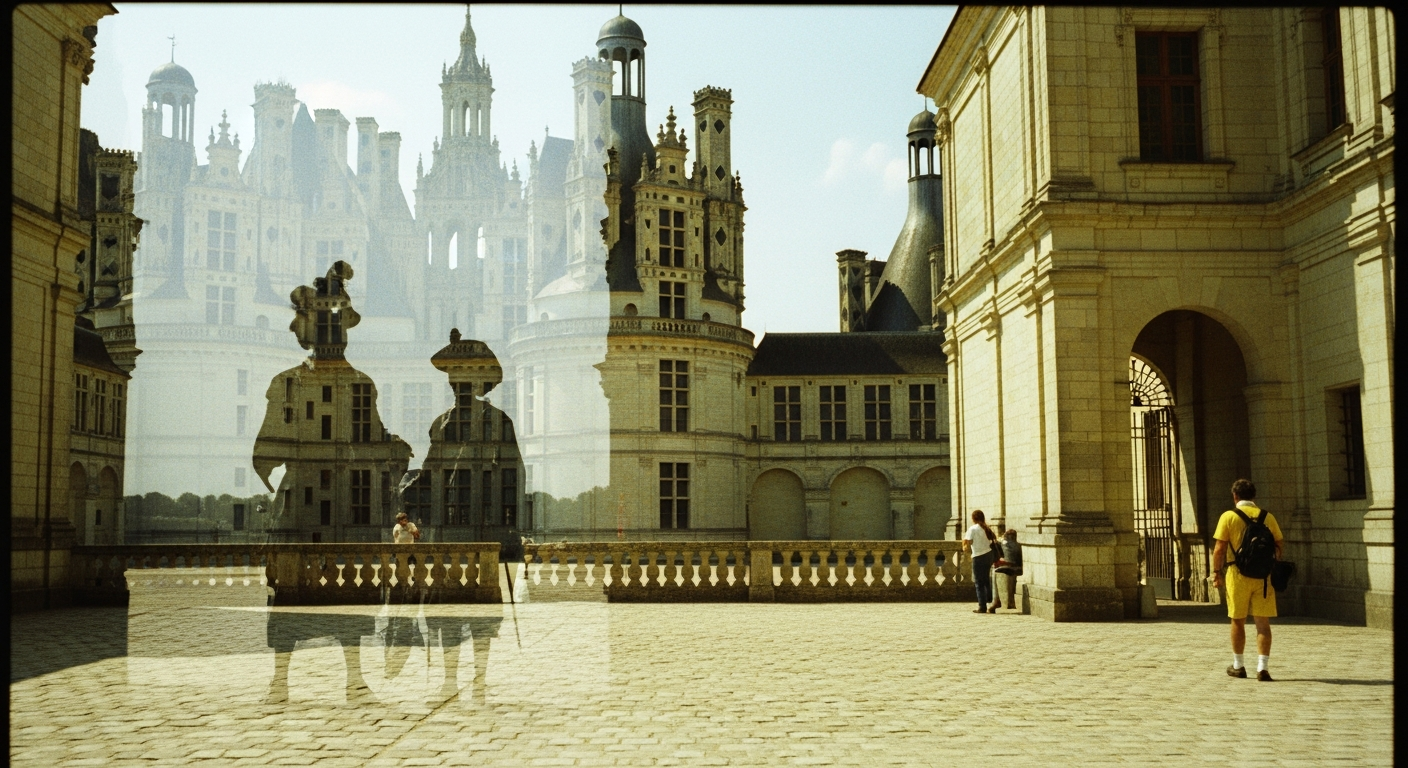
At approximately half past three, the family moved into the main courtyard. The time is not approximate — Geoffrey noted it in his journal that evening, and Marion's camera, fitted with an automatic date-and-time stamp, corroborates it. On a busy August afternoon, the vast courtyard would typically have held dozens of tourists: couples, school groups, the whole cheerful, sunburnt procession of people visiting a famous monument in good weather.
What the Hartleys found was something else entirely.
The courtyard was full — but not with tourists. Before them was what appeared to be a complete assembly of sixteenth-century nobility. Men moved through the space in doublets and hose. Women wore elaborate gowns with stiffened bodices and period headdresses. Servants carried hunting equipment — horns, falconry poles, leashes. And horses. At least a dozen of them, great animals caparisoned in cloth and leather, their breath steaming faintly despite the summer heat. Geoffrey had not heard them arrive. There had been no sound of hooves on cobblestones. They were simply there.
His first instinct was rational: a historical pageant, unannounced, scheduled for that afternoon. He turned to share the thought with Marion, and found her face had gone very still.
"That's not a re-enactment," she said quietly.
Marion, an experienced dressmaker with a long-standing study of historical textiles, directed his attention not to the spectacle as a whole, but to specific details: the drape of a gown near the far wall, the way heavy fabric moved and caught the light. "You can't fake fabric like that," she later told investigators. "The way it hung, the way it caught the light — it was wool and silk and velvet, proper period material. There's a drape to those textiles that modern reproductions can't replicate, no matter how good they are. I've handled enough both to know the difference."
Meanwhile, Sophie had moved towards a cluster of young men adjusting the straps on a large hunting dog's collar. She reached out to tap one on the shoulder and ask if he spoke English. "My hand went towards him," she recalled, "and he just turned slightly, very slightly, like you do when you think you hear something but you're not sure. And then he looked through me. Not at me. Through me. Like I wasn't there at all."
Daniel, remaining by the courtyard doorway, reported a sound quality he found impossible to rationalise. "Everything was muffled. They were all moving and there were horses and dogs and probably fifty or sixty people, and it should have been deafening — hooves on cobblestones, all those voices. But it was like hearing it through glass. Distant. Blurred."
Geoffrey walked into the crowd itself. He moved between figures — between people, he insists, not projections — and noted that the air around them was cooler than it had been a moment before. He was looking for a stage manager, a director, some coordinating presence. He found none. The figures moved with the purposeful ease of a crowd that had its own internal logic entirely separate from his existence.
He reached the centre of the courtyard and turned around.
Then, between one breath and the next, it ended. Not a fade. Not a dissolve. A cessation — complete and instantaneous. Fifty or sixty people, a dozen horses, five centuries of noise and colour, gone. The four members of the Hartley family stood alone in several thousand square metres of empty, sun-hot cobblestone. The ordinary August tourists had not returned either. For approximately ten seconds, there was nothing.
Then a tour group came through the eastern door, a French-speaking guide leading the way, and the ordinary world resumed.
The Hartleys left without speaking. They drove back to the farmhouse in near-silence.
In the days that followed, Geoffrey made formal enquiries with the château's administrative office. No historical re-enactment had been scheduled. The château's programme for that period is documented; there was no costumed event of any kind on that date or the surrounding days. He consulted a local historian in Blois, who listened carefully, asked specific questions about the style of the doublets, the shape of the headdresses, the hunting equipment described, and suggested — tentatively, with full caveats — that the assembly bore resemblance to a royal hunting party of the mid-sixteenth century, consistent with the court of Henry II, who used Chambord extensively as a hunting lodge in the 1550s.
Marion's photographs from the afternoon contain three images she has no memory of taking — courtyard shots from approximately the period of the encounter, showing cobblestones, sky, and nothing else. No crowd. No horses. No figures. Empty stone and empty air.
When Geoffrey submitted his account to a paranormal research journal in 1997, a researcher contacted him who had already collected two comparable reports from Chambord: a German couple in 1988, and a solo traveller from the Netherlands in 1994. All three accounts centred on the main courtyard. All three described figures in period dress. All three witnesses independently reported the same acoustic anomaly — sound arriving as though from behind glass. And all three reported not a gradual fading but a complete, instantaneous cessation.
Sophie, now a physician working in Edinburgh, still thinks about the young man she tried to touch. "What I remember most is the way he half-turned. The way he looked through me. I've thought about what that means a lot. Whether we were the ghosts. Whether from his side of whatever it was, we were the ones who didn't quite exist."
EVIDENCE
- Photographic record: Marion Hartley's camera, fitted with an automatic time-and-date stamp, places the family in the courtyard at approximately 15:30. Three photographs from the encounter period show the courtyard empty of all figures despite the reported presence of fifty to sixty people and at least a dozen horses.
- Contemporary journal: Geoffrey Hartley recorded four pages of detailed notes the evening of the encounter, providing a contemporaneous account with specific observations about clothing, equipment, and the sequence of events.
- Expert corroboration: A local historian in Blois, consulted within days of the event, identified the described assembly as consistent with mid-sixteenth century royal hunting parties associated with Henry II's documented use of Chambord in the 1550s — without being prompted with that specific period.
- Administrative records: Château de Chambord confirmed in writing that no historical pageant, theatrical event, or costumed re-enactment was scheduled on the relevant date or the surrounding days.
- Corroborating accounts: Two independent reports of comparable experiences at the same location — a German couple (1988) and a Dutch solo traveller (1994) — share three specific and unusual features: period-dress figures in the main courtyard, anomalous muffled acoustics, and instantaneous rather than gradual cessation.
- Four independent witnesses: All four members of the Hartley family observed the event simultaneously and provided consistent accounts independently.
FOX'S ANALYSIS
Right. Let me adjust my flat cap, take a long sip of entirely cold coffee, and talk to you about this one, because this one is something.
I've been doing this job long enough to know that family encounters are worth their weight in gold — not because families are automatically more credible than individuals, but because families are harder to keep consistent. Four people, two generations, different positions in a large courtyard, interviewed separately, producing accounts that don't just corroborate each other but complement each other in exactly the way genuine shared experiences do. Sophie gives you the human detail — the young man who looked through her. Daniel gives you the acoustic anomaly. Marion gives you the textile analysis that no stage production could pass. Geoffrey gives you the cold air at the centre and the absence of any coordinating personnel. That's not a rehearsed story. That's a family describing the same elephant from four different sides and producing a consistent elephant.
Marion's expertise is the element I keep returning to. She's a dressmaker who studies historical textiles as a serious hobby. She's not claiming to have seen ghosts. She's claiming that the fabric drape was wrong for a reproduction. That is an extremely specific, extremely testable, extremely boring detail to invent if you're fabricating a paranormal encounter. When your supernatural experience pivots on the behaviour of period-accurate wool-and-silk blends, I tend to take notice. You might say her evidence was... well-suited to the case. (I'll see myself out. I won't though.)
The photographs are the kind of evidence that gives me professional chills. Not because they show something — but because they show nothing. Three shots of a courtyard that was, by all four witnesses' accounts, full of people and horses, containing only empty stone. There are two ways to read this. One: the figures weren't there, the family imagined or fabricated the whole thing, and the photographs are simply accurate. Two: whatever was in that courtyard didn't register on photographic film, which is — from a temporal resonance perspective — actually more interesting than if it had shown up. Film captures reflected light from the physical present. If what the Hartleys witnessed was, in some sense, an imprint from another time rather than a physical presence in their own, the camera's failure to record it isn't a weakness in the case. It might be a data point. The camera wasn't broken. Marion's other photographs from the same roll are perfectly exposed. You could say the evidence is... developing. (I regret nothing.)
The corroborating accounts are what tip this from 'fascinating family story' into 'active investigative priority.' Two independent reports, different nationalities, different years — 1988 and 1994 — centred on the same courtyard, describing the same acoustic anomaly, and crucially, reporting the same instantaneous cessation rather than a gradual fade. Nobody compares notes on cessation patterns. That's not