QUIRK REPORTS — OFFICIAL CASE FILE
Case Number: QR-2026-59643
TITLE: BOLD STREET GOES BOLDLY BACKWARD: LIVERPOOL COUPLE TAKES UNEXPECTED DAY TRIP TO THE PAST (NO PASSPORT REQUIRED)
Classification: Temporal Anomaly — Time Slip Event
Date of Event: Summer 1996
Location: Bold Street, Liverpool, England
Filed by: Fox Quirk, Founder & Lead Reporter, Quirk Reports
This report is based on documented paranormal accounts. Names and identifying details have been changed to protect those involved.
WITNESS STATEMENT
On an unremarkable Saturday afternoon in the summer of 1996, Margaret and Derek Calloway — a Liverpool couple in their forties, lifelong residents of the city — drove into the centre for an ordinary afternoon of shopping. Margaret, forty-three, had lived in Liverpool all her life and knew Bold Street as intimately as her own reflection. Derek, a quantity surveyor of twenty years, was the sort of practical, grounded man who regarded ghost stories with barely concealed impatience. Nothing about that afternoon suggested it would become the event by which both of them would quietly measure everything else that followed.
They parted near the top of Bold Street — Derek doubling back to a sports shop, Margaret continuing down the pavement toward a music retailer she had visited many times before. She was approximately fifty yards along when the world, without courtesy or warning, changed.
The first thing she noticed was the sound. Or rather, the absence of it. The steady background noise of a city Saturday — traffic, voices, the ambient hum of commerce — faded as though someone had reached in and turned a dial. The pavement beneath her feet felt different. Rougher. Less regular.
She looked up and the music shop was gone.
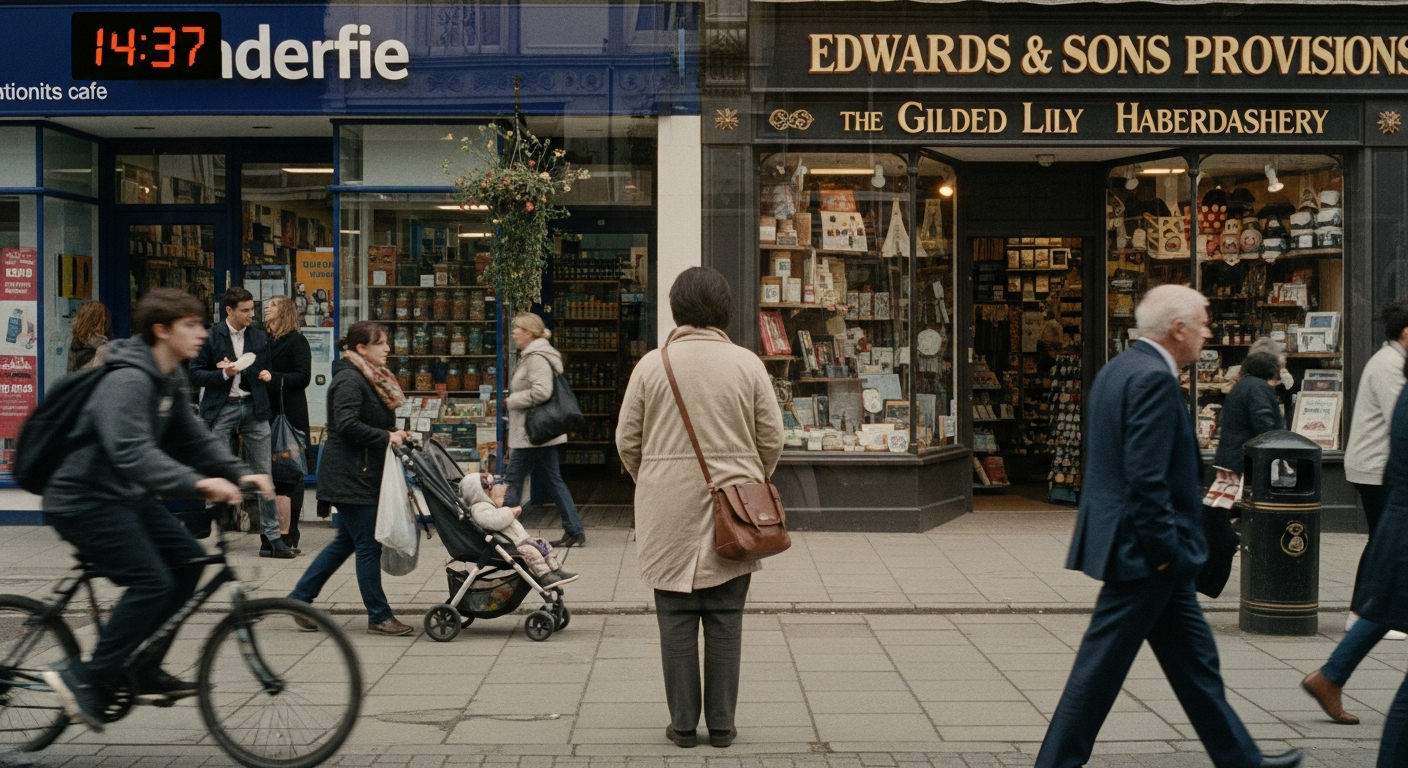
In its place stood an unfamiliar establishment, its name displayed in curved, old-fashioned lettering above the door. The window displayed fabrics and dry goods, arranged with a fussy formality entirely unlike the bold commercial displays she was accustomed to. The people around her were dressed differently — not theatrically, not as though in costume, but simply as people dressed in another era. Women in heavier skirts and structured coats. Men in hats. The colours of the scene seemed muted, though Margaret later acknowledged she could not be certain whether this was a genuine quality of the vision or her own senses adjusting to the shock.
A young woman passed her carrying a paper bag, eyes down, entirely indifferent to Margaret's presence. A man in a long coat crossed the street. There were no cars. At the far end of the street, she glimpsed what might have been a vehicle — dark, boxy, deeply unfamiliar.
She stood still for what she estimated as between thirty seconds and two minutes, experiencing what she would later describe as a profound, almost peaceful confusion — the strange calm that deep bewilderment sometimes produces before panic has the opportunity to arrive. Then a young man walked toward her carrying a bag from a recognisably modern shop. He turned into a doorway. And the street snapped back. The traffic noise returned. The music shop reappeared. The people around her were dressed as people dressed in 1996.
"I wasn't frightened. Not at first. I just stood there thinking — that isn't right. That isn't right at all."
She made her way back to find Derek. She began to describe what had happened. Derek, whose first instinct was to quietly wonder whether his wife needed medical attention, went silent.
Because he had seen it too.
Derek had not followed Margaret down the street, yet while she was experiencing her displacement, he had turned a corner and found himself briefly confronting what he could only describe as a different version of the same city. The building he had been heading toward was wrong. The surfaces were different. The signage was wrong. And there was — he used the precise word his wife had used, without knowing she had used it — a silence that stopped him where he stood. He observed figures in period dress going about their business. None of them acknowledged him. After approximately a minute, the experience ended without transition. The sports shop's automated doors slid open in front of him to admit a teenager carrying a football.
"I'd have said she'd imagined it. I'd have said that straight to her face. Except I couldn't, because I'd been there myself."
Over tea in a nearby café — Margaret's hands shaking now, the delayed shock arriving as promised — they compared their accounts. The parallels were specific and striking: the quality of the silence as the first indicator of displacement; people in period dress who paid them no attention; the abrupt, instantaneous return to the present. Neither experience had involved any physical sensation of movement or transition. The past, it seemed, had simply been there, and then it had not.
Their account might have remained entirely private had it not eventually reached a pair of local paranormal researchers who had been quietly collecting Bold Street testimonies for some years. The researchers — working voluntarily, with no academic affiliation but a notably rigorous approach to documentation — had accumulated a pattern: experiences almost always occurring in mid-afternoon, almost always heralded by a sudden reduction in ambient sound, drawing witnesses into historical periods ranging from the Victorian era to the 1940s and 50s. No witness had ever been harmed. The people of the past, with rare exceptions, appeared entirely unaware of their observers.
Interviewed separately and at length, the Calloways' accounts remained consistent in every significant detail.
EVIDENCE
- Dual Independent Witness Testimony: Margaret and Derek Calloway experienced simultaneous but physically separate time slip events and gave independent accounts that matched in specific, unlikely detail — including the quality of the silence, the period dress of observed figures, and the instantaneous nature of the return to the present.
- Corroborating Historical Accounts: Researchers had previously documented comparable testimonies from Bold Street, including a shop worker who encountered a cobbled street in the early 1990s, and a woman who observed Victorian-dressed pedestrians in the late 1980s and remained silent about the experience for years.
- Pattern Consistency: Multiple independent accounts share the same trigger indicators (ambient sound reduction), the same witness dynamic (ignored by those in the other time), and the same abrupt resolution, suggesting a repeating and consistent phenomenon rather than isolated individual experience.
- Historical Layering of Location: Bold Street sits within an area of Liverpool with documented commercial history dating to the eighteenth century. Significant Victorian and Edwardian fabric is retained within the existing building structures, providing a historically rich physical environment — though researchers were careful to avoid speculative claims about any causal relationship.
- No Physical Traces: No material evidence — photographs, objects, or physical marks — was produced or reported in connection with either experience.
FOX'S ANALYSIS
Right. Let me start by saying that Bold Street and I have something in common: we've both had things happen to us that we cannot fully explain and that polite society would rather we didn't bring up at dinner. I won't go into my own situation — if you've read my previous reports, you know about the probe; if you haven't, count yourself among the lucky — but I will say that an unexpected visit from another dimension hits different when it's happened to you personally.
Now. The Calloways.
What strikes me first — and this is the reporter instinct talking, the part that has survived decades of sources trying to feed me nonsense — is Derek. Derek is the story. Margaret's experience is compelling, but Margaret is open to the world. Derek is a quantity surveyor. Derek does not believe in ghost stories. Derek has opinions about tabloid coverage. And Derek came home having seen the same impossible thing as his wife, on a different corner, at the same moment, completely independently. That's not a coincidence. That's a case file.
You could say Derek and Margaret's Saturday took an unexpected turn of the century. I'm not sorry. I have a notebook full of these and nowhere near enough cases to use them all.
The detail that keeps pulling me back is the silence. Multiple witnesses, none of whom compared notes before giving their accounts, all reached for the same word. Not "quiet." Silence. A specific, wrong quality of silence that precedes the slip. That's a fingerprint. That's the phenomenon identifying itself with a consistency that no amount of group hysteria or shared suggestion can manufacture across separate incidents spanning years.
The historical period variation is interesting too — some witnesses step into what looks like the 1940s, others into something Victorian. If this were straightforward memory or confabulation, you'd expect witnesses to cluster around the same approximate era. The inconsistency, paradoxically, makes the whole thing more credible to me. It suggests something stranger and less tidy than a simple haunting or collective psychological event. Bold Street seems to be sitting on top of several versions of itself, and occasionally — particularly on a mid-afternoon Saturday, apparently — the membrane gets thin.
Why mid-afternoon? I have absolutely no idea, and anyone who claims they do is selling something. Though I will note that my most reliable source for alien activity also tends toward the 2 to 4pm window, so perhaps whatever is wrong with the universe takes a lunch break and gets back to work around half one.
I want to flag the researchers too. No academic affiliation, voluntary work, careful to avoid speculative claims. In my experience, the people most worth listening to in this field are the ones who know what they don't know. These two documented what they found and stopped there. That kind of disciplined restraint is rare, and in paranormal research, it's basically a superpower. You might say they were the bold ones. Bold Street. I've done it again. I regret nothing.
Could the Calloways have confabulated matching details after the fact, cross-contaminating each other's accounts? In theory. But they were interviewed separately and at length, and the accounts held. Could there be a more mundane explanation — temporary dissociation, unusual stress responses, some quality of the light or environment that induced a shared visual disruption? Possibly. I'm a sceptic first and a believer second, always. But I've been doing this long enough to know that when a practical man stops dismissing the paranormal at dinner parties, something real happened to him. That shift doesn't come from nothing.
Bold Street isn't finished with people. Of that much I'm fairly confident. Whatever it is — temporal echo, geological peculiarity, some quality of the historical fabric bleeding through — it's been doing it for decades and shows no signs of giving it up. If you're in Liverpool on a Saturday afternoon and the noise suddenly drops out, I'd suggest staying exactly where you are and paying very close attention. Take notes if you can. And if a man in a long coat crosses the street without looking for traffic, please — for the love of everything — write down what the shops look like.
CREDIBILITY RATING
Rating: 8.5 / 10
Reasoning:
- Multiple witnesses (+2): Two independent witnesses experienced simultaneous but geographically separate events and produced matching accounts without prior comparison.
- Witness character (+1.5): Derek Calloway's documented scepticism and evident reluctance significantly strengthen the weight of his testimony. He had every reason to disbelieve and no apparent motivation to fabricate.
- Pattern corroboration (+2): Independent historical accounts from unconnected witnesses over multiple years share specific, consistent details — the silence, the indifference of observed figures, the abrupt ending — that were not publicly circulated and could not have been borrowed.
- Researcher methodology (+1): Documenting researchers demonstrated appropriate restraint and rigorous separation of accounts.
- No physical evidence (-