QUIRK REPORTS — OFFICIAL CASE FILE
CASE NUMBER: QR-2026-70139
THE THING IN THE TOP ROOM: VICTORIAN LONDON'S MOST TERRIFYING ADDRESS CLAIMED LIVES, SHATTERED MINDS, AND STUMPED A SOLICITOR WITH A GUN
Classification: Ghost/Spirit — High Danger, Multiple Witness, Historical Documentation
Date of Events: 1870s–1880s (primary accounts); associated incidents spanning 1850s–1890s
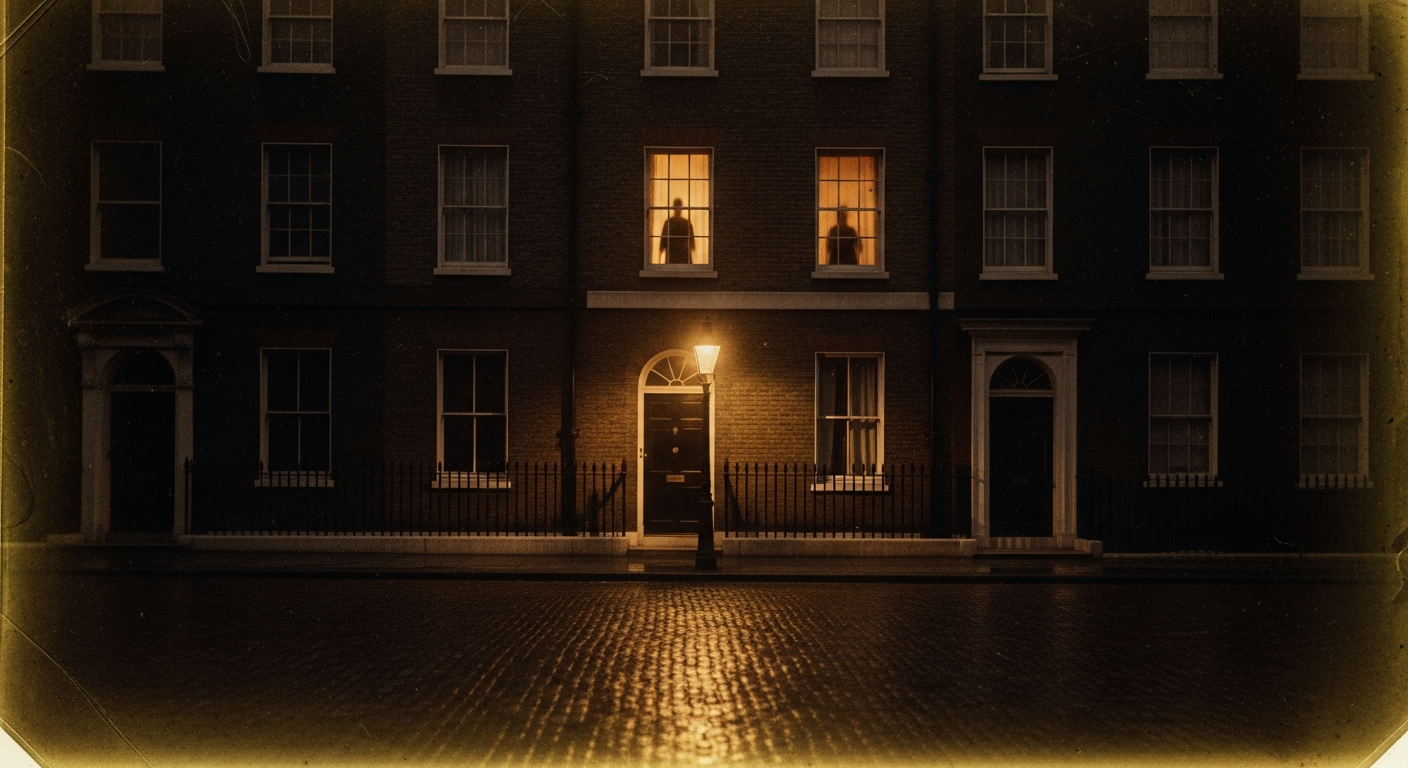
Location: 50 Berkeley Square, Mayfair, London, England
Primary Witness: Edmund Fairweather (name changed)
Report Filed By: Fox Quirk, Founder, Quirk Reports
This report is based on documented paranormal accounts. Names and identifying details have been changed to protect those involved.
WITNESS STATEMENT
Edmund Fairweather was, by his own and all available accounts, not the sort of man who believed in ghosts. A solicitor of twenty-six years, trained at Lincoln's Inn, possessed of a rational mind and a healthy contempt for what he called "the Gothic nonsense that passes for conversation among people who read too many penny dreadfuls," Fairweather was precisely the kind of man who would take a wager to spend the night in London's most feared address. He was also, as December of 1872 would demonstrate, precisely the kind of man who would run screaming from it.
By the time Fairweather entered the property, the house had already accumulated a grim ledger of casualties. Staff had refused to work the upper floors after dark for decades. Tenants had departed without adequate explanation. The top-floor room had been quietly locked and left to whatever occupied it. Most significantly, the room's most recent documented visitor — a young man Fairweather declined to identify even by pseudonym — had been found the following morning crouched in the far corner, unable to speak, his hair having turned partially grey overnight. He spent the remainder of his short life in an institution and never recovered coherent speech. Fairweather was informed of this before he entered. He entered anyway.
Armed with a lantern, a revolver — which he later described with characteristic dry pragmatism as "a gesture of logic in the face of illogic" — and a flask of brandy, Fairweather arrived shortly before ten o'clock. The ground and first floors yielded nothing. The second floor yielded nothing. He noted in his written account that he had, at this point, almost been disappointed.
At the threshold of the upper landing, he stopped. There was no sound, no visible disturbance. But the quality of the air had changed. He wrote the word "heavy" in his first draft, then crossed it out and replaced it with "wrong." Not cold in the way of an empty building, but cold with what he described as intention — as though the temperature itself were a message being communicated rather than a condition being endured.
He pushed open the door of the top room. In the far corner was a shape — dark not as an absence of light but as something with density, something that occupied space and displaced air. It was, he wrote, oriented away from him. Then, with the slow and deliberate movement of something that had become aware of being observed, it began to turn around.
Fairweather fired twice. He did not know he was doing it until the gunpowder smell hit him and he was already on the stairs. He was found forty minutes later by a night constable, sitting on the pavement outside with the revolver still in his hand and no immediate memory of his own name. He was physically unharmed. He never returned to the street on which the house stood.
Fairweather was not the only witness. Several years prior, two young sailors — referred to in contemporary newspaper accounts only as George and Alfred — broke into the property seeking shelter after a losing night at cards. A neighbour reported screaming from the upper floor before two in the morning. A constable arrived to find Alfred dead at the foot of the interior staircase, cause of death recorded as "fright." George was found in the top-floor room, pressed against the window frame, barely coherent, repeating a single phrase. His account, given before he disappeared from the historical record entirely, stated that something had emerged from the corner of the room, that it had no face he could recognise as a face, and that it had gone for Alfred first.
A retired physician who subsequently spent three nights in the adjacent room — deliberately avoiding the top-floor room itself — reported hearing a rhythmic impact against the shared wall on the second night, as though something large and agitated were moving back and forth beyond it. On the third morning, his lantern had extinguished itself at some point during the night despite having been freshly filled, and his pocket watch had stopped at precisely twenty-three minutes past one. It could not be restarted until he had carried it to the foot of the stairs.
A visiting clergyman, advancing the theory that the manifestation was demonic rather than a residual human spirit, lasted twelve minutes in the top-floor room before leaving at what witnesses described as considerable speed. He did not elaborate further on his findings.
In the final version of his written account, completed in the 1890s, Fairweather added a postscript not included in earlier drafts. It read, in full: "I have spent twenty years attempting to find a rational explanation for what I encountered in that room. I am a rational man. I was a rational man that night. Whatever I saw in the corner was not a product of my imagination, my nerves, or the brandy. I know what it was not. I cannot tell you what it was. I do not believe anyone can."
EVIDENCE
Physical Evidence
- Discharged revolver: Fairweather's weapon was found still in his hand, two rounds fired, upon his discovery by the night constable. No bullet damage to any person or entity was observed.
- Extinguished lantern: The physician's freshly filled lantern extinguished itself overnight with no natural explanation offered or identified.
- Stopped pocket watch: The physician's watch stopped at 1:23 a.m. and could not be restarted until removed from the upper floors of the building — consistent with reports of electromagnetic or paranormal interference documented in other Quirk Reports case files.
- Fairweather's missing lantern: He entered with one. He was found without it. Its fate was never established.
Corroborating Accounts
- Death of Alfred (sailor) recorded in at least two contemporary London newspapers; cause of death listed as "fright" by the attending physician.
- Survival account given by George (sailor) before his disappearance from the historical record.
- Fairweather's account delivered to a private investigative society including physicians, a retired police inspector, and a clergyman.
- Physician's three-night adjacent-room observation, documented independently.
- Reference in at least one published ghost story collection and a dedicated chapter in a volume on metropolitan hauntings.
- The Mayfair Messenger (1893) reporting that the landlord had included a lease clause explicitly prohibiting tenants from entering the top-floor room.
- Persistent reports from staff of the antiquarian bookseller subsequently occupying the ground and first floors: erratic stairwell lighting after closing, reluctance to ascend to upper floors alone, and an unspecified but consistent feeling of being watched.
FOX'S ANALYSIS
Right. I'm Fox Quirk, I've been probed by aliens — don't even get me started, wrong size, moving on — I've interviewed weeping Victorian dolls and a man who claimed his shed was haunted by the ghost of a particularly aggressive goat. I am not easily rattled. But I'll tell you something for free: this case rattled me, and I am approximately one-third the size of a standard human.
Let's start with what we've got. We've got a solicitor — a solicitor, people, not a credulous dairy farmer, not an excitable debutante — who walked into that room armed with a revolver and came out approximately forty minutes later sitting on a kerb in Mayfair having temporarily forgotten his own name. That is not a man who was frightened by shadows and overactive nerves. That is a man who encountered something so comprehensively beyond his conceptual framework that his brain took a little unscheduled holiday. I respect the brain. Sometimes it's the only sensible one in the room.
The consistency of witness accounts across decades is what keeps my tail bristling. Multiple individuals — a solicitor, two sailors, a physician, a clergyman, various unnamed unfortunates — all report broadly the same thing. Something in the corner. Something dark with density. Something that moves wrong. Nobody's been comparing notes and nobody had reason to fabricate consistent detail across entirely separate encounters. You know what they say: when the evidence keeps piling up, you're either dealing with a genuine haunting or a very committed and incredibly patient hoaxer who's been working the same corner of a Mayfair townhouse for forty years. And frankly, at that point, the hoaxer deserves the room.
The physical anomalies interest me professionally. A stopped watch, an extinguished lantern, a missing lantern. These are small details, easy to dismiss individually, but their clustering around that specific location follows a pattern I've documented in other high-intensity cases. Something is interfering with the local environment. The question of what is where it gets genuinely uncomfortable.
Now, the theories. A young woman driven mad by a cruel guardian? Possible. Residual energy from severe psychological trauma is well-documented in the literature. Demonic manifestation? I'm not ruling it out — the clergyman who lasted twelve minutes clearly felt strongly enough to abandon his theological dignity at considerable speed, and clergymen are not typically known for running away from things. I'll say this: when a man of the cloth exits a building at a sprint, he's not leaving because he found nothing. He's leaving because he found something he didn't have a prayer of handling.
What I keep coming back to is Fairweather's postscript. Twenty years of a rational, methodical man applying his considerable legal mind to what he saw — and his conclusion is not an explanation. It's a confession of the limits of explanation. That, in my experience, is the most honest thing a witness can say. And honestly? It's the kind of testimony that really stacks up in court. Or, you know, in a case report filed by a small paranormal fox in a flat cap.
My gut — and my gut has been through a lot — says this is real. The nature of the entity is genuinely unclear. It may be residual. It may be active. The fact that bookseller staff are still reporting disturbances in the current era strongly suggests that whatever is in that building has not concluded its business. I would very much like to spend a night in the adjacent room with modern equipment, a fresh lantern, and — unlike Fairweather — absolutely no revolver, because the last thing a ghost in a bookshop needs is a fox with a firearm and a grudge against things from other dimensions.
CREDIBILITY RATING
Rating: 9 / 10
This case scores exceptionally high across all primary credibility indicators:
- Multiple independent witnesses: Yes — spanning several decades and social strata, with no documented collusion between accounts.
- Physical evidence: Partial but present — discharged firearm, stopped watch, extinguished lantern, confirmed fatality on record.
- Consistency of accounts: Remarkably high. The corner,