QUIRK REPORTS — OFFICIAL CASE FILE
CASE NUMBER: QR-2026-13859
STRANGERS ON THE STAIRCASE: THE SHADOW MEN OF CLUMBER STREET
Classification: Shadow Entity Encounter — Sustained / Multi-Witness
Date of Events: October 1981 – January 1984
Location: Clumber Street, Worksop / North Derbyshire Border, Nottinghamshire, UK
Date Filed: Quirk Reports Archive, Case QR-2026-13859
This report is based on documented paranormal accounts. Names and identifying details have been changed to protect those involved.
WITNESS STATEMENT
Number forty-three Clumber Street was, by every outward measure, an unremarkable post-war terraced house. Red brick, modest garden, net curtains. Margaret Hollis had lived there since her marriage in 1973, raised two children within its walls, and decorated its mantelpiece with the small ceramic ornaments of an ordinary life. Nothing distinguished it from its neighbours. Nothing, that is, until the late October evening in 1981 when the first figure appeared on her staircase.
It was approximately half past nine on a Tuesday. Her husband Derek was on the late shift at the colliery. Both children — Sandra, eleven, and Paul, eight — were asleep upstairs. Margaret was washing up in the kitchen when she felt it: not a sound, but a pressure. The precise, unmistakable sensation of being watched.
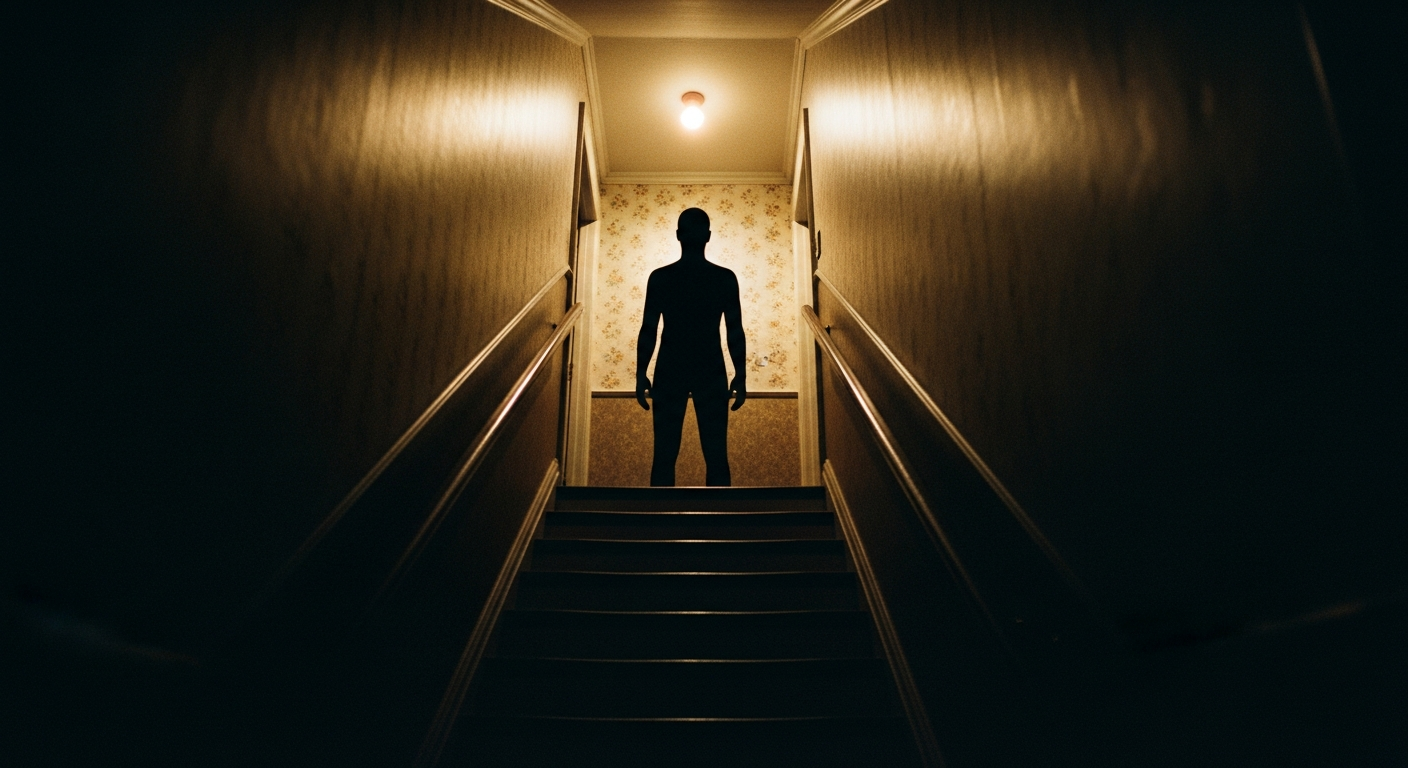
She turned. On the third step of the staircase stood a figure.
It was tall — six feet or more — and entirely, absolutely black. Not shadowed. Not poorly lit. Black in the manner of a hole or an absence. It held the rough silhouette of a man: shoulders, a head, arms held slightly from the body. It had no face. It had no features of any kind. And yet Margaret Hollis knew, with complete and horrible certainty, that it was looking at her.
She did not scream. She stood with her hands still submerged in the washing-up water and she waited. After an estimated twenty to forty seconds, the figure moved — not walked, she was insistent on this distinction — it flowed upward toward the landing, she said, "like smoke pulled by a draught," and then it was gone. She went upstairs. The children were asleep. She told herself it was tiredness. She told herself this for three weeks, until her daughter Sandra came down to breakfast one November morning and said, quite calmly: "There was a tall man on the landing again last night."
The word again stopped Margaret cold.
Questioned carefully, Sandra described at least three separate night-time encounters: a tall, entirely black figure near the top of the stairs. Sometimes motionless. Sometimes moving toward her bedroom door. Once, standing in the corner of her room, opposite her bed. She had not mentioned it sooner, she explained, because she had assumed her mother already knew.
Derek Hollis — a practical, sceptical man by his wife's description — had his own encounter in February 1982. Returning from a night shift and waking again at midday, he saw it on the landing: a figure so dark it seemed, in his words, like "a man-shaped piece of the night that had been left behind when morning came." It was present for no more than ten seconds before collapsing inward on itself and vanishing. It was, Margaret later noted, the first time she had ever seen her husband look afraid of anything.
The encounters multiplied across 1982. Margaret documented seventeen sightings she could specifically account for. The children witnessed it repeatedly. Derek, who began sleeping with the landing light on regardless of the electricity bill, saw it four more times. Two sightings occurred in clear afternoon daylight. The entities — possibly one, possibly several; the family could never determine with certainty — were invariably described in identical terms: tall, featureless, profoundly black, and possessed of what every witness struggled to name but consistently called a wrongness. A sense that the space they occupied was not meant to contain them.
Physical effects accompanied the sightings. Temperatures in the upstairs rooms dropped measurably. The family's ten-year-old labrador, Bramble, refused to go upstairs from autumn 1982 onward and would pace and whine at the staircase foot. Sandra experienced three episodes of crushing chest pressure that lifted when the bedroom light was switched on. Paul, who had been reliably dry for three years, began wetting the bed again — and would not explain why until interviewed separately by a researcher in 1984.
The case eventually reached Phillip Davenport, a retired schoolteacher from Retford who had spent over a decade documenting paranormal cases across North Nottinghamshire. Davenport was not credulous — his files show a high rejection rate for cases he considered explicable — but the Hollis family's corroboration compelled him. He spent eleven nights across four visits in 1983, saw nothing himself, but recorded each family member's testimony independently. The consistency was, by his assessment, difficult to attribute to collusion: identical heights, identical quality of darkness, identical absence of features, identical manner of movement, described separately by four people who had not compared accounts.
Davenport also uncovered a historical footnote. The Clumber Street terrace had been built in 1934 on the former site of a Victorian Union Workhouse — demolished in 1928 — with records indicating significant mortality on the site, as was standard for such institutions. He recorded this as background and was careful not to assert a connection.
The family moved out in January 1984 — not in panic, Margaret emphasised, but in exhaustion. Paul's sleep deprivation had deteriorated to the point of medical involvement. She told Davenport plainly: "I had reached the point where I could not spend another winter there."
The subsequent tenants, a young couple with no knowledge of the Hollis family's experiences, reported nothing unusual in eighteen months of residence.
In a 1991 radio interview, Margaret made two statements that have remained with researchers since. The first: that she did not know what the figures were, had never known, and had stopped expecting to find out. The second: that in the years following her departure from Clumber Street, she had woken — on perhaps half a dozen occasions — in her new home, with the absolute conviction that something was standing in the corner of the room. That when she reached for the light, it was never there. But that the feeling — the precise quality of that attention — was exactly the same as it had been on Clumber Street.
She said this, those who met her agreed, in the same level, unhurried tone she used to discuss everything. That, they concurred, was the most frightening thing about her.
EVIDENCE
- Multiple independent witness testimonies: Four family members — Margaret, Derek, Sandra, and Paul Hollis — provided separate, uncollated accounts to researcher Phillip Davenport, with consistent descriptions across height, appearance, movement, and quality of darkness.
- Temperature differential: Davenport recorded readings showing a consistent four-to-seven degree Celsius drop in upstairs rooms compared to the ground floor across multiple visits.
- Animal behaviour: Labrador Bramble's refusal to ascend the staircase from autumn 1982 onward was directly observed and recorded by Davenport.
- Child behavioural impacts: Paul's regression to bed-wetting, medically noted due to impact on school performance. Sandra's recurring chest pressure episodes. Both consistent with severe and sustained nocturnal distress.
- Historical site records: Documentary evidence confirming the former Union Workhouse on the Clumber Street site, with associated mortality records.
- Davenport's monograph (1987): Case included in a self-published regional survey of sixteen cases; cited in a 1992 Society for Psychical Research survey of shadow figure encounters as one of the more robustly documented British cases of its type.
- Post-departure sightings: Margaret's reported continuation of a subjective sense of presence in her new home — unverifiable but consistent with the witness's established pattern of measured, unsensational reporting.
FOX'S ANALYSIS
Right. Let me level with you, readers. I've covered this beat long enough to know that most shadow figure cases fall apart the moment you look at them sideways. A trick of the light here, sleep paralysis there, someone who had four pints of mild and saw their own coat on a hook. I'm a sceptic. I have to be. It's in the job description, right between "bring your own pen" and "don't let the aliens get your anatomy on a table." Trust me on that last one.
But the Hollis case? The Hollis case keeps me up at night. And not just because I don't have a landing light.
Let me tell you what impresses me here. It's not the figures themselves — as shadow entity reports go, the description is unfortunately standard issue. Tall, featureless, very dark, moves wrong, feels wrong. I've got a filing cabinet full of those. What impresses me is the architecture of the corroboration. Four witnesses. Tested separately. Producing matching accounts they hadn't compared. That's not a ghost story told round a table. That's testimony. There's a difference, and Phillip Davenport — God bless a retired schoolteacher with a filing cabinet and a healthy rejection rate — knew it.
I have to say, for a man who spent eleven nights in that house and saw nothing, Davenport produced the most useful data. You know what they call someone who sits in a haunted house all night and sees nothing? A patient investigator. You know what they call someone who does it eleven times? Either very dedicated or very bad at finding parking. Either way, his temperature readings and his direct observation of that dog are worth more to me than a dozen blurry photographs.
Bramble the labrador refusing to go upstairs deserves its own footnote in the annals of paranormal research. Dogs are not imaginative creatures. Bramble did not read about workhouses. Bramble did not hear his owners whispering over tea. Bramble just knew. And Bramble, frankly, had more sense than any of us, because Bramble stayed downstairs. Smart dog. You might say he had the situation... well in paw.
I'll admit the Union Workhouse angle gives me pause. Not because I'm ready to declare a haunting caused by Victorian institutional mortality — that's a long bow to draw and Davenport was right not to draw it — but because it's the kind of historical footnote that reminds you places carry weight. People suffered there. People died there. Whether that leaves anything behind is above my pay grade, but I note it the same way Davenport did: as background that refuses to sit quietly in the back of the room.
The detail that genuinely unsettles me is Margaret's 1991 disclosure. The new tenants experienced nothing. Fine. Inconclusive, as Davenport politely notes, but fine. But Margaret, calm as a Wednesday morning, tells a radio interviewer that something followed her. Not dramatically. Not with screams. Just: the feeling was the same. The quality of attention was the same. She reached for the light. Nothing there. But the same.
You know, some entities apparently can't let go. I suppose you could say they're really attached to their subjects. Shadow figures: the original stalkers, except they predate the restraining order by several centuries.
My reporter's instinct — and I've been at this long enough that I trust it, even when it tells me things I'd rather not hear — says this family experienced something real, sustained, and genuinely unexplained. I don't know what it was. I don't think