QUIRK REPORTS — OFFICIAL CASE FILE
Case Number: QR-2026-59299
SHADOWS WITH STAYING POWER: THE THING THAT WATCHED A HAMPSHIRE SCHOOLTEACHER FOR SIX WEEKS AND DIDN'T EVEN HAVE THE DECENCY TO EXPLAIN ITSELF
Classification: Shadow Entity Encounter — Prolonged / Escalating
Date of Event: February – March 1998
Location: Andover, Hampshire, England
Investigating Reporter: Fox Quirk, Founder, Quirk Reports
This report is based on documented paranormal accounts. Names and identifying details have been changed to protect those involved.
WITNESS STATEMENT
Margaret Holloway was forty-one years old, recently divorced, and entirely determined to be sensible about things. She had chosen Andover deliberately — a town where she had a job she valued and no difficult memories lurking around corners. The Victorian end-of-terrace on Barrow Lane suited her. She painted the walls yellow. She filled the shelves with books. She did everything a rational, capable woman does when she is building a new life from scratch. For four months, it was enough.
The house, she would later tell investigators, had always felt heavier than other houses. Not haunted — she was careful about that distinction — but weighted. As though the air itself bore more mass inside those walls than it did anywhere on the street beyond them.
The first incident occurred on the night of 14th February 1998. Margaret noted the date afterwards with a humour that was more grim than amused. She had gone to bed at half past ten and woken in the early hours with a wakefulness that was, she told lead investigator Thomas Grieve of the Hampshire Paranormal Research Group, entirely unlike ordinary waking. There was no gradual surfacing. No momentary confusion. One moment she was asleep. The next, she was bolt upright, eyes open, heart already in full revolt — and she knew, with a certainty that required no analysis, that she was not alone.
Standing at the foot of her bed was a figure. Tall — six feet or more. Entirely, absolutely black. Not dark like a person dressed for a winter night, but black in a way that resisted such ordinary comparison. Margaret returned, across multiple testimonies, to the same phrase: "a hole cut in the air in the shape of a person." No face. No features. But — and this was the detail she found most difficult to articulate and most impossible to dismiss — it was not flat. It was not a shadow on a surface. It had depth. Dimension. A front and a back. It occupied space in the room the way a wardrobe or a person occupies space, and she was certain, without being able to say precisely how, that whatever it was, it was looking at her.
"Not that I could see eyes," she told Dr. Patricia Fennell, a University of Southampton psychology lecturer who would later assess the case. "But the attention of it was directed at me. I could feel that. Like pressure."
After somewhere between thirty seconds and three minutes, Margaret pulled the duvet over her head. She lay rigid beneath it for approximately an hour. When she looked again, the room was empty. She told no one. She was a schoolteacher with a professional reputation and a recent divorce that had already generated more concerned expressions than she cared to receive. She filed the incident under things she would not be discussing with anyone and returned to school on Monday.
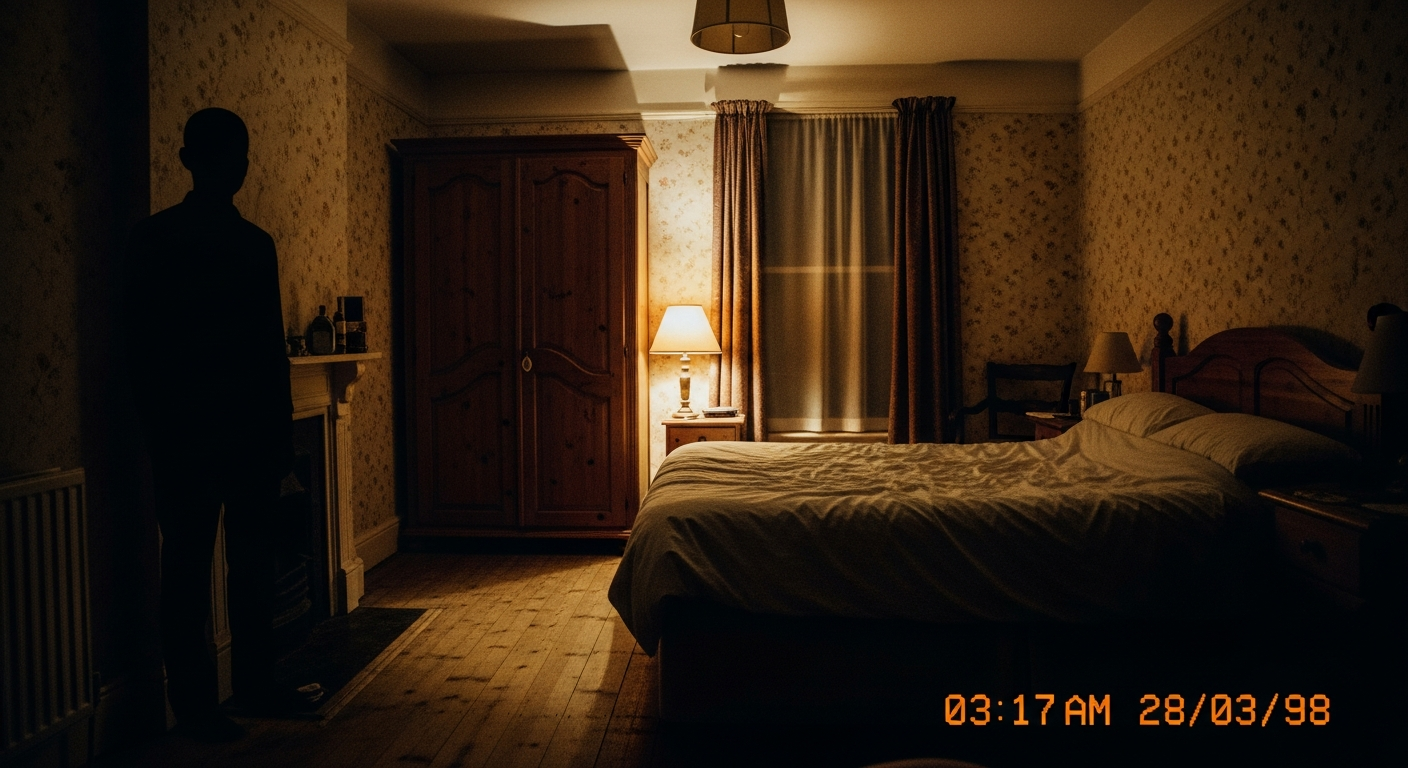
The figure returned four nights later — and this time she was awake. Lamp on. Book in hand. Tea cooling on the nightstand. It appeared not at the foot of the bed but in the left-hand corner of the room, beside the wardrobe. She could see it clearly in the lamplight, and that, she said, was somehow worse. Because the light made no difference to it. It absorbed the light. The corner where it stood was an absolute darkness that the lamp simply could not reach.
She sat up. She looked at it. And then Margaret Holloway, primary school teacher, asked it directly: "Who are you? What do you want?" It did not answer. It stood for another minute or two, and then it did not leave through the door or the window. It faded, from the outside inward, until there was nothing left but the ordinary corner of an ordinary room. Her lamp flickered once.
She contacted Thomas Grieve three days later. Grieve — a retired headmaster, rigorous and sceptical by professional instinct — visited with Dr. Fennell, who conducted a full psychological assessment and found no condition that might account for the experiences. Both investigators described Margaret in their notes as "an exceptionally clear and precise witness, not given to embellishment, and visibly uncomfortable with the fact of having reported the experience at all."
The investigators installed monitoring equipment: a temperature sensor, a motion-activated camera, and audio recorders. Over the following three weeks, the figure appeared seven more times. The final encounter, on the night of 28th March, was the most severe. Margaret woke at 3:17 a.m. — confirmed by camera timestamp — to find the figure not across the room but immediately beside her bed. Level with her pillow. Close enough to touch.
She described a cold that she felt not on her skin but behind it, as though the cold were originating inside her. A sound — or the impression of a sound — registered not in the ears but in the chest. And a feeling, which she relayed quietly to Dr. Fennell, that the thing knew her. Not merely that it had noticed her. That its awareness of her was specific, and sustained, and had been for some time.
She got out of bed on the opposite side, went downstairs, and did not return. She was subsequently hospitalised for shock. She vacated the property within a fortnight and reported no further experiences in any subsequent home.
Investigators later discovered that the previous occupant, Arthur Newby, had reportedly lived with similar experiences for eleven years before his death in 1994. A neighbour recalled him describing "a dark shape that stood in the corners of rooms" — one he had come to call "my companion, though not a kind one."
EVIDENCE
- Motion-activated camera footage: Recorded anomalous drops in ambient light in the area of the entity's appearance on three separate occasions, despite no physical object being present to block the light source.
- Temperature sensor data: On one occasion, recorded a rise of four degrees Celsius in the relevant corner immediately following an encounter — a rise, not the drop that conventional models of haunting would predict.
- Audio recordings: No directly attributable sounds captured, though Margaret reported an infrasonic-adjacent sensation during the final encounter.
- Psychological assessment (Dr. Patricia Fennell, University of Southampton): Found no psychological condition capable of producing the reported experiences. Noted Margaret's description of three-dimensionality and light absorption was consistent with other credible witness accounts in comparable cases.
- Investigator field notes (Thomas Grieve, HPRG): Detailed, contemporaneous, submitted to the British Paranormal Research Association in late 1998. Grieve's report is credited as one of the first in UK paranormal literature to formally classify the 'shadow entity' as a category distinct from conventional hauntings.
- Prior occupant testimony (secondhand): Neighbour account confirming Arthur Newby reported near-identical experiences in the same property across an eleven-year period prior to his death in 1994.
FOX'S ANALYSIS
Right. Let's have a proper look at this one, because this case has got more layers than a Victorian terrace has damp patches, and I mean that as a compliment to the investigators involved.
First things first: Margaret Holloway is, by every metric I apply to witness credibility, the real deal. She delayed reporting. She sought rational explanations first. She was embarrassed by the whole affair. She is precisely the sort of witness who, in my experience, is telling you exactly what she saw — because someone who wanted attention would have called us before she went to the library notice board to find Thomas Grieve's number. She didn't want this story. She just happened to be living inside it.
The light absorption business has my ears perked up further than my flat cap will allow. Standard shadow-figure reports — and we get a few a year at Quirk Reports — describe darkness. This describes something that interacts with light as though it has mass. The camera data supports this. You can't fake a localised drop in ambient illumination with no physical cause, not with 1998 monitoring equipment, not without a production budget this case clearly didn't have. And that temperature rise? Genuinely unusual. Cold spots are the bread and butter of paranormal investigation. A four-degree increase in a room where something anomalous just happened is the paranormal equivalent of your sandwich being toasted when you asked for it plain. Something is going on, and it is not following the rules I expected.
I'll be honest with you — I came into this one a sceptic in full armour. Sleep paralysis, hypnopompic hallucination, stress response following a major life transition. I had my explanations ready, neatly folded, like good notepaper. Then I got to the second incident. Lamp on. Book in hand. Tea out. That is not hypnagogia. That is a woman who is fully awake watching something absorb the light from a bedside lamp in the corner of her bedroom, and then watching it fade from the outside inward like something being switched off. Sleep paralysis doesn't fade from the outside inward. I've checked. Extensively. Mostly because of personal reasons I won't be getting into right now.
Arthur Newby's eleven years of cohabitation with what he called his companion — though not a kind one — is the detail that keeps me up at night, and I say that as a fox who already has enough reasons to avoid sleeping soundly. If this were a stress-triggered hallucination unique to Margaret's circumstances, why did the retired civil servant before her see the same thing in the same house for over a decade? What are the statistical odds of two entirely unconnected tenants independently producing identical reports? I'll tell you: they're slim. They're very, very slim. You might say the odds are... in the shadow of zero. I'm here all week, folks, try the kibble.
What I cannot tell you — and I will not pretend otherwise, because that's not how Quirk Reports does business — is what this thing is. Grieve's conclusion that it exists and observes and waits for reasons that may be permanently opaque is not a failure of investigation. It is, I think, the most honest sentence in the entire British paranormal literature of the 1990s. Some questions don't have answers yet. That's not a reason to stop asking. That's the whole reason I got into this line of work. Well. That and the aliens. But we are absolutely not talking about the aliens today. The point is: this case is dark. And I don't just mean the light absorption readings.
One final note: the current owners of the Barrow Lane property have not been identified and have not granted access. I respect that. I also think that if they've got a six-foot hole-shaped-like-a-person standing in their bedroom corner at three in the morning, they are going to have some questions eventually. Quirk Reports will be ready. We are always, in this job, waiting in the dark.
CREDIBILITY RATING
Rating: 8.5 / 10
Reasoning:
- Witness profile: Highly credible. Delayed reporting, actively sought rational explanations, resistant to dramatisation, professionally assessed and cleared of relevant psychological conditions