QUIRK REPORTS — OFFICIAL CASE FILE
Case Number: QR-2026-38950
SILENT DISC OVER THE PADDOCK: THE SCHOOLMASTER WHO NEVER CHANGED HIS STORY
Classification: UFO/UAP — Close Encounter, Physical Trace, Secondary Witness Corroboration
Date of Event: 13 July 1959
Location: Kaikohe, Northland, New Zealand
Reported By: Gerald Maitland (primary witness); Patricia Maitland (secondary witness)
This report is based on documented paranormal accounts. Names and identifying details have been changed to protect those involved.
WITNESS STATEMENT
The evening of 13 July 1959 was unremarkable by every measure until it wasn't. Gerald Maitland — headmaster of Kaikohe Primary School, lay preacher, and a man whose neighbours consistently described him as methodical, precise, and constitutionally allergic to exaggeration — had been marking exercise books at his kitchen table when his dog erupted into a frenzy of barking that cut through the cold winter quiet with unusual urgency. Maitland was forty-three years old. He had lived in Kaikohe for eleven years. He was not, as his wife Patricia would later put it to investigators, a man given to flights of fancy.
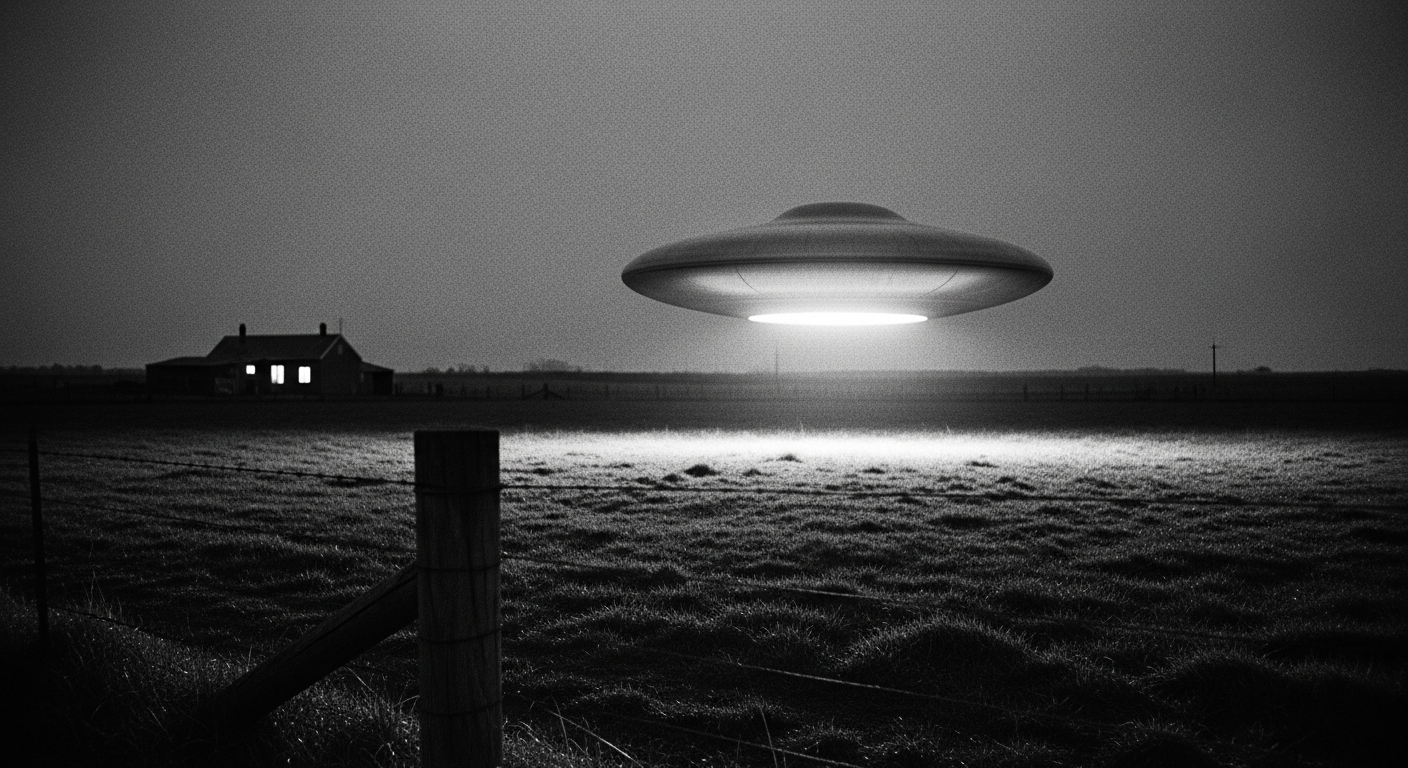
When Maitland stepped outside into the still, clear night, he found hovering above the paddock adjoining his southern boundary an object unlike anything he had encountered in four decades of unremarkable rural New Zealand life. It was disc-shaped — a description he would never once revise across decades of interviews and written statements. He estimated its diameter at forty to fifty feet, its altitude at roughly a hundred and fifty feet. It was luminous with a pale, silvery-white radiance that suffused the paddock beneath it with a quality of light Maitland described, in one of his most striking formulations, as resembling the inside of a cloud with the sun behind it.
There was no sound. This detail disturbed Maitland perhaps more than any other. He stood at his back fence for three to four minutes simply watching the object hang in absolute silence. The dog, which had moments before been barking ferociously, retreated to the porch and pressed itself against the door. Maitland called his wife.
Patricia Maitland came outside in her housecoat and stood with her husband for several minutes. Her account, given independently to investigators, matched his in every material respect. The light was steady, not pulsing. The object did not rock or sway. After approximately five minutes, it began, very slowly, to descend. It was at this point that both witnesses reported a physical sensation — a sub-audible vibration felt more in the chest and teeth than through the ears. Gerald likened it to standing next to very large machinery through a wall.
Patricia described a pressure in her ears consistent with altitude change in an aircraft, though neither of them had ever flown.
The object descended to approximately thirty feet above the paddock. At this proximity, Maitland could discern structural detail. The underside was domed, with a flattened lower section around the rim of which he observed evenly spaced darker apertures — windows without glass, or perhaps vents
— and what appeared to be a slight rotational movement in the outer rim. He retrieved his Kodak Brownie camera from inside and took two exposures. He held no great hope for the results. The photographs, when developed, showed an indistinct luminous form against dark sky. Neither the Royal New Zealand Air Force nor subsequent civilian investigators could confirm or deny the subject, though no evidence of fabrication was identified.
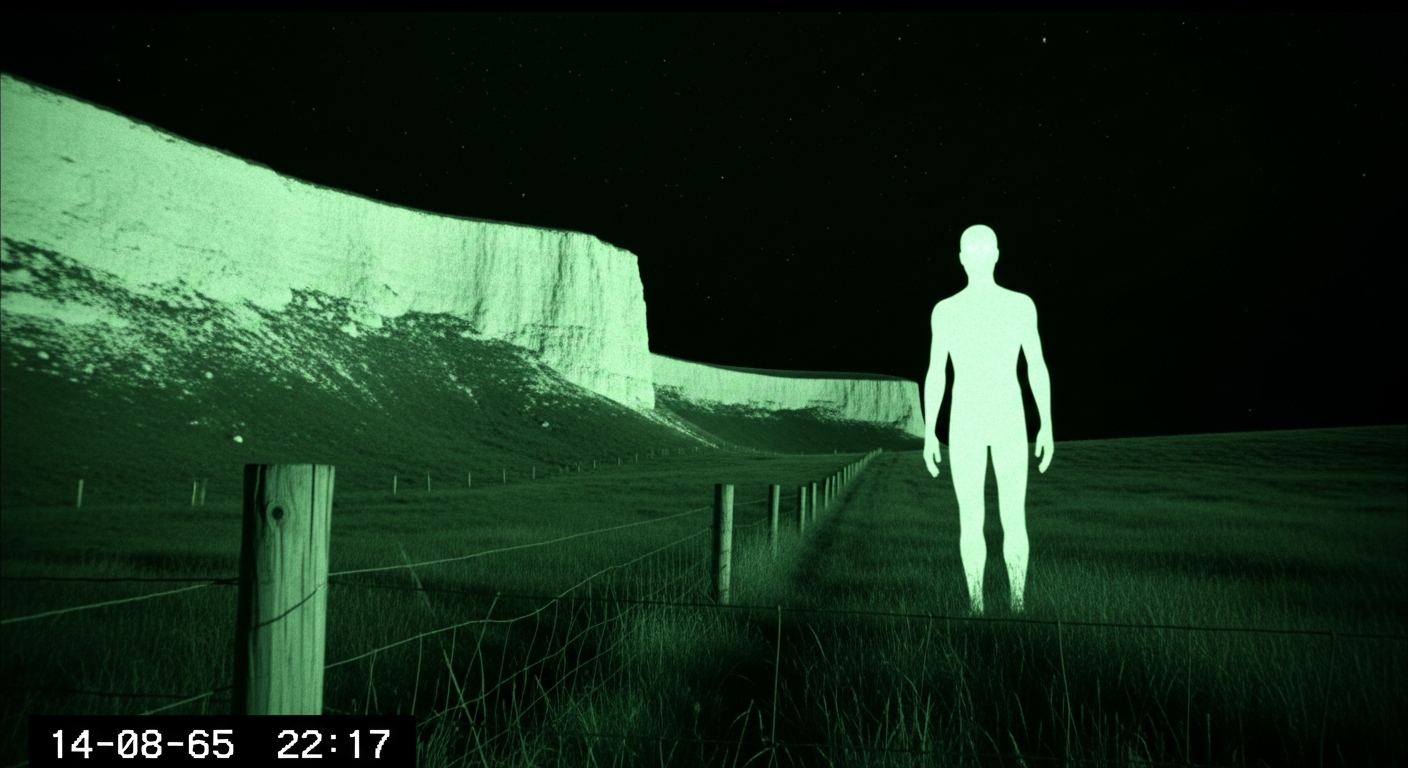
During the extended hovering phase, Maitland became aware of something he initially declined to report: the presence of a figure, visible within or immediately below the craft. Humanoid in outline — bipedal, upright, recognisably shouldered and headed — it was, in Maitland's careful phrasing, present in the light rather than distinct from it.
He omitted this detail from his first two public accounts, disclosing it only eight months later in a private interview with a researcher from the New Zealand Scientific Space Research organisation, and only then with visible distress. Patricia, when pressed, acknowledged only that she had seen something moving
and would not be drawn further.
The departure was, from an aeronautical standpoint, the detail investigators found most striking. The object rose vertically to approximately three hundred feet, paused — Maitland was emphatic about this pause, holding it at four to five seconds — and then moved away to the north-west at a speed he could only describe as instantaneous.
No sonic boom. No heat wash. The vibration ceased. The paddock went dark. The dog resumed barking at the fence.
The following morning, Maitland walked the paddock with his neighbour Douglas Hemi. They found a roughly circular area of flattened grass, approximately thirty feet in diameter, pressed flat in a radial pattern inconsistent with wind, animals, or machinery. At four equidistant points around the inner edge, the soil was compacted into shallow depressions, each roughly the diameter of a dinner plate. An RNZAF investigator, examining the site three days later, described the marks as consistent with mechanical pressure from above,
before noting that no known aircraft could have produced them while hovering silently at low altitude. The official investigation classified the encounter as unexplained.
Follow-up investigation into the ground markings was recommended in the official report. No record of it having been conducted has ever been found.
Gerald Maitland gave his final recorded interview in 1988. Asked whether thirty years of reflection had changed his view, he paused before answering. I saw what I saw,
he said. I have never found a reason to doubt my own eyes.
He died in 1991. His wife Patricia outlived him by four years. In her own final interview in 1992, she was asked the same question. Her answer was three words. It was real.
EVIDENCE
- Photographic: Two exposures taken with a Kodak Brownie camera during the encounter. Developed images show an indistinct luminous form against a dark background. Examined by RNZAF and civilian investigators. Neither confirmed nor denied as depictions of the reported object. No evidence of fabrication found.
- Physical Ground Traces: Circular area of radially flattened grass, approximately thirty feet in diameter, found the morning after the encounter. Four soil compaction depressions, each roughly dinner-plate diameter, located at equidistant points around the inner rim. Soil compaction in depressions remained measurable for nearly two years post-event. RNZAF investigator described marks as consistent with mechanical pressure from above.
- Official Investigation: Two RNZAF interviews with Gerald Maitland, conducted at his home in the presence of his wife. Official report classified the event as
unexplained.
Report released decades later under freedom of information provisions. - Secondary Witness: Patricia Maitland, interviewed independently. Account consistent with husband's in every material particular — object description, duration, light quality, physical sensations, and departure trajectory.
- Third-Party Witness: Neighbour Douglas Hemi independently confirmed the ground trace evidence the morning after the event.
- Multiple Civilian Investigations: Conducted over subsequent years by New Zealand UFO researchers. Cross-referencing of witness accounts found no inconsistencies. No conventional explanation — experimental aircraft, meteorological phenomena, misidentified celestial objects — was found satisfactory.
FOX'S ANALYSIS
Alright, let me flatten my cap and lean over my notebook for this one, because the Maitland case is — and I use this word with full professional gravitas — a stonker.
I'll start with what makes me sit up as a reporter. Maitland never sought a dime from this. No book. No speaking tour. No UFOs Made Me a Better Teacher memoir flogged at school fetes. He gave interviews to researchers he judged credible and turned away those he didn't. That is not the behaviour of a fantasist or a grifter. That is the behaviour of a man who had a genuine experience and wanted it documented accurately, on his terms. It's the difference between someone who wants to be a story and someone who simply has a story. My instincts — and I have been in this game long enough that my instincts have instincts — say this man was telling the truth.
The corroboration architecture here is unusually solid for a 1959 rural encounter. You've got two independent witness accounts that match without being suspiciously identical. You've got physical ground traces examined by official investigators. You've got a secondary witness to the traces. You've got RNZAF involvement and a classified-unexplained designation. That's not a cottage industry of mutual reinforcement — that's converging evidence from multiple independent directions. In my line of work, I'd call that a field day. Specifically, a thirty-foot-diameter, radially-flattened, soil-compacted field day.
The figure is the element I find most interesting from an investigative standpoint, precisely because Maitland didn't want to report it. He knew exactly how it would land. He sat on it for eight months. When he finally disclosed it, he did so with distress and with scrupulous hedging — present in the light rather than distinct from it
is not the language of a man embellishing for effect. That's the language of a man trying very hard not to claim more than he actually observed. You don't fabricate humility that specific.
Now, my personal feelings about visitors from elsewhere are — let's say — complicated. I have reasons. They are physical. They are on file. I won't relitigate them here except to say that those of us who have had up-close-and-extremely-personal encounters with extraterrestrial technology have a particular perspective on these reports. When I read a description of a hovering craft with apertures around the underside rim, a humanoid presence, and a departure so fast it registers as instantaneous — I get what my therapist calls activated. I call it informed professional recognition.
From a purely aeronautical standpoint, the departure profile alone should keep aerospace engineers up at night. Vertical ascent, deliberate pause, then instantaneous lateral displacement with no sonic event. Whatever Gerald Maitland was watching above that paddock was either the most sophisticated black-budget experimental aircraft ever built — in 1959, in rural New Zealand, silently — or it was something that didn't come from any address on this planet. I know which way I'm leaning, and it's the same direction that object departed: north-west, at speeds that don't officially exist.
The RNZAF's recommendation of further investigation into the ground markings, followed by their apparent decision to do precisely nothing about it, is the kind of institutional behaviour that keeps my press pass permanently crumpled. You know what they say about government follow-up on unexplained aerial phenomena: why investigate the unknown when you can just leave it on the shelf? I guess they figured the truth was out there — they just didn't want to file the paperwork.
Bottom line: whatever buzzed Kaikohe on the night of 13 July 1959, Gerald Maitland didn't imagine it, didn't invent it, and didn't exaggerate it. If anything, given his reluctance to report the figure, he probably underreported it. This case is exactly the kind of meticulously documented, corroborated, officially-acknowledged-as-unexplained encounter that deserves to be in every serious UAP research database on the planet. And a few off it, possibly.
I'll close with a thought Gerald Maitland himself would appreciate, being a man of precision: the