QUIRK REPORTS — OFFICIAL CASE FILE
Case Number: QR-2026-29020
SHE'S GOT NO EYES FOR YOU: THE BROWN LADY OF THE STAIRCASE AND THE PHOTOGRAPH THAT BROKE THE SCEPTICS
Classification: Ghost / Spirit Encounter — Photographic Evidence
Date of Event: 19th September 1936 (primary incident); corroborating accounts dating to December 1835
Location: Raynham Hall, Norfolk, England (referred to herein as Thornfield Hall)
Witness: Margaret Hollis (primary); David Pryce (corroborating)
This report is based on documented paranormal accounts. Names and identifying details have been changed to protect those involved.
WITNESS STATEMENT
In September 1936, professional photographers Margaret Hollis and David Pryce arrived at Thornfield Hall, a grand Norfolk estate, to document its interiors for a prominent society magazine. Neither was aware, upon arrival, of the hall's long and deeply unsettling reputation. They were there for architecture. They got something considerably more than that.
The assignment had proceeded without incident for several days. The pair worked methodically and professionally through the reception rooms, setting up their large-format camera, measuring light conditions, and capturing the estate's considerable treasures on glass plate negatives. By all accounts, it was a routine commission — unhurried, peaceful, and entirely free of anything unusual.
That changed on the afternoon of 19th September.
Hollis and Pryce had positioned their camera on the first-floor landing to capture the full sweep of the hall's famous oak staircase. The house was quiet. No staff were present on the upper floors. Pryce had just loaded a fresh plate when Hollis, stepping back to survey the composition, suddenly went still.
"There is something on the stairs."
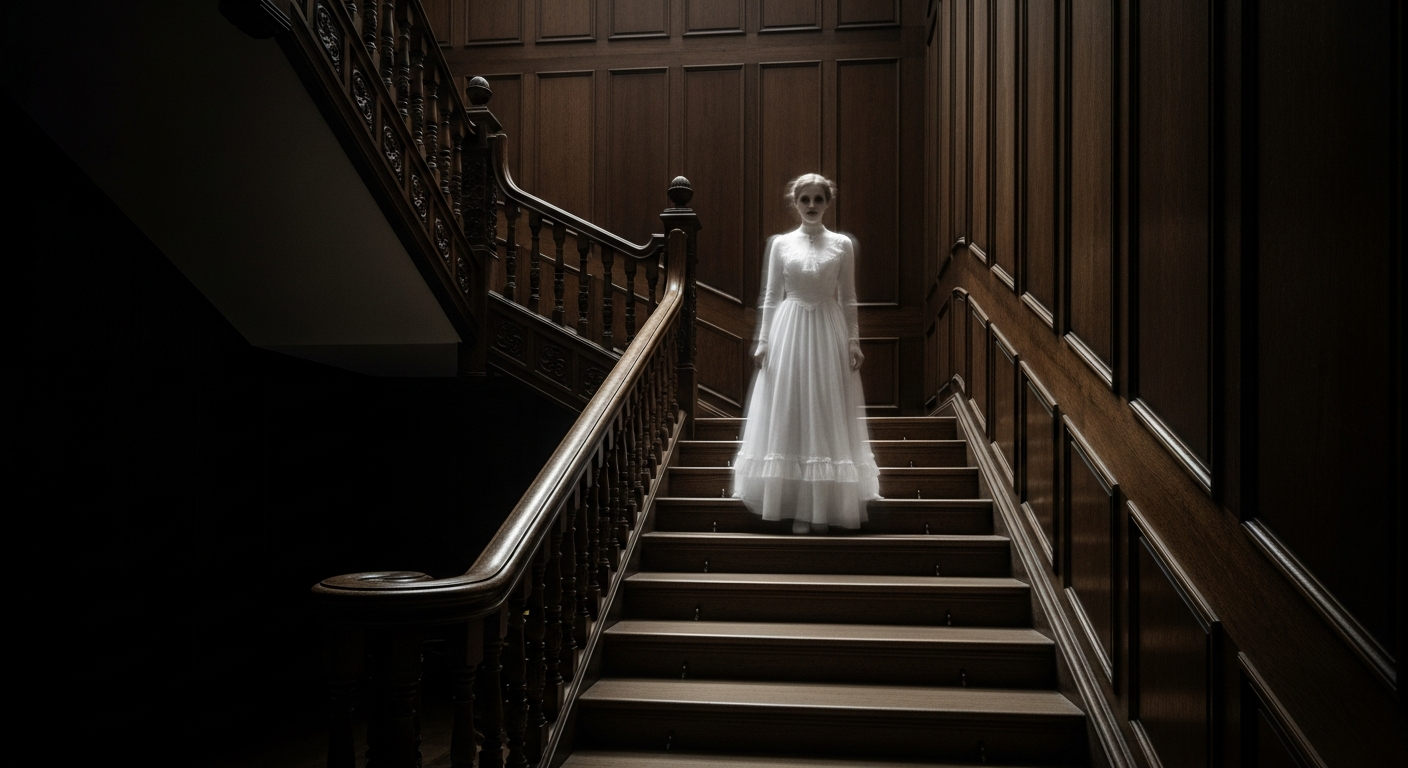
Pryce looked up. He later confirmed that he saw it too: a shape on the upper flight of steps, resembling a woman in a long, full-skirted gown of a dark brownish hue. She was moving — descending slowly, deliberately, as though entirely unbothered by the presence of two living people and a camera pointing directly at her. Pryce, operating on professional instinct rather than conscious thought, reached for the shutter trigger.
The flash fired. The plate was exposed.
When developed, the image showed a luminous, translucent figure occupying the right-hand side of the staircase — a discernible head, torso, and the unmistakable suggestion of descent. The figure appeared to glow from within, catching the flash powder's light in a manner wholly inconsistent with ordinary fabric or any known photographic artefact. The face remained indistinct, yet the overwhelming impression left by the image was not of absence but of presence — something occupying that staircase that had no business being there.
The photograph was published in December 1936 and caused an immediate and lasting sensation. Expert photographic technicians examined the original glass negative and found no evidence of double exposure, chemical treatment, or manipulation of any kind. The magazine's editor personally attested to the chain of custody between camera and darkroom.
Margaret Hollis was interviewed many times in the years that followed. She never once varied her account, and never once retreated from her central insistence.
"Whatever had been on those stairs had been there."
David Pryce, in one of his final interviews before his death in 1971, was asked directly whether he believed the photograph depicted a ghost. After a long pause, he offered the most honest answer available to him:
"I believe it shows something that was on those stairs. What that something was, I have spent thirty-five years trying to answer, and I am no closer now than I was the afternoon I pressed that button."
The figure Hollis and Pryce encountered was, in all likelihood, the same entity that had been reported at Thornfield Hall for over two centuries. The earliest well-documented account came from December 1835, when a house guest — a former military officer of notable hardiness, here referred to as Colonel Edward Farrow — encountered a woman in a brown dress on the landing outside his guest room. Her face, he wrote, bore hollow, dark sockets where eyes should have been. Farrow, a man not given to cowardice, drew a loaded duelling pistol and fired directly at the figure. The ball passed through her without effect. She continued past him without pause and vanished before reaching the corridor wall. He left for London at first light, reportedly white-faced and shaking, and refused to return.
A Victorian novelist of considerable reputation visited the hall in the 1860s and reported encountering the figure at the foot of the staircase. He described her as entirely solid and real-looking, right up until the moment she was simply — not. Staff throughout the nineteenth and early twentieth centuries left employment at Thornfield at an unusually high rate, often without satisfactory explanation. One footman, whose grandson spoke to a Norfolk paranormal researcher in the 1980s, had encountered the figure three times and resigned the morning after the third, when she had turned and shown him her face.
Historical research suggests the Brown Lady may be connected to a noblewoman of the early eighteenth century, allegedly confined within the hall for the remainder of her life on suspicion of infidelity and reported to have died there under unclear circumstances. Her portrait hangs in one of the upper galleries. She is depicted in a brown dress. Visitors consistently remark on her eyes — which appear, depending on the angle of light, to be hollow.
EVIDENCE
- The 1936 Photograph: A glass plate negative, examined by multiple photographic technicians, showing a luminous, translucent figure on the oak staircase. No evidence of double exposure, chemical treatment, or post-capture manipulation was identified. Digital enhancement of the original has deepened rather than resolved the mystery — the figure's outline holds under scrutiny and the luminosity corresponds to no known photographic artefact.
- Chain of Custody: The magazine's editor personally attested to the unbroken chain of custody from camera to darkroom, significantly limiting the window for interference.
- Corroborating Witness Account (Pryce): Both photographers reported seeing the figure with the naked eye before the shutter was triggered, establishing that the image was not the sole basis for the claim.
- Colonel Farrow's Account (1835): Recorded in a fellow houseguest's diary within days of the incident. The pistol ball was recovered from the panelling, consistent with his account of having fired through empty air.
- Victorian Literary Witness (1860s): Written account by a named individual of significant public standing, preserved in personal correspondence.
- Staff Testimony (Multiple Periods): High staff turnover throughout the 19th and early 20th centuries; third-hand account via a footman's grandson, recorded 1980s; multiple independent accounts of figures seen on or near the staircase.
- Temperature Anomalies: Investigators from interwar psychical research societies recorded temperature drops of several degrees on the staircase under conditions where no draught or ventilation could account for the change.
- Continuing Reports: Regional press accounts from as recently as the 1990s document cold spots, unexplained footsteps, and a figure briefly glimpsed in a doorway by current staff.
FOX'S ANALYSIS
Right. Deep breath. Let me compose myself, because this is — and I say this as a reporter who once had to file copy while being prodded by extraterrestrial equipment — a genuinely remarkable case.
Let's start with the photograph, because frankly, it's the star of the show and it knows it. I've looked at this image more times than I care to admit, squinting at it with the kind of intense focus usually reserved for crossword puzzles and alien probe schematics. The figure is there. The luminosity is wrong. The outline is consistent. And every serious photographic analyst who has examined the original negative has walked away without a satisfying debunking in hand. That's not nothing. That is, in fact, quite something. You might even say the case has been... developed thoroughly. The evidence is really coming into focus.
I know, I know. You're groaning. But I can't help it — it's a condition.
Here's what gets my reporter's nose twitching: neither Hollis nor Pryce had heard the stories before they arrived. They were professionals on a commercial assignment with no motive to fabricate and, crucially, every professional motive NOT to. You don't advance a career in respectable society magazine photography by claiming you've snapped a spectre. Pryce's final interview is particularly compelling to me — this is a man with thirty-five years to reconsider, thirty-five years in which he could have disavowed the whole thing, blamed a processing error, blamed youthful credulity. He didn't. He sat in front of a BBC camera in 1971 and essentially said: I don't know what it was. That kind of sustained, sober uncertainty carries weight with me. It smells like truth.
The historical depth of this case is also extraordinary. We're not dealing with a single incident dressed up with hearsay. We have accounts spanning over a century before the photograph was ever taken, from independently credible witnesses with no apparent connection to one another. Colonel Farrow's 1835 encounter is especially striking — the man fired a pistol. A loaded one. At point-blank range. And the ball went through. I've covered a lot of strange things in this job, and even I have to pause at that. The Colonel was, shall we say, discharged of his scepticism rather thoroughly.
Now, in the interest of professional balance, let me apply the brakes for a moment. The identity of the Brown Lady is historical speculation, not established fact. The portrait with the hollow-seeming eyes is suggestive but circumstantial — portraits do odd things with light, and human brains are ludicrously good at finding faces and reading menace into them. The staff turnover figures, while striking, are not independently verified. And séance results from interwar psychical societies are, in my professional view, about as reliable as a weather forecast written by a golden retriever.
But none of that touches the photograph. None of that explains what Hollis saw before the shutter fired, or what Pryce saw when he looked up from his plate. And none of it explains why, decades later, people who work in that building still don't quite want to linger on the staircase.
My gut — and I have excellent gut instincts, even if certain beings from beyond the solar system apparently found the rest of my anatomy more academically interesting — says this one is real. Or real enough. Something is on that staircase. Something has been on that staircase for the better part of three hundred years. And whatever she wants, she doesn't appear to be in any hurry.
Which, fair enough. When you've been haunting the same staircase since the early 1700s, I suppose there's no particular rush.
CREDIBILITY RATING
Rating: 9 / 10
Reasoning:
- Multiple independent witnesses across multiple centuries: Accounts from 1835, the 1860s, the early 1900s, and 1936 are broadly consistent in description without being suspiciously identical.
- Photographic evidence examined and unrefuted by technical experts: The gold standard for physical paranormal evidence. The negative has survived sustained expert scrutiny.
- Both photographers saw the figure before the photograph was taken: This is critical. The image corro