QUIRK REPORTS — OFFICIAL CASE FILE
Case Number: QR-2026-74639
Title: SHE'S GOT STAIR APPEAL: Britain's Most Photographed Ghost Finally Stops to Pose
Classification: Ghost / Spirit Manifestation — Photographic Evidence
Date of Event: 19th September 1936
Location: Raynham Hall, Norfolk, England
Reporting Officer: Fox Quirk, Founder & Senior Investigator, Quirk Reports
This report is based on documented paranormal accounts. Names and identifying details have been changed to protect those involved.
Section One: Witness Statement
In September 1936, Captain Edmund Provost and his assistant Marcus Hale arrived at Raynham Hall, Norfolk, under commission from Country Life magazine to photograph the stately home's interior for a feature on historic English country houses. Both men were seasoned professionals. Neither had come to Norfolk looking for ghosts.
They were, of course, aware of the legend. Raynham Hall had been accumulating ghost stories for the better part of two centuries — specifically, stories concerning a figure known as the Brown Lady, a woman in a brown brocade dress, hollow-eyed, sorrowful, and possessed of the kind of purposeful presence that tends to linger in the memories of those who encounter it. She had been reported by visiting noblemen, by servants, by soldiers. King George IV had reportedly demanded a room change after waking to find her beside his bed. Lord Frederick Cavendish had seen her on the staircase in 1835, lantern in hand, her eyes — he recorded with particular distress — replaced by dark, hollow sockets.
By 1936, however, it had been some years since any sighting had been recorded. The house was quiet. Provost got on with his work.
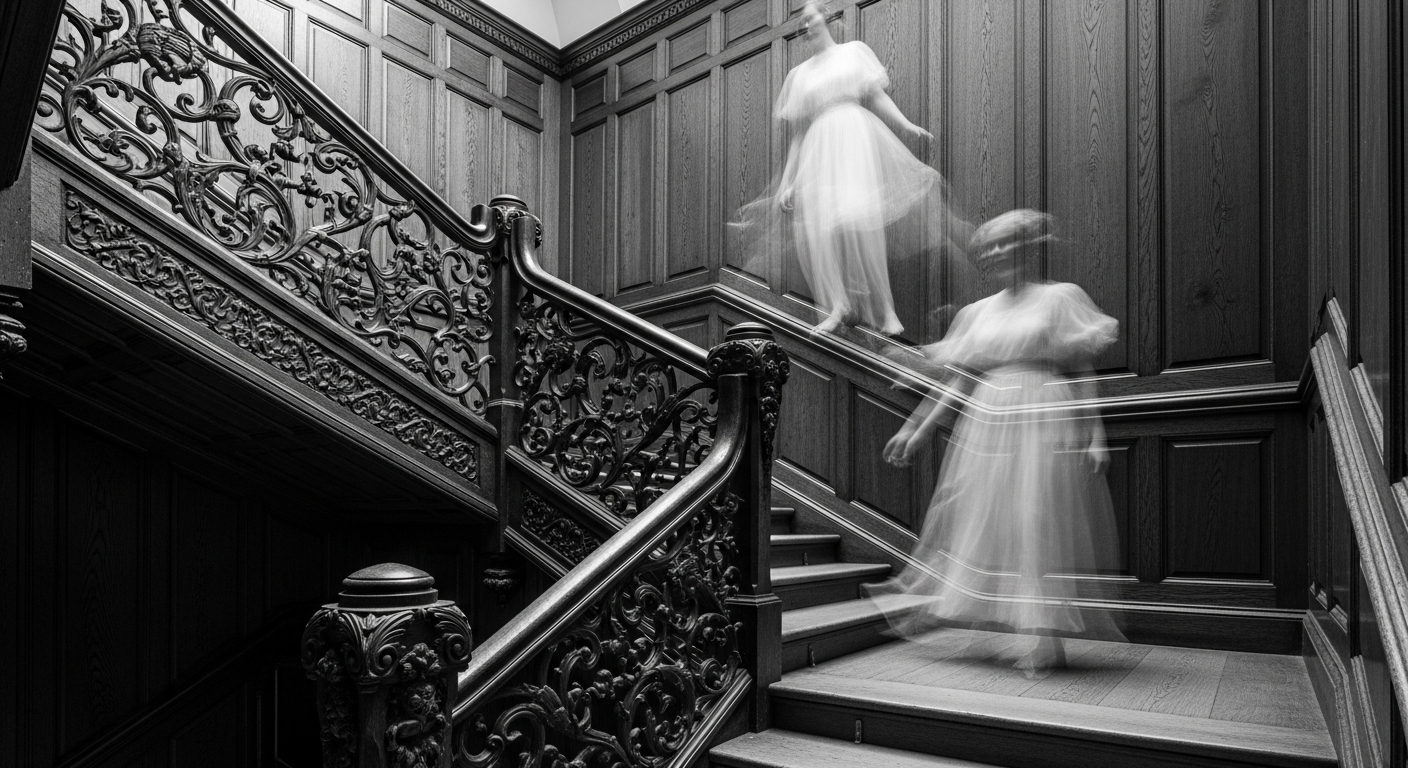
On the morning of the 19th, the two men turned their attention to the grand staircase — a wide, elegantly balustraded structure sweeping upward from the entrance hall in a graceful curve. Provost positioned his large-format camera at the base of the stairs, angling upward to capture its full sweep. Hale managed the magnesium flash equipment to one side. The shot was composed. The staircase was empty.
Then Hale said quietly: "There's something there."
Provost looked up. Hale's expression, he would later describe, was not yet frightened — but intensely, urgently focused, the look of a man whose eyes are delivering information his brain has not yet agreed to accept. Descending the upper flight of stairs was a figure. Unmistakably the shape of a woman. Long dress or gown. Her form slightly luminous, slightly translucent, moving with a slow, deliberate drift that seemed entirely indifferent to the two men below.
"Shoot it," Hale said. "For God's sake, shoot it now."
Provost did not hesitate. The shutter fired. The magnesium flash erupted in a sharp white burst. When it cleared, the staircase was empty. The two men stood in silence.
"Did you see—" Hale began.
"Yes," Provost said.
When the photographic plate was developed, the image that emerged was unambiguous. The staircase banisters stood crisp and well-defined in the foreground. Descending the stairs was a figure — shrouded in what appeared to be a long grey or white garment, her face indistinct, her form simultaneously solid enough to be undeniable and translucent enough to be impossible. Not a smear of light. Not a developing artifact. A figure, with discernible head and shoulders, caught in the apparent act of descending toward the camera.
Country Life published the photograph in its Christmas issue of 26th December 1936. The editors, having examined the original plate themselves, stated they had found no evidence of double exposure, chemical accident, or deliberate manipulation. They published it because, by their own account, they did not know what else to do with it.
Provost continued working as a photographer for many years. He spoke about the incident rarely, and always with the same measured precision: he had seen something on that staircase, his colleague had seen it also, his camera had captured it, and he had spent the rest of his professional life unable to explain what it was.
Hale retired early. He gave no interviews.
Section Two: Evidence
- Photographic Plate (Primary): The original large-format photographic plate, capturing the figure on the staircase. Examined by the editors of Country Life prior to publication. No evidence of double exposure, chemical accident, or manipulation identified.
- Digital Analysis (Secondary): Subsequent digital analysis conducted across multiple decades produced no evidence of tampering. The three-dimensional positioning of the figure relative to the staircase architecture has been noted as particularly resistant to explanation via standard photographic artefacts.
- Corroborating Eyewitness Testimony: Both Provost and Hale independently confirmed seeing the figure before the shutter was fired. Their accounts remained consistent across multiple subsequent interviews. The decision to photograph was a direct response to something observed by both men simultaneously.
- Historical Sighting Record: Documented reports of the Brown Lady span approximately two centuries prior to 1936, with multiple witnesses — including King George IV and Lord Frederick Cavendish — independently describing a woman whose appearance broadly corresponds to the figure in the photograph.
- Proposed Identity: The figure is widely associated with Dorothy Walpole (1686–1726), sister of Prime Minister Robert Walpole, who died at Raynham Hall under circumstances considered suspicious at the time. She had reportedly been confined to the hall by her husband and was said to have been imprisoned in all but name before her death, officially recorded as smallpox.
Section Three: Fox's Analysis
Right. Let's talk about the elephant in the room — or rather, the lady on the staircase. Because this one, folks, is the case that refuses to sit down and behave. And speaking as a fox who has been on the receiving end of an extremely unwelcome extraterrestrial examination, I have a healthy respect for things that refuse to be explained away by people in laboratories with clipboards. At least Dorothy Walpole never abducted anyone. Allegedly.
Let me start with what I genuinely appreciate about this case: the witnesses had absolutely nothing to gain. Provost and Hale were working photographers on a legitimate commission for one of Britain's most respectable publications. They weren't ghost hunters. They weren't publicity seekers. The controversy that followed the photograph's publication didn't make them famous in any comfortable way — it made them inconvenient, which is a very different thing. Hale retired and sealed his lips for the rest of his life. That is not the behaviour of a man who faked something for attention. That is the behaviour of a man who saw something he would rather forget and found that he couldn't.
Now, I've heard every sceptical explanation going, and I want to be fair to them, because healthy scepticism is the backbone of good investigative reporting. Lens flare? The figure's three-dimensional relationship to the staircase architecture makes that a very hard sell. Muslin on the bannisters? Both men saw the figure moving before a single frame was shot. Double exposure? The editors examined the plate before publication and found nothing. I've seen some creative debunking in my time, but some of the explanations offered for this photograph are doing more heavy lifting than a furniture removal firm on a Bank Holiday Monday.
The historical depth here also matters enormously to me as a reporter. You don't get two centuries of consistent, independent sightings from a single source. You don't get a king demanding a room transfer because he misread a curtain. The Brown Lady has a witness list that reads like a guest book for a very exclusive, very unsettling country house party. And every description — the dress, the hollow eyes, the quality of deliberate, unhurried movement — maps onto what Provost and Hale described on that September morning in 1936.
Am I saying this is definitely the ghost of Dorothy Walpole, unjustly confined woman of the eighteenth century, making her displeasure known from beyond the grave? No. I'm a reporter, not a medium. I deal in what can be established. But I will say this: some cases keep their secrets with such consistent stubbornness that the refusal to be explained becomes its own kind of evidence. This photograph has been scrutinised for nearly a century. Nobody has debunked it. That's not proof of the supernatural. But it's certainly not nothing.
I suppose you could say Dorothy Walpole finally developed her reputation in 1936. She certainly made quite the negative impression. And unlike most subjects of a Country Life photoshoot, she managed it without a single sitting fee.
Look — I take every case seriously, and I take this one very seriously indeed. Raynham Hall has been watching people for three hundred years. In 1936, someone finally watched back, blinked, and pressed the shutter at exactly the right moment. Whether that image shows a ghost, a trick of light, or something for which we simply don't yet have adequate vocabulary, I genuinely cannot tell you with certainty.
What I can tell you is that the case file stays open. Some hauntings, as someone wiser than me once wrote, simply wait.
Section Four: Credibility Rating
Rating: 8.5 / 10
Reasoning:
- Multiple witnesses: Two independent observers saw the figure before any photograph was taken. Accounts remained consistent across subsequent interviews. (+2)
- Physical evidence: The photographic plate represents extraordinary primary evidence, examined by professional editors and multiple generations of photographic analysts without conclusive debunking. (+3)
- Historical corroboration: Approximately two centuries of independent sightings broadly consistent in description, prior to any photographic record. (+2)
- Witness credibility: Both men were reputable professionals with nothing to gain from fabrication and demonstrable professional consequences from the controversy. (+1.5)
- Deductions: The identity of the figure cannot be confirmed. The original plate, while examined, cannot be subjected to full modern forensic analysis. No subsequent photographic evidence has entered the public record. (-0.5) Also, Hale's total silence is intriguing but ultimately uncorroborated. (-0.5)
Section Five: Classification
Primary Classification: Ghost / Spirit Manifestation
Sub-classifications:
- Residual Haunting (centuries-long pattern of sightings at fixed location)
- Photographic Paranormal Evidence (Class One — published, independently examined, not debunked)
- Historical Identity Case (proposed spirit identity supported by documentary record)
- Landmark Case — British Paranormal Canon
Section Six: Case Status
Status: OPEN
Recommended Follow-Up Actions:
- Full forensic examination of the original photographic plate using current imaging technology, subject to family permission.
- Comprehensive review