QUIRK REPORTS — OFFICIAL CASE FILE
Case Number: QR-2026-50978
🛸 LIGHTS, CAMERA, ALIEN ACTION: THE NIGHT NEW ZEALAND'S SKY WENT PRIME TIME
Classification: UFO/UAP — Multi-Witness Aerial Encounter with Radar Corroboration and Photographic Evidence
Date of Event: 20 December 1978 (initial encounter) / 30–31 December 1978 (primary filmed encounter)
Location: Kaikōura Coastline, South Island, New Zealand
Primary Witness: Arthur Melling (name changed)
Filed by: Fox Quirk, Founder & Chief Reporter, Quirk Reports
This report is based on documented paranormal accounts. Names and identifying details have been changed to protect those involved.
WITNESS STATEMENT
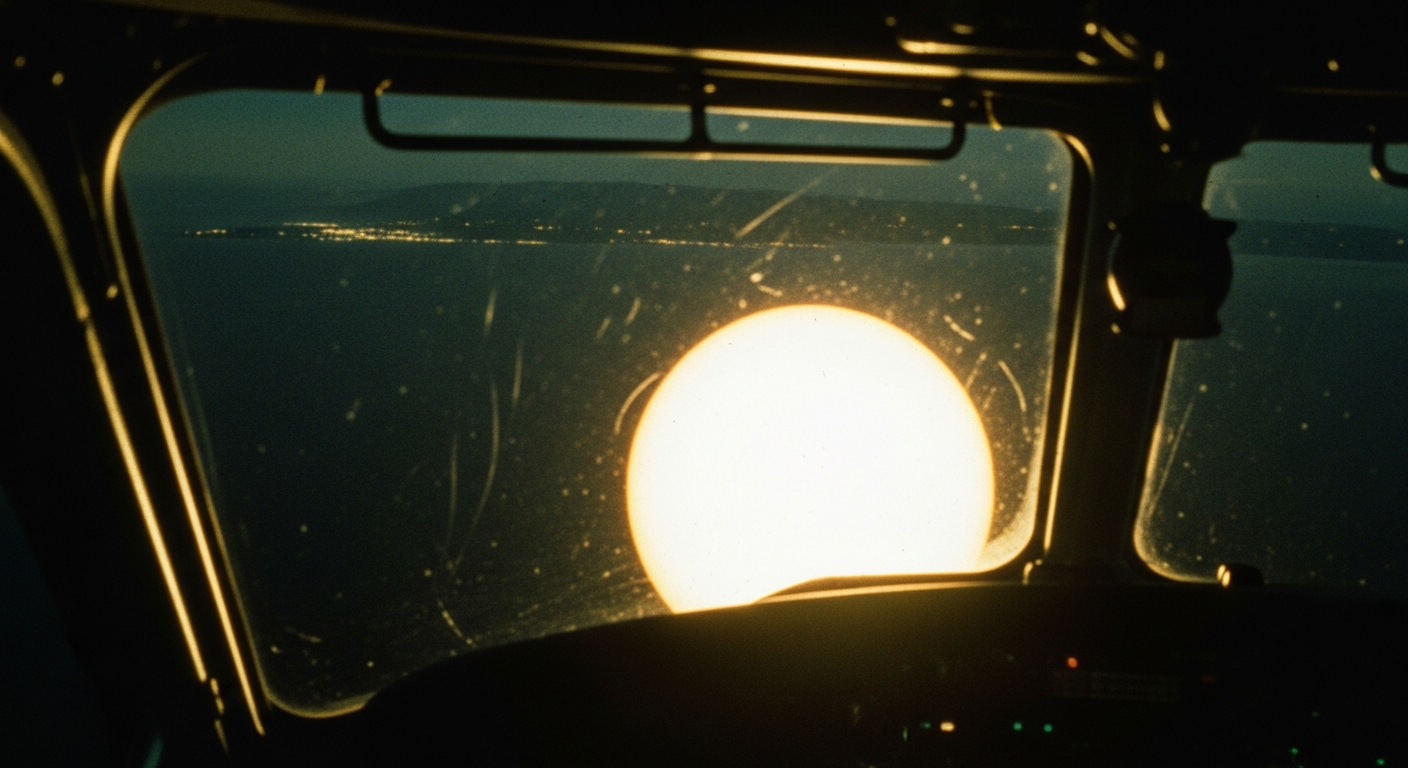
Arthur Melling was not a man given to fantasy. A professional cameraman with a television news crew, he had spent his career pointing lenses at the world as it actually was — fires, floods, politicians saying things they would later regret. When his crew arranged passage aboard a small Safe Air Ltd Argosy freighter on the night of 30 December 1978, flying the Blenheim-to-Christchurch coastal route, he brought his 16mm colour film camera loaded and ready. He was prepared, in the way working journalists are always prepared, for a story that might amount to nothing.
The aircraft departed shortly after midnight. It had barely settled into its course along the Kaikōura Strait when the first object appeared.
A large, luminous form materialised off the right side of the aircraft, holding position at roughly the same altitude. It was not a star. It was not a navigation light. It pulsed from brilliant white at its core through amber and orange at its edges, and it moved — deliberately, purposefully, with the kind of controlled precision that suggested intent rather than drift. Melling raised his camera and began filming. He kept filming for the better part of the next hour across multiple reels.
The objects — for there were several, across both the outbound and return legs of the flight — exhibited behaviour that confounded every conventional explanation subsequently offered. Some held station alongside the Argosy before surging ahead and slowing again to match its speed. One positioned itself directly ahead of the aircraft and appeared to rotate, its light cycling in a regular rhythm. Another, captured in what would become the footage's most dramatic sequence, descended toward the ocean surface before rising and accelerating away at a speed the crew estimated as many times faster than any conventional aircraft.
The aircraft's captain — identified in this report as Captain Dennis Corden, a name changed for this filing — had flown the same route ten days earlier, on 20 December, when similar objects had paced his aircraft. On that occasion, Wellington air traffic control had confirmed unidentified radar returns in the area before the objects vanished. On this second night, history repeated itself: radar operators in Wellington again independently confirmed anomalous returns corresponding to the crew's visual sightings.
The sound technician aboard, a veteran broadcaster with experience covering conflict zones, later described the experience as the most frightening of his professional life — not for any violence or aggression, but for the unmistakable quality of deliberateness the objects projected. The crew's accounts, given separately in the days and years that followed, remained consistent in every essential detail.
The footage was broadcast on Australian and New Zealand television within days and syndicated internationally shortly afterward. The reaction from official quarters was swift and, in the view of most who have studied the case, inadequate. The Royal New Zealand Air Force suggested the lights might be the planet Venus observed under unusual atmospheric conditions. The crew received this explanation with what might charitably be described as limited enthusiasm.
"I was a sceptic before that night," Melling said in an interview conducted several years after the event. "I'm not anything now. I'm just someone who saw something."
American optical physicist Dr. Bruce Maccabee subjected the footage to extensive frame-by-frame analysis, concluding that the primary object exhibited characteristics consistent with a large, structured, self-luminous craft potentially exceeding thirty metres in diameter. The New Zealand government's own declassified UFO files, released in 2010, confirmed that multiple agencies had tracked the events in real time, considered the radar data reliable, and never internally agreed upon a satisfactory conventional explanation. The matter was quietly allowed to close without conclusion.
EVIDENCE
- 16mm Colour Film Footage: Approximately twenty-three minutes of filmed material across multiple reels, capturing luminous objects exhibiting controlled movement, rotation, and high-speed acceleration. Subsequently examined by military analysts in the United States, Australia, and the United Kingdom.
- Radar Corroboration: Wellington air traffic control independently confirmed anomalous radar returns corresponding to the visual sightings on both the 20 December and 30–31 December encounters. Multiple radar operators provided consistent accounts.
- Expert Analysis: Dr. Bruce Maccabee's peer-reviewed optical analysis calculated the primary object's diameter as potentially exceeding thirty metres based on comparative brightness and aircraft positioning data.
- Declassified Government Documents: New Zealand government UFO files released in 2010 confirm official monitoring of the events in real time, acknowledgment of reliable radar data, and the absence of any internally agreed conventional explanation.
- Multiple Independent Witness Accounts: The television crew (reporter, cameraman, sound technician), Captain Corden, and Wellington air traffic control personnel all provided separate, consistent accounts over a period of many years.
- Captain Corden's Prior Encounter: The 20 December incident, logged officially at the time, establishes a pattern of activity in the area predating the filmed encounter and independent of the news crew's presence.
FOX'S ANALYSIS
Right. Deep breath. Flat cap adjusted. Let's talk about Kaikōura.
I've been doing this job for longer than I care to admit — longer than some of those squid boats they tried to blame for this have been in the water — and I want to be straight with you, readers: this one hits different. In a career built on maintaining healthy scepticism while taking witnesses seriously, the Kaikōura case is the kind of file that makes the scepticism work hard for its keep.
Let's start with what we've got. Film footage. Actual, physical, 16mm colour film footage, not a shaky phone video from a nervous teenager, but professional news-crew footage from people whose literal job was to point cameras at things accurately. Radar confirmation from an independent ground station — not once, but across two separate encounters on two separate nights. A veteran pilot with thirty years of aviation experience who never wavered in his account across two decades. A physicist's peer-reviewed analysis. And a government that quietly shelved its own investigation because it couldn't explain what its own agencies had tracked in real time.
Venus. They said it was Venus. I've heard some explanations in my time, but blaming Venus for pacing a freighter aircraft and appearing on radar is a bit like blaming a potted fern for a bank robbery. I'll say this for free: when your official explanation gets rejected with "undisguised contempt" by the very witnesses it's meant to reassure, you have not stuck the landing, scientifically speaking.
Now, do I have a personal history with extraterrestrial visitors that might colour my reporting? Yes. Yes, I do. The probe situation is a matter of record and we won't be revisiting it here. What I will say is that my grudge is personal, not professional, and professionally I am obligated to follow the evidence. The evidence here is, to use a technical term, absolutely wild.
What I find most compelling — more than the footage, more than the radar — is Arthur Melling himself. The man went up as a sceptic. He came down changed. And he didn't become a true believer, didn't go on the lecture circuit, didn't write a book with a foil cover. He just became someone who knows what he saw and has stopped trying to convince people who weren't there. That is the testimony of a man who has processed something real. Converts are loud. Witnesses are quiet.
I've been around enough hoaxes to know they have a smell — usually the smell of someone who wants something. Fame, money, a book deal, the admiration of people at UFO conventions. The Kaikōura crew don't smell like that. They smell like people who went to work, filmed something that shouldn't exist, and have spent the years since being mildly exhausted by the whole business. I find that extremely credible. They didn't ask to be part of New Zealand's most extraordinary UFO encounter. They just showed up with a camera.
The official explanations, meanwhile, have all the structural integrity of a soup sandwich. Squid boats reflected off clouds? Ball lightning for twenty-three minutes across multiple reels? A weather balloon that also appeared on radar and performed high-speed acceleration manoeuvres? I've seen better cover stories written on the back of a napkin. I once covered a haunted napkin, actually — that's a different file.
Look. I'm not going to tell you definitively what lit up the Kaikōura sky on that December night. Anyone who tells you they know for certain is either working for a government agency or trying to sell you something. What I can tell you is that the evidence base here — filmed, radar-confirmed, multiply witnessed, expert-analysed, and officially unresolved — is about as solid as it gets in this game. If this case doesn't deserve serious investigation, I'm a four-legged fraud in a flat cap.
Oh, and to whatever was up there that night: you picked the most documented, most professionally witnessed stretch of night sky in New Zealand to make your appearance, and you still didn't give us a straight answer. You know what that makes you? Extra-terrestrially evasive. I'd say you're giving us the runaround, but I suppose at those speeds, you're giving us the fly-around.
I'll see myself out.
CREDIBILITY RATING
⭐ 9 / 10
Reasoning:
- Multiple independent witnesses (+3): Television crew, experienced pilot, and air traffic control personnel all provided consistent, separately given accounts across years of subsequent interviews. This is not a single-witness case by any measure.
- Physical/instrumental evidence (+2): 16mm film footage and independent radar confirmation from Wellington ATC are the dual pillars of a case that refuses to be quietly dismantled.
- Expert analysis (+1): Dr. Maccabee's peer-reviewed optical analysis adds scientific rigour that the official investigations conspicuously failed to match.
- Witness credibility and consistency (+2): Captain Corden's account remained unchanged across two decades. Melling's quiet, non-evangelical certainty is the hallmark of genuine experience rather than fabrication.
- Official corroboration (+1): Declassified government documents confirm the events were tracked in real time and never satisfactorily explained internally.
- One point withheld because the military analyses from the US, Australia, and UK were never made public, and Fox Quirk does not award full marks to cases where governments are still sitting on paperwork. Hand it over, lads.
CLASSIFICATION
Primary Classification: UFO/UAP — Confirmed Unidentified
Sub-categories:
- Close Aerial Encounter (Multiple Objects)
- Radar-Confirmed Anomalous Returns