QUIRK REPORTS — OFFICIAL CASE FILE
Case Number: QR-2026-20344
SHADOWS WITHOUT A LANDLORD: THE SHEFFIELD FIGURE THAT DARKNESS ITSELF FEARED TO CAST
Classification: Shadow Entity / Sustained Residential Haunting / Multiple Independent Witnesses
Date of Events: October 1981 – Autumn 1983
Location: Perwick Street, Sheffield, South Yorkshire, England
Date of Report: Filed by Fox Quirk, Quirk Reports
This report is based on documented paranormal accounts. Names and identifying details have been changed to protect those involved.
WITNESS STATEMENT
Sheffield in the early 1980s was not a city in the mood for mysteries. The steel industry was on its knees, the terraced streets of the east end carried a particular kind of grinding anxiety, and Gerald Mossop — thirty-eight years old, shift worker, rolling mill, Attercliffe — was a man whose life was built around practical, physical things. He was not, by any account, a man given to fancy.
The house on Perwick Street had been the Mossop family home since 1974. Gerald lived there with his wife Patricia and their two children, Thomas, fourteen, and Dawn, eleven. It backed onto a railway embankment, mid-terrace, unremarkable. Nothing was supposed to happen there. Then October 1981 arrived, and something did.
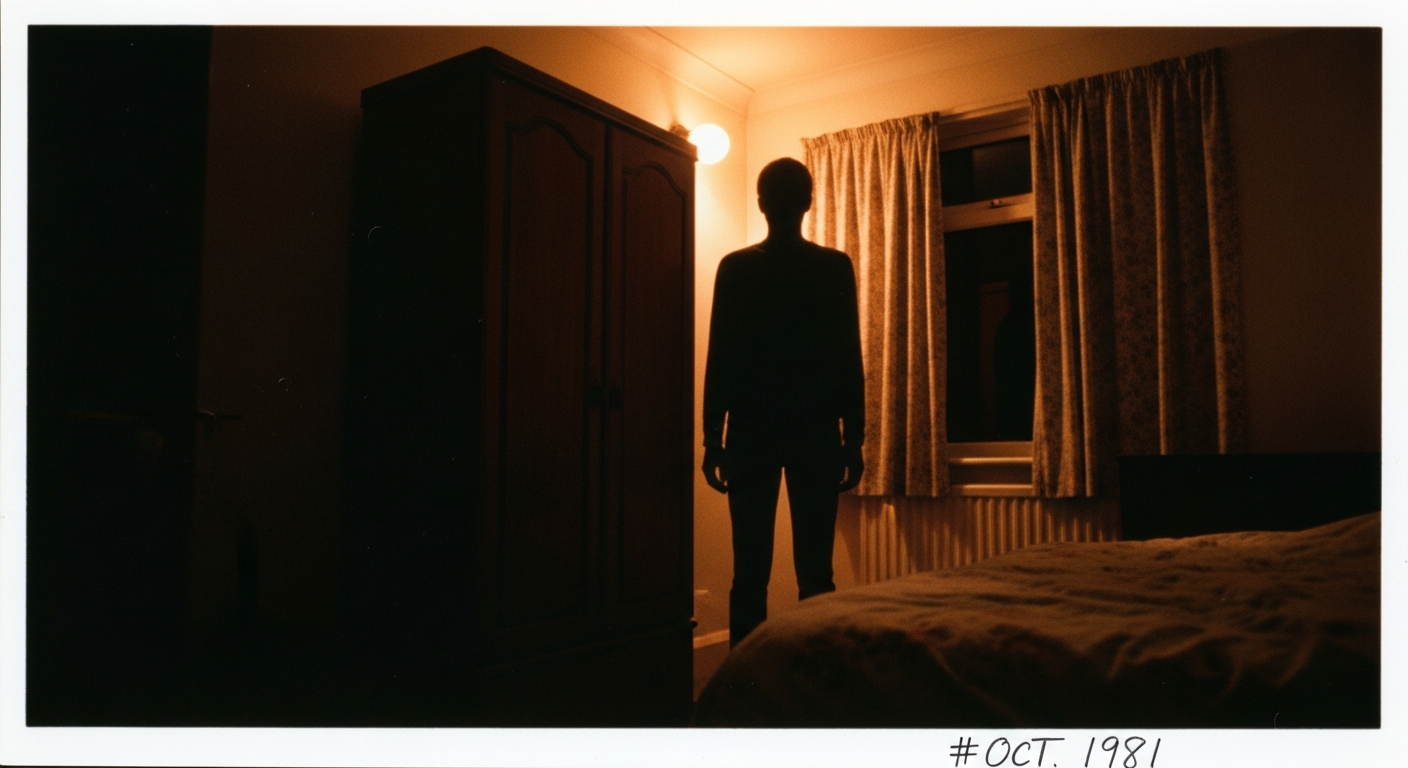
Gerald woke at approximately 2:15 in the morning with no apparent cause — no sound, no disturbance, simply a sudden, complete alertness. He lay still, listening to the freight trains. Then he turned his head. In the corner of the bedroom, between the wardrobe and the window, stood something that looked approximately like a man and was approximately nothing like one. Tall — six and a half feet or more. Featureless, not in the sense of being obscured, but in the absolute sense: no face, no texture, nothing. An organised absence of light in the rough shape of a human being, perfectly still, angled toward the bed.
What followed, Gerald later told researcher Alan Fenwick, was the most terrifying experience of his life — more frightening, he emphasised, than a serious industrial accident in 1969 that had hospitalised him for three weeks. He could not move. Not would not. Could not. His nervous system, as he described it, had simply stopped cooperating. He lay there for what he estimated as three to five minutes while the figure did absolutely nothing. Then it was gone — not retreating, not fading, simply absent between one moment and the next.
Gerald told no one. He saw the figure again in January 1982 and again in March. Each visitation was identical in nature: same corner, same paralysis, same abrupt disappearance. On the third occasion, he made an observation that would become central to all subsequent discussion of the case. The figure, despite being composed entirely of darkness, cast no shadow of its own. The orange streetlight outside threw faint secondary shadows from every object in the room. Not from the figure.
"It was darker than the dark already there, but it didn't put any darkness anywhere else. It was like it was eating the light instead of blocking it."
The case changed character in spring 1982 when Patricia Mossop, home alone while Gerald worked a night shift, woke to find the figure standing at the foot of the bed. She described the same sudden alertness, the same paralysis — perhaps thirty seconds of it — before she broke through it and screamed loudly enough to wake both children. Thomas reached the bedroom door to find the figure already gone. That night, Gerald finally told Patricia what he had been seeing. The conversation took place in the kitchen at four in the morning, all the lights on, both of them drinking tea and speaking very quietly. Neither of them used the word ghost.
Thomas Mossop encountered the figure in August 1982. It stood not across the room but beside his bed — close enough that he felt what he described as a cold emanating from it that was unlike ordinary cold.
"Like putting your hand near something that doesn't have any temperature at all."
He was frozen for approximately two minutes. When the figure vanished, he walked directly to his parents' room and sat on the end of their bed until morning. No one asked him to explain. No explanation was needed.
Dawn Mossop, the youngest, never saw the figure directly. She did report waking twice to a strong sense of presence, finding her closed bedroom door open, and glimpsing — on one occasion in the summer of 1982 — what she called "a dark bit" on the landing that retreated when she looked at it. Whether this constituted a genuine encounter or the product of a household living under sustained psychological pressure remains uncertain.
Alan Fenwick, a retired schoolteacher from Rotherham with over a decade of experience documenting paranormal accounts in South Yorkshire, learned of the case through a church contact and visited the Perwick Street house four times between December 1982 and June 1983. He interviewed Gerald and Patricia separately before speaking with them together. He also conducted a limited survey of the house and its history. Records revealed that a previous occupant in the 1950s — a widower — had suffered severe psychological disturbance during his tenancy, reportedly "seeing things" in the house, and had ultimately been removed to a psychiatric facility. Fenwick recorded this as background context, making no causal claim.
His physical investigation found nothing anomalous: no unusual structural features, no significant electromagnetic readings, and railway vibrations within normal parameters. The bedroom corner where the figure most frequently appeared ran one to two degrees cooler than the rest of the house, attributed tentatively to radiator placement and external wall exposure.
What Fenwick could not account for was the testimony. Gerald and Patricia, interviewed independently, gave descriptions of the figure identical in every material detail — height, featurelessness, position, the induced paralysis, the manner of vanishing. Thomas's account, gathered without his parents present, corroborated on all major points. Fenwick, who had spent years distinguishing genuine paranormal accounts from confabulation and fabrication, wrote that Gerald Mossop was "constitutionally resistant to exaggeration and visibly distressed by the memory of each encounter in a way that is not consistent with invention."
The visitations stopped, apparently without reason, in the autumn of 1983. No renovation, no ritual, no blessing. The figure simply ceased to appear. Gerald wrote to Fenwick that November to report that he was sleeping properly again, though he had left a hallway light on every night and did not expect to stop.
"I don't know what it wanted. I'm not even sure it wanted anything. That might be the worst part. It might have just been there. Just watching. For no reason at all."
The family remained in the Perwick Street house until 1991, when Gerald relocated to Barnsley. The case was included by Fenwick in a privately circulated 1986 research document on shadow entity encounters in northern England — one of only three in his files to feature multiple independent witnesses corroborating sustained contact with a shadow figure over an extended period. The other two came from the same general region of South Yorkshire, the same decade. Fenwick noted the geographical clustering twice and drew no conclusions from it.
EVIDENCE
- Multiple Independent Witnesses: Gerald, Patricia, and Thomas Mossop each encountered the figure independently. Accounts were gathered separately by researcher Alan Fenwick and found to be consistent across all major details.
- Researcher Documentation: Fenwick conducted four site visits and recorded extended interviews over a six-month investigation period. His notes, produced for a private research network, describe the Mossops as among the most credible witnesses he had encountered.
- Anomalous Temperature: The bedroom corner most associated with the figure consistently measured one to two degrees cooler than the rest of the house. Attributed tentatively to structural factors, though Fenwick noted the attribution without conviction.
- Historical Property Record: A previous occupant in the 1950s reportedly experienced visual disturbances and psychological breakdown during his tenancy at the same address, resulting in removal to a psychiatric facility.
- Geographical Clustering: Fenwick identified two additional independent shadow figure cases from South Yorkshire in the same decade, all within the same general region. No explanation offered.
- No Physical Evidence: No photographs, no recordings, no physical traces. Investigation equipment of the era returned no readings of significance.
FOX'S ANALYSIS
Right. Pull up a chair, pour yourself something strong, and let me tell you why this one keeps me up at night — and not just because I already sleep with one eye open on account of certain interstellar visitors who shall remain nameless but whose names rhyme with "Smextraterrestrials."
The Mossop case is the kind of file that makes a reporter sit back, stare at the ceiling, and think: yeah, alright, something happened here. I've been doing this long enough to know the difference between a family that's rehearsed a story and a family that's independently arrived at the same one. Gerald and Patricia were interviewed separately. Thomas was interviewed separately. Their accounts line up like steel girders — which is fitting, given the city. You don't get that kind of consistency from people making things up. You get inconsistency, embellishment, the small competitive escalations of family storytelling. You get that nowhere in this file.
Gerald Mossop, let me be clear, is not a man who wanted this to happen to him. He sat on these experiences for three months before telling anyone. He never sought publicity. He told Fenwick he didn't intend to tell most people and didn't expect to. That is not the behaviour of someone performing for an audience. That is the behaviour of a man who had a terrible experience and was trying to quietly survive it.
Now, the sceptic in me — and there is a sceptic in me, he wears a smaller flat cap and mutters about sleep paralysis — wants to note the obvious. Sleep paralysis is a real phenomenon. Hypnopompic hallucinations are real. A household under significant economic stress, in an industrial city undergoing contraction, with all the ambient dread that comes with that, could plausibly generate shared anxiety states and mutually reinforced perceptual experiences. This is not impossible. I'm obliged to say it.
But here's where my sceptic starts shuffling his feet: you can explain Gerald's initial sightings with sleep paralysis. You can explain Patricia's encounter similarly. But Thomas encountered the figure while seated in his own bedroom, felt cold emanating from it, got up, walked to his parents' room, and sat there in silence until morning without anyone asking why. That's not a child performing a learned narrative. That's a kid who saw something and had no words for it and needed to be near people. I've interviewed enough people in shock to know what that looks like.
And then there's the detail that genuinely stops me cold — colder, I'd wager, than whatever Thomas felt emanating from that corner. The figure cast no shadow. Gerald was specific, insistent, and consistent on this point across multiple interviews. Everything in that room threw a faint secondary shadow from the streetlight. The figure, which was itself composed of darkness, did not. That is an extraordinarily strange detail to invent. If you were making this up, you wouldn't add it, because it sounds paradoxical and slightly absurd. The fact that it sounds paradoxical and slightly absurd is precisely why I believe it. Nobody embellishes a ghost story with a note about the physics of secondary illumination. That's an observed detail. That's somebody reporting what they actually saw.
As for the previous occupant with the psychological breakdown — look, I'm not going to stand here and tell you one man's breakdown in the 1950s proves a haunting. That would be a dark conclusion to jump to. Perhaps too dark. You might say the evidence is casting a shadow over my better judgement. You might say