QUIRK REPORTS — OFFICIAL CASE FILE
Case Number: QR-2026-46002
📸 SHE'S STILL DESCENDING: THE BROWN LADY WHO NEVER GOT THE MEMO ABOUT DYING
Classification: Ghost / Spirit — Photographic Evidence, Recurring Apparition, Historically Documented Entity
Date of Event: September 1936
Location: Raynham Hall, Norfolk, England
Primary Witness: Dorothy Fairfax (name changed) and associate
Reporting Investigator: Fox Quirk, Founder & Senior Reporter, Quirk Reports
This report is based on documented paranormal accounts. Names and identifying details have been changed to protect those involved.WITNESS STATEMENT
In September 1936, two professional photographers — identified in this report as Arthur Pemberton and his assistant Thomas Graves — arrived at Raynham Hall, a grand Jacobean manor in the flat, autumnal quiet of Norfolk, England. They had been commissioned by a prominent London society publication to document the interior of the estate. They were experienced, methodical, and entirely uninterested in ghosts. They were there to do a job.
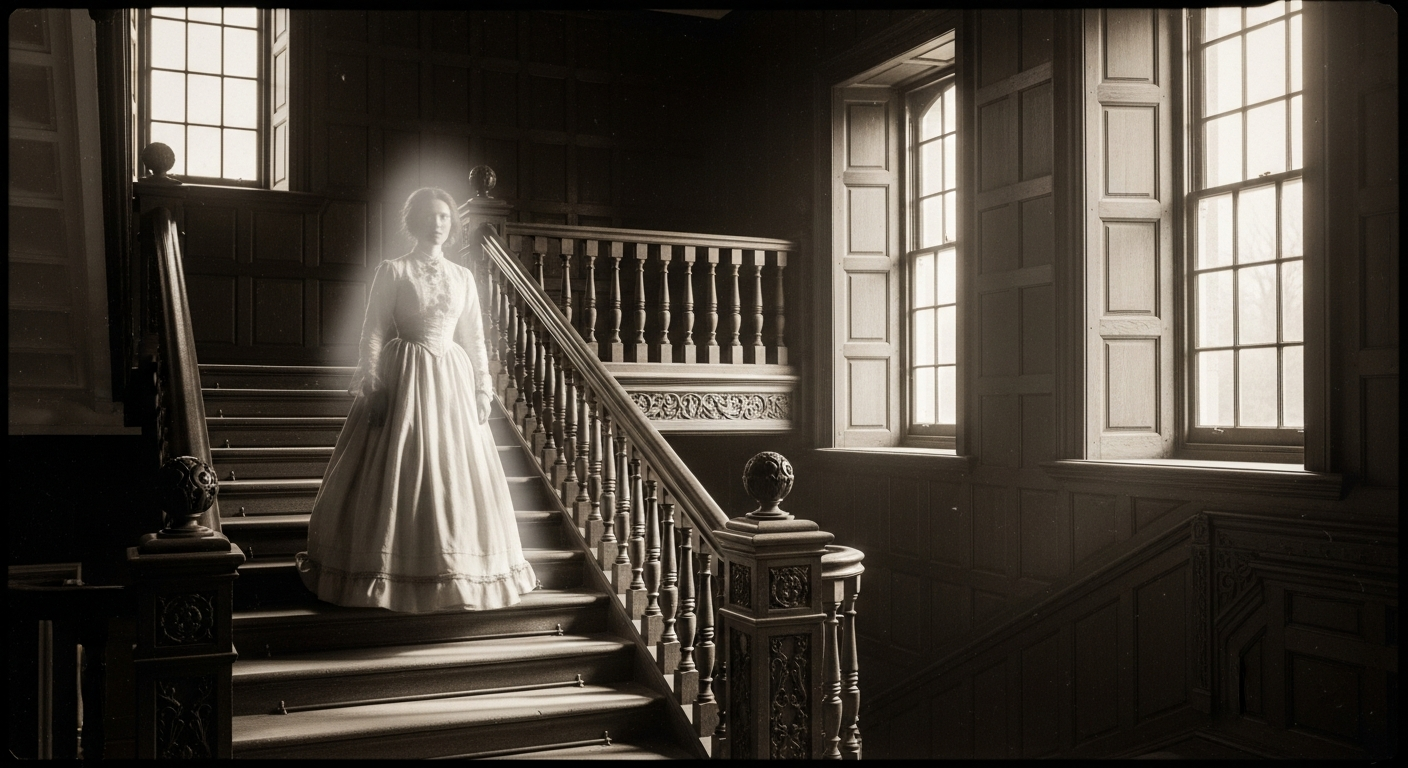
The assignment proceeded without incident through the morning. The two men worked their way through the state rooms — the dining room, the drawing room, the great hall — setting up lighting rigs, adjusting exposures, recording the accumulated grandeur of centuries on glass plate negatives. By early afternoon, they had reached the oak staircase: one of Raynham's celebrated architectural features, a sweeping balustraded rise of dark wood curving from the ground floor to the upper landing.
It was here that everything changed.
As Pemberton prepared his equipment and Graves stood on the stairs to judge the angle of the shot, Graves stopped. He spoke quietly. There was, he said, something on the stairs.
Both men saw it. Descending slowly — almost gliding — was a luminous, semi-transparent form: the suggestion of a woman in a long dress, her face a pale and undefined radiance within a nimbus of cold light. It moved in complete silence. It moved without hesitation. Working on pure professional instinct, Pemberton pressed the shutter release.
Graves described the experience in subsequent interviews:
"It went through me. Like cold water poured inside. I couldn't move. I just watched it."
Pemberton, for his part, recalled little of the actual moment of exposure. His hands, he said, had acted independently of his conscious mind. In later interviews, he was measured, precise, and consistent:
"I have looked for thirty years. I haven't found one."
The photograph was published in the December 1936 issue of the commissioning magazine. It showed the oak staircase in sharp, clear detail — and on it, unmistakably, a translucent figure mid-descent. A head. Shoulders. The fall of a gown. A face, such as it was, that appeared to look directly into the lens. The response was immediate and worldwide.
The entity in the photograph is believed to be the spirit of Lady Dorothy Walpole, born 1686, sister of Britain's first Prime Minister, and second wife of Charles Townshend, the second Viscount Townshend. Historical accounts suggest that Townshend, consumed by jealousy over a prior relationship, confined Dorothy to Raynham Hall after their marriage — imprisoned in the house that bore his name, forbidden from seeing her own children. She died in April 1726, aged thirty-nine. The official cause of death was smallpox. The whispers at the time, and in every generation since, have been rather more troubling than that.
Sightings of the Brown Lady — so named for the brown brocade dress she is said to wear, the same dress visible in a portrait that still hangs in the hall — predate the photograph by well over a century. King George IV reportedly fled his bedchamber at Raynham in a state of extreme terror, claiming to have seen a pale and rotting female form standing beside his bed. The Victorian novelist Captain Frederick Marryat fired a pistol at an apparition in 1835; the bullet, he reported, passed through her entirely. She smiled at him as it did.
The photograph was examined extensively. Photographic experts of the era found no evidence of double exposure, chemical manipulation, or tampering with the glass plate negative. A Cambridge-educated paranormal researcher interviewed the photographers at length and found them credible, consistent, and notably lacking in any enthusiasm for the fame the image had brought them. He also noted that the form visible in the photograph bore a resemblance — in posture and general outline — to the portrait of Dorothy Walpole that hangs in the hall. Digital analyses conducted in the 1990s and 2000s have produced divided expert opinion. What no analysis has ever established, in ninety years of trying, is that the photograph is a fake.
EVIDENCE
- The Photograph: A glass plate negative taken during the September 1936 assignment, showing a translucent luminous figure on the oak staircase at Raynham Hall. Published in a London society magazine, December 1936. The negative was examined by contemporary photographic experts and found to show no evidence of tampering, double exposure, or chemical interference. Adjacent images in the sequence showed nothing unusual on the staircase.
- Expert Analysis: Multiple rounds of analysis over nine decades. 1950s and 1960s photographic experts found no evidence of fabrication. Digital analysis in the 1990s and 2000s produced conflicting results, with some experts citing light distribution consistent with a physical form, and others suggesting lens flare or emulsion defect. No consensus has ever been reached that the image is fraudulent.
- Corroborating Witness Testimony: Pemberton and Graves gave consistent accounts across multiple independent interviews. Pemberton's account never varied across three decades. Graves rarely spoke of the incident and displayed visible distress when he did — behaviour noted by friends and contemporaries.
- Historical Sighting Record: A documented history of apparitions at Raynham Hall stretching from the early 18th century through to the present day, including named witnesses of high social standing: King George IV (early 1800s), Captain Frederick Marryat (1835), and numerous household staff and visiting guests across intervening generations.
- The Portrait: A contemporary portrait of Dorothy Walpole still hanging in Raynham Hall, the subject wearing the brown brocade dress associated with the apparition. The paranormal researcher noted similarities in posture and outline between the portrait and the photographic form.
- Contemporary Visitor Reports: Ongoing accounts from visitors to Raynham Hall describing unease on the oak staircase — sudden drops in temperature, a sense of being observed, and peripheral awareness of a figure that is not there when sought directly.
FOX'S ANALYSIS
Right. Let me take my flat cap off for a moment — metaphorically speaking, I never actually remove the flat cap, it's basically structural at this point — and address this one seriously, because it deserves it.
The Brown Lady of Raynham Hall is, in my professional assessment, one of the most compelling cases in the Quirk Reports archive. And I do not say that lightly. I have covered alien cattle mutilations in Wyoming, a poltergeist who appeared to have a personal vendetta against a specific brand of ceramic teapot, and a haunted photocopier in a Swindon accountancy firm that exclusively printed images of a Victorian child. I have standards.
What strikes me first, and hardest, is the evidence problem — or rather, the lack of it. Not the lack of evidence for the ghost. The lack of evidence against it. In ninety years, with all the tools of modern forensic photographic analysis thrown at this image, nobody has managed to prove it's fake. That's not nothing. That's actually quite a lot. As a reporter, I know that absence of proof isn't proof of absence, but I also know that when every expert who has ever tried to debunk something comes up empty, you sit up and you pay attention.
Pemberton's behaviour is what really gets my whiskers twitching. The man actively sought a rational explanation for thirty years. He found the attention uncomfortable. He was not, by any account, cashing in — there was no Brown Lady merchandise, no speaking tour, no lucrative book deal. He just quietly, for the rest of his life, could not explain what he had photographed. A fraudster who maintains his story flawlessly for thirty years in the hopes of… what, exactly? The editor of the original publication put it plainly: a proven fabrication would have destroyed him professionally. He had nothing to gain and everything to lose.
You could say his career was really at steak — and he still wouldn't budge his story. Sorry. I tried to hold that one in. I really did.
Then there's Dorothy herself — and here I find the case genuinely affecting, which is not a feeling I arrive at easily. This is a woman who, by all historical evidence, was imprisoned by her own husband in her own home, separated from her children, and died under circumstances that have never been satisfactorily explained. If anyone has unfinished business lingering on a staircase, it's her. Some entities stick around because of what was done to them. I respect that. I understand holding a grudge. My feelings about a certain species of grey extraterrestrial are a matter of public record.
The sceptical explanations — lens flare, emulsion defect, Vaseline on the glass — have all been examined and none have stuck. Could it be an elaborate hoax? Technically, yes. But hoaxes require motivation, and motivation requires benefit, and the benefit here is conspicuously absent. What I'm left with is two credible professionals, a piece of physical evidence that has survived a century of scrutiny, a location with a documented multi-generational haunting history, and a woman with every reason in the afterlife to make her presence known.
I'll admit — photographing a ghost is not something I thought was genuinely possible before this case. But as a wise fox once said: the camera never lies. It does, of course, sometimes — but in this instance, I'm not convinced it did. The Brown Lady, it seems, simply decided that September morning was a good time for her stair-ring debut.
I'll see myself out.
No but seriously — this one keeps me up at night, and I'm a nocturnal fox. That's saying something.
CREDIBILITY RATING
Rating: 8.5 / 10
Reasoning:
- Multiple witnesses: Two independent observers present at the moment of the photograph, both providing consistent accounts across multiple interviews over many years. (+2)
- Physical evidence: A glass plate negative photograph that has survived nine decades of forensic examination without being conclusively debunked. This is extraordinary. (+2.5)
- Historical corroboration: A documented haunting record stretching over two centuries, with named witnesses of credible standing. Not a single-incident report. (+1.5)
- Witness consistency and demeanour: Pemberton's account never varied. Graves's visible discomfort is consistent with genuine traumatic experience rather than performance. (+1)
- Absence of motivation for fabrication: No professional, financial, or reputational benefit identified. Significant professional risk if debunked. (+1)
- Deductions: The photographic ambiguity prevents full marks — conflicting expert analyses mean we cannot entirely rule out a technical explanation, however imp