QUIRK REPORTS — OFFICIAL CASE FILE
Case Number: QR-2026-50309
STEPPED BACK IN TIME: TWO WOMEN VANISH INTO EDINBURGH'S LOST CENTURY
Classification: Time Slip / Temporal Dislocation Event
Date of Incident: Autumn 1996 (Specific Saturday, October, unconfirmed)
Location: Old Town, Edinburgh, Scotland — specific close and courtyard withheld at witness request
Reported By: Margaret Calvert (primary witness); Dorothy Shaw (corroborating witness)
Filed By: Fox Quirk, Quirk Reports
This report is based on documented paranormal accounts. Names and identifying details have been changed to protect those involved.
WITNESS STATEMENT
Margaret Calvert was not a woman who looked for strangeness. A working pharmacist in her mid-forties, precise by professional habit and cautious by temperament, she had come to Edinburgh in October 1996 for a long weekend of galleries, good food, and a structured amble through the Old Town with her friend Dorothy Shaw — a retired schoolteacher, a few years her senior, and by all accounts equally no-nonsense. Neither woman had any particular interest in the paranormal. They had a walking guide, sensible shoes, and a restaurant booking for seven o'clock.
They did not make the restaurant booking.
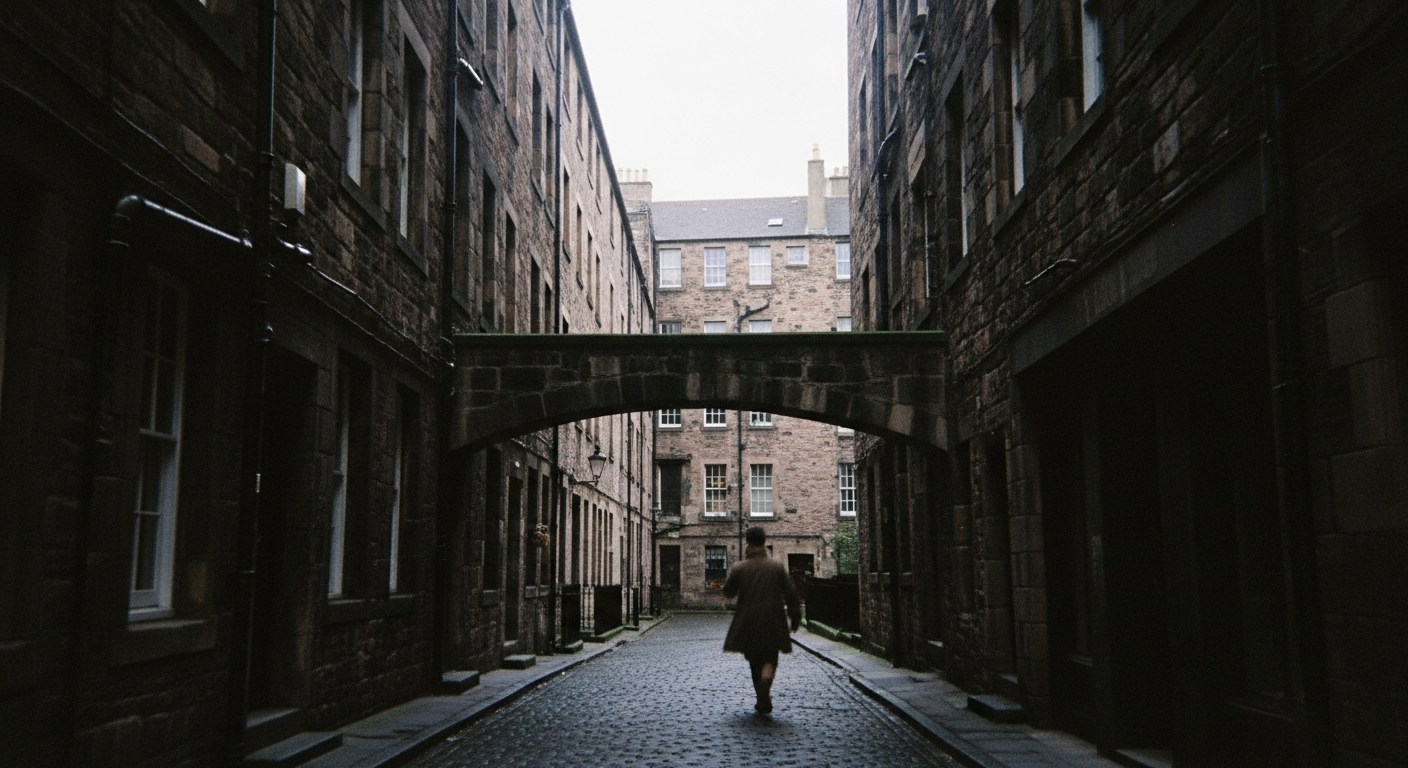
The afternoon had been unremarkable in the way that ordinary afternoons are, right up until it wasn't. The pair had worked their way down through the Grassmarket and were looping back uphill through the network of closes — Edinburgh's narrow stone passageways that have threaded between its tall tenement buildings for centuries. The weather was mild for October, overcast but dry, the streets appropriately busy. At some point, following their walking guide, they turned off a main thoroughfare and entered a close that should, according to the map, have led back toward the High Street.
The noise stopped.
Not gradually. Not as the sound of traffic fades when you turn a corner. It was simply absent — tourists, a busker, the ambient hum of a living city — gone with a completeness that Margaret would later struggle to describe accurately.
"It wasn't that it went quiet. It was that it had been quiet, as if the noise had never been there. I didn't notice it go. I just noticed it was gone."
The close opened into a small courtyard that appeared in neither woman's walking guide. The stone was weathered and dark. The surrounding buildings were different — not ruined or dilapidated, but structurally unfamiliar. The windows were small and deep-set, framed in thick wood and filled with what appeared to be blown glass: wavy, imperfect, entirely unlike modern glazing. The cobblestones underfoot were uneven in a way that felt genuinely ancient rather than restored. There was no signage. No litter. No Victorian ironwork. No television aerials.
There were people.
Four or five individuals moved through the courtyard with the unhurried ease of those going about an ordinary day. A woman carried a basket. A man in a long coat and wide-brimmed hat paused at a doorway, glanced up at the sky with an expression of mild, domestic consideration, and went inside. A young boy ran across the far end of the space and disappeared through an archway, his footsteps audible on the stone. Their clothing was heavy, dark, and layered in a way that recalled seventeenth-century paintings rather than any modern costume drama.
Not one of them acknowledged Margaret or Dorothy. The woman with the basket passed within a few feet without a glance. There was no flicker of recognition, no curious double-take. The two women from 1996 stood, apparently invisible, in the middle of someone else's afternoon.
"They were real. That's the thing I can't get past. They weren't translucent. They weren't misty or strange-looking. They were just people. Going about their day. It was we who didn't belong."
Dorothy reached out and took Margaret's arm. Neither woman spoke, gripped by what they would later describe not as terror but as a profound, weighted suspension — as if significance itself had thickened the air. Margaret tried to speak at one point and heard her own voice as though from a distance. Dorothy noted a pressure in the ears, the kind associated with descent in an aircraft.
By their mutual reckoning, they stood in that courtyard for somewhere between twenty minutes and an hour. Then Margaret looked down — she cannot explain why — and when she looked up again, the courtyard had shifted back. Same stone, same proportions, but the windows were modern, the sills painted white. A television aerial sat above one roofline. A wheeled bin rested against a wall. From beyond the close came the sound of a car horn and the cheerful, indifferent noise of contemporary Edinburgh.
The two women walked back to their hotel and sat in the bar for a considerable time. It was Dorothy who finally broke the silence.
"We were somewhere else, weren't we."
It was not a question.
Margaret spent days after returning home attempting to construct a rational framework — a film set, a historical re-enactment, a shared moment of confusion. Each theory collapsed under basic scrutiny. There had been no cameras, no modern equipment, no production barriers, no ropes or crew. And the re-enactment theory foundered on its most obvious weakness: if those figures were performers, why had two women in modern clothing standing open-mouthed in their midst prompted no reaction whatsoever?
It was Dorothy who eventually contacted a Scottish paranormal research group after reading about time slip accounts. Researchers who interviewed the women separately were struck by the quality and precision of their corroborating testimony. Cross-referencing the location with historical maps, they identified a courtyard in Edinburgh's Old Town that had been substantially altered in the late nineteenth century, with original structures demolished and rebuilt. The architectural details both women described — the window style, the cobble depth, the proportions of surrounding buildings — were consistent with how the area would have appeared in the seventeenth century. Neither woman possessed any specialist knowledge of Edinburgh's architectural history.
"I don't have a category for it. I've stopped trying to find one. I know what I saw. I know Dorothy saw the same thing. The rest of it — the explanation, the why — I've let go of that. Some things are just what they are."
Dorothy's final reflection was characteristically quieter: "I hope they were all right. I hope it was an ordinary day for them. It looked like it was."
EVIDENCE
- Dual corroborating testimony: Margaret and Dorothy gave their accounts separately, without prior detailed discussion between them. Researchers noted the precision with which their descriptions aligned — the window glass, the clothing, the absence of sound, the pressure sensation, the abrupt return to the present.
- Architectural consistency: Details volunteered by both women — window construction, cobble texture, building proportions — were independently verified against historical maps as consistent with the courtyard's pre-Victorian appearance, specifically pointing toward the seventeenth century. Neither witness had specialist knowledge that would have allowed them to fabricate these details convincingly.
- Negative evidence: A thorough review of film and television production schedules for Edinburgh that weekend produced no record of any shoot in the relevant area. No re-enactment events were documented in the Old Town on that date.
- Contextual pattern: Edinburgh's Old Town has generated a small but documented body of comparable time slip accounts, the majority clustering in the same area and featuring the same characteristic sudden silence as an onset marker.
- Wider phenomenon: The account shares structural features with the 1901 Versailles incident, widely considered the most thoroughly documented time slip case on record, including: cessation of ambient sound, anomalous quality of light, witnessing of historically-dressed figures who do not acknowledge observers, and abrupt return to the present moment.
FOX'S ANALYSIS
Right. Let me get my notebook out for this one, because — and I say this as a fox who has seen some things, including the inside of an alien examination suite that was, I want to be clear, not calibrated for my dimensions — this case is genuinely, stubbornly compelling.
Let's start with the witnesses, because witnesses are everything. Margaret and Dorothy are not, to deploy the technical investigative term, cranks. A pharmacist and a retired schoolteacher on a civilised weekend break in Scotland are not your typical paranormal-experience demographic. These are women who count pills for a living and correct children's grammar for sport. If Margaret says those windows had blown glass and Dorothy independently says the same thing, and it turns out she's right about seventeenth-century Edinburgh architecture without knowing anything about seventeenth-century Edinburgh architecture — well. That's not nothing. That's actually rather a lot.
I'll be honest with you: the corroborating architectural detail is where this case gains serious weight with me. Anyone can describe figures in old-fashioned clothes. But the specific type of glass? The cobble depth? The absence of Victorian ironwork? That's either extraordinarily lucky guessing, a level of historical research that two women on a city break somehow found time to do, or — and here's where my ear twitches — it's because they actually saw it. You could say the whole thing is a real pane to explain away. And I stand by that.
The separation between the women before they gave their statements is also critical. This isn't a case where one witness has contaminated the other's recollection. The details aligned without the two women sitting down and getting their story straight. In my experience — and I've interviewed everyone from alien abductees to a man in Stoke-on-Trent who claimed his lawnmower achieved sentience — that kind of independent corroboration is very difficult to manufacture accidentally. You could call it a timely coincidence, but I don't think it is.
Now. Sceptic hat, as required by professional standards. Could this be a shared neurological event? Some form of simultaneous temporal lobe episode producing highly similar hallucinations? Theoretically possible. Extraordinarily unlikely without any prior history in either woman, any triggering condition, or any subsequent recurrence. Could they have wandered into some unusual atmospheric pocket — low-frequency sound, unusual air pressure, proximity to underground vaults — that produced a dissociative episode? Edinburgh's South Bridge vaults do create unusual environmental conditions. I don't dismiss it. But I'd like to see the physics that makes two women independently hallucinate period-accurate architectural glazing.
The thing that gets me — right between the ears, and I have very good ears — is Dorothy's final comment. "I hope they were all right." That is not the remark of someone who has confected a ghost story. That is the remark of a woman who saw people going about their lives and retained a very human concern for their wellbeing. That level of emotional texture is extraordinarily hard to fake, and I've met a lot of people who've tried. Dorothy struck a chord there. A very timeless one.
Edinburgh itself is worth noting as a variable. This city is geologically, architecturally, and historically stratified in a way that is genuinely unusual. Medieval closes sit on top of buried streets. Georgian streets sit on top of medieval ones. The underground vaults are practically a separate city. If there is anywhere in Britain where the past presses physically close to the present, it is here. Whether or not you believe in location memory — the idea that places can retain some imprint of their history — Edinburgh is the kind of city that makes the hypothesis feel less absurd than it probably should.
I take this one seriously. Seriously enough that if I'm ever in Edinburgh, I'm walking every close in the Old Town. With a notebook. And my good shoes. And possibly a very long scarf, because apparently time travel comes with