QUIRK REPORTS — OFFICIAL CASE FILE
Case Number: QR-2026-17334
📰 SOMETHING WICKED THIS WAY GLIDES: THE FLATWOODS MONSTER AND THE NIGHT WEST VIRGINIA LOOKED UP
Classification: Strange Creature / Unidentified Aerial Object / Physical Effects Case
Date of Event: 12 September 1952
Location: Braxton County, West Virginia, USA
Primary Witness: Eugene Strickland (name changed)
Total Witnesses: 7 (at scene) + 2 corroborating independent accounts
This report is based on documented paranormal accounts. Names and identifying details have been changed to protect those involved.
WITNESS STATEMENT
The evening of 12 September 1952 began without distinction in the rolling hill country of Braxton County, West Virginia. A group of local boys had been playing on the school grounds at Flatwoods when one of them noticed something extraordinary crossing the sky — a bright, pulsing object moving with a deliberate, unhurried arc before appearing to descend onto a hillside at a nearby farm. It was not a plane. It was not behaving like any meteor any of them had knowledge of. It came down, and it stayed down.
Among those watching was Eugene Strickland, seventeen years old and already serving in the National Guard. He was joined, as word spread quickly in the way that words do in small communities, by a local woman here called Miriam Garrett, the farmer's mother, a practical and levelheaded woman in her thirties who had watched the object descend herself and did not dismiss what the boys were telling her. Miriam agreed to accompany the group up the hill. She brought a torch. One of the party had a dog. There were seven of them in total as they set off into the September dark — energised, curious, and not yet frightened.
The dog ran ahead. It came back almost immediately, tail between its legs, refusing to go further.
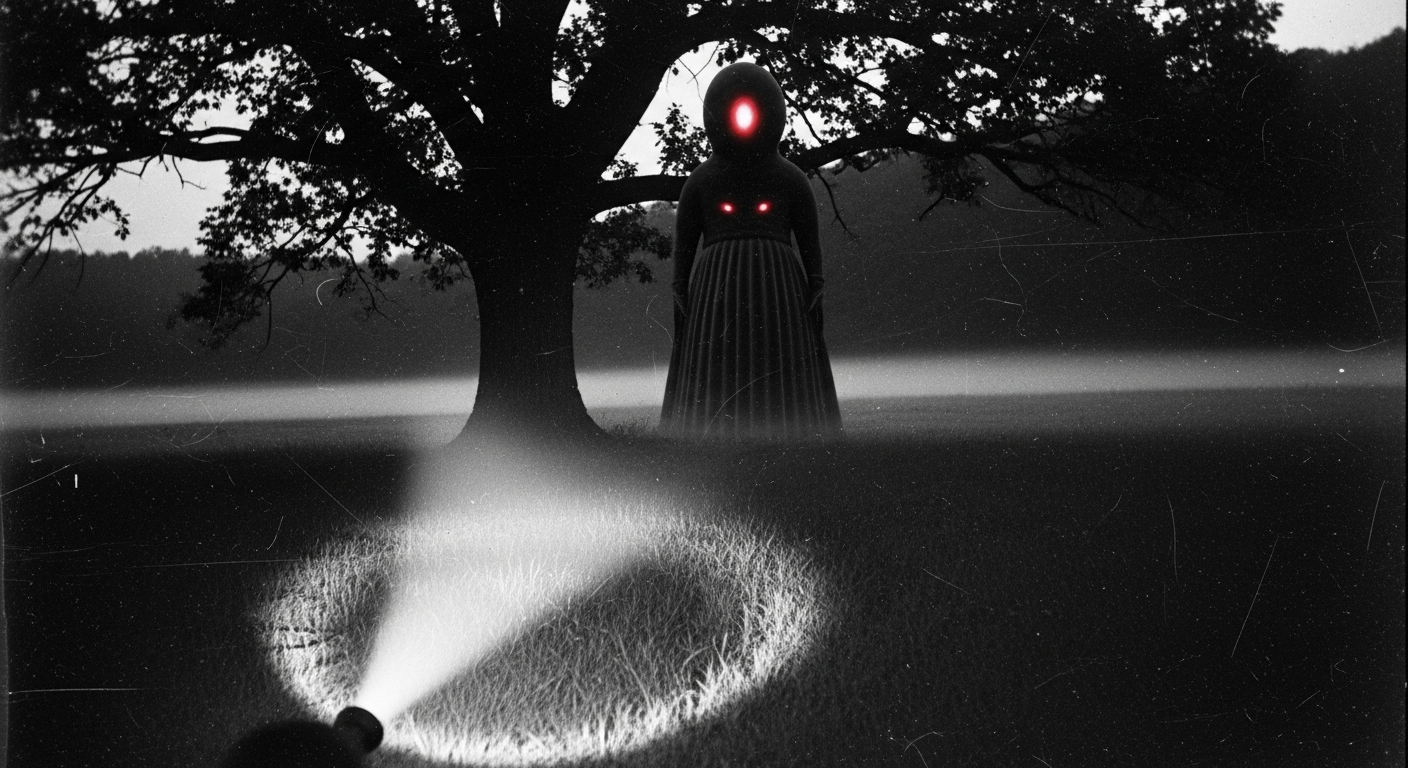
As the group crested the hill, the air changed. A thick, acrid mist clung to the ground near a large oak tree at the edge of the meadow. The smell was described independently by multiple witnesses as metallic and burning — like overheated machinery. Eyes began to water. Throats tightened. Miriam swept her torch across the darkness and caught two points of red, glowing light, spaced far wider than any animal any of them recognised.
What stepped — or rather, did not step — into the torchlight was beyond immediate comprehension. The figure was upright. It towered between ten and twelve feet in height. Its lower body appeared encased in a dark, pleated, ridged structure, like armoured folds or a vast mechanical skirt. Above this sat a rounded, bulbous head, oversized and unreadable. The face glowed — crimson, or deep orange, witnesses varied slightly in the telling — with a light that appeared to come from within rather than be reflected from without.
And then it hissed. Not the warning of an animal. Something mechanical in the sound, witnesses said later. Something that did not come from a throat.
Miriam Garrett screamed. Eugene Strickland, a trained young Guardsman, did not reach for a weapon — he said later that in that moment, a weapon felt beside the point. The figure began to move toward them, not walking, not running, but gliding — a smooth, hovering progress that removed the last rational handhold any of them were clinging to. The group ran. All seven of them, without discussion or decision, ran back down that hill and did not stop until they reached the farmhouse.
The physical aftermath was severe and well-documented. Miriam Garrett vomited repeatedly through the night. Strickland suffered a burning sensation in his nose and throat that persisted for days. Several of the boys developed skin irritation and throat inflammation requiring medical attention. One of the younger children suffered convulsions. A local physician documented these symptoms — a detail that distinguishes this case from encounters that leave no trace beyond memory.
A local reporter, here called Richard Haslam, arrived the following morning and interviewed witnesses separately, before they had opportunity to coordinate their accounts. The consistency he found across those independent testimonies — the size, the red face, the gliding motion, the acrid mist, the hissing — was striking enough that he filed the story nationally within days. It ran during a summer already saturated with UFO reports following the celebrated Washington D.C. overflight incidents of 1952.
The naturalist and researcher Ivan Sanderson visited the site shortly after and found physical evidence on the hillside consistent with an object having rested there: disturbed earth, a flattened circle, and an oily residue on the grass. He documented the witness symptoms and suggested in print that the atmospheric mist and the creature's apparent propulsion method may have been biochemically related.
Two independent corroborating accounts were also logged that same evening: a farmer two miles away reported a bright, low-moving light that disturbed his livestock, and a family on the other side of the county filed a separate account of a circular luminous object descending into treeline at approximately the same time the Flatwoods group were climbing the hill.
Miriam Garrett gave interviews for decades with a consistency that impressed those who spoke with her — no embellishment, no performance, no retreat. She said, plainly, that she could still smell it sometimes on certain mornings without knowing why.
Eugene Strickland spoke of the encounter less as the years passed — not from doubt, but from exhaustion. In an interview with a researcher in the 1970s, he reflected on what had stayed with him most:
"Things that size don't need to chase you. That's what I keep thinking about, all these years later. It didn't need to chase us. But it came anyway."
EVIDENCE
- Physical symptoms: Multiple witnesses suffered nausea, vomiting, throat inflammation, skin irritation, and in one case convulsions. Documented by a local physician at the time.
- Atmospheric effects: Acrid, metallic-smelling mist reported independently by multiple witnesses at the site before the creature was observed.
- Site traces: Ivan Sanderson documented disturbed earth, a flattened circular area, and an oily residue on the hillside grass consistent with an object having rested there.
- Animal behaviour: The dog with the group refused to continue up the hill and returned in evident distress — consistent with animal sensitivity to unusual stimuli.
- Independent corroboration: Two separate unconnected accounts filed the same evening reporting aerial objects in the same area at approximately the same time.
- Witness consistency: Accounts taken separately by Haslam before witnesses could compare notes showed strong alignment on key descriptive details.
- Long-term witness reliability: Miriam Garrett maintained a consistent account without embellishment or retraction across decades of interviews.
FOX'S ANALYSIS
Right. Let me put my flat cap on straight and talk to you about the Flatwoods Monster — because this case, friends, is not a case you bat away with a barn owl and a shrug.
I'll deal with the sceptical explanation first because it deserves the respect of a direct refutation rather than a dismissive tail-flick. Yes, barn owls have large, reflective eyes. Yes, they hiss. Yes, caught in torchlight on a dark hillside, a barn owl can give a person a jolt. I once startled a barn owl in rural Ohio and it gave me a fright I won't be forgetting quickly — though in fairness, anything gives me a fright that's perched at eye level on a fence post when I'm only three and a half feet tall. But here's the thing: a barn owl does not cause children to require medical attention. A barn owl does not leave oily residue in a flattened circle in a meadow. A barn owl does not make a National Guardsman feel that reaching for a weapon is philosophically beside the point. And a barn owl — I cannot stress this enough — is not twelve feet tall. You might say the owl theory is a hoot, but it simply doesn't fly.
What actually impresses me here, and I've filed enough reports to know what genuine cases feel like, is the layered corroboration. You've got seven witnesses on the hill. You've got two independent accounts from different parts of the county on the same evening. You've got documented physical symptoms reviewed by a physician. You've got Ivan Sanderson — not a tabloid man, a serious naturalist — finding site evidence consistent with the story. And you've got Miriam Garrett, decades later, still smelling something she can't name. That's not a woman performing a ghost story. That's a woman carrying something real.
Eugene Strickland's final quote is the one that keeps me up at night, and I say that as someone who already has trouble sleeping ever since a certain extraterrestrial incident that I won't go into here except to note that it was deeply undignified and the probe was not fox-sized. Strickland isn't saying the creature was terrifying because of its appearance. He's saying it was terrifying because it chose to move toward them. Intent. That's what he's describing. Whatever was under that oak tree had intent. And that, my friends, is far scarier than any monster that's simply large and hisses. You could say the whole encounter was truly... ground-breaking. The flattened grass certainly was.
My reporter's nose — and it's a good nose, very sensitive, occupational asset — tells me this case is the real thing. Not necessarily in the sense that I can tell you what the Flatwoods Monster was. I cannot. But I can tell you with confidence that seven people went up a hill in West Virginia in 1952 and encountered something that left marks on the ground, marks in their lungs, and marks in their memory that none of them could shake for the rest of their lives. That's not hysteria. That's a case file.
What was it? A scout from a larger craft using some form of propulsive technology that contaminated the local atmosphere? A genuine non-human entity? Something even further outside our current taxonomy? I don't know. But I know what it wasn't. It wasn't a barn owl. And it wasn't nothing.
CREDIBILITY RATING
⭐ 8.5 / 10
Reasoning:
- Multiple witnesses (+2): Seven present at the scene. Accounts collected separately before witnesses could compare notes show strong descriptive consistency.
- Physical evidence (+2): Documented medical symptoms, site traces found by a credentialed investigator, atmospheric effects. This is one of the better-evidenced creature cases in the American record.
- Independent corroboration (+1.5): Two separate unconnected reports filed the same evening from different locations in the county.
- Long-term consistency (+1): Primary witness Miriam Garrett maintained her account across decades without embellishment or retraction.
- Emotional authenticity (+1): Strickland's account in particular has the texture of lived experience rather than constructed narrative. His observation about the creature's intent is not a detail anyone inventing a story would choose.
- Slight deduction (-0.5): No photographs, no recovered physical material from the object itself. The case cannot be rated higher in the absence of any direct material evidence of the craft or creature beyond site traces.
- Barn owl theory deduction: 0. The barn owl theory does not merit a deduction from witness credibility. It merits a deduction from the credibility of people who propose it without reading the case file properly.