QUIRK REPORTS — OFFICIAL CASE FILE
Case Number: QR-2026-73465
Title: HOUND OF HELL OR SHUCK OF LUCK? THE GLOWING-EYED GIANT THAT STALKED SHUCKLAND LANE
Classification: Strange Creature / Cryptid / Folkloric Entity
Date of Encounter: 14 November 1893 (primary); recurring sightings, c.1891–1901
Location: Shuckland Lane crossroads and surrounding lanes, Northrepps, Norfolk, England
This report is based on documented paranormal accounts. Names and identifying details have been changed to protect those involved.
WITNESS STATEMENT
Gerald Ashworth, a forty-one-year-old farmhand employed on a parish landholding near Northrepps, was a man unremarkable by reputation in the best possible sense — steady, unsentimental, not given to drink or fancy. It was precisely this quality that gave his account, recorded meticulously by the local vicar Reverend Clive Pearce in the weeks following the incident, its considerable weight among the community.
On the evening of 14 November 1893, Ashworth was returning from Cromer by cart, his horse — an aged grey named Merchant — carrying him through the deeply banked lanes of north Norfolk in near-total darkness. He estimated the time at between half past eight and nine in the evening. He was approximately two hundred yards from the crossroads on Shuckland Lane when Merchant stopped without warning.
"He didn't shy. He didn't rear or bolt. He stopped, as though he had walked into a wall, and he would not move. I could feel him shaking beneath the boards."
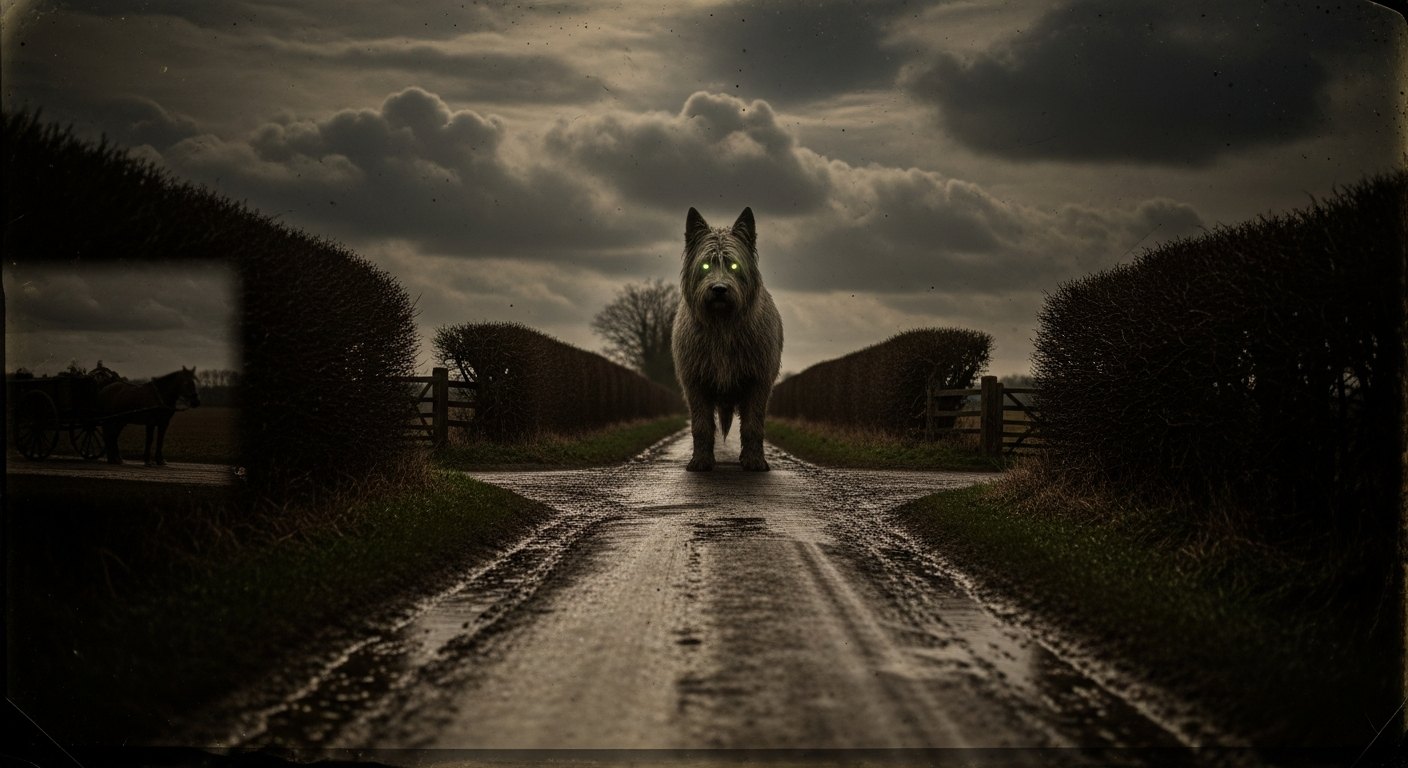
Ashworth dismounted to inspect the road. He found no rut, no ditch, no obstruction. Instead, at the crossroads thirty feet ahead, he saw it: a creature of enormous size, described as resembling a dog scaled to the proportions of a pony, covered in long, rough black fur. It stood motionless at the centre of the crossroads. Its eyes, he told Pearce, were the most disturbing feature of all.
"They gave off a light — not a reflected light, as a cat's eye will catch a lantern — but their own light, yellowish-green, and large. The size of a hen's egg, each one. It did not growl. It did not move. It looked at me."
Ashworth remained frozen, incapable of determining how much time passed. Then, without any visible crossing of the ground between, the creature was no longer at the crossroads. It was beside him — to his left, between him and the hedgerow — without having been observed to move at all.
"I had not seen it cross the ground between us. It was at the crossroads, and then it was beside me, and I had not seen it come."
Unable to flee, Ashworth turned the violently trembling cart and began the return journey. For an estimated quarter of a mile — to the turning for the Overstrand road — the creature kept pace beside the cart, its great head level with Ashworth's own, its glowing eyes fixed steadily forward, never once turning toward him. Then it was simply gone. He did not see it leave.
Ashworth did not arrive home until after midnight. His wife found him in the barn with Merchant, both visibly distressed. He could not eat that night nor the following morning, and by the second day had developed a severe fever that confined him to bed for eleven days. The attending physician could identify no cause.
Reverend Pearce, rather than dismissing the account, began gathering corroborating testimony. Within three weeks, he had collected statements from four additional witnesses covering encounters in the same area across the preceding eighteen months. A widow, Mrs Dora Hallet, had observed a massive black animal standing motionless over her dog kennel, her own dogs pressed silently against the back wall. A seventeen-year-old delivery boy, Frederick Crane, had encountered the same creature near the mill pond in early 1892 — identical in every particular — and had run, told his employer, been laughed at, and said nothing since. Most strikingly, retired coastguard Thomas Mull had watched the creature on the cliff path above Overstrand on a summer evening, observed it for several minutes, and then watched it step over an eighty-foot cliff edge. He went to look. The beach below was empty.
"It wasn't alive the way things are alive. It was present the way a storm is present."
Pearce published a summary in the 1894 parish record, cautiously noting that the accounts, delivered independently by individuals of varying background and temperament, agreed in all principal details and "strongly suggest they describe a genuine phenomenon, the nature of which remains unclear." Gerald Ashworth never again used Shuckland Lane crossroads after dark. In a follow-up conversation with Pearce in 1901, he said, quietly: "Whatever it was, it did not belong to this world. I am certain of that. I wish I were not."
EVIDENCE
Physical and Circumstantial Evidence
- Ashworth's illness: An eleven-day debilitating fever following the encounter, with no medically identified cause. This is consistent with a pattern documented by Norfolk folklorist Edith Barker in 1947, who noted no fewer than eleven Shuck encounter cases involving subsequent fever, exhaustion, or temporary partial blindness in primary witnesses.
- Animal behaviour: Multiple accounts record the abnormal behaviour of domestic animals — Merchant the horse trembling to the point of shaking the cart; Mrs Hallet's dogs pressing silent into their kennel and one permanently losing its nerve. Animal distress responses are frequently noted as among the more reliable indicators in anomalous encounter cases.
- Reverend Pearce's archive: Pearce's notes and compiled witness statements were deposited in the Norfolk County Archive, providing a primary documentary record. His 1894 parish summary further circulated among clergy and later reached the attention of early 20th-century folklore scholars.
- Five independent corroborating witnesses: Ashworth, Hallet, Crane, Mull, and at least one additional unnamed witness, all describing the same entity in the same location cluster, with no recorded contact between them prior to Pearce's investigation.
- The cliff incident: Thomas Mull's account of the creature vanishing over an eighty-foot drop with no trace on the beach below provides a particularly stark data point that resists conventional zoological explanation.
Contextual Documentation
- Black Shuck encounter tradition documented in East Anglia from at least the 16th century in written records, with oral tradition extending further.
- Barker's 1947 compiled study of Shuck accounts, noting the persistent illness pattern across eleven cases.
FOX'S ANALYSIS
Right. Let me start by saying that as someone who has personally experienced an unwanted close encounter of the probing kind, I have considerable sympathy for Gerald Ashworth. A massive uninvited creature appearing beside you in the dark, apparently indifferent to your existence — I know the feeling, Gerald. I know it intimately.
But let's set my baggage aside and look at this one properly, because this case is genuinely one of the strongest in the Quirk Reports archive for its period.
The first thing that strikes me as a reporter is the source pipeline. You've got Reverend Pearce, a methodical vicar with a documentarian's instinct, who wasn't running around collecting ghost stories for his own amusement. He had a professional and theological interest in being careful. When a man like that starts quietly gathering accounts, deposits them in a county archive, and publishes a measured summary in the parish record, that's not folklore — that's field journalism. Frankly, Reverend Pearce would have made a decent reporter. He could have had a column. Pearce Investigates. I'd have read it.
The consistency across five independent witnesses is, to use the technical term, not nothing. The rough black fur, the pony-scale size, the self-luminous yellowish-green eyes, the characteristic stillness — these details didn't travel between the witnesses before Pearce collected them. Crane hadn't spoken of his encounter since his employer laughed at him in 1892. Mrs Hallet was a widow on a smallholding. Mull was a retired coastguard on a cliff path in summer, geographically distinct from the lane encounters. These people weren't comparing notes at the pub. And yet the description is, to borrow Pearce's phrase, consistent in all principal details.
Now, am I going to tell you this was a supernatural hellhound of Anglo-Saxon origin stalking the lanes of Norfolk? No. I'm a sceptic. I take my scepticism seriously. But I'm also a reporter, and a reporter's job is to ask: what explains the data? The data includes a horse refusing to move and trembling violently. It includes five dogs pressing silent to the back of a kennel. It includes an eleven-day fever in a previously healthy forty-one-year-old man with no identified cause. It includes a creature that appears to teleport thirty feet instantaneously and descend an eighty-foot cliff without a trace. You know what doesn't explain that data? A big black dog got loose from a farm.
Could there be a natural large canid involved in some of the sightings? Possibly. Norfolk had its share of large working dogs. But the light-emitting eyes — and I want to be clear, multiple witnesses are independently describing self-luminous eyes, not eyeshine — the apparent teleportation, the cliff disappearance, and the associated illness pattern push this well outside the range of any known animal. Unless someone has been breeding Labrador-storm hybrids in Suffolk, which, knowing the British countryside, I wouldn't entirely rule out.
The illness pattern documented by Barker across eleven cases is, for me, the thread that makes this case genuinely unsettling rather than merely compelling. Psychosomatic response to extreme fear is a real phenomenon — I'm not dismissing it. But eleven documented cases showing the same post-encounter syndrome, including Ashworth's eleven-day fever? That's a pattern. And patterns, in this line of work, are the closest thing we get to a smoking shotgun.
What I find most affecting — and I don't say this lightly, because I'm a fox in a flat cap who once filed a story from inside a hedge — is Ashworth's 1901 follow-up. Eight years later. He's had time to rationalise, to minimise, to construct a comfortable explanation. Instead, he says: "It did not belong to this world. I am certain of that. I wish I were not." That's not a man who enjoyed the story he was telling. That is a man who would have given a great deal to have a different one.
I suppose you could say the evidence is pretty... Shucking compelling.
I'll see myself out.
Actually, wait — one more. Merchant the horse stopped dead on a dark lane and refused to move for an entity of unknown origin. Which just goes to show: you can lead a horse to Shuck, but you cannot make him drink.
Now I'll see myself out.
CREDIBILITY RATING
Rating: 8 / 10
Reasoning:
- Multiple independent witnesses (5+): Significant. No evidence of prior contact or shared storytelling between witnesses before Pearce