QUIRK REPORTS — OFFICIAL CASE FILE
Case Number: QR-2026-48553
Title: PAW BLIMEY: THE BLACK BEAST OF CANNICH AND THE PHANTOM PREDATOR TERRORISING THE HIGHLAND GLENS
Classification: Cryptid / Anomalous Animal Encounter
Date of Event: November 14, 1994 (primary sighting); broader incident cluster October 1994 – March 1995, with follow-up reports through 2001
Location: Cannich, Inverness-shire, Scottish Highlands, United Kingdom
Witness: Callum Dreich (primary); multiple corroborating local witnesses
This report is based on documented paranormal accounts. Names and identifying details have been changed to protect those involved.
WITNESS STATEMENT
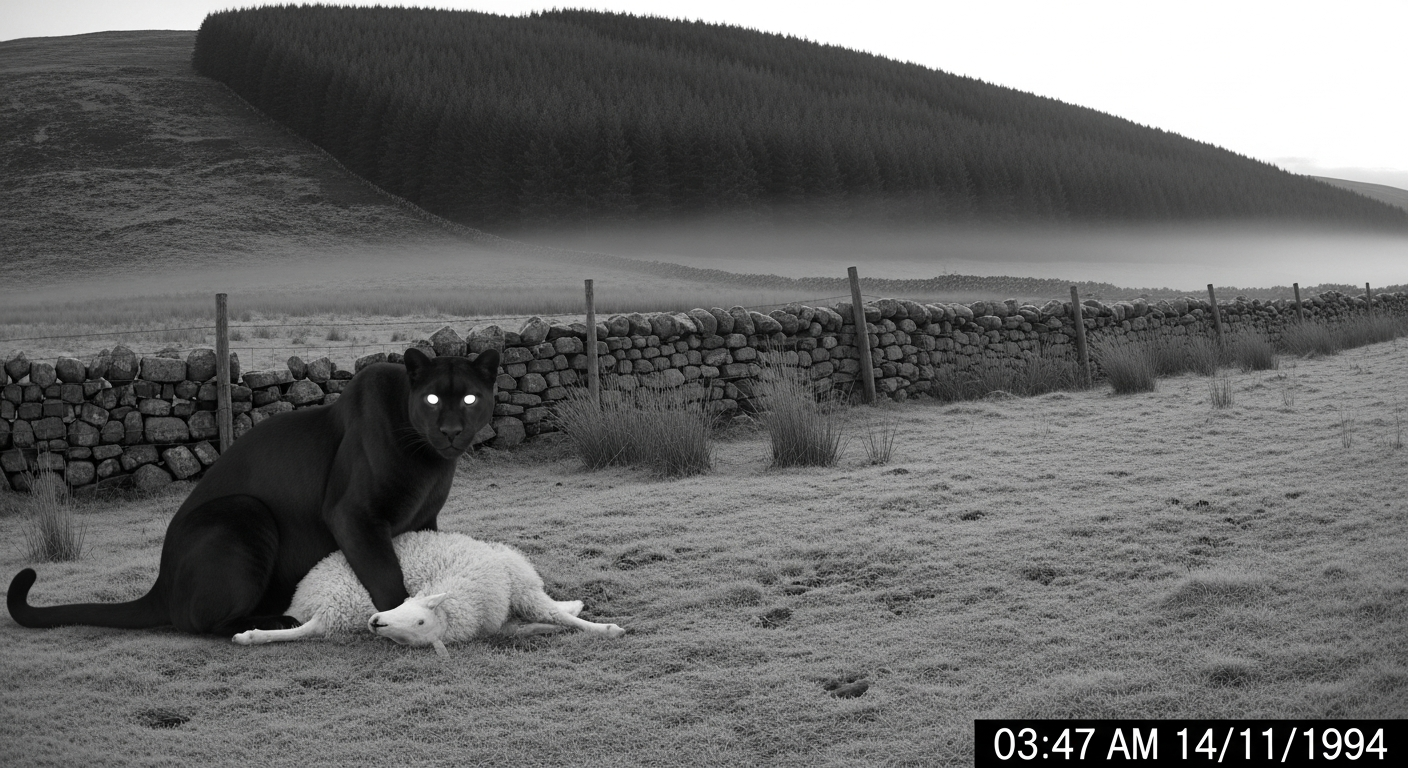
Callum Dreich had farmed the same stretch of upland pasture above Cannich for the better part of twenty years when the killings began. The first victim — a ewe — was discovered near a stone dyke at the edge of his top field on a Tuesday morning in late October 1994. Dreich, a man with three decades of experience raising sheep in difficult Highland terrain, knew immediately that this was no dog attack, and no fox. The carcass had been opened with a single, powerful strike across the flank. The flesh had been consumed with what he could only describe as clinical efficiency. The head was intact. The spine had been snapped.
"I thought fox at first," Dreich later told investigators. "But no fox did that. No dog did that either. I've kept sheep thirty years. I knew it was something else."
He filed a report with the local agricultural office. Then a second sheep was killed. Then a third. Over three weeks, four animals died across three separate Cannich-area farms, each displaying the same signature: powerful, clean kills, evidence of a large predator feeding at leisure, and — pressed deep into the surrounding peat — large, round, clawless paw prints.
It was a neighbouring shepherd, Fionnuala Begg, who first made a plaster cast of the tracks she found near a forestry plantation above her employer's land. The cast measured nearly four inches across, round, with four toe impressions and no claw marks — the unmistakable profile of a retractile-clawed animal. A cat. A very large cat. She brought it into the village with trembling hands.
By November, the talk in the post office and hotel bar had moved from disbelief to nervous laughter to the quieter admissions that always follow — someone's cousin had seen something on the forestry road, old Murdo from up the glen had lost three lambs and found the remains forty metres from where he'd left them. The Highland grapevine was humming.
Then came the fourteenth of November.
Dreich drove his Land Rover to the top field just before dusk, as he did most evenings, to check on his flock. The sky had turned the colour of a bruise. The temperature had dropped sharply. He parked at the gate, walked the field edge, and was halfway along the dry-stone dyke when he saw it.
The animal was crouching at the far end of the field, approximately a hundred and twenty metres away. It was black — not dark brown, not dark grey, but a deep, absorptive black that seemed to swallow what remained of the fading light. Comparing it later against the dry-stone wall beside which it sat, investigators estimated the creature stood roughly two feet at the shoulder and stretched four to five feet in body length, excluding a tail described as long, thick, and curved slightly upward at the tip. The size and build of a large Labrador, but moving — when it finally moved — with something no Labrador has ever possessed: the low, fluid, utterly unhurried grace of an apex predator.
For thirty seconds — though Dreich admitted time had become unreliable — the animal simply watched him.
"It didn't run," he said. "It just sat there, looking at me. Right in the eyes. Like it was deciding something. Like it wasn't afraid at all."
Then the creature turned, stepped over the dyke in a single motion, and disappeared into the darkness of the plantation beyond. Dreich found the same round, clawless prints pressed into the soft earth at the site. He photographed them with a disposable camera he kept in the Land Rover. He did not sleep much that night.
Sightings and livestock losses continued sporadically through the winter and into 1995. In February of that year, a local stalker discovered a partially consumed red deer carcass in a gully near the Affric river — the animal had been dragged approximately twenty metres from its kill site, and the consumption pattern matched the profile of a large felid feeding undisturbed. A hillwalker photographed what appeared to be a large black feline resting on a rocky outcrop above Loch Mullardoch in March 1995. Zoomed and enhanced, the image is, by all accounts, striking — unmistakably feline in posture and proportion.
The sightings slowed after 1995 but never entirely stopped. In 2001, a clear set of prints was found in snow near the village itself — less than a mile from Dreich's original field. He retired from farming in 2008, and in a final interview with a local Highland newspaper, he was asked whether he believed the animal was still out there.
"I never had any doubt," he said. "The question was never whether it existed. The question was always whether anyone official would ever admit it."
EVIDENCE
- Physical paw print cast: Recovered by shepherd Fionnuala Begg from peat near a forestry plantation. Measured approximately four inches across, round, four toe impressions, no claw marks — consistent with a retractile-clawed felid of substantial size.
- Photographic evidence (paw prints): Dreich photographed prints at the site of his primary sighting using a disposable camera.
- Kill site analysis: Four sheep across three farms displaying consistent signature kills — single powerful strike, efficient consumption, intact skulls, snapped spines. Consistent with large predatory felid methodology.
- Deer carcass: Partially consumed red deer found in a gully near the Affric river, February 1995. Dragged approximately twenty metres from kill site. Consumption pattern — shoulders and haunches preferentially eaten, ribcage largely intact — consistent with large felid feeding undisturbed.
- Scat samples: Recovered near the plantation during the investigation period and submitted for analysis.
- Photographic evidence (animal): Image taken by a hillwalker above Loch Mullardoch, March 1995. Shows a large, black animal resting on rocky outcrop approximately eighty metres from the camera. Described by reviewers as unquestionably feline in posture and proportion.
- Wildlife biologist report: Dr. Alistair Murchie conducted a two-week systematic site survey in late 1994/early 1995. His report, submitted to a wildlife research group in early 1995, concluded that all physical and testimonial evidence was consistent with the presence of a large melanistic felid — most likely a black leopard — operating across a territory of roughly forty square miles.
- 2001 snow prints: Clear paw print set recovered in snow near Cannich village, less than a mile from the original site of the 1994 livestock killings.
- Multiple independent witnesses: Cluster of corroborating accounts from local farmers, a shepherd, a stalker, and a hillwalker across the investigation period.
FOX'S ANALYSIS
Right. Let me get my notepad out, adjust my flat cap, and take a good long look at this one — because the Beast of Cannich is, frankly, one of the more compelling cases to land on my desk in a while, and I say that as a fox who has sat across the table from people claiming their kettle was haunted by the spirit of a disappointed Edwardian butler.
First things first: this is not, technically speaking, a paranormal case in the traditional sense. We are not dealing with interdimensional entities, glowing orbs, or — shudder — beings of ambiguous extraterrestrial origin with an unhealthy interest in anatomy. What we are dealing with is a large, physical, flesh-and-blood predator that almost certainly should not be living wild in the Scottish Highlands — and yet, by every measurable indicator, apparently was.
And look, I'll be honest: Britain's phantom big cat phenomenon is the one cryptid category that makes my reporter's nose twitch with something dangerously close to actual belief. Why? Because unlike your average cryptid case, this one comes with bones. With casts. With scat samples. With kill sites that wildlife biologists look at and go quiet. You might say the evidence is... paw-sitively compelling. (I'm not sorry. I am never sorry.)
The 1976 Dangerous Wild Animals Act is, in my view, the Rosetta Stone of the British big cat mystery. Release dates, people. Exotic pet owners who didn't fancy the paperwork just... opened the door. Into the British countryside. Where there are forty square miles of dense Highland forestry and a buffet of sheep and deer. Was anyone thinking this through? I've seen better forward planning from a fox who buries a sandwich in autumn and forgets where he put it. (That fox was me. The sandwich was tuna. We don't talk about it.)
What strikes me most about Callum Dreich's testimony is the quality of its detail and the absence of embellishment. He is not a man who wants to be believed — he is a man who wants to be accurate. The account of the animal simply watching him, unhurried and unafraid, is genuinely chilling and rings absolutely true to documented leopard behaviour. These are not skittish animals. They are patient, territorial, and deeply unbothered by the existence of humans.
The corroboration here is exceptional for a case of this type: multiple independent witnesses, a plaster cast, a professional wildlife biologist's written report, kill site analysis consistent across multiple farms, a deer carcass with drag marks, and photographs that zoologists declined to definitively dismiss. That's not nothing, folks. That's actually rather a lot.
My only note of caution — because I was trained on scepticism along with the dad jokes — is that distance estimation in low light is notoriously unreliable, and a small number of genuinely large domestic or feral cats have, historically, triggered big cat reports. But a four-inch, clawless paw print is not a large tabby. A deer dragged twenty metres is not a large tabby. A spine-snapped sheep is absolutely, categorically not a large tabby. I've met large tabbies. They are ambitious but limited.
I'd also note that the Dangerous Wild Animals Act provides a perfectly rational, non-paranormal mechanism for this animal's presence — which actually increases my confidence in the case rather than diminishing it. Sometimes the most credible explanation is also the most unsettling one. You might say the truth was... lurking in plain sight. Like a melanistic leopard on a Highland outcrop. Like that.
The fact that official bodies have consistently declined to confirm what multiple experts have privately accepted tells you everything you need to know about institutional risk management and precisely nothing about what is actually stalking the glens above Cannich. Callum Dreich put it better than I ever could: the question was never whether it existed. The question was always whether anyone official would admit it.
They haven't. The prints in the snow in 2001 didn't care.
"It didn't run