QUIRK REPORTS — OFFICIAL CASE FILE
CASE NUMBER: QR-2026-95479
🗞️ DEATH ON REPEAT: THE PHANTOM NUN WHO WON'T REST, THE BELLS THAT RANG THEMSELVES, AND THE MOST HAUNTED HOUSE IN ENGLAND
Classification: Ghost / Spirit Manifestation — Active Haunting
Date of Events: 1929–1938
Location: Borley Rectory, Essex, England
Primary Witness: Reverend Arthur Fenn (name changed)
Report Filed By: Fox Quirk, Founder & Chief Reporter, Quirk Reports
This report is based on documented paranormal accounts. Names and identifying details have been changed to protect those involved.
SECTION ONE: WITNESS STATEMENT
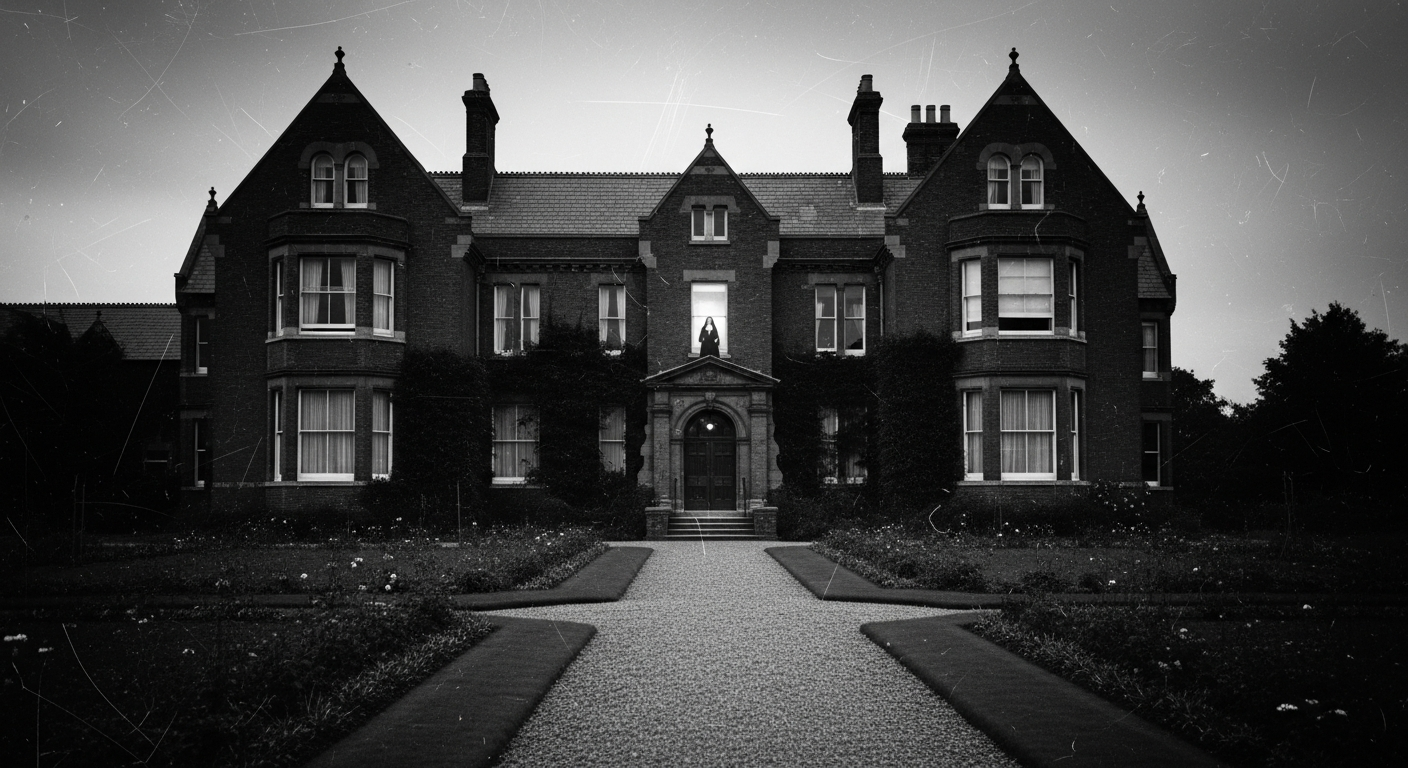
When Reverend Arthur Fenn and his family arrived at Borley Rectory in the summer of 1929, they came as reluctant tenants rather than willing investigators. The Church of England had assigned them to the large, draughty Victorian building — red brick, poorly lit, long corridors — and Fenn, a rational and devoutly Anglican man, had no particular interest in its local reputation. The locals, for their part, rarely spoke of the rectory directly. When pressed, they would lower their eyes and say only that the house had always had its troubles.
The troubles wasted no time making themselves known.
On the third night of their residence, Clara Fenn woke at approximately 2am to the sound of heavy, deliberate footsteps moving along the corridor outside her bedroom. Assuming it was her husband, she turned — and found him asleep beside her. The footsteps continued, rounded the corner at the end of the corridor, and stopped. No door opened. No further sound followed. The steps had simply ceased, as though their maker had stepped out of existence entirely. Clara told no one.
Two weeks later, the servant bells rang.
The rectory's old bell system had been non-operational for years — corroded wires, broken fixtures, thoroughly useless by any practical measure. On the evening of August 14th, 1929, all twelve bells in the kitchen passage rang simultaneously. The family rushed to the passage to find it completely empty, the bells still swinging gently on their brackets. Fenn documented the incident carefully in his personal diary, which would later become one of the most scrutinised personal records in the history of British paranormal research. His entries from this point onward chart a steady escalation: stones thrown against windows from inside the house, a woman's voice calling his name from empty rooms, his youngest daughter found in the garden in the middle of the night, sleepwalking, pointing at something none of the adults could see.
But it was the nun who became the defining presence of Borley Rectory.
Clara first saw her on a grey October afternoon — a figure in dark robes standing at the far end of the overgrown garden path, a stretch of ground locals had long called the Nun's Walk. The figure stood completely still among the long grass, face obscured. When Clara called out, there was no response. When she took three steps forward, the figure was gone. Over the following months, the nun was seen by virtually every member of the household, always near the garden, always at dusk or in low light, never communicating. One of Fenn's daughters described the apparition as very sad, like she'd lost something and didn't know where to look.
A visiting relative who had been told nothing of the previous sightings came running into the house one November evening, pale and shaking, insisting she had just seen a woman in old-fashioned dress standing in the garden, staring at the rectory windows.
The legend attached to the site offered a grim explanation. A thirteenth-century nun, it was said, had conducted a secret affair with a Benedictine monk from the monastery believed to have once stood on the same ground. When discovered, the monk was executed. The nun was bricked up alive within the walls — some versions placing her entombment within the very foundations beneath the rectory. No historical record has ever conclusively confirmed the story, but it had circulated in Borley for generations.
By 1931, Fenn had written to the Church of England in careful, measured language requesting guidance. The letter was largely ignored. What was not ignored was a national newspaper report that same year, which brought the case to the attention of paranormal investigator Harold Greer — a name used here in place of the real researcher. Greer arrived at Borley in June 1931 and conducted what he described as the most comprehensive investigation of an allegedly haunted location ever undertaken in Britain. He interviewed household members separately, installed recording equipment throughout the rectory, and spent numerous nights alone logging every sound, temperature variation, and unexplained event.
He witnessed a candlestick slide twelve inches across a mantelpiece in full daylight with no draught, vibration, or mechanical explanation he could identify. He heard footsteps in the corridor outside his room on multiple occasions and found, each time, an empty and undisturbed hallway. He recorded a cold patch in the Blue Room — a temperature drop of some fifteen degrees Fahrenheit that appeared, vanished, and on two occasions appeared to move independently of any external weather conditions.
And then the writing began.
Starting in the winter of 1931, pencilled messages appeared overnight on the walls of the rectory — cramped, uneven, appearing on surfaces that had been blank the evening before. Most were fragmentary. Several referred repeatedly to a name — Marianne — and several read as desperate pleas for help. Some appeared to respond, in disjointed fashion, to questions Greer had spoken aloud in the room the previous night. No member of the household could account for them.
I have investigated many claims in my career,
Greer wrote in his 1935 published account. I have exposed fraud in perhaps two-thirds of them. I cannot explain what I witnessed at Borley. I have tried. I am still trying.
The Fenn family left in 1935, worn down by years of disturbance. Clara later described not fear exactly, but a pervasive sense of being watched — not malevolently,
she said, but desperately, as though whatever remained in that house was in pain and had nowhere else to direct it.
A subsequent occupant, referred to here as Mr Wickes, took possession briefly in 1937 and reported equally disturbing activity within weeks. A séance organised by Wickes produced a claimed communication from the entombed nun — including, it was said, an approximate location for her remains and a prediction that the rectory would be destroyed by fire, with the truth revealed in the ruins.
In February 1939, the rectory burned to the ground. An overturned oil lamp was cited as the official cause. Several witnesses reported seeing, during the blaze, the figure of a nun standing motionless in an upper window as the flames rose around her.
In 1943, partial human remains — bones consistent with a young woman — were discovered buried in the cellars during excavation of the ruins. They were given a Christian burial. Some reported the sightings diminished afterward. Others say they did not stop at all.
SECTION TWO: EVIDENCE
Physical Evidence
- Human remains: Partial skeletal remains of a young woman discovered in the cellar ruins in 1943, consistent with the legend of the entombed nun.
- Wall writings: Pencilled messages appearing overnight on rectory walls, extensively photographed by investigator Harold Greer. Content included the name "Marianne" and repeated pleas for help.
- Bell system activity: Simultaneous ringing of twelve non-operational servant bells on August 14th, 1929, witnessed by multiple family members.
- Moving objects: Candlestick movement observed by Greer in full daylight with no identifiable mechanical cause.
Witness Corroboration
- Multiple independent witnesses to the nun apparition, including a visiting relative with no prior knowledge of the sightings.
- Greer's independent investigation corroborated household accounts across multiple categories of phenomena.
- Subsequent occupant Mr Wickes reported comparable disturbances without prior detailed knowledge of the Fenn family's experiences.
- Multiple independent witnesses reported seeing a nun's figure during the 1939 fire.
Documentary Record
- Reverend Fenn's personal diary — extensively documented, later scrutinised by researchers.
- Greer's 1935 published account of his investigation.
- Greer's photographic record of wall writings.
- Fenn's 1931 letter to the Church of England.
SECTION THREE: FOX'S ANALYSIS
Right, settle in. I've got my notebook, I've got my coffee going cold, and I have feelings about this one. Big feelings. The kind that keep a fox up at night — and I don't mean the usual "did I leave the oven on" variety.
Borley Rectory is the crown jewel of British hauntings. It's the case that paranormal researchers whisper about reverently the way journalists whisper about Watergate. And having gone through every scrap of documented evidence with a fine-tooth comb, here's where I land: this one is genuinely difficult to dismiss, and I don't say that lightly. I've spent twenty years separating the ghosts from the con artists, and Borley makes me work for it every time.
Let's start with what I love about this case, professionally speaking. You've got stratification of witnesses — a clergyman, his family, an independent investigator, a subsequent unrelated occupant, and multiple bystanders at the fire, all reporting overlapping phenomena across nearly a decade. That's not one excitable person in a draughty house. That's a pattern. And patterns are what get a reporter's ears pricked up — or in my case, quite literally pricked up, because they're on top of my head and I can't help it.
The wall writing is the detail that gets under my fur most. Pencilled messages appearing overnight, responding thematically to spoken questions, referring to a specific name — that's either the most elaborate long-form prank in Victorian-adjacent history, or it's something I don't have a tidy explanation for. I've seen hoaxes. I know what hoaxes smell like. This doesn't smell like one. It smells like Essex in November, which is admittedly also unsettling, but for different reasons.
Now — and here's where my reporter's scepticism earns its keep — I cannot fully discount the era. Greer was a man of his time, working with crude instruments and a methodology that would make a modern parapsychologist wince. The séance evidence is essentially worthless from an evidentiary standpoint. And the "fire prediction" that came true? Could easily be retconned after the fact. The rectory was an old, draughty, poorly maintained Victorian building full of oil lamps. You didn't need a ghost to predict that. You needed basic fire safety awareness and a strong dislike of Victorian architecture — which, frankly, is a legitimate position.
I'll also note: the physical remains found in 1943 are compelling but not conclusive. Bones in old foundations are, sadly, not unusual in England. You can't swing a cathedral without hitting a medieval skeleton. What is notable is the location's consistency with the legend, and the reported decrease in activity following the Christian burial — though "some reported" is doing a lot of heavy lifting there.
What I keep coming back to is Clara Fenn's description of the presence — not malevolent,