QUIRK REPORTS — OFFICIAL CASE FILE
Case Number: QR-2026-19158
DARKNESS IN THE HALLWAY: THE BLACK MONK OF PONTEFRACT AND THE SHADOW THAT WOULDN'T TAKE THE HINT
Classification: Shadow Entity / Poltergeist / Residual Haunting (Complex)
Date of Events: Summer 1966 – Spring 1968
Location: Doncaster Road, Pontefract, West Yorkshire, England
Primary Witness: Megan Griffiths (name changed)
Report Filed By: Fox Quirk, Founder & Lead Investigator, Quirk Reports
This report is based on documented paranormal accounts. Names and identifying details have been changed to protect those involved.
WITNESS STATEMENT
In the summer of 1966, a sixteen-year-old named Megan Griffiths was staying alone at her grandparents' council house on Doncaster Road, Pontefract, when the first sign arrived — not as a thunderclap or a vision, but as flour. A fine, inexplicable dusting of white powder settling silently onto kitchen linoleum, the sealed bag on the shelf entirely undisturbed. When a water board official visited the following morning, he found nothing mechanically wrong with the property and departed looking, as Megan would later recall, as though he wished very much to be somewhere else. The family told themselves it was damp. The house, apparently, had not finished introducing itself.
Over the following weeks, objects relocated themselves with quiet persistence. A pot appeared in the hallway overnight. Photographs turned to face the walls. The television changed channels independently. These were strange, but Megan's grandparents — Harold and Edna, working-class Yorkshire people of considerable fortitude — absorbed these incidents with the stoicism of people who had survived considerably worse. Then came the figure.
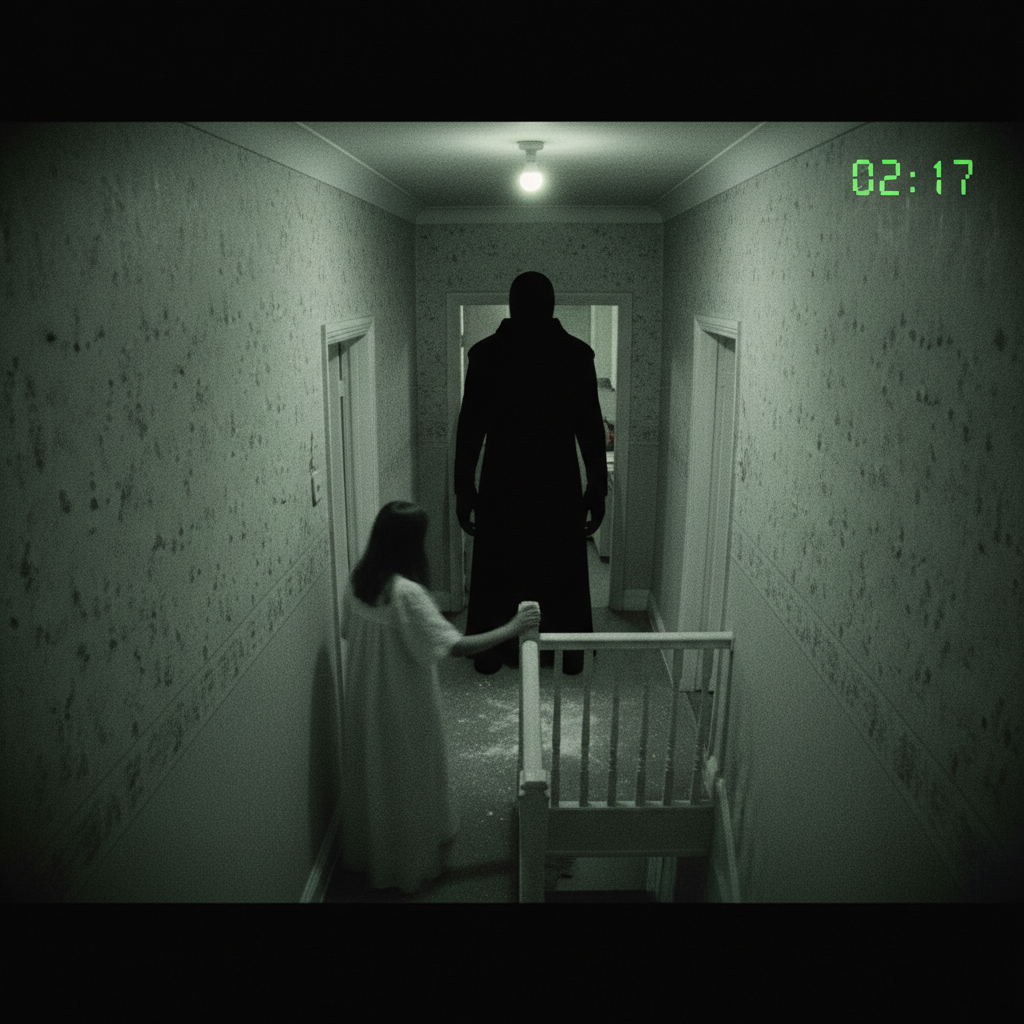
Coming downstairs late one evening for a glass of water, Megan stopped dead at the foot of the stairs. In the narrow hallway stood a shape — towering, featureless, and darker than the unlit corridor surrounding it. "It wasn't just dark," she would later explain. "It was a different kind of dark. Darker than anything. And it knew I was there." She screamed. The figure vanished. Harold conducted a thorough inspection of the hallway and found nothing. He told his granddaughter she had been dreaming. She had not been dreaming.
The activity intensified through autumn and winter of 1966. Green foam appeared in the sink without explanation. The family cat refused categorically to enter the hallway, flattening itself against the living room wall and tracking something invisible with wide, unblinking eyes. Edna's rosary was found hanging from the hallway light fitting, swaying gently. Then the entity became physical. Edna was gripped by the ankle on the stairs and fell, left with faint bruising that bore the impression of fingers. A doctor found no medical explanation.
Megan's own confrontation was worse. Reading alone in her bedroom, she watched the door open by itself. The figure stood in the frame — the same impossible height, the same absolute darkness. "It moved toward me," she recalled. "Not walking exactly. More like flowing." It stopped at the foot of her bed. Then it was gone. She slept with the light on for the remainder of her time in the house. She was not, she said, ashamed of this.
Independent investigators who visited the property documented a sideboard shifting several inches across the floor before three simultaneous witnesses, a jug of milk found cold inside a locked wardrobe, and a rhythmic knocking — described consistently as BOK BOK BOK — that moved from room to room through the night as if something was pacing. In the spring of 1968, Edna's journal recorded every painting and photograph in the house removed from the walls and placed face-down on the floor — not scattered, not damaged, but arranged with methodical, deliberate care. Harold, a man not given to admissions of fear, requested a council transfer.
The investigators had meanwhile uncovered the history beneath the estate. The land had once housed a Cluniac priory, and local records pointed to a medieval monk hanged for the rape and murder of a young girl — his body reportedly buried on the very ground where Doncaster Road now stood. The silhouette of the figure, tall and cowled, aligned with this history closely enough to earn the haunting its name: The Black Monk of Pontefract.
A priest conducted a blessing in 1967. The intensity appeared to diminish briefly. The knocking returned within a fortnight. After the family vacated, subsequent tenants reported further disturbances — not universally, but consistently enough that the house retained its reputation across decades. A book drawing on the investigators' notes and family testimony sold steadily for years after publication.
Asked in later life whether she believed in what she had seen, Megan's answer was precise: "Belief implies a choice. I saw what I saw. The choice was never mine to make."
EVIDENCE
- Physical trace — unexplained powder: Fine flour-like substance found on kitchen surfaces with no identifiable source. Water board inspection found no mechanical explanation.
- Physical injury: Bruising consistent with finger-pressure found on Edna's ankle following staircase fall. No medical cause identified by attending physician.
- Animal behaviour: Family cat persistently refused to enter the hallway and exhibited tracking behaviour toward an unseen presence — documented across multiple incidents.
- Object displacement: Multiple instances across two years, including a sideboard moved in the presence of three simultaneous witnesses.
- Locked-room anomaly: Milk jug found cold and intact inside a locked wardrobe.
- Auditory phenomena: Rhythmic knocking witnessed by multiple family members and independent investigators, consistent in character across separate accounts.
- Investigator testimony: Two experienced independent investigators with no commercial interest at the time stated this case was categorically different to others they had attended.
- Historical corroboration: Local records indicating a Cluniac priory on the site and the documented execution of a monk for violent crimes, lending potential identity to the entity.
- Post-vacancy reports: Subsequent tenants reported independent disturbances over the following decades.
- Written documentation: Edna kept a contemporaneous journal at investigators' request, capturing incidents in real time.
FOX'S ANALYSIS
Right, settle in. This one's the real deal, and I say that as a fox who has stared down everything from crop circles to creatures that allegedly emerged from the New Jersey swamp wearing what appeared to be a novelty hat. I've seen the fakers, the wishful thinkers, the people who genuinely want to believe so badly they bend every shadow into something sinister. Megan Griffiths is none of those people.
What strikes me first, notebook out, battered pen in paw, is the consistency. Two years of documented incidents. Multiple witnesses from different generations with different scepticism thresholds — Harold, an industrial man who practically had "I don't believe in ghosts" stamped on his birth certificate, was frightened enough by the end to request a council house transfer. That's not dramatics. That's a man who spent months trying every rational explanation available before conceding that something was genuinely, profoundly wrong with the property he lived in. Harold is, in my professional estimation, the most valuable witness in this case. Sceptics who change their minds are worth ten true believers.
The physical evidence is harder to dismiss than most. Bruising consistent with grip pressure on a woman's ankle. A locked wardrobe. A sideboard with three simultaneous witnesses. This isn't one person in a dark room seeing shapes. This is a pattern of escalating, physically manifest phenomena across an extended period.
Now, the historical backstory — the hanged monk, the Cluniac priory, the buried body — I hold at arm's length. Not because it doesn't fit the silhouette, but because it's exactly the kind of detail that gets embellished in retrospect, and historians have been arguing about the specifics of those records ever since. You could say the investigators were a little monk-y with the facts. I'm not saying it's fabricated. I'm saying it arrived conveniently and should be corroborated independently before being treated as settled. The haunting doesn't need the medieval backstory to be credible. It stands on its own two — terrifyingly tall — legs.
The shadow figure itself matches a classification we see consistently in the literature — what we call a Shadow Person, though "person" does feel a little polite for something that grips elderly women on staircases and looms over teenagers in the dark. The characteristic features are all here: extreme height, featureless form, darkness that appears denser than its surroundings, and — crucially — that quality Megan described as intention. Awareness. That's the detail that keeps me up at night, and I say that as a fox who already has trouble sleeping because a certain species of extraterrestrial left me with lasting lumbar issues I will not be elaborating on here.
The cat. Always trust the cat. Animals don't have an ego investment in the supernatural. They don't read ghost story books. They don't want to impress anyone at a dinner party. That cat tracked something real. End of discussion.
What I find most remarkable is Megan's final formulation: belief implies a choice. She didn't choose to believe. She chose to report what she saw, accurately, and let others make of it what they would. That kind of epistemic honesty is rarer than anything I've encountered in this field, including the alleged ghost of a sailor I once interviewed in Portsmouth who turned out to be a very committed local actor. You could say that case was a bit of a pier review.
The Black Monk of Pontefract is, in my view, one of the most thoroughly documented and compelling haunting cases in British paranormal history. It is dark business — and I mean that in ways that go considerably beyond the obvious pun.
CREDIBILITY RATING
Rating: 8.5 / 10
Reasoning: Multiple independent witnesses across a two-year period, including at minimum one committed sceptic whose position changed under direct experience. Physical evidence including medical documentation of injury. Contemporaneous written records. Independent investigator testimony from individuals with no commercial interest. Consistent animal behaviour indicating a non-psychological phenomenon. Post-vacancy corroboration from subsequent tenants. Score deducted for the impossibility of fully verifying the historical backstory and the inherent limitation that the most dramatic individual sightings rest primarily on Megan's testimony alone. Nevertheless, as cases go, this one is exceptionally well-supported.
CLASSIFICATION
Primary Classification: Shadow Entity (Type II — Corporeal Interaction)
Secondary Classification: Poltergeist Activity (Escalating / Physically Aggressive)
Tertiary Classification: Residual Haunting (Site-Specific / Historically Tethered)
Entity Designation: The Black Monk of Pontefract
CASE STATUS
Status: OPEN
Recommended Follow-Up Actions:
- Independent historical verification of Cluniac priory records and alleged monk burial site by qualified medieval historian.
- Interview compilation