
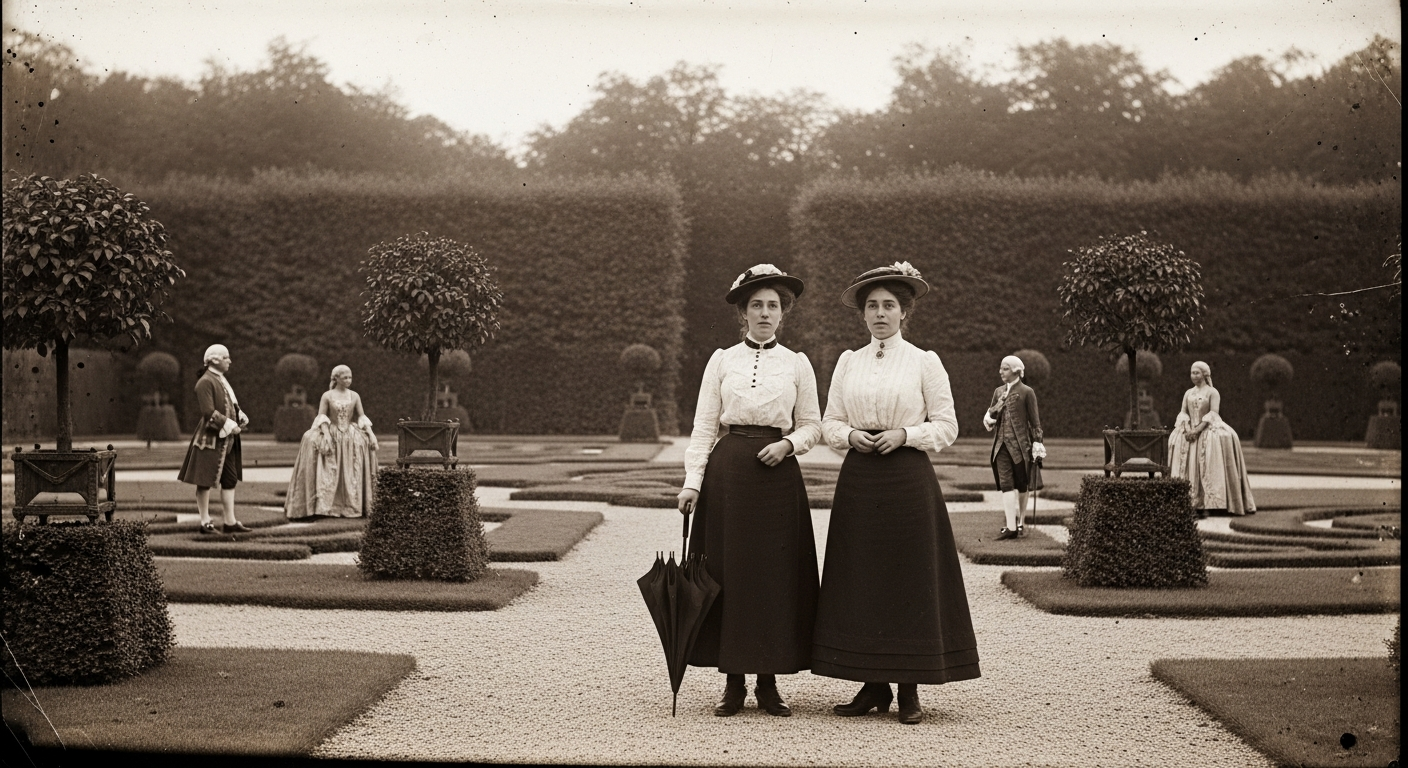
Trapped in Yesterday: The Day Two Women Walked Into 18th Century Versailles
QUIRK REPORTS — OFFICIAL CASE FILE
CASE NUMBER: QR-2026-59127
TRAPPED IN YESTERDAY: TWO OXFORD WOMEN WALK STRAIGHT INTO THE 18TH CENTURY AND LIVE TO WRITE A BOOK ABOUT IT
Classification: Temporal Anomaly — Time Slip (Witnessed, Dual Account)
Date of Event: 10th August 1901
Location: Gardens of the Petit Trianon, Palace of Versailles, France
Witnesses: Eleanor Marsh (Senior Academic Administrator, Oxford) and Dorothy Fellowes (Lecturer, French Literature, Oxford)
Report Filed By: Fox Quirk, Founder & Senior Correspondent, Quirk Reports
This report is based on documented paranormal accounts. Names and identifying details have been changed to protect those involved.
WITNESS STATEMENT
On the afternoon of 10th August 1901, two English academic women — Eleanor Marsh and Dorothy Fellowes — visited the gardens of the Palace of Versailles as part of a brief holiday following the close of the Oxford academic year. Both women were educated, intellectually rigorous, and by all accounts entirely unaccustomed to flights of fancy. What they experienced that afternoon would come to define the remainder of their lives.
The visit began without incident. The palace was duly admired, the tourists duly tolerated, and the pair set out on foot toward the Petit Trianon — Marie Antoinette's personal retreat within the broader palace grounds. It was somewhere along the path leading to the Petit Trianon's formal gardens that the world, as Eleanor would later describe it, began to go quietly, inexplicably wrong.
The crowds thinned without explanation. The ambient noise of a busy tourist attraction faded. The atmosphere itself seemed to Eleanor to have become physically heavier — "flattened," she wrote, "as though the colour and vitality of the place had been slowly drained away." She felt faintly nauseous, oddly detached, as though observing her own movements from a small distance. Dorothy experienced the same sensations independently and simultaneously, though neither woman mentioned it to the other at the time, each attributing it privately to heat or fatigue.
The first anomalous figures appeared near a small stone structure along the path: two men in heavy coats and tricorn hats, deeply inappropriate dress for a warm August afternoon. Eleanor initially assumed they were costumed performers or historical re-enactors, but the assumption did not hold. They moved without the self-consciousness of actors. They took no notice whatsoever of the two women passing nearby. And their clothing was not the pristine replica work of a costume department — it was worn, layered, and authentically dirty in the manner of real 18th-century dress.
Further along the path, seated alone near a small garden kiosk, was a third figure: a man of dark complexion, engaged in writing or sketching, who glanced upward periodically with an expression Eleanor described as one of profound and radiating melancholy. "Not aggression," she was careful to clarify in her later written account, "but a sorrow so absolute it seemed to emanate from him like heat from stone." He did not acknowledge the women. The encounter lasted only moments, but it left Eleanor with an acute and inexplicable dread.
The formal garden terraces beyond the kiosk presented a more alarming discovery. Eleanor, who had consulted maps of Versailles before the visit, noted immediately that the garden layout was wrong — the formal planting arrangements differed from what she expected, and certain architectural features she recognised from historical illustrations of the grounds were visibly present where she knew, from contemporary photographs, they no longer stood. The physical landscape had been altered — or rather, it had reverted.
It was Dorothy who spotted the woman in the pale dress.
She was seated some distance away on the grass near a low terrace, wearing a wide-brimmed hat and engaged in some quiet occupation — sketching, perhaps. Dorothy grasped Eleanor's arm. Both women slowed. The figure turned her head and looked directly at Dorothy — a glance Dorothy later described as one of the most disturbing experiences of her life, not for any hostility it contained, but for its complete and utter absence of ordinary human social awareness. "She looked at me," Dorothy wrote, "as one might look at an object that has appeared in the wrong place."
At this moment a young man appeared on the path behind them, dressed in the same archaic fashion as the other figures, and addressed them urgently in French — redirecting them, Eleanor understood, away from the direction they had been heading, with an insistence that felt very much like a warning.
Then it was over. Completely and instantaneously over. The gardens filled with tourists. The sounds of voices and footsteps flooded back all at once. The pale-dressed woman was gone. The kiosk where the melancholy man had sat was simply not there — no structure of any kind occupied that space. The path was as it was supposed to be. The experience had lasted approximately twenty minutes.
Eleanor and Dorothy returned to Paris in silence. That evening, over dinner, they spoke for four hours. Upon returning to England they spent nearly a decade in serious historical and archival research before publishing their account under pseudonyms in 1911. Cross-referencing garden maps, court portraits, and historical records, Eleanor concluded with careful academic caution that the woman in the pale dress bore a strong resemblance to Marie Antoinette, and that the garden layout they had witnessed corresponded to documented depictions of the Petit Trianon grounds from the 1780s. The melancholy seated man appeared to correspond to a documented member of the late court known for significant psychological distress in the years preceding the Revolution.
On return visits to Versailles, Eleanor reported that physical features she clearly remembered from the anomalous experience — the garden kiosk, a specific tree, a bridge — were either absent or positioned differently to her recollection. On one occasion she encountered a topographical feature that should not have existed in the modern garden but which she was entirely certain she recognised from the 1901 experience. It was, she wrote, as though fragments of a different time remained embedded in the terrain — unevenly distributed, partially present, like echoes that had not quite finished sounding.
EVIDENCE
- Dual Independent Witness Accounts: Both Eleanor Marsh and Dorothy Fellowes reported identical sensory experiences — the atmospheric change, the fading of crowds, the anomalous figures — independently and without conferring at the time of the event. Their accounts, recorded separately before the 1911 publication, are consistent in all major details.
- Historical Correspondence: Eleanor's research identified strong correlations between the garden layout witnessed and documented 18th-century plans of the Petit Trianon grounds, including the presence of architectural features known to have been removed or altered before 1901.
- Figure Identification: The woman in the pale dress was identified with reasonable circumstantial confidence as resembling Marie Antoinette. The melancholy seated man corresponded to described characteristics of a documented court figure of the 1780s.
- Corroborating Testimonies: At least three other tourists independently reported episodes of spatial and temporal disorientation in the same section of the Petit Trianon gardens during the same period. These accounts were gathered by Eleanor and Dorothy during their investigative return visits.
- Topographical Anomalies on Return Visits: Physical features recalled from the 1901 experience were absent on subsequent visits. One feature not present in the contemporary garden was identified by Eleanor as recognisable from the anomalous experience.
- Published Account (1911): The women's volume, published under pseudonyms, was circulated widely enough to attract both significant critical attention and a credibility assessment from a prominent contemporary paranormal investigator, who found the account largely credible.
- Character Testimony: Those who knew both women personally attested consistently that they were not individuals given to fabrication, self-dramatisation, or the pursuit of celebrity. They actively invited scrutiny and deliberately anonymised the account to avoid personal notoriety.
FOX'S ANALYSIS
Right. Deep breath. Hat adjustment. Let's do this one properly.
I have been reporting on paranormal cases for longer than I care to admit, and I want to be straight with you: the Versailles time slip is not a case I approach lightly, and it is absolutely not a case I approach with a smirk. This one has weight. Real weight. The kind that sits in the chest a bit, even for a cynical old fox who has had a probe inserted somewhere that shall not be named by beings who clearly did not read the metric conversion chart.
Let me start with what matters most in any credible paranormal case: the witnesses. Eleanor Marsh and Dorothy Fellowes were not thrill-seekers. They were not tabloid readers. They were, by every available measure, exactly the kind of witnesses you would design in a laboratory if you wanted the paranormal community to take a case seriously. Oxford academics. Meticulous researchers. Women who spent a decade checking their own story before they published it. Who used pseudonyms specifically to avoid fame. Who invited investigation and criticism rather than retreating from it. In my experience — and I have interviewed a lot of people across a lot of cases — that combination is extraordinarily rare. Most people who fabricate paranormal experiences want the spotlight. These women actively dimmed it.
The dual-witness angle is where this case really gets its legs. Or should I say — it really stands the test of time. Eleanor and Dorothy experienced identical phenomena simultaneously, reported those phenomena independently before conferring, and produced consistent accounts across a decade of scrutiny. The probability of two independent witnesses separately hallucinating or misremembering the same sequence of specific, unusual events — the atmospheric change, the specific figures, the altered garden layout, the woman in the pale dress, the urgent young man in archaic dress — is, to use the technical reporter's term, very small indeed.
The garden layout discrepancy is, for my money, the single most interesting piece of evidence in the entire case. Eleanor had done her research before the visit. She knew what the Petit Trianon gardens were supposed to look like. What she witnessed matched not the 1901 layout but documented historical depictions from the 1780s — including architectural features known to have been removed. You cannot hallucinate a specific historically accurate garden configuration you were not expecting to see. That is not how memory contamination works. That is not how anything works.
Now, the sceptical counterarguments. Yes, the decade-long gap between the experience and publication is a problem. Memory is not a recording device. It is a story we keep editing. Over ten years of intensive historical research, it is genuinely possible — and I say this as someone who takes this case seriously — that certain details of the memory became unconsciously shaped by what the research revealed. The resemblance of the pale-dressed woman to Marie Antoinette, for instance, is a detail I hold at arm's length. The brain is quite capable of retrospectively sharpening a blurry impression into a historically convenient face once you know whose face you might be looking for. I'm not saying Eleanor was lying. I'm saying human memory is, not to put too fine a point on it, a bit of a timeslip all on its own.
But here is what the sceptics cannot easily account for: the corroborating testimonies from three independent visitors. And the topographical anomalies on the return visits. And the fact that the kiosk where the melancholy man sat was simply not there when the experience ended. You cannot misremember an absence. Either a structure was there or it was not. Eleanor said it was not. That is verifiable in a way that facial resemblances to dead queens are not.
What do I think happened? I think something happened. I think the Petit Trianon — for reasons that may involve the extraordinary psychic residue of the events that occurred there in the 1780s, or some quality of the location itself, or something we do not yet have