
The Watchers in the Walls: How a Sheffield Family Was Terrorised by Figures That Had No Right to Exist
QUIRK REPORTS — OFFICIAL CASE REPORT
Case Number: QR-2026-52196
THE WATCHERS IN THE WALLS: SHEFFIELD FAMILY TERRORISED BY SHADOW ENTITIES FOR FOURTEEN MONTHS
Classification: Shadow Entity / Paranormal Location Attachment
Date of Events: Spring 1996 – April 1997
Location: Trellis Street, Sheffield, South Yorkshire, England
Lead Investigator (Original): Gerald Petch & Anne Whitfield, South Yorkshire Paranormal Research Group
Quirk Reports Case Officer: Fox Quirk, Founder & Editor-in-Chief
This report is based on documented paranormal accounts. Names and identifying details have been changed to protect those involved.
WITNESS STATEMENT
Diane Morrow arrived at a red-brick terraced house on Trellis Street, Sheffield, in the spring of 1996 with her two children — Marcus, fourteen, and Ellie, nine — and the cautious optimism of someone attempting to rebuild after a difficult divorce. The rent was affordable, the neighbours were unobtrusive, and she painted the front door yellow. It was, in every visible respect, a fresh start.
The first anomaly presented itself six weeks after the move. While washing up in the kitchen, Diane caught a shape in her peripheral vision — tall, dark, standing in the doorway to the hallway. She turned. The doorway was empty. She attributed it to exhaustion and double shifts and did not dwell on it. The shape, however, was not finished with her.
Over the following weeks it appeared four more times in various rooms, always at the edge of vision, always vanishing the instant she looked directly at it. The form was consistent: well over six feet tall, entirely featureless — no face, no hands, no clothing — a dark mass denser than its surroundings, somehow more substantial than shadow had any right to be.
It was Marcus who first confirmed the experience was not Diane's alone. He woke one night to find a figure standing motionless in the corner of his room — black against the dark, and yet visible, as though it carried its own quality of darkness within it. He lay paralysed for roughly a minute before the figure, in his words, "just sort of... slid into the wall." He said nothing for three days, persuading himself it had been a dream. Then it returned — this time while his bedside lamp was on, while he was wide awake doing homework — standing near his wardrobe, its featureless face oriented toward him with a quality of attention that required no eyes to be unmistakable. He described its exit as "like someone walking through water." That night, he told his mother.
Ellie, nine years old and deeply pragmatic, had been keeping her own counsel for weeks. She had been seeing a figure on the landing — she called it 'the tall man' — and had reached the entirely logical conclusion, available only to small children, that this was simply something houses had. She had not mentioned it because it had not occurred to her that anyone would find it remarkable.
By November 1996 the situation had escalated significantly. Sightings were now occurring with overlap: two family members witnessing the same figure simultaneously, in the same location. On one occasion Diane and Marcus both observed a shadow figure standing in the kitchen doorway while they were eating breakfast. They froze. The figure stood for approximately eight seconds — long enough for both to look directly at it — before retreating into the hallway shadow and vanishing. The house had also begun to produce anomalous cold spots, most consistently at the foot of the stairs and in the corner of Marcus's room. On one recorded occasion, Diane's thermometer showed that corner to be six degrees colder than the rest of the room, with the radiator running at full capacity.
Diane contacted the Sheffield-based paranormal research group run by retired schoolteacher Gerald Petch and former council surveyor Anne Whitfield — a methodical, sceptic-first operation with a history of debunking more cases than it verified. They visited in December 1996 and were immediately struck by the coherence of the family's accounts. Interviewed separately, with the children questioned out of earshot of their mother, Diane, Marcus and Ellie produced descriptions that aligned in every significant detail: height, density, featurelessness, movement, and the distinct, unnerving sense of being watched. There were no contradictions.
"What we found unusual was the quality of the witnesses' distress. They were not performing. Diane Morrow was clearly a practical, grounded woman who found the entire situation deeply shameful. She did not want to believe what was happening in her house. That resistance, in our experience, is a marker of genuine experience." — Gerald Petch, case notes
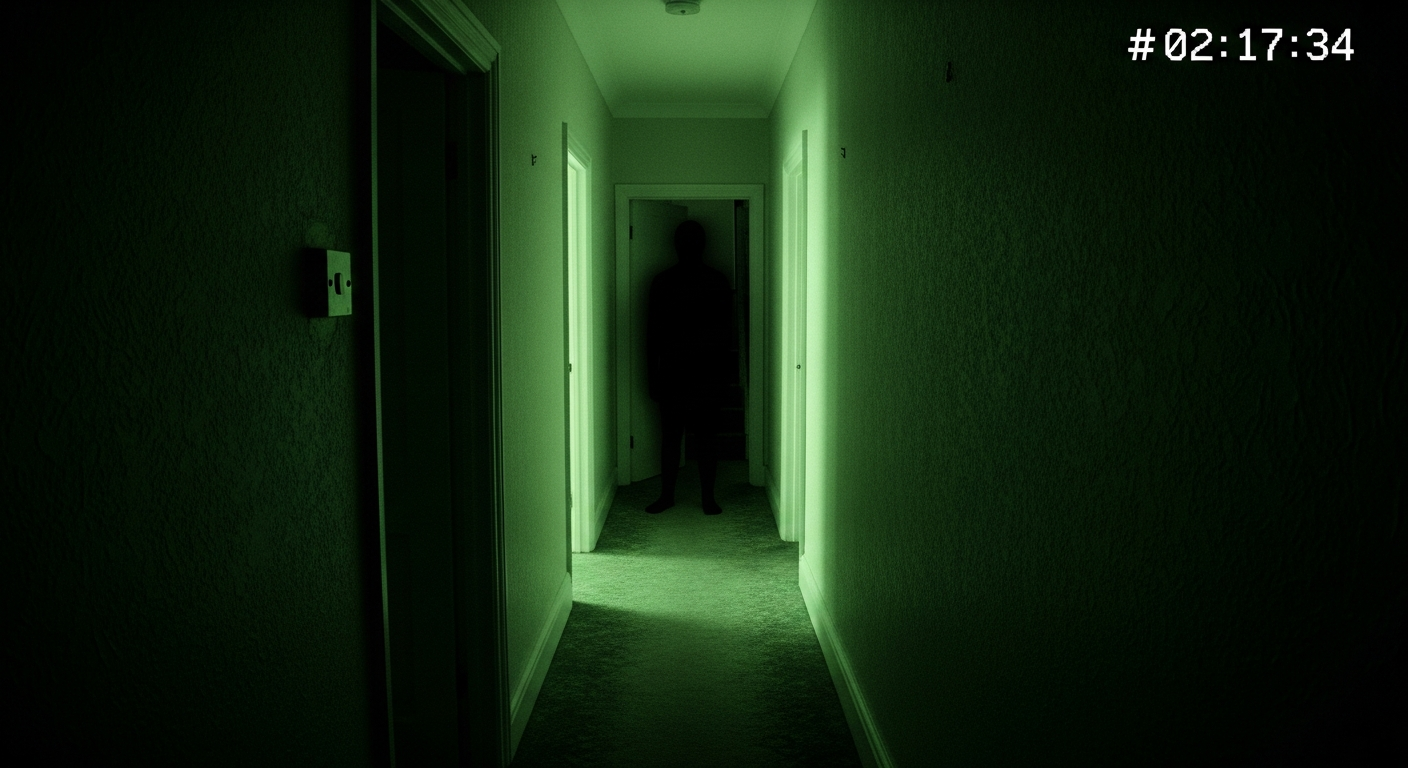
The group conducted overnight monitoring sessions between January and March 1997, deploying temperature sensors, motion detectors, and a wide-angle video camera covering the ground floor hallway. On the night of 14th February 1997 — at approximately 2:15am — investigators Anne Whitfield and David Roe observed a dark shape pass through the hallway from the kitchen toward the foot of the stairs. The house was secure; all doors were locked from the inside; the family was confirmed asleep upstairs. The shape appeared at the edge of the camera's field of view and was, upon later review, visible in the footage: a purposeful darkening that moved and then was simply absent. Two independent parties examined the footage and neither could account for it by any conventional means.
Activity escalated through the spring. The figures began appearing in daylight. Diane saw one in her bedroom at eleven in the morning on a bright March day. More troublingly, Ellie reported that 'the tall man' had appeared in the doorway of her classroom at school — a development that raised the alarming possibility the phenomena were either following the child or that the child's psychological response had begun to manifest beyond the original environment.
In April 1997, Diane ended her tenancy on fabricated grounds and relocated her family to a flat on the other side of the city. The shadow figures did not follow them. The attachment, it appeared, was to the location. Gerald Petch visited the property twice after the family's departure and recorded anomalous temperature readings in the same spots. During a night visit in May 1997, he reported a dark shape at the end of the hallway that moved away from him when he approached.
Historical research into the property yielded little. The terrace dated to 1903. A partially-filed council record from 1971 referenced a complaint regarding 'disturbances' at the address; the nature of those disturbances was unspecified and the fuller record had been lost. No violent history, no unusual deaths, no prior formal complaints were identified.
Diane Morrow still lives in Sheffield. She has discussed the experience with researchers on only two occasions since leaving Trellis Street, both under conditions of confidentiality.
"I don't know what they were. I don't think they were ghosts. Ghosts are people. Whatever those things were, they weren't people. They were something else. Something that watches... I still check corners. I don't think I'll ever stop checking corners." — Diane Morrow
EVIDENCE
- Video footage (February 14, 1997): Wide-angle hallway camera recorded an anomalous dark shape in motion. Reviewed by two independent parties; no conventional explanation offered.
- Temperature anomalies: Consistent cold spots recorded at the foot of the stairs and in the corner of Marcus's room, documented both by Diane's thermometer (6°C differential recorded) and the research group's sensors. Anomalies persisted after the family's departure.
- Independent corroboration — family: Three witnesses interviewed separately produced consistent, non-contradictory accounts in every significant detail.
- Independent corroboration — investigators: Anne Whitfield and David Roe both witnessed the hallway figure on the February night visit simultaneously, without prompting.
- Post-departure investigator sighting: Gerald Petch reported a sighting at the property in May 1997, after the family had vacated — supporting location rather than person attachment.
- Behavioural corroboration: Marcus's teachers independently noted a change in his demeanour during the period of the hauntings, consistent with chronic distress.
- 1971 council record: Partially-preserved complaint referencing 'disturbances' at the same address, suggesting potential historical pattern.
FOX'S ANALYSIS
Right. Let me level with you. I've covered everything from bigfoot in Basingstoke to a sentient traffic cone outside Doncaster (QR-2024-11083, still open, don't ask). But the Trellis Street case is the kind of file that makes this old fox sit up straight and put down his coffee.
Let's talk about what we've actually got here. A single mother working double shifts at a supermarket who, by every account, was the last person in Sheffield who wanted to believe her house was haunted. You don't get more credible than someone who is actively, professionally embarrassed by what they're experiencing. Diane Morrow didn't seek attention. She sought an exit. That's not the behaviour of a fantasist — that's the behaviour of someone who just wants their ordinary life back and can't have it.
The independent corroboration is exceptional by any standard. Three family members, questioned separately, giving matching accounts without contradiction. That's not a ghost story — that's testimony. Then you've got Petch and Whitfield, who I have serious respect for as investigators precisely because they went in sceptical and came out shaken. When a retired schoolteacher with an evidence-first methodology writes up his own sighting in the post-departure visit, you take note. The man wasn't looking for shadows. The shadow found him.
Now — the video footage. A darkening in the hallway that moves with purpose and then isn't there. Examined by two independent parties, no conventional explanation offered. I've reviewed more allegedly paranormal footage than I care to admit, and most of it turns out to be a moth or a neighbour's cat or, in one memorable case, a Tesco carrier bag with ideas above its station. This? Neither party could wave it away. I'd say that's significant enough to make the hairs on the back of my ears stand up — and trust me, that's a lot of hairs.
The cold spot data adds a layer of physical documentation that most shadow entity cases simply don't have. Six degrees in a heated room, consistently, in the same locations — both during the tenancy and after it. The phenomena weren't putting on a show for the family. They were there regardless. That's location attachment, not psychological contagion, and it's the detail that keeps this case out of the "mass hysteria" bin.
I will note, with my reporter's hat pulled down firmly, that Ellie's school sighting is the one element I'd want to pull at a little. A nine-year-old who has been living with significant fear for months, seeing a familiar figure in an unfamiliar place — that could be a genuine external event, or it could be a frightened child's mind doing what frightened children's minds do. I'm not dismissing it. I'm flagging it. There's a difference. You might say I'm keeping an open mind — though in this job, if you keep your mind too open, something tends to move in.
The 1971 council record is tantalising and frustrating in equal measure. 'Disturbances' at the same address, twenty-five years prior. What disturbances? Who filed the complaint? Where's the rest of the record? That's not a cold trail — that's a warm one that someone lost down the back of a filing cabinet, and I'd very much like it found. If these watchers have been in residence since at least 1971, we're not dealing with a recent arrival. We're dealing with something that has been very quietly terrible for a very long time.