The Thing That Rose from the Water: How a Scottish Loch's Most Famous Resident Finally Showed Its Face
QUIRK REPORTS — OFFICIAL CASE FILE
Case Number: QR-2026-75852
NESSIE SHOWED UP AND NOBODY COULD PROVE A THING: THE LOCH NESS CREATURE'S DEBUT PERFORMANCE
Classification: Cryptid Encounter — Aquatic / Large Unidentified Organism
Date of Event: April 1933
Location: Loch Ness, Scottish Highlands, United Kingdom
Reported By: Arthur Mackinnon (and wife Margaret Mackinnon)
Filed By: Fox Quirk, Founder and Senior Investigator, Quirk Reports
This report is based on documented paranormal accounts. Names and identifying details have been changed to protect those involved.
WITNESS STATEMENT
On a quiet Tuesday afternoon in April 1933, Arthur Mackinnon — a fifty-two-year-old local businessman of established reputation and decidedly unromantic temperament — was driving along the newly constructed northern shore road of Loch Ness with his wife Margaret, returning from a trip to Inverness. It was Margaret who first reacted, placing a hand on her husband's arm and asking him to bring the car to a stop.
What had caught her eye, and what both of them then stood watching from the roadside for several long minutes, was a disturbance of considerable violence occurring in the otherwise flat, grey-black water of the loch. Something large — very large — was rolling and plunging in the water approximately thirty feet across. Arthur would struggle, in subsequent tellings, to find adequate language for it. The closest analogy he could reach was a breaching whale, but the thing was longer, heavier, and moved without the clean, predictable arc of a cetacean. There was, he said repeatedly, simply too much of it.
The couple watched in silence as the creature churned the water. Arthur estimated the observation lasted several minutes; Margaret believed it was longer. Then, as suddenly as it had begun, the disturbance subsided. The loch settled. The surface resumed its customary dark indifference, and whatever had been there was gone.
Arthur Mackinnon did not go looking for publicity. He mentioned the sighting almost reluctantly to a friend employed at the regional newspaper — less out of a desire for attention, it seems, than out of a genuine need to make sense of what he had witnessed. His account, when published in early May 1933, was careful and precise. He had seen something enormous in the loch. It had been animate. It had been unidentifiable. He was not prepared to speculate beyond those facts.
The newspaper's readership treated it as anything but a small thing. Letters flooded in from locals who had never previously spoken of what they had glimpsed in the dark water. A retired gamekeeper, William Forsyth, wrote to confirm a similar sighting from the southern shore in the summer of 1927. A schoolteacher from the village of Dores described a long neck rising from the surface and watching her at a distance before slipping back without a ripple. A shepherd reported hearing something immense moving through the shallows on a dark October night, too dark to see clearly but impossible to mistake for anything small.
By the summer of 1933, eyewitness reports had become almost routine. A couple from Surrey described a long, tapering neck and a small, flat head near the village of Foyers and produced a sketch. An engineer from London claimed to have observed the creature for nearly half an hour from a hotel window, estimating its body at forty feet in length with a texture resembling elephant skin. Taken together, the accounts formed a portrait of remarkable consistency: a long neck, a large dark body, fluid non-piscine movement, no visible fins, no sound, and an ability to submerge with extraordinary speed.
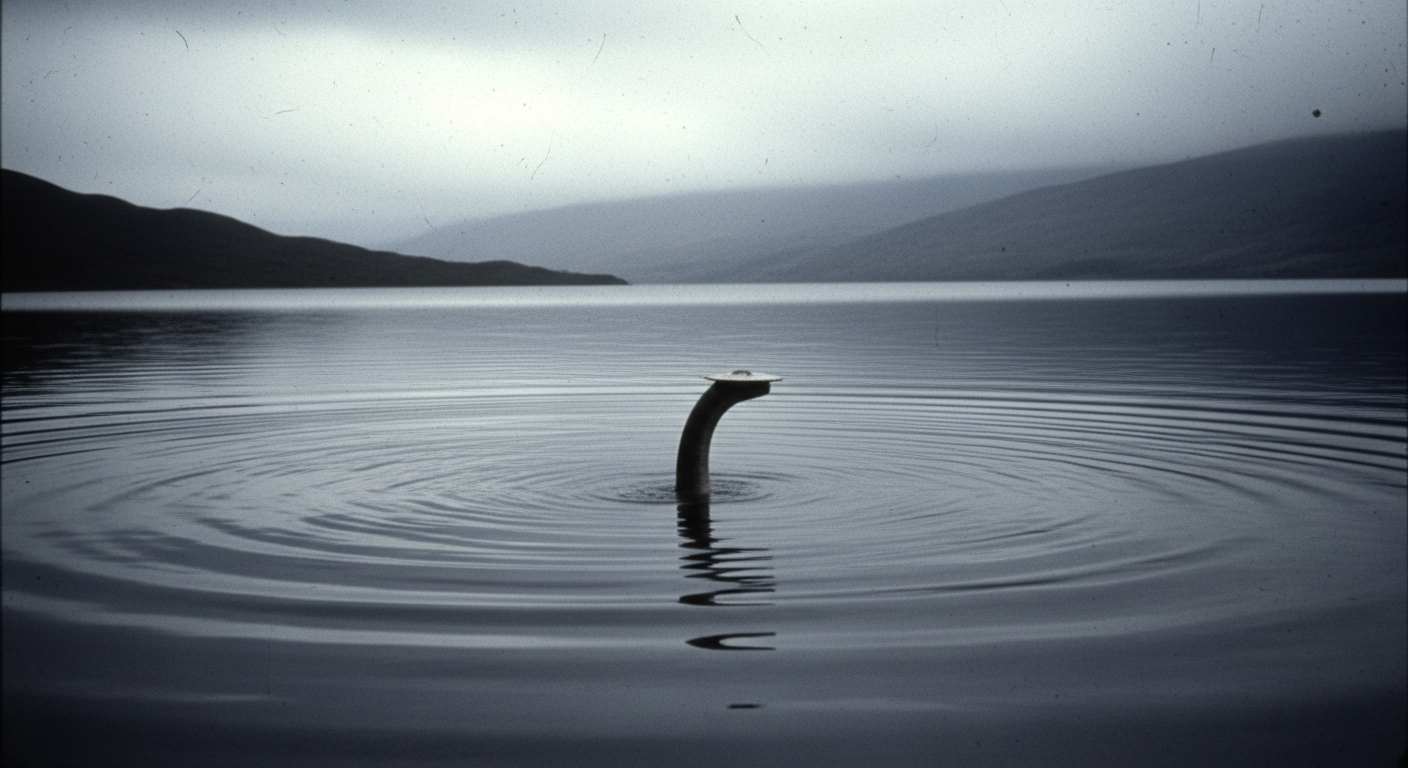
In December 1933, the first claimed photograph appeared, taken by a London surgeon near Invermoriston. Grainy, blurred, and contested immediately, it nonetheless showed what appeared to be a long neck and small head above dark water. The debate it ignited has never fully cooled.
Arthur Mackinnon gave interviews for the remainder of his long life without once revising or embellishing his original account. He died in 1967. In one of his final interviews, on the thirtieth anniversary of the sighting, he said that the creature had never permitted the kind of prolonged, unambiguous observation that would settle the matter, and that the loch seemed, in some fundamental way, to be protecting it. "The dark water," he said, "kept its secret like a locked room."
EVIDENCE
- Primary eyewitness account: Arthur and Margaret Mackinnon, independent corroboration from two witnesses present simultaneously.
- Published newspaper report: Account recorded in regional press, May 1933, described as careful, measured, and precise by the reporting journalist.
- Corroborating witness letters: Multiple independent accounts submitted to the newspaper following publication, including retrospective sightings dating to at least 1927.
- December 1933 photograph: Taken by a London surgeon near Invermoriston. Image contested but widely circulated; subject of ongoing expert debate.
- Witness sketches: Produced by a couple from Surrey independently of the original Mackinnon account, consistent with other descriptions.
- 1960s university underwater camera footage: Captured what appeared to be large, fin-like appendages moving at depth. Described as inconclusive but troubling.
- 1970s American sonar investigation: Tracked a large moving object at depth on multiple occasions, estimated at twenty to thirty feet. Object changed direction and descended. No biological explanation provided.
- 1990s sonar sweeps: Returned anomalous readings of large, fast-moving contacts at depths inconsistent with any known fish species.
- Early 2020s DNA sampling: Identified substantial presence of large eel DNA in loch water. Scientists proposed possibility of an extraordinarily large European eel population, though the largest authenticated specimen on record falls considerably short of witness-described sizes.
- Ongoing public livestream monitoring: Cameras mounted along the loch shore continue to log the surface; anomalous sightings reported with ongoing regularity by volunteer observers.
FOX'S ANALYSIS
Right. Let me start by saying that Loch Ness is twenty-three miles long, three hundred metres deep in places, perpetually peat-dark, and cold enough to preserve a grudge. If I were a giant prehistoric reptile trying to avoid scientists, I would absolutely live there. Five stars on the hiding-from-humans front. Would recommend.
Now. Arthur Mackinnon. I like Arthur Mackinnon. I like him because he's the kind of witness every paranormal reporter prays for: no agenda, no flair for drama, no book deal in the pipeline. He was a respectable businessman who saw something he couldn't explain, told someone about it almost reluctantly, and then spent thirty years saying exactly the same thing without adding a single flourish. That's not the behaviour of a fantasist. Fantasists embellish. Arthur just kept saying too much of it like a man who genuinely couldn't shake the image. That's authentic bewilderment, and it smells different from fabrication. I've interviewed enough people who've made things up to know.
The wave of corroborating accounts after publication is particularly interesting to me. People who had been sitting on sightings for years — in one case, six years — suddenly felt licensed to speak. That's a recognisable social pattern. You don't get that kind of retrospective flood unless something real is being validated. You could say it was mass hysteria, but William Forsyth's 1927 account was submitted before the hysteria had time to get properly hysterical.
The physical characteristics described across dozens of independent accounts are, I'll admit, impressively consistent for a creature that officially doesn't exist. Long neck, large dark body, fluid movement, no audible sound, vanishes like it's got somewhere better to be. I've seen less consistent descriptions of things that definitely do exist. You'd think witnesses could at least agree on what a labrador retriever looks like. Apparently not. And yet these people, spread across years and shorelines, are all basically describing the same animal.
The DNA evidence from the 2020s is worth sitting with. Large eel DNA. Substantial quantities. Now, I'm not saying it's a giant eel. But I'm also not not saying it. You know what they call a really long eel? A reel mystery. I'll see myself out. The point is that the DNA study doesn't close the case — it opens a different door. Something biologically significant is in that water. The debate is just about size, shape, and how many people it's been terrifying since at least 1927.
The sonar contacts from the 1970s bother me most. A moving object, twenty to thirty feet, changing direction, descending. That's not a log. Logs don't change direction. I have logged a lot of hours investigating strange phenomena and I can tell you with confidence that logs are not known for their evasive manoeuvres.
My honest assessment: whatever the Mackinnons saw that April afternoon was real, was large, and was alive. Whether it's a surviving plesiosaur, a population of anomalously enormous eels, or something else entirely is a question the loch has been declining to answer for nearly a century. The loch, if I may say so, is being very Nessie-tating about the whole thing.
I respect the creature. I don't respect the loch's PR strategy. Show yourself. You've had ninety years.
CREDIBILITY RATING
Rating: 8 / 10
Reasoning:
- Multiple witnesses: Two primary witnesses present simultaneously (Arthur and Margaret Mackinnon), plus numerous independent corroborating accounts across years and locations. Strong positive indicator.
- Witness character: Arthur Mackinnon's profile — established community figure, no history of sensationalism, reluctant to seek publicity, consistent account over thirty years — significantly bolsters credibility.
- Consistency of independent accounts: Physical descriptions from unconnected witnesses across decades align with unusual precision. Difficult to attribute to coaching or suggestion given the retrospective nature of several accounts.
- Physical and technological evidence: Sonar contacts, underwater camera footage, and DNA sampling all provide imperfect but non-trivial supporting data.
- Deductions: No definitive physical specimen; photographic evidence contested and unverified; biological mechanism for survival of large unknown species in the loch remains scientifically unresolved. Two points withheld accordingly.
CLASSIFICATION
Primary Classification: Cryptid Encounter
Sub-classifications:
- Aquatic Cryptid — Large Unidentified Organism
- Multi-Witness Sighting
- Historically Recurring Phenomenon
- Partial Physical Evidence (Sonar / DNA / Photographic)
- Culturally Significant Encounter — First Modern Era Report
CASE STATUS
Status: OPEN
Recommended Follow-Up Actions: