
The Thing in the Trees: How a Surrey Village Was Stalked by a Great Cat That Science Said Couldn't Exist
QUIRK REPORTS — OFFICIAL CASE FILE
Case Number: QR-2026-86195
THE THING IN THE TREES: SURREY'S PHANTOM PANTHER HAS BEEN GIVING LOCALS THE PAWS FOR SIXTY YEARS
Classification: Cryptid / Mystery Animal / Anomalous Felid
Date of Event: 1962–present (peak documented activity: 1960s–1990s)
Location: Surrey Hills, Surrey, England — specifically the Worplesdon, Godalming, Farnham, Leith Hill and Reigate corridors
Primary Witness: Gerald Ashworth (name changed)
Report Filed By: Fox Quirk, Founder and Editor, Quirk Reports
This report is based on documented paranormal accounts. Names and identifying details have been changed to protect those involved.
WITNESS STATEMENT
On a grey Tuesday morning in the autumn of 1966, Gerald Ashworth was inspecting the fence line on the eastern boundary of his smallholding near the village of Worplesdon when he encountered something he would spend the rest of his life trying to explain.
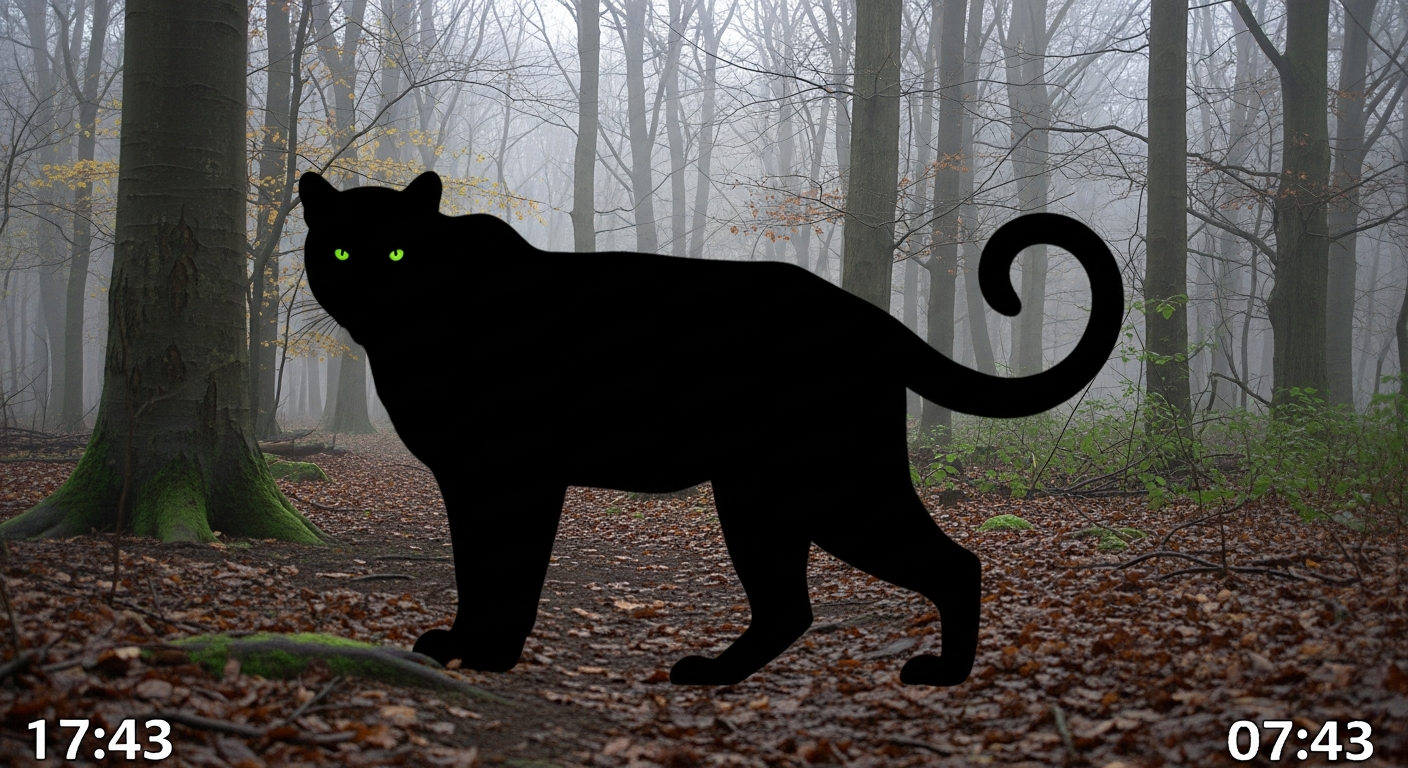
Approximately forty feet away, crouched at the tree line, was an animal unlike anything Ashworth had seen in decades of farming the Surrey Hills. It was black — not the dappled dark of a shadow-caught domestic cat, but a profound, absorbing black. It was large. Its shoulders reached the height of a fence post. Its tail was long, thick and curled lazily at the tip. And it was watching him with an unsettling, unhurried calm.
"I've farmed this land since I was nineteen. I know every animal that lives in these hills. That was not any animal I know. It looked at me the way something looks at you when it has decided it doesn't need to be afraid."
For approximately fifteen seconds, man and creature regarded one another across the wet grass. Then, with a deliberate slowness that Ashworth found more disturbing than any sudden movement, the animal turned and walked back into the trees. It did not flee. It simply left.
Ashworth was not the first to encounter the creature that would become known as the Surrey Puma, and he would not be the last. Sustained reports first entered the public record around the Godalming area in 1962 and 1963, with multiple witnesses describing a large cat moving along ridge lines and through the dense scrub of the North Downs. By 1964, Surrey Constabulary were logging reports formally, accumulating over 360 separate sightings in a single eighteen-month period. Officers dispatched expecting confused ramblers who had misidentified large dogs returned shaken. Paw prints were recovered. Livestock was found dead with wounds consistent with large predator kills. One officer, filing his report with evident discomfort, described watching a large black animal move along a hedge line at sixty yards, noting that its "movement was entirely unlike a domestic or farm animal" and that it "appeared to be stalking something in the field."
Three weeks after his initial sighting, Ashworth found one of his sheep dead in the lower pasture — killed cleanly with a single bite to the back of the neck, partially consumed in a manner wildlife experts told him was characteristic of a large felid rather than fox or dog. Police attended, photographed the scene, filed a report. Ashworth heard nothing further. He began keeping a journal.
Over the following four years, that journal documented eleven additional sightings — his own and those of neighbouring farmers, walkers on the North Downs Way, and a local council forestry worker. Descriptions were remarkably consistent across all accounts: black, large, unhurried, always at dusk or dawn, always at the woodland's edge, always gone before approach was possible.
One winter entry from 1969 stands apart. Returning home by car through thick fog, Ashworth's headlights caught a large shape crossing the road ahead. The animal paused and turned its head toward the beam. Ashworth described its eyes as catching the light "the way a cat's eyes do, but bigger — two green lights about as far apart as my two hands." Then it was gone into the hedgerow.
"I sat there for a while. I didn't know what to do. I thought about going home and not saying anything. I thought about that seriously. Because the moment you tell someone, they look at you a certain way."
Ashworth persisted in documenting what he saw. His neighbours did the same. The creature persisted too. Ashworth died in 2004, passing the farm to his son, who claims to have seen nothing himself — but who has, since boyhood at his father's insistence, kept his sheep in the lower pasture only during daylight hours.
EVIDENCE
- Surrey Constabulary records: Over 360 formally logged sightings during a single eighteen-month period in the mid-1960s. Officer field reports describing animal movement inconsistent with domestic or farm species.
- Livestock casualties: Multiple incidents of sheep and other livestock found dead with wounds described by veterinary and wildlife consultants as consistent with large felid predation — single neck bite, selective consumption of haunches, stomach and head left intact.
- Plaster cast paw prints (Army sweep, Farnham area): Recovered following a sighting near a primary school. Submitted to the Natural History Museum, London. Assessment: "consistent with a large felid." Non-committal, but not dismissive.
- Plaster cast paw prints (Danny Nuttall, 1990s): Taken from a stream bank east of Dorking. Print measured four and a quarter inches across — larger than any domestic cat, consistent with leopard or puma. Crucially, no claw impressions were present, consistent with felid retraction behaviour, inconsistent with dog.
- Infrared trail camera footage (Nuttall, 1994): Approximately four seconds of footage captured near Leith Hill showing a large dark shape moving through undergrowth. Movement described as unambiguously feline. Examined privately by a London university zoologist who declined public attribution but stated: "I would say I believe this is a genuine animal. A large one."
- Corroborating witnesses: Over six decades, documented witnesses include serving police officers, farmers, foresters, naturalists, a wildlife documentary cameraman, two armed forces personnel, and a veterinary surgeon who identified the animal as "a melanistic leopard" without qualification.
- Dashcam/mobile footage (2016, A25 near Reigate): Blurred mobile phone footage of a dark shape crossing the road at dusk. Acknowledged as inconclusive but catalogued as an additional data point.
- Gerald Ashworth's personal journal: Four years of contemporaneous first-hand and corroborated third-party sighting records, maintained by a witness with decades of professional familiarity with local fauna.
FOX'S ANALYSIS
Right. Let me get my notes in order, adjust my flat cap, and try to approach this one without my ears going fully flat with excitement — because the Surrey Puma case is, frankly, one of the most a-paw-ling failures of institutional nerve in the history of British wildlife management, and I have a lot of feelings about it.
Let's start with what we've actually got, because the evidence base here is not thin. It is, in fact, notably robust by the standards of this field. You have over three hundred formally logged police reports from a single period. You have physical trace evidence — paw casts — assessed by the Natural History Museum and found consistent with large felid anatomy. You have dead livestock with wounds that veterinary professionals attributed to large cat predation. You have infrared camera footage that a zoologist reviewed privately and called genuine. You have six decades of witnesses who include the kinds of people who, professionally, are paid to be accurate about what they observe: police officers, vets, wildlife workers, soldiers.
Now, I've covered a lot of cases. I've been probed, buzzed, slimed, and on one memorable occasion in rural Nebraska, mildly haunted. My nose for a bad witness is sharp — perhaps literally, being a fox — and I am not smelling anything off here. Gerald Ashworth's account has every hallmark of genuine experience: the involuntary detail, the honest ambivalence about coming forward, the behavioural change that persisted for the rest of his farming life. A man who keeps his sheep in during darkness for forty years because his father told him to is not a man whose father was telling tall tales for attention.
The Dangerous Wild Animals Act of 1976 is, in my professional opinion, the smoking gun in this case — or perhaps I should say the prowling cat in this case. The pre-Act exotic pet culture in Britain was genuinely extraordinary. People kept leopards. People kept jaguars. When the regulations arrived, the paperwork was too much for some owners and the zoos didn't want them all, and the temptation to simply open a gate on a quiet night on the North Downs must have been considerable. You don't need many founding animals to establish a breeding population, particularly in a landscape as prey-rich as the Surrey Hills with its abundant deer.
The institutional response to all of this evidence is, I'll be honest, more baffling to me than the cat itself. I've dealt with alien cover-ups — don't get me started, those grey-fingered boundary-crossers have a lot to answer for regarding my personal dignity — but at least there's a geopolitical logic to that kind of suppression. What is the downside of formally surveying for big cats in Surrey? What terrible consequence awaits if the Natural History Museum says yes, there appear to be leopards? The deer already know. The deer are living with the consequences.
I will note, for balance, that the footage evidence remains genuinely weak. Four seconds of blurry infrared and a windscreen-shot phone video do not a confirmed species make. The "consistent with" language from the museum is doing a lot of heavy lifting. And the fact that in sixty years no carcase, no live capture, and no high-resolution photographic confirmation has emerged is a genuine puzzle — though a determined apex predator in dense woodland is a very hard thing to photograph, as Nuttall's three years of trying will attest.
Still. Something is out there. Something big, and black, and patient, and possessed of a frankly un-fur-tunate talent for avoiding cameras. The cumulative case is, to use the appropriate technical term, extremely catvincing. I'd stake my press pass on it — and that press pass has survived situations I am not at liberty to discuss.
The Surrey Hills deserve a proper survey. The witnesses deserve an official acknowledgment. And the sheep, frankly, deserve to graze past sunset.
CREDIBILITY RATING
Rating: 8 / 10
Reasoning: The Surrey Puma case scores exceptionally well against standard credibility metrics. Multiple independent witnesses across a sixty-year span, including professionals with formal observational training, describe a consistent animal with consistent behavioural patterns. Physical evidence — paw casts, livestock kills, camera footage — has been assessed by credentialed experts and found plausibly consistent with a large felid, even where formal confirmation was withheld. The primary witness, Ashworth, demonstrates classic markers of genuine experience: reluctance to report, ongoing behavioural modification, contemporaneous written records. Points are deducted for the absence of definitive photographic or physical confirmation, the inherent ambiguity of the 1994 footage, and the frustrating "consistent with" ceiling that the evidence has never fully broken through. This is one of the most credible mystery animal cases in the Quirk Reports archive. Two points