
The Soldier and the Saucer: How a Canadian Farmer's Close Encounter Left a Crater the Government Couldn't Explain
QUIRK REPORTS — OFFICIAL CASE FILE
CASE NUMBER: QR-2026-90874
THE FALCON LAKE FLARE-UP: HOW A WEEKEND ROCK-HUNTER WALKED INTO CANADA'S MOST RADIOACTIVE MYSTERY
Classification: UFO/UAP — Close Encounter of the Second Kind (Physical Trace) / Close Encounter of the Third Kind (Proximity)
Date of Event: 20 May 1967
Location: Falcon Lake, Manitoba, Canada — Precambrian rock shelf, approx. several miles into boreal bush, Trans-Canada Highway corridor
Report Filed By: Fox Quirk, Founder & Lead Investigator, Quirk Reports
This report is based on documented paranormal accounts. Names and identifying details have been changed to protect those involved.
WITNESS STATEMENT
On the morning of 20 May 1967, Edwin Michalski — a fifty-one-year-old amateur prospector from Winnipeg — set out alone into the dense boreal forest near Falcon Lake, Manitoba, carrying a geology hammer, a compass, and a packed lunch. It was a long weekend. He had made the ninety-mile drive east along the Trans-Canada Highway to pursue his hobby: hunting quartz veins in the ancient Precambrian rock of the Canadian Shield. He was a practical, methodical man. The sky held no interest for him.
At approximately 11am, several miles into the bush, his attention was seized by an unusual disturbance — a panicked cluster of geese scattering above the treeline with urgent, alarmed honking. He paused. And then he saw them.
Two disc-shaped objects, each roughly forty feet in diameter, were descending through clear air toward a flat shelf of exposed granite approximately a hundred and sixty feet ahead of him. They were smooth and metallic — burnished steel in colour — each bearing a slight central dome and what appeared to be a ring of vents or ports around the craft's midsection. The sound they produced was, in Michalski's own words, a high-pitched hum, like a transformer, but changing, going up and down.
One craft hovered at low altitude while the other settled onto the rock with extraordinary precision, extending what appeared to be a tripod undercarriage. Shortly afterward, the hovering craft accelerated silently upward and disappeared. The grounded craft remained. And Edwin Michalski — driven, he later insisted, by nothing more exotic than ordinary curiosity — walked toward it.
As he closed the distance, he noticed a warm blast of air from the craft's underside and a sharp, unpleasant smell of sulphur. An aperture had appeared in the craft's wall — not a hinged door, but a section that had simply slid aside, revealing a violet-tinged interior light. He was approximately fifteen feet away when the craft abruptly began to spin. The hum climbed sharply in pitch. A blinding flash of light erupted from the opening. Michalski stumbled backward, hands raised to his face. Within seconds, the craft had lifted from the rock and vanished into the sky.
He initially believed he had escaped unharmed. He had not. Navigating back to the road by instinct — his vision had been seriously damaged by the flash — he was assisted by passing motorists who returned him to Falcon Lake. His wife drove from Winnipeg to collect him that evening.
In the days that followed, the full horror of his exposure became apparent. Michalski developed nausea, vomiting, and diarrhoea consistent with acute radiation syndrome. Severe burns appeared on his face, chest, and hands despite having been clothed. Most disturbingly, a wound emerged on his chest in a precise grid-like pattern — corresponding exactly, investigators would later note, to the arrangement of vents he had observed on the craft's underside. He lost weight rapidly and required multiple hospitalisations over the following weeks. The chest wound refused to fully heal and reopened repeatedly for years.
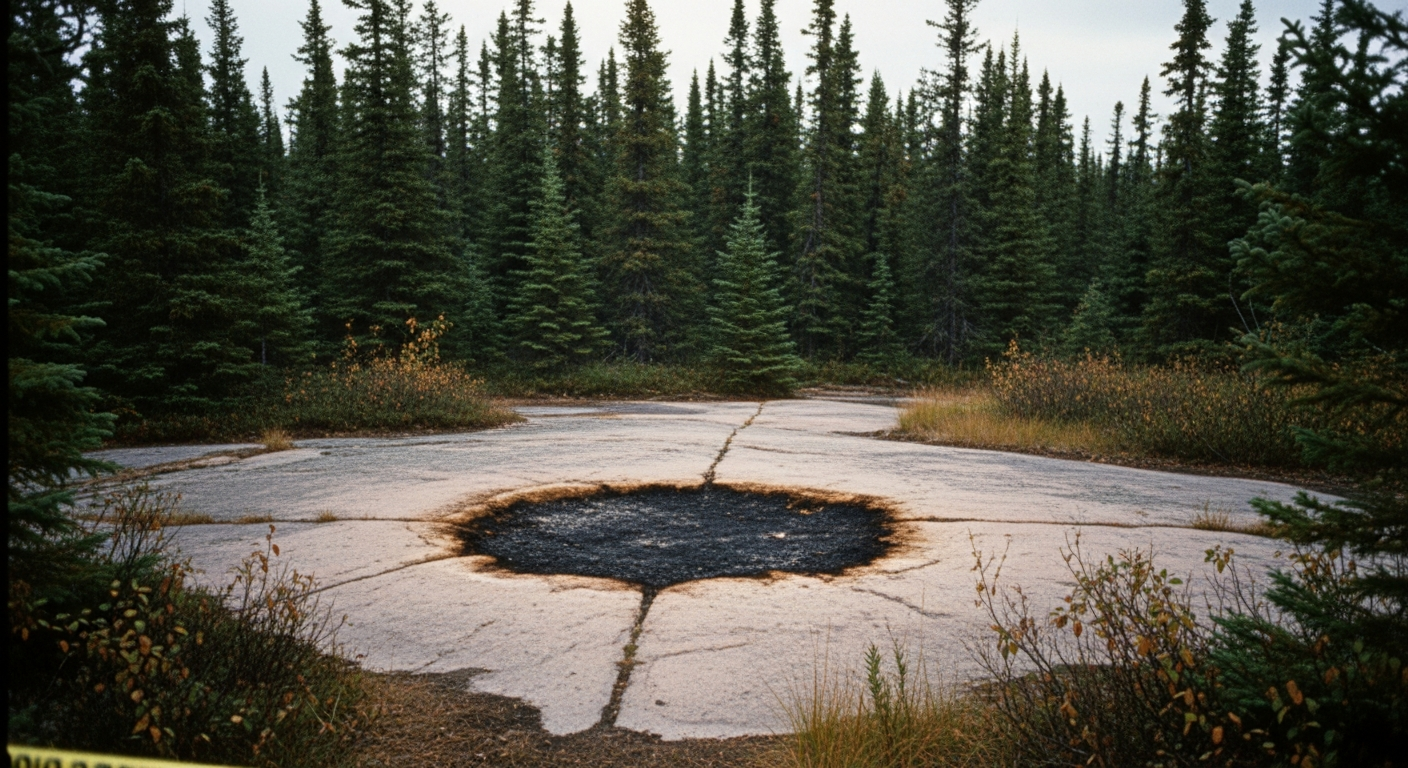
When Canadian Forces personnel, Royal Canadian Mounted Police officers, and civilian UFO researchers visited the site days later, they discovered exactly what Michalski had described — and one extraordinary addition. On the flat granite shelf, a ring fifteen feet in diameter had been scored into the rock, with scorched vegetation at its edges. Radiation readings taken at the site significantly exceeded background levels. Laboratory analysis of rock and soil samples confirmed the elevated radiation, and isotope breakdown indicated the source was inconsistent with any known natural occurrence or industrial contamination.
Michalski was, by all accounts, a deeply reluctant witness. He disliked public attention. He resented press intrusion. He worried, persistently, about whether people would believe him. He gave interviews sparingly, and only when he felt his account was being misrepresented. Over decades of sustained questioning, he never amended, embellished, or retracted a single detail. He maintained the same account until his death. Internal memos obtained through Canadian access-to-information requests later revealed that RCMP officers and Canadian Forces personnel who had visited the site wrote candidly that they could not explain
the physical evidence. No official body ever offered a public explanation.
EVIDENCE
- Physical landing trace: A fifteen-foot diameter ring scored into Precambrian granite at the reported landing site, with scorched vegetation at the perimeter. Visible for years after the event.
- Elevated radiation readings: Independently confirmed by multiple parties at the site. Isotope analysis found no match with natural background radiation or known industrial contamination sources.
- Medical documentation: Michalski was examined by multiple physicians. Radiation burns were confirmed as consistent with significant ionising radiation exposure. The grid-pattern chest wound — corresponding in its geometry to the observed underside vents — could not be accounted for by any conventional mechanism. His illness course was formally assessed as consistent with acute radiation syndrome.
- Official documentation: RCMP site reports, Canadian Department of National Defence assessment, and internal government memos — all later released via access-to-information — acknowledged the physical evidence and recorded genuine institutional puzzlement.
- Witness consistency: Michalski's account remained unchanged across decades of independent interviews. No inconsistencies were identified by any investigative body.
- Corroborating behaviour: Alarmed wildlife (geese) noted immediately prior to visual contact — consistent with a significant environmental disturbance at the reported location.
FOX'S ANALYSIS
Alright, folks. Pull up a chair, pour yourself something strong, and let's talk about Edwin Michalski — a man who went looking for rocks and found something considerably more alarming. As someone who has personally had an unpleasant close encounter with extraterrestrial interest in my personal anatomy, I approach all UAP cases with a combination of deep professional commitment and a slight twitch near my left ear. But let me be straight with you: this one got under my fur from the first read.
Let's start with what we've got. A credible, reluctant, practically-minded witness. Physical traces on rock that don't erode in a convenient hurry. Medical injuries that multiple physicians couldn't explain away. Government files that don't say "hoax" — they say "we don't know." In the world of close encounter cases, that's not just unusual. That's what we in the reporting business call a scoop. Or in Edwin's case, a very bad scoop indeed — the kind that gives you acute radiation syndrome.
My reporter's instincts are firing on all cylinders. The grid-pattern wound is the detail that keeps me up at night — well, that and my ongoing personal grievances against certain visiting species. The geometry of that burn pattern corresponding precisely to the vents Michalski described seeing? That's not something you fabricate. That's not something you can fake with a kitchen accident or a sunburn. That's evidence, ladies, gentlemen, and beings of indeterminate planetary origin.
Now, do I have concerns? I always have concerns. That's what makes me a journalist rather than a pamphlet. The lone-witness element gives me pause — though I'd note that "lone witness" in a stretch of dense Manitoba boreal forest at 11am on a long weekend is hardly suspicious; the rocks and the geese were also present and they weren't filing affidavits. The geese, incidentally, knew something was wrong before Edwin did. That's the thing about birds — they've got no ego investment in not believing what they're seeing. We could all stand to be a little more goose-like. I suppose you could say they really... took flight from the situation.
What strikes me most, and what I find genuinely moving in a way I don't always advertise, is Michalski's enduring reluctance. This man did not want to be famous. He did not want the attention. He was a fifty-one-year-old amateur geologist who wanted to spend his long weekend looking at quartz. Instead he got a radiation burn shaped like a spaceship's exhaust ports and decades of unwanted notoriety. The simplest explanation — that he stuck to his story because it was true — is, in this case, also the most compelling one. As we reporters like to say: if it looks like a disc, hovers like a disc, and burns you like a disc... it's probably a disc.
The government files are, frankly, the cherry on this particularly radioactive cake. When the RCMP writes internal memos saying they cannot explain the physical evidence at a location where a man claims to have been irradiated by a flying saucer, we are not in the territory of casual dismissal. We are in the territory of genuine institutional bafflement. And in my experience — covering everything from haunted lighthouses in Newfoundland to cattle incidents in New Mexico — genuine institutional bafflement is the closest thing to official confirmation you are ever going to get. You might say the government's position was... glowing.
Whatever came down on that granite shelf in Manitoba in the spring of 1967, it left marks that time has only partially softened, and a case file that no one has ever managed to close. Edwin Michalski paid a lasting physical price for walking toward something he didn't understand. I respect that kind of courage, even when I think it might have been prudent to walk the other direction. Then again, I'm a fox who spent his career walking toward things that shouldn't exist. We're cut from the same cloth, Edwin and I. His was just slightly more irradiated.
CREDIBILITY RATING
Rating: 9 / 10
Reasoning: The Falcon Lake case sits at the very top tier of close encounter credibility for the following reasons: the physical trace evidence (landing ring on bedrock, measurable radiation exceeding background levels) was independently confirmed by multiple parties including government agencies; the medical injuries were examined by multiple physicians and could not be conventionally explained; the government documentation, obtained via official access-to-information processes, records genuine institutional uncertainty rather than dismissal; and the witness maintained a completely consistent account over decades while actively resisting public attention. The single deduction from a perfect score reflects the absence of a second human witness to the craft itself. The geese, while clearly alarmed, declined to provide sworn statements.
CLASSIFICATION
Primary Classification: UFO/UAP — Confirmed Sighting with Physical Trace Evidence
Sub-classifications:
- Close Encounter of the Second Kind (CE2) — Physical effects on witness and environment
- Close Encounter of the Third Kind (CE3) — Extreme proximity to craft (<20 feet)
- Physical Trace Case — Landing ring, radiation anomaly, geological disturbance
- Medical Evidence Case — Documented radiation injury, acute radiation syndrome presentation, anomalous wound geometry
- Government Documentation Case — RCMP and Canadian DND involvement, access-to-information confirmed