
The Skull That Screamed: How a Dorset Manor Was Held Hostage by the Dead
QUIRK REPORTS — OFFICIAL CASE FILE
Case Number: QR-2026-78076
THE SKULL THAT SCREAMS: BETTISCOMBE'S UNDYING TENANT REFUSES TO CHECK OUT
Classification: Ghost/Spirit — Relic Haunting, Object-Bound Entity
Date of Event: Documented from approximately 1700; most intense activity 1872–1960s; phenomena ongoing
Location: Bettiscombe Manor, Marshwood Vale, Dorset, England
Primary Witness/Researcher: Edmund Farleigh, independent historian and family archivist
This report is based on documented paranormal accounts. Names and identifying details have been changed to protect those involved.
WITNESS STATEMENT
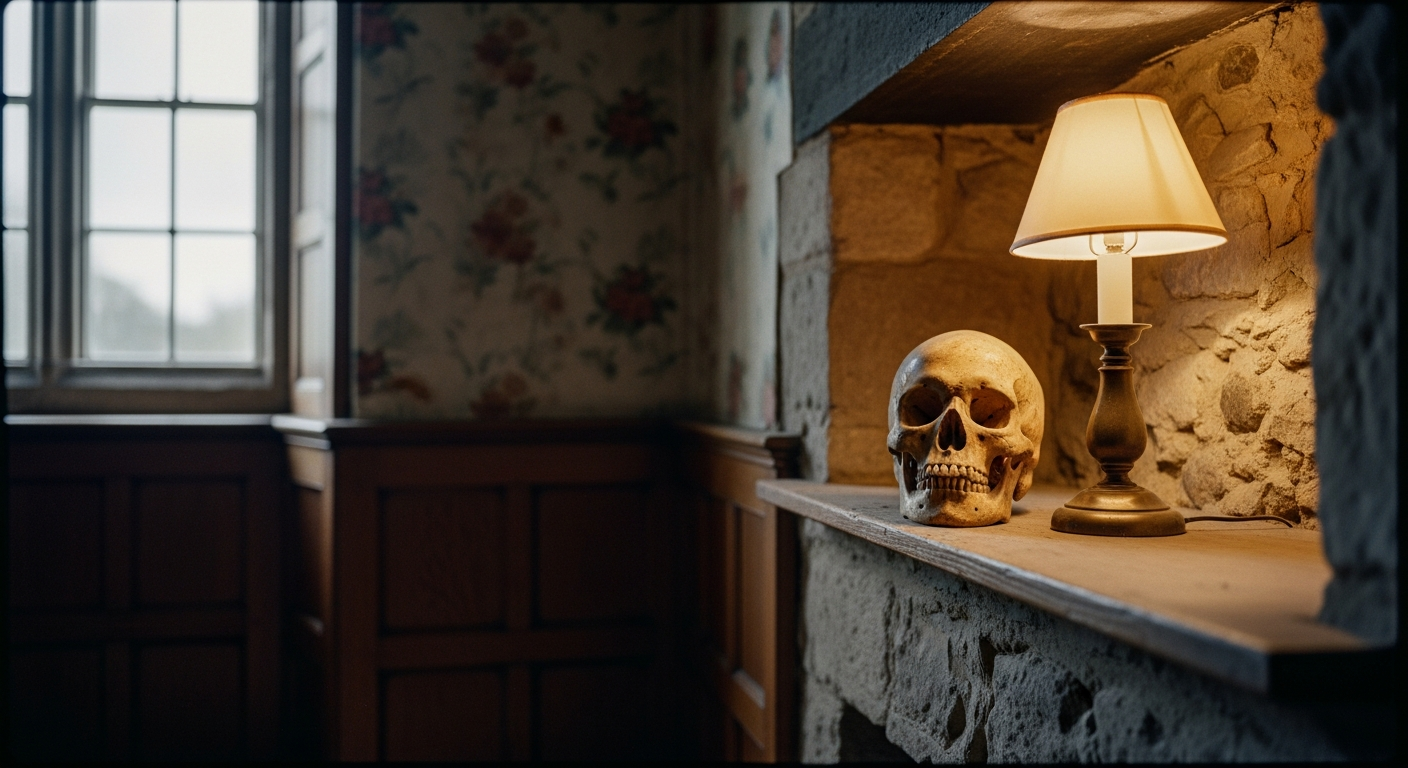
Edmund Farleigh has spent decades documenting the history of Bettiscombe Manor and the extraordinary phenomena associated with its most unusual resident — a human skull that has occupied the property for at least three centuries, and which, by every account gathered across that span of time, has made its feelings about relocation emphatically clear.
The story, as Farleigh reconstructs it from family records, oral testimony, and archival correspondence, begins with the Monmouth Rebellion of 1685. One Azariah Pinney was transported to the West Indies as punishment for his involvement in the uprising. His descendant, John Frederick Pinney, returned to England around 1700 and took possession of Bettiscombe Manor, bringing with him an enslaved African man who had served the household. The man died at the manor, far from home, and according to tradition, swore before his death that his spirit would find no rest unless his body was returned to his native soil. He was buried in the local churchyard. The house, shortly thereafter, began to scream.
Unearthly cries were reported at night. Doors opened onto empty rooms. Objects moved. Scratching sounds emanated from within the walls. According to the account preserved through subsequent generations of the Pinney family, the disturbances intensified until the man's body was exhumed and the skull — by then separated from the skeleton — was brought inside the manor. Only then did the house fall silent.
For nearly two centuries the skull was tolerated as a peculiar heirloom. Then, in 1872, a tenant farmer decided the whole business was superstitious nonsense and buried the skull in the garden. Within a week the household was in chaos. Letters and oral testimonies from the family archive describe screaming heard at night — not quite animal, not quite human, a sustained ululating sound that seemed to emanate from everywhere simultaneously. Crops failed. Animals sickened. The farmer, by all accounts a robust and unsentimental man, became pale and sleepless, convinced of a presence watching him from within the walls. Within a month he had the skull exhumed and returned to its place inside the house. The screaming, according to every account, stopped that same night.
The most vivid modern account dates to the 1950s, when a visiting relative — identified in Farleigh's records only as a cousin of the then-owner — decided to test the legend during a solo stay at the manor. Finding the stories charming in a Gothic way, she removed the skull from its resting place, carried it to the garden, positioned it at the base of an apple tree, and covered it with a flat stone. She returned to bed feeling quietly satisfied with herself.
She was woken at half past two in the morning by what she later described as "a woman wailing very far away, but also somehow inside the room." Initially assuming it was a fox, she attempted to return to sleep. The sound did not stop. Over the following two hours it grew — not louder, but closer, more textured, as though moving through the very fabric of the building, circling her room without entering it. By four in the morning she was sitting upright with the lamp on.
At dawn she returned to the garden. The stone had been moved. The skull was sitting upright, facing the house. She replaced it immediately, telephoned the owner in Bridport, and left Bettiscombe that same day. According to Farleigh's records, she never returned.
In the 1960s, physical examination of the skull by a university scientist produced a result that overturned the historical narrative entirely: the skull was not that of an African man, but appeared to be that of a young European woman, possibly of Iron Age origin and potentially two thousand years old. Far from resolving the mystery, this finding multiplied it. Farleigh's own interpretation, offered after decades of investigation, is characteristically measured: "What we're dealing with is probably not one haunting but several, compressed into one object over centuries. The skull has been in that house for so long that whatever is attached to it has become inseparable from the building itself. You can't understand one without the other."
The skull remains at Bettiscombe today. The current custodians, Farleigh reports, treat it with pragmatic respect rather than reverence. When he asked them whether they had ever considered quietly disposing of it, their response was simple. "We know what happens when you do that," one said. "We've always known. And that's why it stays."
EVIDENCE
- Physical relic: The skull itself, present at Bettiscombe Manor, confirmed by physical examination in the 1960s to be human remains of a young European female, estimated Iron Age origin — approximately 2,000 years old
- Scientific analysis: University examination contradicting the historical narrative of the skull's origin, raising significant questions about the object's provenance and the layered nature of the associated legend
- Family archive documentation: Letters and preserved oral testimonies from the Pinney family and associated households describing the 1872 incident, including the farmer's period of disturbance and the cessation of phenomena upon the skull's return
- Multiple independent accounts: Consistent reports of screaming, crop failure, animal sickness, and sensation of being watched spanning several distinct periods and households
- 1950s incident: First-hand testimony of the visiting relative, corroborated by her immediate departure and documented refusal to return; the repositioned skull with no evident natural explanation
- 1970s investigator report: Documented temperature anomalies, persistent sensation of observation, and one investigator reporting an auditory phenomenon (low continuous humming) undetected by others; recording equipment produced no anomalous audio
- Wider folkloric context: Bettiscombe is consistent with a documented pattern of "screaming skulls" in English folklore, recorded at multiple properties across Yorkshire, Devon, and Lancashire
FOX'S ANALYSIS
Right. Let me get my hat straight and my notes in order, because this one is a proper piece of work.
Bettiscombe Manor has been running the same haunting for roughly three hundred years, and unlike most paranormal cases that come across my desk — which tend to fizzle out after a few cold spots and one blurry photograph — this one has aged like a particularly stubborn cheese. It gets more complicated the longer you look at it, and it absolutely refuses to go quietly. Much like the skull itself.
What strikes me immediately as a reporter is the consistency. We're not talking about one family member with an overactive imagination and a fondness for Gothic atmosphere. We have multigenerational testimony, multiple unconnected witnesses across centuries, a documented physical event in 1872 with measurable consequences — failing crops, sick animals, a practical man driven to insomnia — all resolving at the same moment the skull was returned. That is a remarkable chain of corroboration for any case, let alone one this old.
The 1960s scientific examination is, frankly, the most interesting twist in a story that doesn't lack for them. The skull being Iron Age and female rather than seventeenth-century and African doesn't debunk anything — it just means the haunting has more layers than a Dorset pasty. Which, given that the disturbances apparently predate the Pinney family's ownership entirely, rather supports Farleigh's theory that this is several hauntings compacted into one object over two millennia. Whatever is attached to that skull was old when the Romans were still complaining about British weather.
I want to be the sceptical fox here. I do. But I keep coming back to the 1950s incident. The visiting cousin had every social incentive to play it cool, explain the wailing as a fox — my people get blamed for everything, by the way, and I resent it — go back to sleep, and tell a mildly amusing story at a dinner party. Instead she sat rigid in a lamplit room for two hours, found the skull repositioned at dawn, and left a property she'd been comfortably visiting without ever going back. That is not the behaviour of someone enjoying a Gothic adventure. That is the behaviour of someone who has been genuinely frightened out of their sophistication.
I'll also note: the 1970s investigators described the house as "profoundly unwilling." As a description of a haunted location, that's one of the finest I've encountered. Most haunted properties feel sad, or charged, or simply cold. A house that feels unwilling — that is something else. That is a house with an opinion.
Now, could there be rational explanations for some of this? Certainly. Infrasound can produce feelings of unease and apparent auditory phenomena. Confirmation bias can shape how witness accounts are reported and remembered across generations. A skull repositioning itself is harder to account for — but then, the cousin did admit she'd been awake and terrified, and one doesn't always remember the exact position of things one placed in a garden at four in the afternoon the previous day while trying to prove a point.
What I can't dismiss is the cumulative weight of it all. You could say any single account is unreliable. You cannot easily say that about three centuries of consistent, patterned, independently reported phenomena tied to a specific object in a specific house. I've covered cases where an alien could barely be bothered to put on a light show — and don't get me started on aliens, my feelings there are very personal and probe-related — but whatever is at Bettiscombe has been working consistently and professionally for a very long time.
My conclusion? There's something genuinely anomalous at Bettiscombe. Whether it's the original servant's spirit, an Iron Age votive entity, something that accreted to the skull over two thousand years, or all three at once having a haunting committee meeting, I cannot say. But the skull has been making its presence known since before William and Mary were on the throne, and it shows absolutely no signs of quieting down.
I'll say this for it: it's certainly got a head for this sort of thing. And unlike most cases I investigate, this one has real bone fides.
You're welcome.
CREDIBILITY RATING
Rating: 8.5 / 10
Reasoning: This case scores exceptionally well across almost every credibility metric. The testimony is multigenerational and consistent across independently sourced accounts spanning three centuries. Physical evidence exists in the form of the skull itself, confirmed as genuine human remains by scientific examination. The 1872 incident is documented in archived correspondence rather than relying solely on oral tradition. The 1950s account demonstrates classic indicators of genuine experience: the witness had no incentive to be frightened, attempted rational explanations, and responded with immediate, permanent avoidance behaviour. The 1960s scientific findings, rather than debunking the case, added a layer of complexity that strengthens rather than weakens the overall mystery. Points are withheld only for the absence of controlled extended investigation, the inability to rule out infrasound or environmental factors for some phenomena, and the acknowledged gap between the skull's physical origin and its attributed legend.
CLASSIFICATION
Primary Classification: Ghost/Spirit