
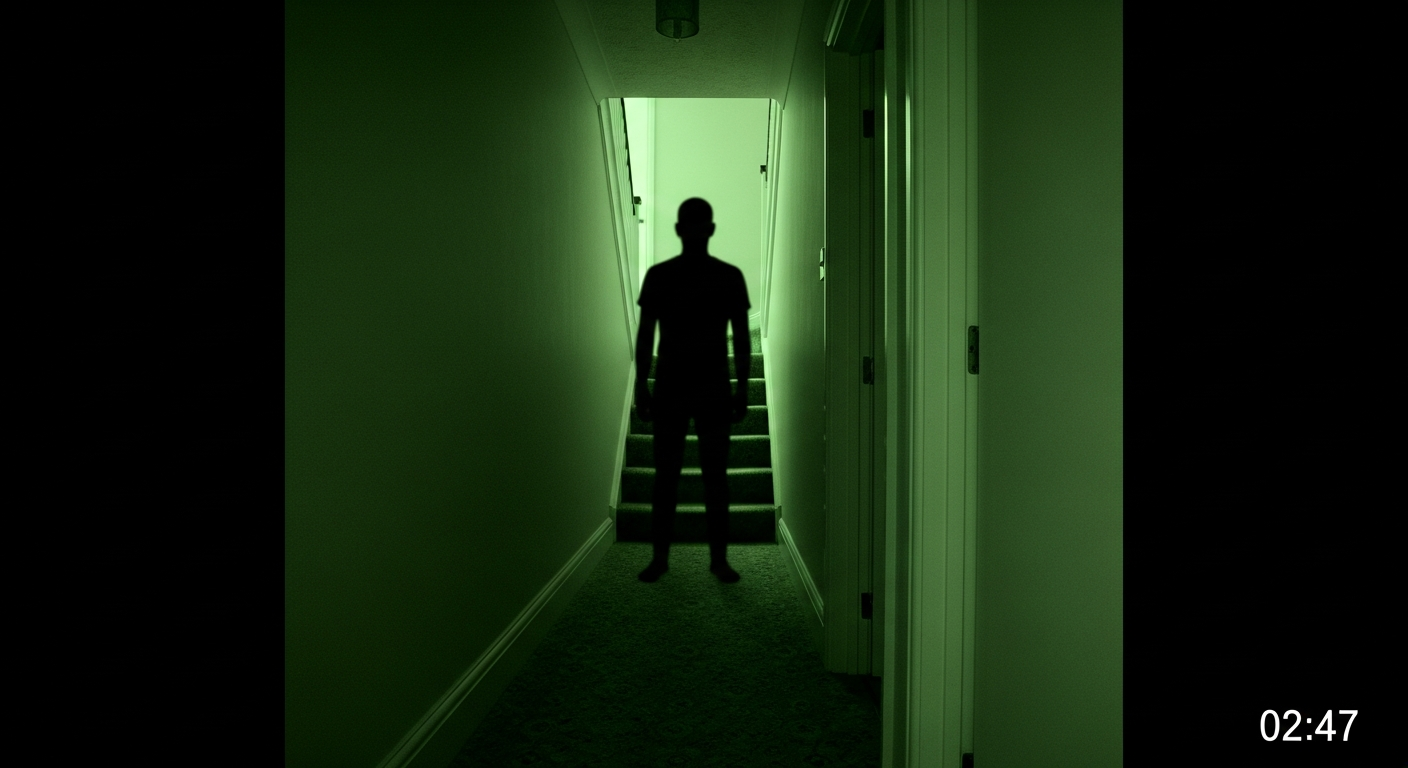
The Shadow at the Foot of the Bed: How a Cannock Chase Family Were Visited by Something That Had No Face
QUIRK REPORTS — OFFICIAL CASE FILE
CASE NUMBER: QR-2026-24559
DARKNESS WITH DEPTH: THE CANNOCK CHASE SHADOW THAT WATCHED A FAMILY FOR THREE YEARS
Classification: Shadow Entity / Liminal Apparition (Class III — Recurring, Multi-Witness)
Date of Events: October 2003 – Autumn 2006
Location: Cannock Chase, Staffordshire, England
Reporting Investigator: Fox Quirk, Founder & Lead Reporter, Quirk Reports
This report is based on documented paranormal accounts. Names and identifying details have been changed to protect those involved.
WITNESS STATEMENT
Diane Holloway was thirty-four years old and six years settled in her semi-detached house on the edge of Cannock Chase when, in late October 2003, her ordinary life acquired something extraordinary and uninvited. Her husband Gary worked shifts at a distribution warehouse outside Rugeley. Their children — Caitlin, eleven, and Marcus, eight — attended the local primary school. Nothing about the household invited the strange. The strange arrived anyway.
The first encounter occurred on a Tuesday evening. Diane had gone upstairs to check on the children when she stopped in the hallway. At the far end of the corridor, above the staircase, stood a shape. She later described it to investigators as:
"Taller than a man, but wrong in its proportions — like someone had stretched a person upwards and taken all the detail away."
No face. No features. A solid, three-dimensional absence of light occupying space with the confidence of something that had every right to be there. The landing light was on. The figure was darker than the wall behind it — darker than the shadows in the corners — a presence defined entirely by what it lacked. After four or five seconds, it did not walk away or fade. It shifted, like smoke in a draught, and folded itself into the wall. When Diane pressed her hand to the plaster moments later, it was cold. December-windowpane cold, despite central heating that had been running all evening.
She said nothing to Gary. She told herself it was exhaustion, a car's headlights thrown strangely through frosted glass. She checked the landing three times before sleeping.
Six weeks later, Gary came downstairs at half past two for a glass of water and found a tall, featureless, deeply black figure standing at the kitchen door. He had not been told about Diane's experience. He described it as looking not like a surface, but like a hole — a quality of darkness with physical depth to it. He stood in the doorway for what felt like a full minute before the figure was simply, instantaneously, gone. No movement. No transition. An absence where something had been.
When Gary described it over breakfast the next morning, Diane's face went pale. They agreed to say nothing to the children. That resolution lasted until March 2004, when Caitlin came trembling into her parents' bedroom at three in the morning. It took her several minutes to speak. She described a tall black figure with no eyes standing at the foot of her bed. She had hidden under her duvet for twenty minutes before finding the courage to run.
The family contacted a local paranormal investigation group the following week. Over two weekends, investigators using EMF meters and thermal imaging equipment recorded several temperature anomalies in the upstairs hallway and in Caitlin's bedroom, including one reading that dropped eleven degrees Celsius in forty seconds before returning to normal. On the second weekend, a retired schoolteacher named Philip — fifteen years a paranormal researcher — witnessed the figure himself in the downstairs living room. He subsequently wrote:
"The figure I observed was not a shadow in the conventional sense. It had a clearly defined edge, a three-dimensional quality, and was perceived as occupying space in the room rather than being projected onto a surface. It was between six and a half and seven feet tall, and its proportions, while humanoid, were not quite human. There was an intelligence to it — a sense that it was aware of being observed. When it disappeared, there was no fading or transition. It was simply no longer present."
Across 2004 and 2005, the figure — or figures, the family could never be certain — appeared on at least fourteen separate recorded occasions across three family members and two investigators. It favoured liminal spaces: doorways, hallways, the foot of staircases. It was never seen in the same location consecutively. It never made a sound. The family dog, Biscuit, refused to enter certain rooms and was observed pressing himself against the landing wall, whimpering at apparently empty space.
Diane began a journal in January 2005. The entries are not dramatic. They are tired. One reads: "Saw it again in the hall tonight. About 2am. Gary was asleep. Just stood there for a while and then it went. I'm so tired of being frightened in my own home."
A researcher from a Midlands paranormal studies group interviewed each family member separately in the summer of 2005. She noted that the children's descriptions, given independently and without prompting, were strikingly consistent: tall, entirely black, no facial features, with an impression of density despite apparent immateriality. Marcus, nine years old, told her with the economy of a child who has thought carefully about something: "It's not a ghost. Ghosts are people. That's not a person."
The researcher also found two households within four hundred metres reporting their own shadow figure encounters — neither had spoken of them publicly before. An elderly local man told her his father had seen "the black shapes" in the woods in the 1950s, and that locally it was considered something old. Something that had always been in the Chase.
By 2006, the encounters had reduced to four or five over the year. The family had not moved, had not cleansed the house, had made no deliberate attempt at communication or confrontation. The activity simply wound down, the way a storm does — without ceremony or explanation. In her final recorded interview that autumn, Diane was measured and precise:
"I know what we saw. All four of us saw it, and so did investigators who came into the house with no expectation of seeing anything. I don't know what it was. I don't know if it meant us harm — it never did anything to us, just stood there and watched. But I know it was real. I know that as well as I know anything."
EVIDENCE SUMMARY
- Thermal anomalies: Multiple temperature drops recorded by investigators, including an eleven-degree drop in forty seconds in the upstairs hallway and Caitlin's bedroom. No environmental explanation identified.
- Independent corroboration: Investigator Philip witnessed and independently documented a shadow figure during the second investigation weekend, with a written account published in a regional paranormal newsletter.
- Consistent cross-witness testimony: Four family members and two investigators, interviewed separately at various points, gave descriptions that align on all major points: height, extreme darkness, three-dimensionality, featurelessness, absence of sound, preference for liminal spaces.
- Animal behaviour: The family dog exhibited persistent avoidance of specific rooms and distress responses in the upstairs hallway, consistent across the period of reported activity.
- Written record: Diane's journal, maintained from January 2005, provides dated contemporaneous documentation of encounters throughout the case period.
- Corroborating neighbourhood accounts: Two nearby households confirmed shadow figure experiences independently; a long-term local resident referenced family accounts dating to the 1950s.
- Physical anomaly: Cold wall surface documented immediately following the first encounter, inconsistent with ambient temperature and active central heating.
FOX'S ANALYSIS
Right. Let me flatten my cap, uncap my pen, and say what I think, because this one deserves the full treatment.
In thirty-odd years of covering the paranormal beat — from Roswell knockoffs in Romford to lake monsters in Loch Nothing-There — I have developed a fairly reliable nose for cases that carry genuine weight. The Holloway case has that smell. Not the smell of a haunted house story told for effect, not the smell of a family with something to sell. The smell of people who saw something they didn't want to see and had the misfortune to keep seeing it.
What impresses me most is the architecture of discovery. Gary hadn't been told about Diane's first sighting when he had his own. Caitlin hadn't been told about either when she came running in at three in the morning. The children were interviewed separately by a third-party researcher and produced consistent descriptions unprompted. That's not a rehearsed story. You can coach a story into consistency; you cannot easily coach the independent testimony of an eight-year-old who thinks ghosts are people but this thing isn't a person. That line, right there, is the most unsettling sentence in this entire file, and I've included a temperature reading that dropped eleven degrees in forty seconds.
Now, do I have alternative explanations? A few. Infrasound — low-frequency sound waves produced by certain building structures or nearby machinery — is known to produce sensations of unease, dread, and in some cases visual disturbances. Cannock Chase has unusual topography, and the area's geological and industrial history isn't without candidate sources. Sleep paralysis and hypnagogic hallucination can produce vivid dark figures, particularly in the small hours. Shadow misperception — pareidolia of the dark — is well-documented.
None of these explanations, individually or in combination, accounts neatly for Philip's waking, standing, fully-alert observation of a figure in a lit living room, or for Biscuit the Labrador's refusal to enter certain rooms. Dogs, it should be noted, are not susceptible to suggestion, the power of narrative, or the ambient paranormal reputation of Cannock Chase. Biscuit was not reading the regional paranormal newsletter. Biscuit just knew something was wrong on that landing, and Biscuit, in my professional estimation, had good instincts. I'd give Biscuit a press pass if he were still with us.
I'll also note — and I'm putting on my serious-reporter hat here, which sits somewhat oddly on fox ears but stay with me — that the figure's behaviour is consistent across all accounts in ways that feel structurally significant. It occupies liminal spaces. Doorways. Hallways. The foot of staircases. Thresholds. If you were designing a phenomenon from scratch to make the most architecturally meaningful statement about transition and boundary, you would put it exactly where the Holloways kept finding it. I'm not sure what to make of that. I'm not sure anyone does. But it's the kind of detail that keeps me up at night — which, given my general proximity to unexplained phenomena, is saying something.
On the question of what this is: I genuinely don't know, and I'll tell you something — I'm suspicious of anyone in this field who claims they do. Shadow people reports are among the most globally consistent paranormal accounts in the literature. The same features appear across cultures, continents, and centuries with a regularity that is either deeply meaningful or deeply annoying, depending on your philosophical mood. The Cannock Chase accounts fold neatly into that pattern. Whether we're dealing with a genuinely anomalous entity, some form of environmental or psychological phenomenon we don't yet have the instruments to measure, or something that doesn't fit any category we currently have — I can't say. What I can say is that this family told the truth. I'd stake my battered notebook on it.
One final thought: they never moved. Never cleansed. Never confronted. And eventually, whatever it was simply... stopped. It came, it watched, it left. That, to me, is the most unsettling part of the whole file. Not that it was there. That it was done when it was done, for reasons entirely its own. Whatever it wanted from the Holloways — or whatever it was