
The Shadow Army: How an Entire Town Learned to Fear the Dark
QUIRK REPORTS — OFFICIAL CASE FILE
Case Number: QR-2026-69686
THE SHADOW ARMY: HOW AN ENTIRE TOWN LEARNED TO FEAR THE DARK
Classification: Shadow Entity Encounter — Mass Wave Event
Date of Events: October 1993 – Present (Primary documented wave: 1993–2005)
Location: Cannock Chase, Staffordshire, England
Lead Witness: Gerald Hartwick (name unchanged at subject's request)
Investigating Researcher: Mike Holloway, Regional Paranormal Investigator
This report is based on documented paranormal accounts. Names and identifying details have been changed to protect those involved.
WITNESS STATEMENT
Gerald Hartwick, a retired postal worker from Hednesford, Staffordshire, had walked the southern fringe of Cannock Chase for nearly two decades before the evening in October 1993 that would permanently alter his perception of the world. The route was as familiar to him as his own home — every oak, every bend in the path, every hollow where foxes sheltered in spring. That familiarity, paradoxically, is what made the wrongness so immediately apparent.
The silence came first.
"The birds went quiet about two hundred yards in. I've walked that path in rain, fog, January cold — I'd never heard it go that quiet before. Not dead quiet. Wrong quiet."
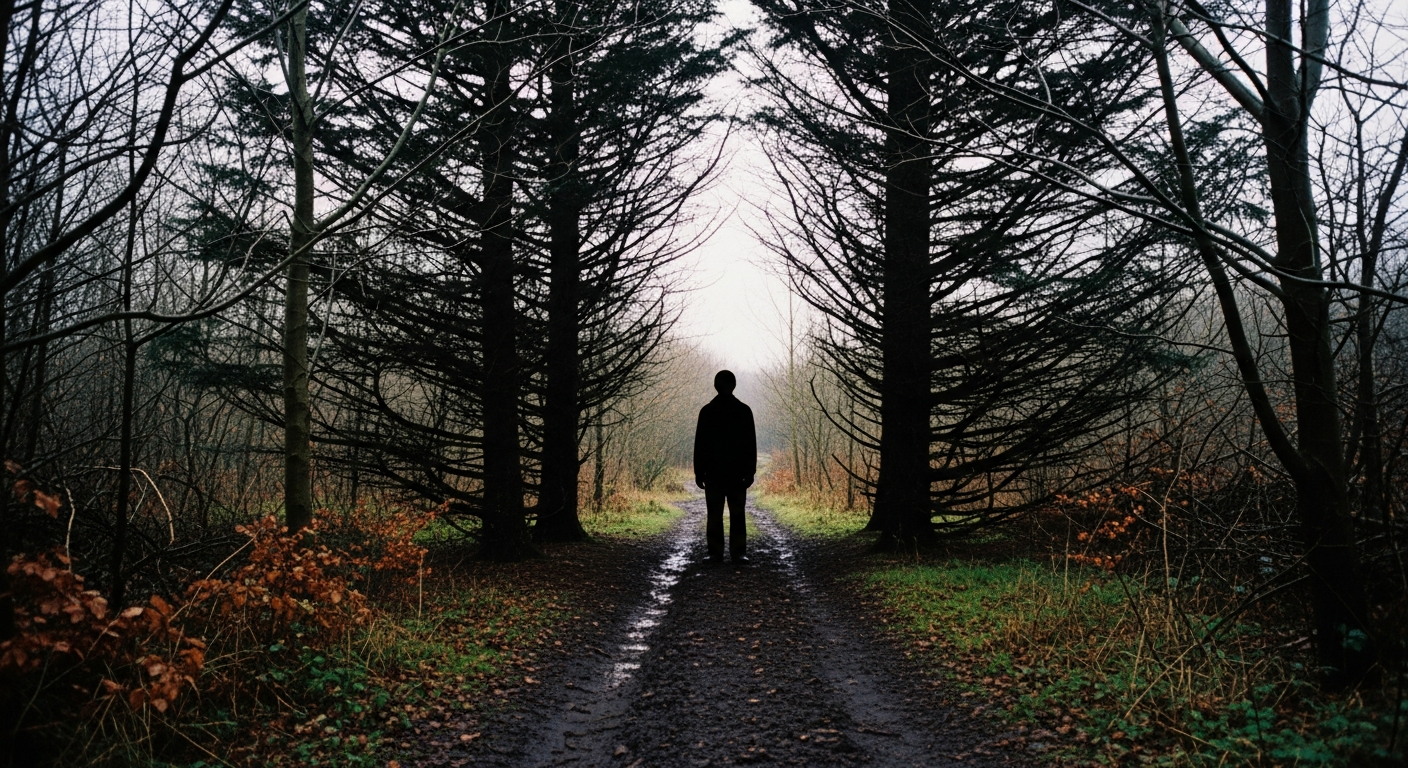
Approximately half a mile from the nearest road, Hartwick saw a figure standing between two Scots pines, roughly thirty feet from the path. It was tall — he estimated six and a half feet or more — and entirely black. Not dark in the manner of clothing or shadow, but black in a more fundamental, more troubling sense: the quality of an absence. A person-shaped excision from the visible world.
"It was like someone had cut a person-shaped hole in the air. Where it stood, there was just nothing. No texture, no depth. Just black."
Despite possessing no discernible face or eyes, Hartwick was absolutely certain the figure was facing him. He stood motionless for approximately forty seconds — experienced as considerably longer — before the figure simply ceased to be present. There was no movement, no retreat, no transition. It was there, and then it was not.
Hartwick told nobody for three days. When he finally confided in his wife, she mentioned it to their neighbour, Margaret Fenwick, who had experienced something remarkably similar on a housing estate at the Chase's northern boundary the previous spring. This private, ashamed, overlapping silence — one frightened person discovering they were not alone — would prove to be the defining pattern of what followed.
By 1997, local researcher and journalist Mike Holloway had logged fourteen separate incidents. The witnesses defied every convenient explanation: a secondary school teacher, a retired police sergeant, two members of a local walking club, a nurse, a van driver, and a twelve-year-old boy — referred to in all subsequent publications as Danny Reeves — who encountered a shadow figure stepping out from a garden hedge on his walk home from a friend's house. Danny told his parents immediately. His mother called the police, who noted the report and took no further action. His father assumed a large dog or a person in dark clothing until Danny, unprompted, drew the figure on the back of a school exercise book: a featureless, elongated silhouette with arms fractionally too long, no visible neck, and a subtle forward inclination — a lean toward the viewer — that made both parents deeply uneasy.
Danny's account was independently corroborated in all essential details by a woman named Carole Simms, who reported an almost identical encounter on the same street six weeks earlier, at approximately the same time of evening. She had not come forward because, as she explained, she was not in the habit of telling people she saw things that weren't there.
Holloway documented recurring characteristics across the majority of accounts: the figures were almost always solitary; most commonly observed in late afternoon and early evening rather than deep night; consistently reported in transitional spaces — the edge of woodland, a garden boundary, the threshold between lit and unlit ground. And in a significant number of cases, witnesses described a pronounced physical sensation: a drop in temperature, a pressure in the chest, and an overwhelming sense of being deliberately scrutinised.
Teacher Helen Marsh, who encountered a figure in a community centre car park in February 2000, described the experience in language almost identical to Hartwick's own:
"I felt assessed. That's the only word for it. Like being stared at by something that was making a judgement."
In 2003, a Birmingham-based paranormal investigation team conducted several nocturnal vigils at locations associated with the reports. They recorded localised temperature drops of up to eight degrees Celsius and three team members reported peripheral visual experiences — tall, standing shapes at the treeline that vanished when viewed directly. No photographic or video evidence was obtained. This was consistent with every prior attempt at documentation. No one, across more than a decade of sightings, had ever successfully photographed a Cannock Chase shadow figure.
Gerald Hartwick returned to his route for years after his initial 1993 encounter. He saw the same figure three more times — always in October, always at dusk, always on the same stretch of path. The last occasion was in 2002, when he was sixty-one years old and still recovering from hip surgery. In his final interview with Holloway, conducted in 2004, he was asked why he had kept returning.
"I don't think I was looking for it. I think I wanted to prove to myself that it was real. That I hadn't invented it. That I wasn't losing my mind."
He paused, and then offered what Holloway would later use as the epigraph of his published monograph:
"The fourth time I saw it, I wasn't afraid anymore. I was sad. I don't know for which of us."
EVIDENCE
- Witness volume: Fourteen logged incidents by 1997, growing to dozens of independent accounts spanning more than a decade, clustered within a ten-mile radius.
- Witness profile: Includes a retired police sergeant, a secondary school teacher, a nurse, a van driver, members of a walking club, and a minor — all considered credible, none with prior involvement in paranormal communities.
- Independent corroboration: Danny Reeves and Carole Simms reported near-identical encounters on the same street, six weeks apart, with no known contact between them prior to documentation.
- Danny Reeves's drawing: An unprompted illustration produced while fear was still immediate, depicting a featureless elongated figure with disproportionately long arms and a forward inclination — consistent with descriptions from unrelated adult witnesses.
- Temperature anomalies: The Birmingham investigation team recorded localised drops of up to 8°C in areas associated with reported sightings.
- Peripheral visual experiences: Three investigators independently reported similar visual phenomena during nocturnal vigils.
- No photographic evidence: Despite multiple attempts across the documented period, no images of the figures have been obtained.
- Consistency of description: Across all accounts: tall, featureless, darker than ambient darkness, silent, associated with a sensation of being scrutinised, most often seen at thresholds and during transitional light conditions.
- Historical context: The Chase encompasses a First World War military camp, a German prisoner of war cemetery, and pre-Christian sites — a layered landscape with significant associations of death, displacement, and antiquity.
FOX'S ANALYSIS
Right, let me get my notes in order, because this one's got more layers than a Staffordshire oatcake and considerably less comfort.
I'll be upfront: I came into this file with my usual healthy scepticism firmly in place — the same scepticism I apply to every case, alien or otherwise (and don't get me started on aliens; those grey-fingered nightmares have no business operating at that scale without appropriate species-adjusted equipment, but that's a complaint for another filing). Shadow people cases are a common category in paranormal investigation, and a common category means common causes: pareidolia, hypnagogia, carbon monoxide, the human brain's frankly excessive enthusiasm for finding faces in everything. I was ready to tip my cap and file this under PROBABLE MUNDANE.
I was not able to do that.
What stops me is not any single element of the case, but the sheer structural integrity of the whole. You want to dismiss one frightened person in a forest at dusk? Fine. But you're then dismissing a retired police sergeant. A secondary school teacher. A nurse. A van driver. A twelve-year-old whose drawing — produced immediately, unprompted, while still visibly upset — matches the detailed descriptions of adults he had never met. You're dismissing Carole Simms, who specifically avoided reporting her encounter because she valued her professional reputation, and who had independently experienced something indistinguishable from Danny Reeves's account six weeks earlier on the same street.
At some point, the sceptic's burden becomes as heavy as the believer's. I call this the Threshold Problem, which is appropriate because the figures themselves seemed to favour thresholds. You could say they really had a thing for boundary issues.
The recurring detail that catches my reporter's instinct most sharply is the sensation of being assessed. Not threatened. Not chased. Assessed. Multiple witnesses, with no connection to one another, reached independently for the same word. That is not what collective hysteria looks like. Collective hysteria produces dramatic, escalating, performative fear. This produces people who go home, say nothing for days, and then confide in someone they trust with the quiet exhaustion of people who have spent three days trying to explain something away and failed.
The October timing of Hartwick's recurring encounters is interesting and I'm not sure what to do with it. Seasonal pareidolia? Some atmospheric quality of late autumn light and sound in that specific microclimate? A genuinely seasonal entity, if such a thing can be said with a straight muzzle? I'm noting it and setting it aside. I'm a reporter, not a meteorologist. Though I will say — if the figure only appears in October, it might be suffering from shadow seasonal affective disorder. Or perhaps it simply prefers the autumn. Can't blame it. The Chase is beautiful that time of year, right up until something featureless and six-and-a-half feet tall decides to stand next to you.
Mike Holloway's methodology deserves acknowledgement. Eight years of documentation, careful consistency, a deliberate refusal to speculate beyond his evidence, and a clear-eyed observation that the absence of photographic documentation is itself consistent across all accounts — which he notes rather than dismisses. This is how investigation is supposed to work. Holloway is the kind of researcher this field needs more of, and I say that as someone who has met a great many researchers who would speculate wildly based on a cold draught and a creaky floorboard.
The historical substrate of Cannock Chase — the military dead, the prisoner of war graves, the pre-Christian topography — is compelling context, but I want to be careful here. The presence of tragedy does not automatically produce the paranormal. Plenty of places with terrible histories have produced nothing but historical sadness and, eventually, heritage plaques. What I will say is that if consciousness leaves some kind of residue in place — a hypothesis I neither endorse nor dismiss — then Cannock Chase is a site where the residue would, by any calculation, be considerable.
Gerald Hartwick's final statement is, for my money, the most important piece of evidence in this entire file. Not because it proves anything, but because it has the texture of authentic human experience and not of confabulation. Fear is easy to perform. Sadness for the thing that frightened you — that is