
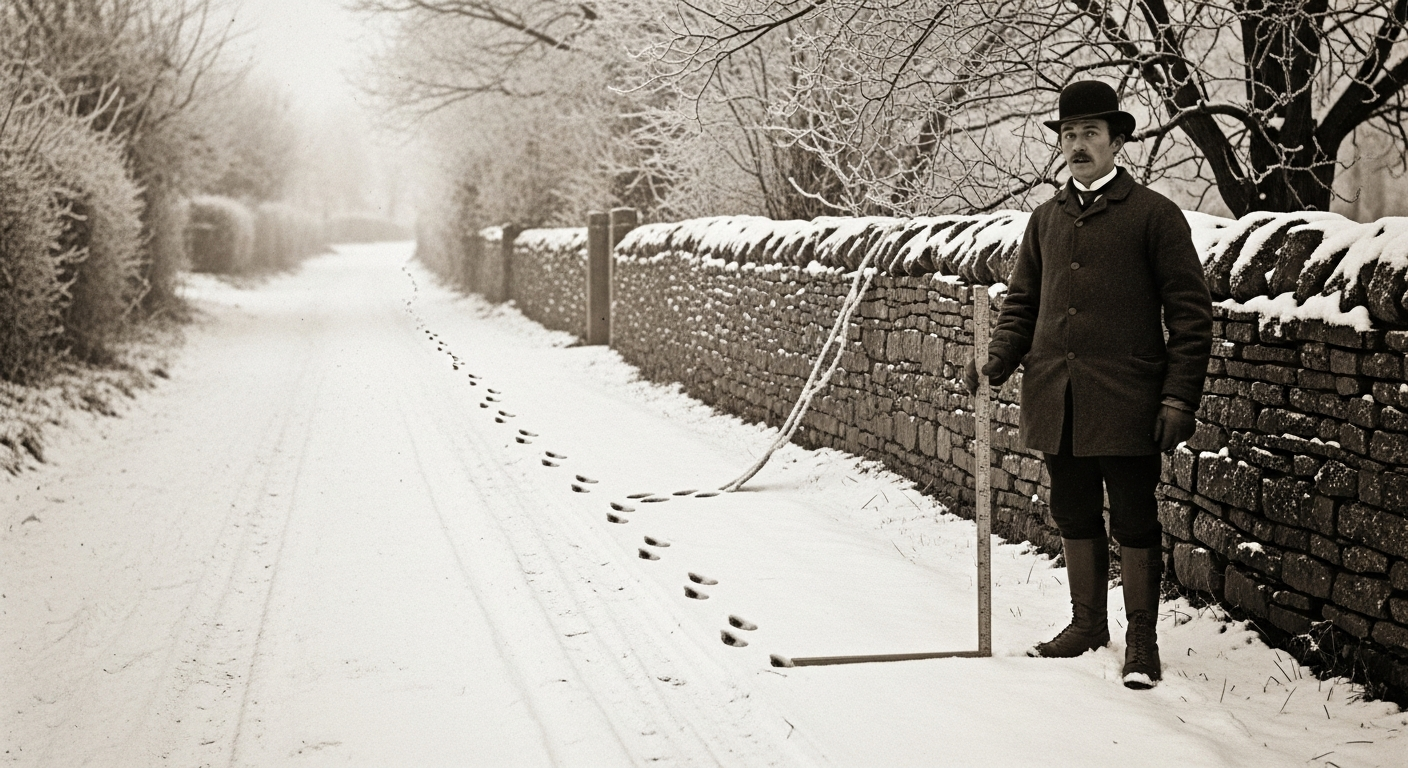
The Prints in the Snow: How a Devonshire Village Woke to the Trail of Something Impossible
QUIRK REPORTS — OFFICIAL CASE REPORT
CASE NUMBER: QR-2026-67112
🐾 THE DEVIL'S FOOTPRINTS: ONE HUNDRED MILES, ONE NIGHT, ZERO EXPLANATIONS 🐾
Classification: Strange Creature / Unexplained Phenomenon
Date of Event: Night of 8th–9th February, 1855
Location: Devon, England (Tiverton to Totnes; crossing the Exe Estuary)
Primary Witness: Reverend Thomas Carver
Report Filed: Quirk Reports Archive, Case QR-2026-67112
This report is based on documented paranormal accounts. Names and identifying details have been changed to protect those involved.
WITNESS STATEMENT
The morning of the 9th of February, 1855, began as any other winter morning in Devon — cold, quiet, and draped in a fresh overnight snowfall that had settled in an unbroken white sheet across churchyard walls and thatched rooftops alike. It did not remain quiet for long.
Reverend Thomas Carver, a man not given to fancy by his own repeated insistence, had risen before dawn to tend to his church as was his custom. Moving through the snow-blanketed churchyard in the pale pre-light, he almost missed them entirely. Almost. The prints were narrow — barely wider than a man's fist — pressed into the snow with a precision he later described as almost mechanical. Their shape resembled a small hoofprint, a narrow crescent, deeply indented and perfectly formed. They ran in a straight line from the direction of the churchyard wall toward the lane beyond.
He assumed, at first, that a pony or an errant goat had wandered through in the night. Then he noticed the prints were on top of the wall.
He climbed up. The impressions continued on the far side, identical in depth and spacing — over the lane, over a garden hedge, disappearing toward a row of cottages. Reverend Carver stood in the cold for a long moment, and by his own account, simply could not account for what he was looking at.
By mid-morning, he knew he was far from alone. Word had spread through the Exe valley with the breathless speed that only bad news in a small community can achieve. In Exmouth, fishermen reported the prints running the length of the harbour wall and vanishing at the water's edge. Across the Exe Estuary — more than two miles wide and frozen only at its margins — the same prints had been found emerging from the opposite shore at Dawlish, resuming without interruption, as though the river had presented no more obstacle than a pavement crack.
Local naturalist and schoolmaster Edmund Pryce assembled a group of men to follow the trail. What they found was, by any rational measure, impossible. The prints passed directly over a six-foot garden wall with no disturbance to the snow at the base on either side. They tracked across enclosed courtyards with locked gates. They were found on the rooftops of haystacks. They appeared at the entrances of several homes — and stopped. Not turning back. Simply stopping, as though the maker had passed clean through the door itself.
Pryce recorded his findings meticulously in a notebook. Each print measured approximately four inches across and three inches in depth. Their most unsettling characteristic, which he noted in careful, troubled prose, was that the snow showed no forward or rearward displacement — no drag, no scuff — only clean, vertical compression, as though something had descended straight down at each step and lifted straight back up.
"It is as though whatever made these marks descended vertically at each step, and lifted vertically at each departure. The snow is not dragged or displaced at the front or rear of each print, as one would expect. It is simply compressed, perfectly, again and again."
— Edmund Pryce, field notebook, 9th February 1855
Tracking reports placed the trail stretching over a hundred miles, from as far north as Tiverton, down through Cullompton, Exeter, and Exmouth, continuing south of the estuary through Dawlish and Teignmouth, and growing patchy only near Totnes. To cover that distance in a single winter night would have required a speed no known creature could sustain.
The story reached the national press within days. The Illustrated London News ran a lengthy feature on the 16th of February, prompting an avalanche of letters from scientists, clergymen, and amateur naturalists proposing explanations ranging from otters and badgers to escaped kangaroos from a travelling menagerie. A circus keeper was questioned and cleared. No explanation held.
Reverend Carver was measured and precise in his public statements. He confirmed he had examined the prints personally with a carpenter's rule, found them uniform throughout the stretch he inspected, and stated plainly that he could not account for their presence atop a six-foot wall with undisturbed snow on both sides.
One elderly woman whose cottage the trail had passed directly beside told her vicar she had heard something in the night — rhythmic, she said, and unlike any animal she had known in seventy years of rural Devon life. Her neighbours reported hearing nothing.
At a farmhouse outside Kenton, the prints led to the front door and stopped. The farmer — who gave his name to the press only as W. Hargreaves — bolted his shutters the following night and kept a fire until dawn. He did not say what he feared. He did not need to.
Reverend Carver lived for another twenty-three years. He never offered a definitive explanation. In a letter to a colleague near the end of his life, he returned to the subject one final time:
"Whatever passed through this village on the night of the eighth of February did not walk in the way that any creature I have ever known walks. It descended and it rose, step after step, mile after mile, and it passed through everything in its path as though the walls of men were of no consequence to it whatsoever. I do not know what that means. I am not sure I wish to."
— Reverend Thomas Carver, letter to a colleague in Exeter, circa 1878
EVIDENCE
- Physical traces: Cloven hoof-like prints, approximately four inches wide and three inches deep, pressed vertically into snow across a documented trail of over one hundred miles. Consistent in depth and spacing throughout all examined sections.
- Pryce's field sketches: Original drawings preserved in a regional archive. Show narrow crescent-shaped impressions with no forward or rearward snow displacement — inconsistent with any known walking gait.
- Corroborating witness accounts: Dozens of independent reports from multiple parishes across a broad geographic corridor, describing identical prints in consistent detail. Accounts came from fishermen, farmers, clergymen, naturalists, and ordinary villagers with no apparent connection to one another.
- Contemporary press coverage: The Illustrated London News, 16th February 1855, with illustrations derived from witness sketches. Substantial correspondence archive from credible witnesses across the county.
- Geographic anomalies: Trail documented crossing the River Exe at a point more than two miles wide, passing over six-foot walls, through locked courtyards, and terminating at — or through — the doors of multiple private dwellings.
- Auditory report: One elderly resident reported a rhythmic, unidentifiable sound during the night in question. Unverified; neighbours reported nothing.
FOX'S ANALYSIS
Right. Deep breath. Let me pour myself a coffee and try not to lose my mind over this one, because the Devil's Footprints of 1855 are, without question, one of the most extraordinary cases this reporter has ever had the pleasure of getting ink on his paws about.
Let's start with what we have. We have Reverend Carver — a clergyman, early riser, not a hysteric, and by every available account, a man whose idea of a wild evening was a careful measurement with a carpenter's rule. This is not your average eyewitness. This is a man who explicitly told the press he did not believe in demons "in the literal sense" — a phrase that does rather make you wonder about the non-literal sense — and who nonetheless went to his grave unable to explain what he had seen. That's not faith overriding reason. That's reason running out of road.
Then there's Pryce. A naturalist. A schoolmaster. A man who kept field notebooks. His observation that the snow showed no forward or rearward displacement is the detail that keeps me up at night — and I sleep in a foxhole, so that's saying something. Walking creatures drag and push snow. They don't descend and ascend vertically at each step, like some kind of unthinkably patient cosmic sewing machine stitching hoofprints across a hundred miles of English countryside. The physics of it don't work for any animal I've ever covered, and I've covered some weird ones.
Now, I'm a sceptic by profession and a cynic by personal experience — don't get me started on extraterrestrial medical procedures — so I'll acknowledge the alternative theories. The wood mouse prints enlarged by thaw-freeze cycles: plausible for one or two impressions on flat ground, implausible across rooftops and estuaries. Experimental balloons dragging anchor chains: I love the creativity, I truly do, but you cannot drag an anchor chain over a locked courtyard and through a farmhouse door. The conflation of multiple animal trails by a frightened rural population: possible for the outlying reports, but Pryce followed a single continuous trail for three miles himself, and he was not frightened. He was puzzled. There is a difference.
The kangaroo theory, I will admit, made me laugh. Not because it's impossible — escaped exotic animals do cause unusual tracks — but because the kangaroo would have needed to simultaneously cross a two-mile estuary, scale six-foot walls from a standing position, and move at roughly the speed of a locomotive. That's not a kangaroo. That's a superhero kangaroo, and even then I'd want to see its travel documentation.
I'll be honest with you, readers. When I look at this case — the geographic spread, the independent corroboration, the consistency of the physical description, the archival evidence that has survived 170 years — I feel something I don't feel very often. I feel like I genuinely don't know. And for a reporter who makes his living being professionally nosy, that's a humbling place to stand.
Could it be something atmospheric? Something seismic? Some confluence of natural forces we don't have a framework for? Maybe. But here's the thing about the prints stopping at those front doors: nature doesn't do that. Nature doesn't walk up to a door and stop. Whatever this was, it had intent. Or at least the appearance of it. And that, my friends, is the print that sticks.
You know what they say about Devon in February. If you're not careful, you'll get a bad case of the runs. A hundred miles of them, apparently.
On a more serious note: Reverend Carver's final letter is perhaps the most compelling piece of evidence in this entire file. Not because of what it claims, but because of what it doesn't. He doesn't say monster. He doesn't say miracle. He says: I looked carefully, and I cannot explain it, and I am not sure I want to. After twenty-three years of thinking about it. That is a man telling you the truth about the limits of his understanding, and those are the witnesses I trust most.
Whatever made those prints had one heck of a sole. And whatever it was — it left no forwarding address.