
The Owl That Was Not an Owl: How a Cornish River Valley Bred Britain's Strangest Feathered Terror
QUIRK REPORTS — OFFICIAL CASE FILE
Case Number: QR-2026-13859
EYES IN THE PINES: THE OWLMAN OF MAWNAN SMITH AND THE CREATURE THAT CORNWALL COULDN'T EXPLAIN
Classification: Cryptid — Winged Humanoid Entity
Date of Primary Incident: July 1976
Location: Mawnan Smith, Cornwall, England — woodland surrounding St Mawnan's Church
Primary Witness: Sandra Trewin (name changed)
Reporting Officer: Fox Quirk, Founder, Quirk Reports
This report is based on documented paranormal accounts. Names and identifying details have been changed to protect those involved.
WITNESS STATEMENT
The village of Mawnan Smith, perched quietly above the Helford River in Cornwall's far southwest, is not the sort of place that invites notoriety. Its ancient oaks, salt-tinged air, and a parish church of considerable age make it a destination for watercolour painters and birdwatchers, not paranormal investigators. That changed irrevocably in the long, hot summer of 1976.
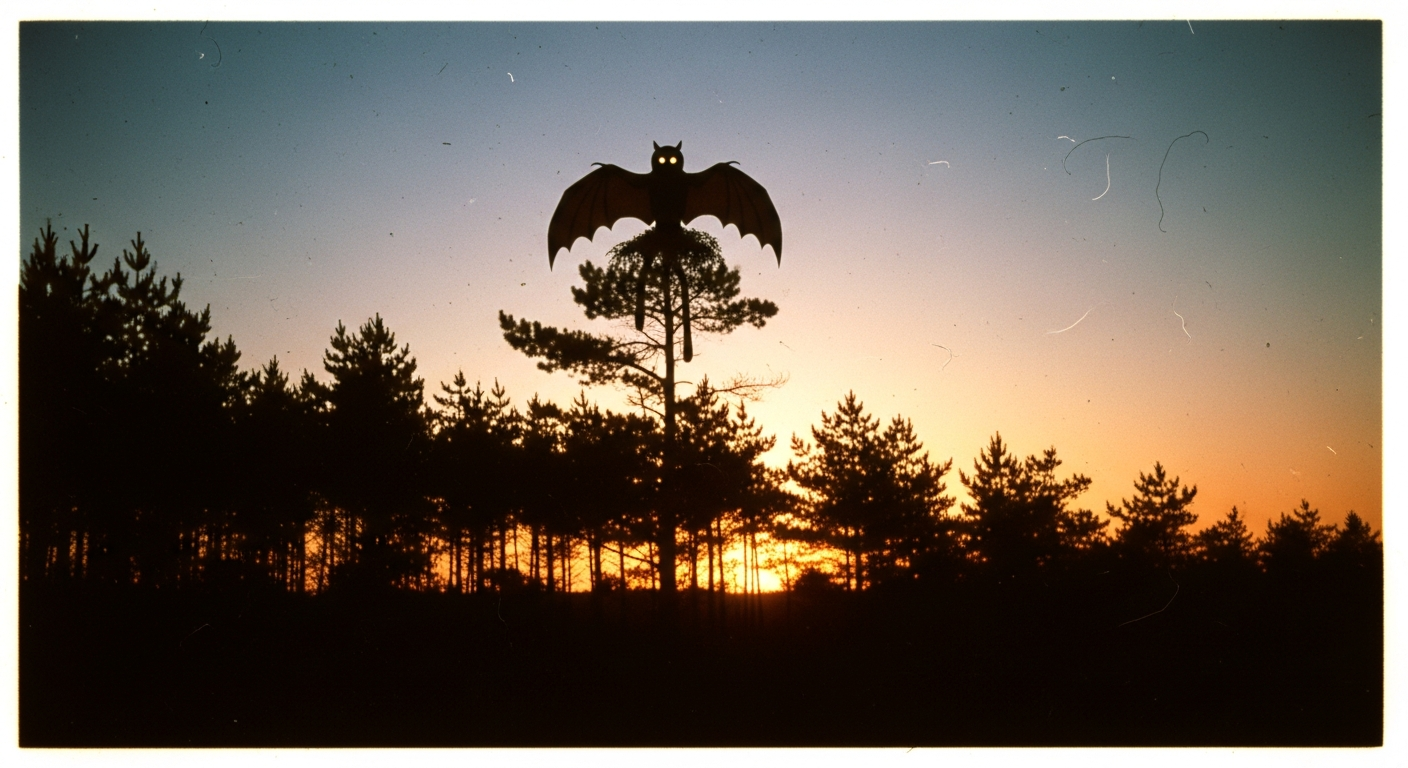
The groundwork had been laid in April of that year, when two young girls holidaying with their family reported seeing a vast, feathered, humanoid creature hovering above the tower of St Mawnan's Church. Their father, sufficiently alarmed, cut the holiday short and forwarded a sketch — drawn by his eldest daughter — to a local Fortean researcher. The drawing depicted something like an enormous owl rendered in human proportions: upright body, wide dark wings, and eyes described as glowing like hot coals. The family departed without giving interviews, and the account might have slipped quietly into obscurity.
It did not.
Sandra Trewin was fourteen years old that July. Staying with her family at a campsite approximately one mile from the village, she had spent the afternoon walking the wooded paths toward the Helford River — a route she knew from previous holidays. The evening light was still warm and golden between the trees when she rounded the path bordering the churchyard and stopped.
Something was hovering above the pine canopy.
Sandra later described the encounter in notes shared with a researcher. The creature's wingspan, she estimated, measured five to six feet across. Unlike any bird she had seen, it held itself nearly stationary in the air — no frantic wingbeats, no gliding arc. Its body was upright. Its legs hung downward, ending in large, darkened claws. Its head was round in the manner of a barn owl's, but scaled to something far larger. And its eyes — she returned to the eyes repeatedly in her account — were circular, bright red, and fixed directly upon her.
"It wasn't looking past me or through me. It was looking at me. The way something looks at you when it has decided to look."
She ran. She did not stop until she reached the campsite, where her parents found her shaking and, for several minutes, unable to speak. When she recovered, she drew what she had seen. The sketch, later circulated among researchers, was striking in its consistency with the April drawing: the same hunched hovering posture, the same upright form, the same burning eyes.
The Falmouth-based Fortean researcher who had received the April sketch had spent weeks quietly gathering accounts in the area. When Sandra's report reached him through local contacts, he travelled to Mawnan Smith immediately — and found he was not short of material. He collected corroborating accounts from at least three additional witnesses, all centred within a few hundred yards of the church.
Two were teenagers from the Midlands, holidaying at a nearby campsite, who reported seeing the creature on consecutive evenings in the same stretch of pines. Their descriptions matched Sandra's closely. One reported an unusual auditory detail: "A low, hissing click — though I'll admit I can't be certain I didn't imagine it afterwards."
A third witness, an adult man walking his dog along the wooded lane toward the church in the early hours, described something large dropping silently from the trees as he passed beneath them. He caught only a brief glimpse, but what disturbed him most was not the scale of the creature. It was the silence. His dog, he noted, froze on the path and refused to move until the thing was gone.
The researcher spent several evenings in the churchyard himself. He recorded nothing conclusive, but noted one anomalous period of perhaps twenty minutes in the north-facing pines during which all birdsong and insect noise ceased entirely — an absence he found difficult to explain and was careful not to overstate.
Sightings in and around the same woodland continued intermittently for nearly two decades. American tourists in 1978 filed a written account describing a winged figure in the pines at dusk. A local teenager reported a brief encounter in 1989. In 1995, a visiting birdwatcher — a man with no interest in the paranormal — wrote a puzzled letter to a wildlife magazine describing a large, upright, winged creature that had watched him from a tree for several seconds before vanishing. No reply was published.
Sandra Trewin, interviewed again as an adult several years after the original sighting, had not altered her account in any material respect. She had spent time, she said, attempting to construct a rational explanation — an unusual angle of light, a large bird glimpsed at a distorting distance. She had not found one that satisfied her. What stayed with her, above all else, was that quality of deliberate attention. The sense, unmistakable and persistent, of being considered.
EVIDENCE
- Witness Sketches: Two independent drawings — one produced in April 1976 by a child witness, one by Sandra Trewin in July 1976 — described as near-identical in posture, form, and ocular detail, despite having been made by individuals with no known contact with one another.
- Corroborating Witness Accounts: A minimum of five separate witnesses across the summer of 1976, drawn from at least three unconnected parties, all reporting consistent descriptions of the entity within the same geographical area.
- Canine Behavioural Response: One witness reported their dog freezing on the path and refusing to move during the encounter — a response consistent with accounts of animals reacting to anomalous presences in other documented cases.
- Acoustic Anomaly: The investigating researcher noted an unexplained cessation of ambient sound — birdsong and insect noise — lasting approximately twenty minutes in the pine trees north of the church during one of his evening vigils.
- Extended Timeline of Reports: Independent accounts from 1978, 1989, and 1995, sourced from witnesses with no documented connection to one another or to the original 1976 cases, describing consistent entity characteristics in the same location.
- Mothman Parallel: Correspondence between researchers in late 1976 identified strong structural similarities between the Mawnan entity and Point Pleasant's Mothman — approximate size, hovering posture, luminescent eyes, and proximity to a site of historical significance.
FOX'S ANALYSIS
Right. Let me perch on this one for a moment. Perch. Because we're dealing with a giant owl-man. I'll see myself out — after I file this report.
I've covered a lot of strange cases in my career, and I've developed what I like to call my Nonsense Detector — finely tuned, thoroughly field-tested, and only occasionally wrong (the less said about the Roswell incident and what those grey-fingered nuisances did to my personal regions, the better). And what my Nonsense Detector is telling me here is: this one deserves serious attention.
Here's what I find genuinely compelling. Sandra Trewin's account is not the account of someone who saw something ambiguous and inflated it into a monster. It is specific, consistent across two separate interviews spanning years, and grounded in physical detail — the hanging legs, the stationary hover, the scale, the eyes. She actively tried to debunk herself. She went looking for a rational explanation and came back empty-handed. That is not the behaviour of a fantasist. That is the behaviour of someone who saw something real and found it inconvenient.
The sketch correlation is, frankly, extraordinary. Two drawings, made by different individuals who had no contact with one another, describing the same entity in the same location weeks apart. If you told me two strangers independently sketched the same postman, I'd be mildly impressed. Two strangers sketching the same hovering red-eyed owl-humanoid above a Cornish churchyard? That's either remarkable evidence or the most elaborate holiday prank Cornwall has ever produced. And I've been to Cornwall. They're more of a cream-tea-argument county than a conspiracy county.
The eagle owl hypothesis — the go-to sceptical explanation — has wings, I'll grant it that. Wings. But it doesn't fly. Eagle owls are large, yes, and unsettling up close, but they do not hover. They do not stand upright with pendulous legs. And they do not, in any documented instance, lock eyes with a teenage girl at close range and hold that gaze in a way she still remembers with clarity decades later. Behaviour matters in cryptid investigations. The behaviour described here is not eagle owl behaviour. It is something else's behaviour entirely.
The Mothman parallel gives me pause. Not because I think we're dealing with the same entity necessarily, but because the structural similarities — winged humanoid, glowing eyes, significant location, prolonged multi-witness sightings, no physical remains — suggest either a shared phenomenon operating across geography, or a shared psychological architecture in how humans perceive and report certain kinds of encounters. Both possibilities are worth taking seriously. I'm a fox who got probed by beings from another dimension — I've learned not to rule things out on grounds of inconvenience.
The acoustic anomaly reported by the researcher is the detail I keep returning to. Silence like that — a genuine, total cessation of ambient natural noise — is not something you manufacture with a large bird in a tree. That kind of silence has been reported in conjunction with other unexplained presences in enough credible accounts for it to constitute what I'd cautiously call a pattern. It doesn't prove anything. But it adds a layer that the eagle-owl explanation cannot account for.
In short: whatever Sandra Trewin saw in the pines above that Cornish churchyard, I believe she saw it. I believe the others saw it too. Whether it was flesh and blood, something older, or something that doesn't fit any category we currently have, I cannot say. But I'll tell you this — I'll be taking a very bright torch if Quirk Reports ever sends me to Mawnan Smith at dusk. And noise-cancelling headphones, for ironic reasons.
You might say the case has me... ruffled.
CREDIBILITY RATING
Rating: 8 / 10
Reasoning:
- Multiple independent witnesses (+2): A minimum of five separate witnesses across 1976 alone, from at least three unconnected groups, with consistent descriptions of the entity.
- Corroborating sketches (+2): Independent drawings produced without cross-contamination showing near-identical physical characteristics.
- Extended longitudinal timeline (+1): Consistent sightings spanning nearly two decades, from witnesses with no known connection to earlier reports.
- Witness self-scrutiny (+1): Sandra Trewin's documented attempt to rationalise the encounter before confirming her original account significantly strengthens her credibility.
- Lack of physical evidence (-1): No feathers, markings,