
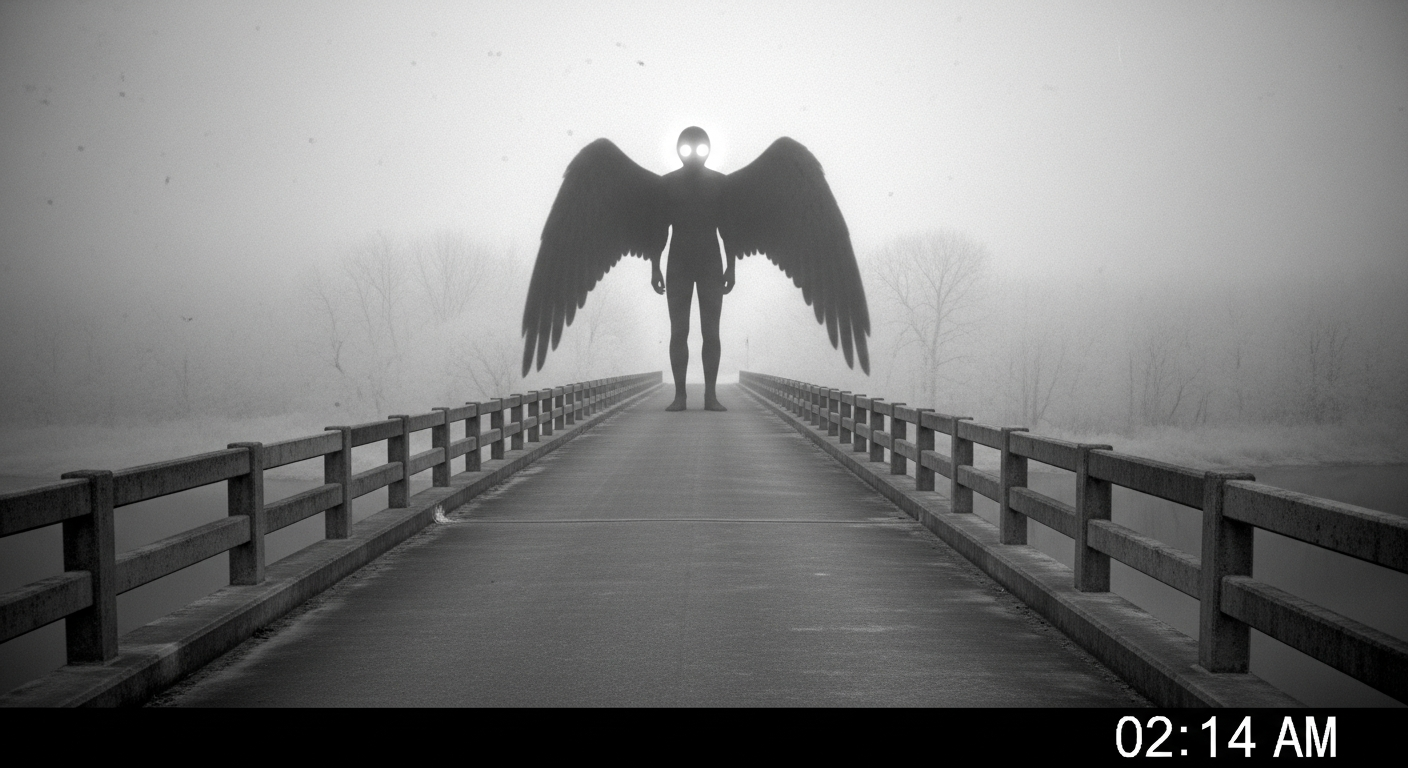
The Moth-Winged Thing Over the Bridge: How a West Virginia Town Was Stalked by a Monster With Eyes Like Fire
QUIRK REPORTS — OFFICIAL CASE FILE
CASE NUMBER: QR-2026-83817
WINGS OF DOOM OVER POINT PLEASANT: THE MOTH-WINGED THING THAT WATCHED A TOWN DIE
Classification: Cryptid — Winged Humanoid / Harbinger Entity
Date of Events: November 1966 – December 1967
Location: Point Pleasant, West Virginia, USA
Primary Witness: Roger Calloway (name changed)
Reporting Officer: Fox Quirk, Founder and Senior Investigator, Quirk Reports
This report is based on documented paranormal accounts. Names and identifying details have been changed to protect those involved.
WITNESS STATEMENT
On the night of 15 November 1966, Roger Calloway was twenty years old and doing what twenty-year-olds do — driving somewhere he probably shouldn't with people he probably should have known better than to follow. He, his girlfriend Sandra, and another couple, Dean and Patty Hoskins, had taken a late-night drive out to the TNT Area: a decommissioned World War II munitions site on the outskirts of Point Pleasant, a tangle of abandoned concrete igloos and dark woodland that locals visited specifically for its atmosphere of low-grade menace.
That night, the menace showed up in person.
As Roger's headlights swept across one of the derelict structures, they illuminated a figure. Tall — seven feet at minimum. Humanoid in shape but fundamentally, disturbingly wrong: shoulders too wide, arms too long, with enormous wings folded against its back like a coat it hadn't bothered to take off. All four witnesses agreed without hesitation on the worst detail. The eyes. Two points of deep, burning red light that were not the passive reflection of an animal caught in headlights, but something self-generated. Something alive and attentive.
Roger reversed at speed and fled toward town along Route 62. The creature did not chase them on foot. It opened its wings — a span later estimated at ten feet or more — and flew. It kept pace with the car at over a hundred miles per hour before banking silently away as the lights of Point Pleasant appeared ahead.
The four went directly to the sheriff's office. Deputy Martin Frazee, who took their statements that night, recalled later that the witnesses were unambiguously distressed.
"They weren't drunk. They weren't joking around. Whatever they'd seen had genuinely terrified them."
A search of the TNT Area the following morning found nothing. No tracks. No feathers. No physical traces of any kind. But within forty-eight hours, the phone lines at the sheriff's office and the local newspaper were busy. A contractor reported seeing the same grey figure standing in his garden at dusk, staring at his house. A woman reported it crouching on her roof at night, watching her through her bedroom window. Two volunteer firemen spotted a winged shape crossing the road ahead of them, heading toward the river.
The local paper named it the Mothman. The name invited ridicule from elsewhere. In Point Pleasant, nobody was laughing.
The sightings continued with grim regularity for thirteen months. A schoolteacher reported it perched on the courthouse roof at three in the morning. Children playing near the river described it landing in a nearby field and watching them in silence before rising, effortlessly, into the air. A truck driver reported it pacing his vehicle for four miles at highway speed before turning toward the river. In total, researcher Philip Strand documented over a hundred separate witness accounts, from people who had no connection to one another and had not compared notes.
The descriptions were consistent to an unsettling degree. Seven to eight feet tall. Grey or dark brown. Humanoid torso. Featureless face save for those eyes — described by one witness as
"like looking into two small furnaces."
The sightings clustered in two locations: the TNT Area, and the Silver Bridge, a 700-foot suspension structure spanning the Ohio River. Multiple witnesses reported seeing the creature perched on or hovering near the bridge's towers in the weeks leading up to Christmas 1967.
On the evening of 15 December 1967, at 5:04pm, during rush hour, the Silver Bridge collapsed into the Ohio River. Forty-six people died. The official investigation attributed the disaster to a stress fracture in a single suspension component that had gone undetected for years.
The Mothman sightings stopped the same night. Completely. Permanently.
Roger Calloway, interviewed by Strand in the spring of 1968, said what many Point Pleasant residents felt but couldn't quite articulate:
"It's like it got what it came for. I don't know if it caused the bridge to fall. I don't know if it was warning us. I don't know what it was. But it came, it watched us for a year, and then it left when forty-six people died. You can't make that mean nothing."
Years later, Roger had married Sandra, had children, built a life. He still didn't park near the river at night. He still didn't cross bridges after dark if he could help it.
EVIDENCE
- Eyewitness testimony: Over one hundred separate witness accounts documented by researcher Philip Strand across the thirteen-month sighting period, from witnesses with no known contact with one another.
- Law enforcement corroboration: Deputy Martin Frazee confirmed the visible distress of the first four witnesses and validated the credibility of their initial report.
- Consistency of description: Independent witnesses produced near-identical physical descriptions — height, wingspan, colouration, facial features, and the specific quality of the eye illumination — without apparent coordination.
- Geographical clustering: Sightings concentrated around the TNT Area and the Silver Bridge, the latter being the site of the subsequent structural disaster.
- Temporal correlation: The complete and abrupt cessation of sightings on the night of the Silver Bridge collapse, after thirteen months of near-daily reports, represents a statistically remarkable coincidence at minimum.
- Physical evidence: None recovered. No tracks, feathers, biological material, or physical traces were found at any sighting location.
- Sceptical explanations on record: Sandhill crane and barn owl identifications were proposed by ornithologists and biologists. Both were dismissed as inadequate by the consulting experts themselves and rejected by witnesses.
- Published research: Philip Strand's 1975 account remains a primary documentary source, drawing on six weeks of on-the-ground interviews and over a hundred individual testimonies.
FOX'S ANALYSIS
Alright. Let me put my notebook down for a second and talk to you straight, the way I do when a case has genuinely gotten under my fur.
I have covered a lot of ground in my career. I have interviewed people who claimed to have seen everything from lake monsters to levitating grandmothers. I approach every report with scepticism intact and press pass ready. And I will tell you without embarrassment that the Mothman case is the one that keeps me up at night — and not just because I spent three hours going over Strand's original testimony files with a cold cup of coffee at two in the morning. (Though I did. Don't judge me. A fox's gotta do what a fox's gotta do.)
Here is what I cannot dismiss: one hundred independent witnesses. Not a rumour chain. Not a game of telephone played by bored teenagers. One hundred people, spread across thirteen months, who had no demonstrated contact with one another, producing descriptions so consistent you could have used them to file a police composite. The eyes alone — that specific quality of self-generated light, described identically by a schoolteacher, a truck driver, two firemen, and a group of children — that is not the kind of detail that propagates through social suggestion. That is the kind of detail that comes from seeing the same thing.
The sandhill crane theory? Please. With respect to my ornithologist colleagues, a sandhill crane does not keep pace with a vehicle at 100 miles per hour. A sandhill crane does not crouch on a courthouse roof and stare down at the street. And a sandhill crane does not — does not — have eyes like two small furnaces. I've seen sandhill cranes. They're magnificent birds. They are not this. That explanation has more holes in it than a bridge with a stress fracture. Which, speaking of — too soon? Probably too soon. I apologise to the people of Point Pleasant. Only partially.
Now. The bridge. This is where my reporter's instincts get complicated and my personal feelings about unexplained aerial entities get involved. I want to be careful here, because forty-six people died, and I am not in the business of making entertainment out of genuine tragedy. But the correlation between thirteen months of creature sightings clustering around a specific structure and that structure's catastrophic failure on the night the sightings ended? That is not something I can file under coincidence and move on. It is either the most extraordinary accident of timing in paranormal history, or it is something that demands a harder look than the official record has given it.
Was the Mothman a harbinger? Was it causing the disaster or trying to prevent it? Was it something extraterrestrial, something mutated, something folkloric? I genuinely do not know. And I say that as someone who has a fairly robust personal opinion about things that arrive uninvited from the sky. (Don't get me started. The aliens get their own editorial some other time. This is Mothman's case.)
What I do know is this: Roger Calloway still doesn't cross bridges after dark. And after sitting with this file for as long as I have, I find that I understand him completely. You could say his caution is well-founded — he's really bridging the gap between rational fear and hard experience. Some things, once seen with those kinds of eyes watching you, change the geometry of the world. They don't unhappen. The TNT Area gave Point Pleasant something it has never fully put down, and no amount of festival merchandise and Mothman statues changes what those thirteen months actually felt like to the people who lived through them.
This case is one of the most compelling in the Quirk Reports archive. I am recommending it for our highest credibility rating. I am also recommending that anyone planning to visit Point Pleasant check the structural integrity of local bridges before making the crossing.
I'm not joking about that last part.
CREDIBILITY RATING
Rating: 9 / 10
Reasoning:
- Witness volume: Over one hundred documented accounts from independent witnesses across a thirteen-month period is exceptional by any standard of paranormal investigation.
- Consistency: The physical description remained stable across witnesses with no demonstrated coordination, including specific details — eye quality, wingspan, flight behaviour — that are not easily explained by shared cultural suggestion.
- Law enforcement validation: First-hand police confirmation of witness credibility and distress at the time of initial report.
- Temporal correlation: The precise cessation of sightings on the night of the Silver Bridge collapse, after near-daily reports for over a year, is a datum that no sceptical explanation has adequately addressed.
- Emotional authenticity: Long-term behavioural changes in primary witness (Roger Calloway's enduring avoidance of bridges and riverbanks) suggest genuine traumatic experience rather than fabrication or exaggeration.
- Deduction of one point: Complete absence of physical evidence prevents a perfect score. No biological traces, no photographic documentation, and no physical recovery from any s