
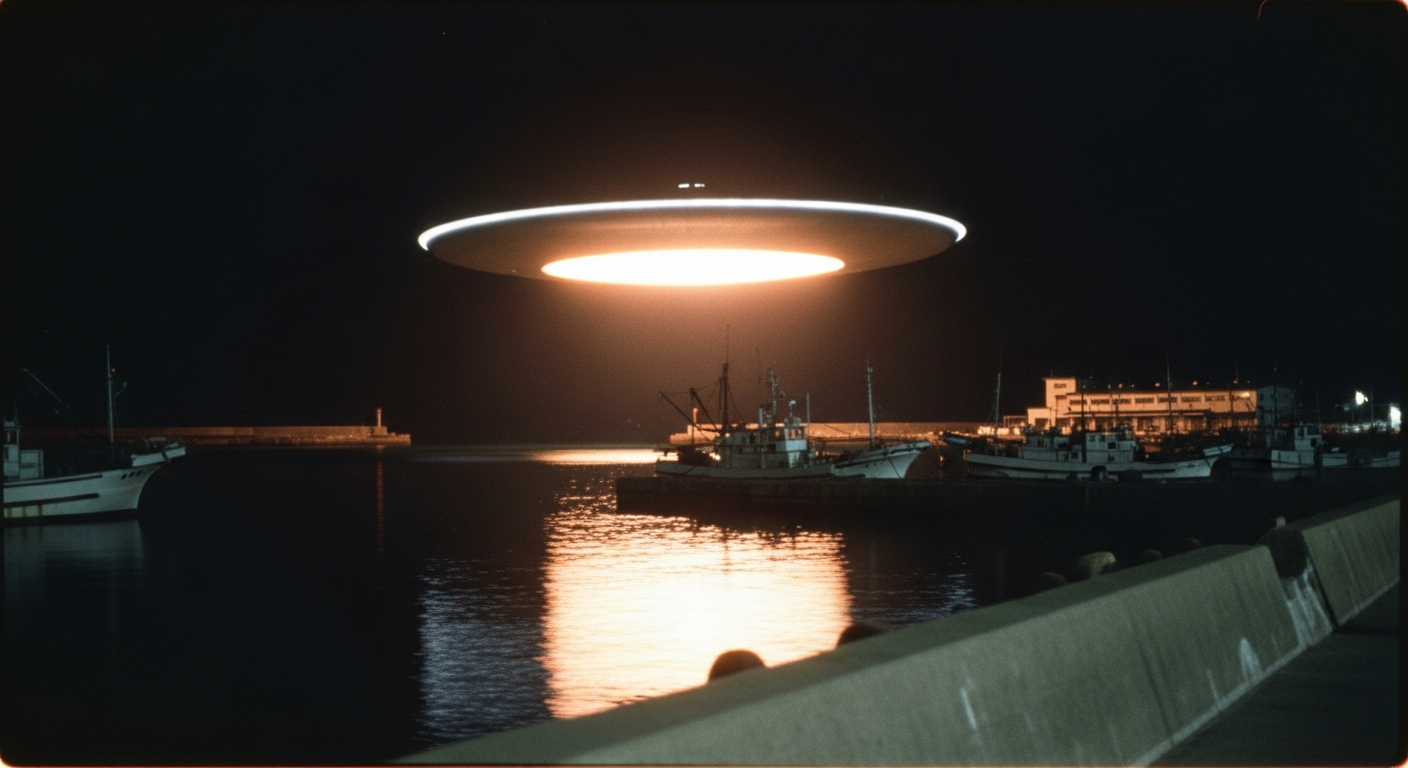
The Light That Swallowed the Night: How a Japanese Harbour Town Was Buzzed by a Craft the Size of a Football Pitch
QUIRK REPORTS — OFFICIAL CASE FILE
Case Number: QR-2026-44555
THE LIGHT THAT SWALLOWED THE NIGHT:
FOOTBALL PITCH–SIZED CRAFT BUZZES JAPANESE HARBOUR FOR TWENTY-THREE MINUTES STRAIGHT
Classification: UFO/UAP — Close Encounter of the First Kind (Mass Witness Event)
Date of Event: August 1975 (approx. 1:47 AM – 2:11 AM JST)
Location: Niigata Prefecture, Japan — Coastal Harbour, Sea of Japan
Primary Witness: Kenji Matsumori, Harbour Authority Officer
Filed by: Fox Quirk, Founder & Chief Investigative Reporter, Quirk Reports
This report is based on documented paranormal accounts. Names and identifying details have been changed to protect those involved.
WITNESS STATEMENT
Kenji Matsumori had worked the graveyard shift at the harbour authority office for eleven years. An meticulous, methodical man by all accounts — the kind who double-checked his logs and trusted what the instruments told him — he was not the sort to startle easily. On an August night in 1975, something startled him considerably.
At approximately 1:47 AM, Matsumori noticed a pale, diffuse glow reflected in the dark glass of his office window. Assuming a fishing vessel had activated a searchlight, he turned to look directly — and immediately pushed back from his desk and stood.
Hovering above the outer harbour wall, roughly three hundred metres distant and no more than a hundred and fifty feet above the water, was an object of extraordinary size. Matsumori's immediate and unwavering impression was that it was at least the size of the local school football pitch. Roughly oval or disc-shaped, its edges appeared to blur slightly, as though the surrounding air was disturbed or heated. Its underside emitted a steady, pulsing light cycling between pale white and deep amber — bright enough to throw the moored fishing boats beneath it into sharp silhouette against the harbour wall.
He described his initial reaction not as fear, but as a kind of enforced stillness: "My body had made a decision that my mind had not yet caught up with." He stood at the window for nearly a minute before reaching for his radio.
He was, by that point, already behind the curve. Two officers from the nearby police koban — Officer Daiki Horikawa and Officer Fumiko Shiraishi — had been on a routine patrol break outside the harbour gate when the glow appeared. Horikawa initially assumed a vessel was on fire. When no heat arrived and no sound followed, the two officers moved towards the harbour wall for a closer look. Their subsequent written statements, filed independently, matched Matsumori's account with striking precision: a vast, silent, disc-shaped form hovering over the water, its underside pulsing in rhythmic shades of white and amber. Officer Shiraishi noted that the craft appeared entirely seamless — "smooth, almost organic" — and observed that the fishing boats moored beneath it were rocking gently in a slow radial pattern, as though stirred by a circular current in the water below.
Within minutes, at least a dozen witnesses had gathered along the harbour wall. Fishermen preparing for an early departure had abandoned their work entirely. A lorry driver delivering to the fish processing plant had pulled over and climbed onto his cab. A local woman walking her dog stood motionless on the harbour road for the full duration of the event. She later declined to give her name publicly, which, given the circumstances, seems entirely reasonable.
The object remained stationary for an estimated eighteen to twenty minutes — an almost unheard-of duration in reported UAP events. Throughout that time, every witness independently noted the same detail with particular emphasis: the craft was absolutely silent. The fishermen, accustomed to the constant noise of engines and machinery, found the total absence of sound profoundly unsettling. Officer Horikawa noted that even the ambient sounds of the harbour — lapping water, creaking ropes, a distant dog — seemed muffled, as though the air itself had thickened.
At approximately 2:09 AM, the object's light intensified sharply. Several witnesses shielded their eyes. When they looked back, the craft had relocated — not gradually, not in a visible arc, but instantaneously. It was now roughly half a kilometre out to sea at the same altitude, with no observable transit between positions. It held this new position for approximately forty seconds before its light deepened from amber to what witnesses variously described as red-orange, rust-coloured, or "the colour of a dying coal." Then it accelerated out over the Sea of Japan and was gone in under two seconds.
Matsumori would later say that the speed had made him feel physically ill to watch — not from threat, but because "the speed was wrong in a way that my brain refused to properly process." The harbour fell silent. Nobody spoke. Then the fishermen all began talking at once.
Matsumori's harbour log survives. At 1:47 AM, in neat official script: "Unidentified luminous object, outer harbour, altitude approx. 150 feet. Duration of observation ongoing." At 2:11 AM: "Object departed seaward at high speed. Duration approx. 23 minutes. All harbour personnel present confirm sighting." Bureaucratic understatement has rarely carried more weight.
EVIDENCE
- Primary Documentary Evidence: Matsumori's official harbour authority log, containing two timestamped entries made during the event itself — contemporaneous, professional, and unambiguous.
- Multiple Independent Witness Accounts: Minimum twelve witnesses confirmed, including two police officers (Horikawa and Shiraishi), harbour workers, fishermen, a lorry driver, and a civilian pedestrian. All independent accounts are mutually consistent on size, shape, light behaviour, silence, and movement characteristics.
- Physical Observations: Fishing vessels observed rocking in a radial pattern beneath the craft, noted independently by Officer Shiraishi and corroborated by fishermen present on the dock.
- Sound Anomaly: Multiple witnesses independently reported unusual muffling of ambient harbour noise during the event — a consistent and unexplained environmental detail.
- Official Military Interest: Representatives from the Japan Air Self-Defence Force arrived the following afternoon, conducted two days of witness interviews and site examination. Their report was never made public. Draw your own conclusions. I certainly have mine.
- Civilian Research Documentation: The case entered the files of multiple Japanese civilian UFO research groups and was subsequently documented by international investigators specialising in Pacific-region incidents.
- Absence of Conventional Explanation: Weather balloon, atmospheric plasma, and misidentification hypotheses all fail to account for the object's size, twenty-three-minute stationary duration, instantaneous repositioning, or final acceleration.
FOX'S ANALYSIS
Right. Let me loosen my flat cap, crack my knuckles, and give this one the full Quirk treatment — because this case deserves it.
I'll be straight with you: in fifteen years of chasing lights in the sky, crop circles of dubious origin, and enough blurry photographs to wallpaper a stadium, the Niigata harbour encounter is one of the cases that genuinely keeps me up at night. And I say that as a fox who already has plenty of reasons to lose sleep over extraterrestrial visitors. Personal reasons. Anatomical reasons. We don't need to get into it.
What makes this case so compelling isn't any single element — it's the architecture of the whole thing. You've got a primary witness who is, by every professional measure, exactly the kind of person you'd want watching your harbour at two in the morning: experienced, systematic, unflappable, and apparently constitutionally incapable of embellishment. Matsumori filed a log entry during the encounter. During it. That's not the behaviour of someone constructing a story after the fact. That's a harbour officer doing his job in the middle of something that had no business happening. The man was writing down notes while a craft the size of a football pitch hung over his harbour. I respect that professionally. It's exactly what I would have done. Right after I'd finished having a small personal crisis in the corner.
Then you add the police officers — two of them, statements filed separately, cross-referencing perfectly without collusion. You add the fishermen, the lorry driver, the unnamed dog-walking woman who, frankly, showed tremendous composure given the circumstances. Twelve-plus witnesses, no significant contradictions, a twenty-three-minute window, and a contemporaneous written record. I've seen murder trials built on thinner foundations than this.
The silence detail is the one that really gets under my fur. Experienced maritime workers — people who live inside an ocean of engine noise and industrial sound — independently flagging not just the craft's silence, but an active dampening of ambient sound around it. That's not a shared hallucination. That's a physical phenomenon. Something was doing something to the air in that harbour, and nobody on Earth in 1975 — or, I'd argue, today — has a satisfying explanation for what it was.
Now, could I play devil's advocate? Sure. I'm a journalist; playing devil's advocate is basically my second job, right after wearing this hat. Could mass hysteria explain the consistency? Theoretically. Does it? No. Mass hysteria produces escalating, diverging accounts, not twelve independently stable testimonies filed over weeks. Could it have been some experimental military aircraft? Possible, but then why did the Japan Air Self-Defence Force turn up the very next day like they'd already had the address written down? You don't dispatch military investigators to a weather balloon, folks. That's a saucer-shaped hole in someone's classified budget, and I'd stake my press pass on it.
The instantaneous repositioning is where I part ways entirely with the conventional-explanation crowd. You want to tell me a plasma phenomenon moved half a kilometre with no transit time? I'd say that theory has a few holes in its atmosphere. And the final acceleration — gone in under two seconds from a standing hover — that's not aerodynamics. That's something else entirely. Something that, in my considerable and personally traumatic experience, tends to leave a fellow feeling quite small and quite certain that the universe has not fully introduced itself yet.
Matsumori said it best, I think. His understanding of what was possible had been permanently amended, and there was no amending it back. I know that feeling. I know it in a very specific, non-consensual, probe-related way. But the point stands universally: some things, once seen, cannot be unseen. This harbour full of practical, unromantic working people saw one of those things on an August night in 1975, and fifty years later, nobody — not the government, not the scientists, not the debunkers — has given them a better answer than the one staring up at them from Matsumori's log book.
Unidentified luminous object. Duration 23 minutes. All harbour personnel confirm.
You could say this case is harbour-ing some serious secrets. And unlike the Japan Air Self-Defence Force, I intend to find them.
CREDIBILITY RATING
Rating: 9 / 10
Reasoning:
- Multiple independent witnesses (high weight): Twelve-plus confirmed witnesses from varied professional backgrounds, with no prior acquaintance between several of them. Statements filed independently and cross-referencing consistently.
- Professional primary witness (high weight): Eleven-year harbour authority veteran with documented reliability. Contemporaneous log entries made during the event are an exceptional and