
The House That Turned on Itself: How a Quiet Cardiff Street Was Terrorised by an Invisible Force
QUIRK REPORTS — OFFICIAL CASE FILE
Case Number: QR-2026-79583
THINGS THAT GO SMASH IN THE NIGHT: THE CARDIFF POLTERGEIST THAT REARRANGED A FAMILY'S LIFE — AND THEIR CROCKERY
Classification: Poltergeist Activity — Major Incident
Date of Event: March – July 1989
Location: Cardiff, Wales, United Kingdom
Primary Witness: Margaret Hayward (name changed)
Reporting Investigator: Fox Quirk, Founder, Quirk Reports
This report is based on documented paranormal accounts. Names and identifying details have been changed to protect those involved.
WITNESS STATEMENT
Margaret Hayward was, by every account, not the kind of woman who invented things. A school dinner lady of six years' residence on an unremarkable Cardiff street, she had no history of fantasy, no appetite for the dramatic, and no prior interest in the paranormal. All of that was beside the point by the time the stones started arriving.
It began on a Tuesday in early March 1989. Margaret was standing at her kitchen sink when a small, smooth pebble struck the window — from the inside. The stone came to rest on the draining board as though placed there deliberately. She was alone in the room. She put the stone in the bin and tried to move on. The house had other ideas.
Over the following weeks, the incidents multiplied with what witnesses would later describe as a horrible sense of purposefulness. Pebbles materialised inside locked rooms. Furniture relocated itself overnight. Margaret's eleven-year-old daughter, Ceri, woke on more than one occasion to find her wardrobe on the opposite side of her bedroom. Margaret's husband David — a depot worker and committed sceptic — returned home one evening to find every kitchen cupboard standing open. He began closing them in sequence. By the time he reached the last, the first was open again.
The family endured in silence for weeks, reluctant to invite the particular British embarrassment that attaches to paranormal claims. Then, in April, the fires began.
Scorched scraps of newspaper appeared in the hallway. Curtains ignited. On one night, the living room carpet caught fire at its centre with no proximate heat source. The fire brigade attended and found no explanation. An attending officer noted formally that the burn pattern was inconsistent with any dropped or discarded flame source.
It was the fires that finally drove Margaret to call the police. The first officer to respond — recorded in contemporary documents only as PC R. Davies — arrived expecting a gas leak or a domestic dispute dressed in supernatural clothing. During his visit, a china ornament rose from the mantelpiece, arced slowly across the living room, and shattered against the far wall. Davies was six feet away. No one was near the mantelpiece. He filed his report with what investigators later described as visible reluctance, stating that he could provide no rational account of what he had witnessed.
The Society for Psychical Research dispatched a team in late April, led by researcher Dr. Philip Garrett, a psychologist with fifteen years of investigative experience and a formidable record of debunking fraudulent cases. He expected to be home within three days.
He stayed for six weeks.
Garrett's team documented one hundred and twenty separate incidents: stones appearing inside sealed rooms, sometimes warm to the touch; seventeen spontaneous fires; wholesale furniture rearrangement; crockery destroyed or relocated; and — most disturbingly — physical contact. Both Margaret and Ceri reported being touched, pushed, and scratched by something invisible. Three parallel marks running from Ceri's elbow to her wrist were photographed and assessed by a consulting dermatologist, who confirmed they were consistent with fingernail contact and inconsistent with self-infliction at the angle shown.
The neighbours were not spared. The retired couple next door — referred to in the record as the Bevans — reported stones striking their shared garden wall on fourteen separate occasions, always in the evening, always when the Hayward garden was visibly empty. A geologist at Cardiff University analysed the collected stones and found their composition matched no local material. Several specimens were consistent with geological deposits found only in the Brecon Beacons, some thirty miles distant.
The case reached its crescendo on the night of 14th May. Ceri had been sent to her grandmother's the previous day, in an attempt to establish whether she was the locus of the activity. The incidents continued without her. At 10:45 PM, with Margaret, David, Garrett, and two other investigators present in the sitting room, every light in the house extinguished simultaneously. Battery-powered recording equipment continued to function. The surviving audio captures, in sequence: heavy footsteps ascending the staircase, the sound of drawers opening in an upstairs bedroom, a long low exhalation described by Garrett as almost but not quite human
, and then a tremendous crash from the kitchen.
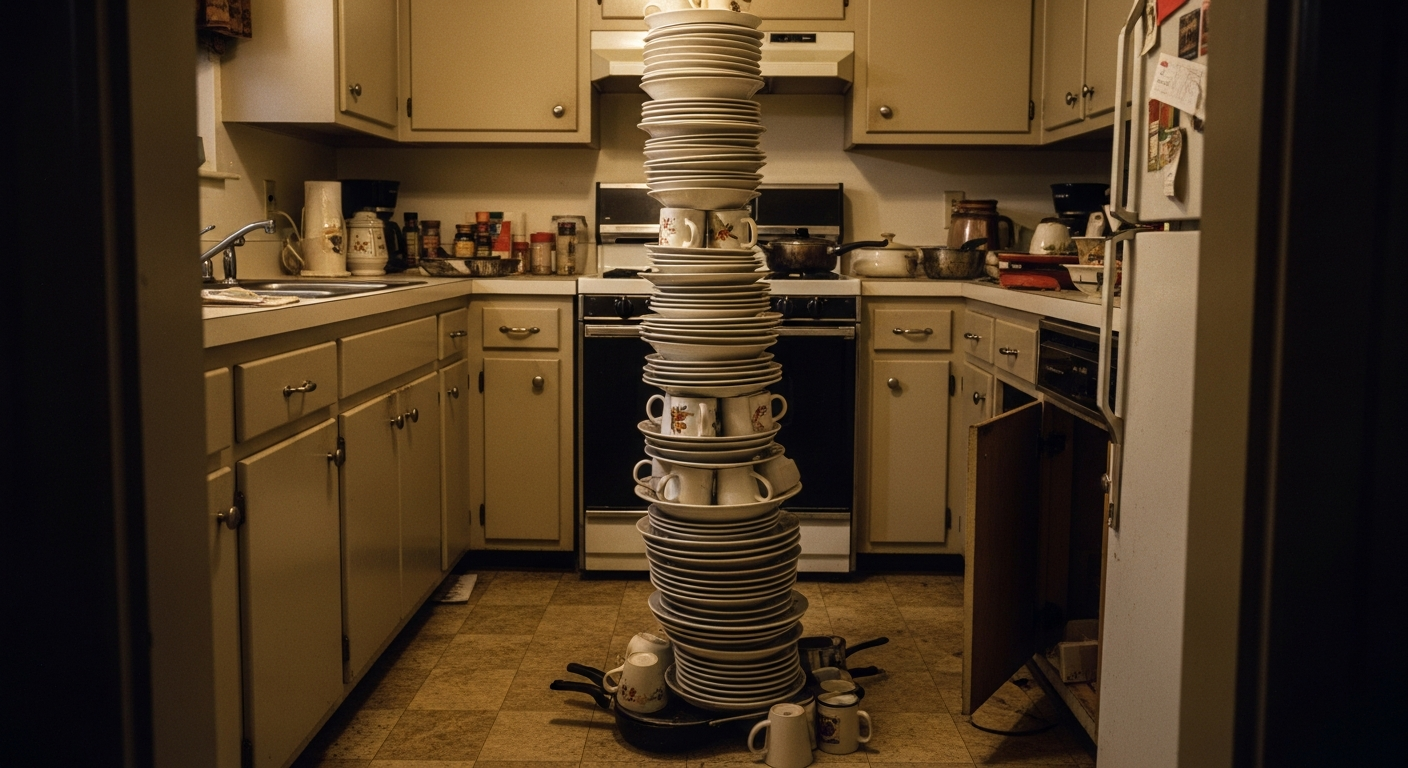
When torchlight reached the kitchen, every item of crockery, glassware, and cookware in the house had been removed from its place and stacked in a single pile in the centre of the kitchen floor. Three feet high. Nothing broken. Garrett described it as constructed with deliberate and almost architectural precision.
Margaret Hayward sat down on the kitchen floor and wept.
The activity subsided through June and ceased entirely by mid-July. The Haywards remained in the property for another year before moving — not, Margaret would clarify in a 1993 interview, because of any further incidents, but because the house had become impossible to inhabit emotionally. I could never feel comfortable in a house where I'd seen those things,
she explained. You can tell yourself it's over, but you can't make yourself believe it.
Two families subsequently occupied the property over the following decade. Neither reported any unusual activity.
Margaret, now retired and living elsewhere in South Wales, rarely discusses the case. When she does, she returns always to the same conclusion: I don't know what it wanted. But it knew we were there. That's the part that stays with me. It knew we were there.
EVIDENCE
- Physical — Stone specimens: Stones collected from the Bevan property on fourteen occasions. Geological analysis by Cardiff University confirmed composition inconsistent with any local material, with several specimens matching deposits in the Brecon Beacons, approximately thirty miles away.
- Physical — Scratch marks: Three parallel marks on Ceri's arm, photographed by Garrett's team and assessed by a dermatologist as consistent with fingernail contact, inconsistent with self-infliction at the angle shown.
- Physical — Fire damage: Seventeen documented fire incidents. Fire brigade attending officers recorded that scorch patterns were inconsistent with any conventional ignition source.
- Audio recordings: Recordings made on the night of 14th May survive and have been subjected to acoustic analysis. They capture footsteps, drawer movement, an anomalous exhalation sound, and the kitchen incident in sequence.
- Corroborating witness — PC R. Davies: Independent police witness to the flying ornament incident. Filed a formal report acknowledging the event with no rational explanation offered.
- Corroborating witness — The Bevans: Neighbouring couple who independently reported and collected stones from their garden on fourteen separate occasions.
- SPR Report: Dr. Garrett's full report submitted to the SPR archives in late 1989, documenting one hundred and twenty separate incidents across six weeks of on-site investigation.
- Psychological assessments: Both Margaret (adult assessment) and Ceri (child psychologist assessment) were found to present no indicators of fabrication, fantasy-proneness, or capacity for sustained fraud.
- Character investigation — David Hayward: Investigators independently verified his whereabouts on key dates via workplace colleagues. No evidence of staging found.
FOX'S ANALYSIS
Right. I'll be straight with you. I've been doing this long enough that most cases come in two flavours: interesting but explainable and interesting but probably explainable. Cardiff 1989 is sitting in a third category I don't open very often, and it's making me uncomfortable in ways that have nothing to do with the aliens. (We don't talk about the aliens. They know what they did.)
Let me start with the bones of this case, because they are good bones. Unusually good. You have an independent police witness who had no stake in validating the family's account and every professional incentive to find a rational explanation — and he couldn't. You have a seasoned paranormal debunker who turned up expecting fraud and stayed six weeks. You have geological analysis suggesting those stones didn't come from anywhere near Cardiff, which is the kind of detail that makes the sceptical part of my brain sit down and put its hat in its lap. You have audio recordings. You have corroborating neighbours who were bothered by the thing without even being asked to be. You have forensic assessment of physical injuries. This isn't a case built on one family's word. This is a case built on documentation.
Now, I'm professionally obligated to note the classic poltergeist wrinkle: eleven-year-old in the house, onset of adolescence, the well-worn theoretical connection between pubescent psychological energy and physical disturbance. I'd be poltergeist-ing around the issue if I didn't mention it. But here's the thing — Garrett was ahead of me. He noted, carefully, that incidents continued with equal frequency when Ceri was absent, and that some of the most dramatic events involved only Margaret. The crockery architecture on the 14th of May happened with Ceri at her grandmother's. Whatever was running this show wasn't exclusively dependent on the eleven-year-old. That rules out the most comfortable explanation, which I resent, because comfortable explanations are my bread and butter.
I'll be honest: the crockery incident is the thing that keeps me up at night — and I'm a fox who has been probed by extraterrestrials, so my threshold for unsettling is fairly robust. It's not the dramatic chaos I'd expect from a random destructive force. It's the neatness. The precision. Three feet of stacked crockery, nothing broken, arranged with what a fifteen-year veteran investigator called architectural deliberateness. That's not entropy. That's a statement. Whatever moved that crockery wanted to be understood as intelligent. That is either genuinely remarkable or the most committed kitchen prank in Welsh history. I find I cannot entirely dismiss either possibility, but I lean heavily toward the former.
The geological evidence is, for me, the dark horse of this case. Stones matching Brecon Beacons deposits appearing inside a sealed Cardiff terraced house is the sort of fact that doesn't fit anywhere tidy. You can't sleight-of-hand thirty-miles-away geology into your kitchen undetected, and the family was under observation for weeks. I've heard of poltergeists throwing things, but teleporting geological specimens from a mountain range is a new one. I suppose you could say the case really rocked the investigators. I'm not sorry.
One more thing. Margaret's final words in interview: 'It knew we were there.' That sentence is doing a lot of heavy lifting, and it lands because it's not dramatic. It's not it was trying to kill us or it spoke to me. It's quiet, specific, and verifiable against her own experience. That kind of restraint in a witness is, in my experience, more compelling than any amount of vivid testimony. Margaret didn't need it to be a monster. She just needed to be believed. On the evidence, I think she should be.
Final note from your correspondent: the Cardiff case is, appropriately enough, a capital example of why good documentation matters