
The House That Grew Hands: How a Quiet Enfield Street Was Held Hostage by a Force That Spoke, Threw, and Breathed
QUIRK REPORTS — OFFICIAL CASE FILE
CASE NUMBER: QR-2026-46883
THE HOUSE THAT GREW HANDS: THIRTEEN MONTHS OF TERROR ON A QUIET ENFIELD STREET
Classification: Poltergeist / Residual Haunting / Possible Intelligent Haunting
Date of Events: August 1977 – September 1978
Location: Green Lane, Enfield, North London, England
Primary Witness: Margaret Harper (name changed)
Report Filed By: Fox Quirk, Founder & Lead Investigator, Quirk Reports
This report is based on documented paranormal accounts. Names and identifying details have been changed to protect those involved.
WITNESS STATEMENT
On the evening of the 26th of August 1977, Margaret Harper — a thirty-six-year-old single mother of four — encountered something in her council house on Green Lane, Enfield, that would consume the next thirteen months of her family's life and baffle investigators across three continents.
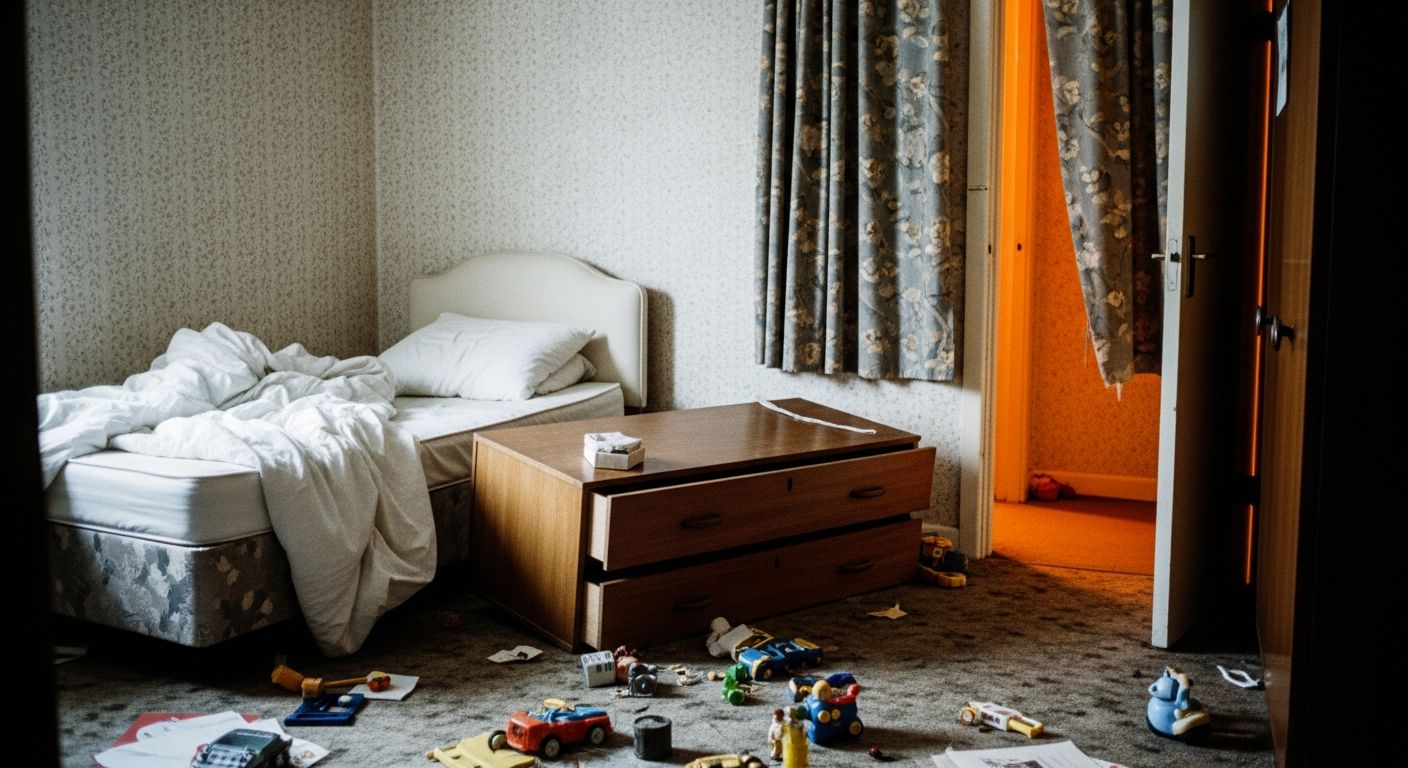
It began quietly. A shuffling sound from upstairs. A child at the top of the stairs, pale and frightened, reporting that her bed had been moving. Margaret Harper was, by all available accounts, a grounded, practical woman. She told her daughter she'd been dreaming and went back downstairs. The following night, she was in the room when Janet's chest of drawers slid four feet across the floor under no visible power. When Margaret pushed it back, it moved again. When she pushed it back a second time, she found she could not move it at all. Something was holding it in place.
She evacuated the children to the neighbours — a family named the Campbells — and returned to the house with Robert Campbell, a former merchant navy man who described himself as not easily rattled. They heard four deliberate, measured knocks from inside the walls. Campbell later said the sound made the hair on his arms stand up. The knocking continued through the night.
Margaret called the police.
What followed became one of the most thoroughly witnessed paranormal events on record. Over thirteen months, more than thirty individuals — police officers, journalists, researchers, a medium, and a senior Metropolitan Police official — attended 284 Green Lane and reported phenomena they could not explain. Constable Sarah Dermot, the first officer to attend, watched a Lego brick fly across the living room and strike the far wall with no one near it. She recorded in her official notes that it had moved, in her words, 'as if thrown by an invisible hand.' A second constable witnessed a chair in the hallway rotate on one leg before toppling forward into the wall.
Investigators David Hollis and Patricia Gould arrived from the Society for Psychical Research in September 1977. The activity centred almost entirely on Janet, the eleven-year-old. Objects were thrown. Books flew from shelves. A wardrobe opened and closed independently while she slept. On multiple independently witnessed occasions, Janet was observed apparently levitating — rising from her bed, once found at a distance from it in a posture no conscious child could have assumed without waking. She was asleep throughout. On one occasion, a curtain was wrapped around her neck in a manner that, had it tightened, could have killed her.
In October 1977, the case entered a new phase. Janet began producing a low, guttural voice utterly unlike her own — deeper, rougher, with a coarse North London accent. Researchers recorded hours of material. The voice identified itself as the spirit of a man named Douglas Perkins, who claimed to have lived in the house and died in the downstairs armchair. Investigators traced records and located the man's surviving family. The details the voice provided — the specific chair, a reference to a chest complaint — were confirmed as consistent with what the family knew of him.
Laryngologists who examined the recordings concluded the sound was being produced by the false vocal cords — a technique virtually impossible to sustain consciously, and one that would cause significant physical pain if attempted deliberately.
Disturbances escalated into early 1978. Unexplained fires broke out in rooms where no one had been smoking and no electrical fault was found. A water jug upended itself in the kitchen. A metal gas fire grille detached from the wall and struck seven-year-old Billy across the legs. Billy himself was on one occasion found suspended above his bed at an angle Patricia Gould described, in contemporaneous notes written with shaking hands, as defying all physical explanation. He did not wake.
The voice continued through spring and summer of 1978. It described the experience of dying in the chair. It expressed confusion. When investigator Hollis asked what it wanted, the voice replied, after a long pause: 'I want to be left in peace.' When Margaret asked it to stop frightening her children, it went silent for eleven days. Then it began again.
Three separate investigative bodies filed final reports concluding that the Harper case represented a genuine and unexplained phenomenon. The disturbances ceased in September 1978 — thirteen months after they had begun — not with any single event, but with a gradual fading. One day Margaret realised the house had been quiet for a month.
In adulthood, Janet Harper gave only a single brief interview on the subject. She said it had been real, that she had never fully understood it, and that she hoped no other family would go through what hers had.
EVIDENCE
Physical Events Witnessed by Multiple Independent Adults
- Chest of drawers moving independently, witnessed by Margaret Harper
- Lego brick propelled across a room, witnessed by Constable Sarah Dermot
- Chair rotating on one leg and striking a wall, witnessed by a second constable
- Repeated levitation of Janet Harper, witnessed independently by Hollis, Gould, and two photographers
- Levitation of Billy Harper, witnessed by Patricia Gould with contemporaneous written notes
- Gas fire grille detaching and striking Billy, leaving physical bruising
- Unexplained fires in rooms with no ignition source identified
- Measured wall-knocking heard by Robert Campbell and independently throughout the investigation
Audio and Medical Evidence
- Hours of recorded audio featuring the anomalous voice
- Laryngological analysis confirming false vocal cord production — a technique inconsistent with conscious, sustained, painless use
Historical Corroboration
- Records search and family confirmation matching the voice's claimed identity, specific location of death, and medical details
Investigative Records
- Official police reports from two separate constables
- Extensive field notes from Society for Psychical Research investigators
- Final reports from three separate paranormal research organisations, all concluding the events were genuine and unexplained
- Senior investigator Maurice Grosse's documentation estimating fewer than three per cent of witnessed events attributable to deliberate trickery
FOX'S ANALYSIS
Alright. Let me straighten my flat cap, uncap my pen, and give you the honest assessment from a fox who has been poked, prodded, and frankly violated by forces beyond human understanding — and who therefore takes the subject of unexplained phenomena very, very seriously.
The Enfield case is the one. This is the case that keeps other cases up at night. When paranormal investigators gather around a campfire and tell scary stories, this is what they tell. And having gone through every scrap of documented testimony on file, I'll tell you something for nothing: it does not read like a hoax. It reads like a family who had absolutely no idea what was happening to them and wanted it to stop.
Let's talk about the sceptical angle, because I'd be a poor reporter if I didn't. Yes, one journalist claimed to catch young Janet bending a spoon herself. One journalist. Against eleven independently witnessed incidents where objects moved with no child in reach. You don't throw out a case on the basis of one shaky data point — you'd throw out half the courtrooms in England on that logic. The presence of occasional trickery in a thirteen-month ordeal involving a frightened eleven-year-old doesn't invalidate the rest of it. You know what they say: when life gives you poltergeists, you make poltergeist lemonade. Actually, I don't think anyone says that. But they should.
The voice is what I keep coming back to. False vocal cords. Laryngologists — actual doctors who examine throats for a living — saying this production method is virtually impossible to sustain consciously and would cause pain if attempted deliberately. Janet Harper was not a trained theatrical performer or a practised ventriloquist. She was eleven years old and, by every account, genuinely terrified. You can't fake the false vocal cords any more than I can fake being probed at forty thousand feet over Nevada. Trust me on that one.
And the historical corroboration. This is the part that genuinely raises the fur on the back of my neck. A voice claiming to be a dead man. Investigators digging through records. A family confirming the specific chair, the chest complaint, the details no living person in that household could have known. That's not the kind of evidence you dismiss with a nervous cough and a change of subject. That's the kind of evidence that makes a seasoned reporter sit very still for a while.
Maurice Grosse's closing statement — something that wants to be heard, something that doesn't know it's finished — might be the most quietly devastating line in the history of paranormal investigation. And I've been in this business long enough to know that the quiet, devastating lines are usually the true ones.
My professional verdict: something happened in that house on Green Lane. Something that affected a family, terrified a child, shook a police constable, made a naval veteran's hair stand up, and left three separate investigative bodies unable to offer a rational explanation. I don't know what it was. I suspect nobody does. But I'll say this much — whatever Douglas Perkins was, or whatever was wearing his name like an overcoat — it had a lot on its mind. You might say it had a lot of unfinished business. Which, given the circumstances, I suppose makes it a real dead ringer for the truth.
I'll see myself out.
CREDIBILITY RATING
Rating: 9 / 10
Reasoning:
- Multiple independent witnesses: Over thirty individuals from varied professional backgrounds — police officers, researchers, journalists, medical professionals — all reported unexplained phenomena. This is exceptional corroboration.
- Physical evidence: Bruising on Billy Harper from the gas fire grille. Audio recordings subjected to independent medical analysis. Contemporaneous written notes from investigators on scene.
- Historical corroboration: Details provided by the voice were verified against records and confirmed by the deceased's family.
- Consistency across thirteen months: The pattern of activity is internally consistent and documented across multiple independent reports.
- Emotional authenticity: Margaret Harper refused rehousing despite the disturbances. Janet Harper gave almost no interviews as an adult. Neither behaviour is consistent with hoaxers seeking publicity.
- Minor deduction: One point withheld for the documented incident of apparent trickery, which — though minor in context — must be noted in any honest assessment.
CLASSIFICATION
Primary Classification: Poltergeist — Active / Extended Duration
Sub-classifications: