
The House That Fought Back: How a Quiet Nottinghamshire Home Became a Battlefield of Flying Objects and Invisible Hands
QUIRK REPORTS — OFFICIAL CASE FILE
CASE NUMBER: QR-2026-51187
THE HOUSE THAT FOUGHT BACK: POLTERGEIST LAYS SIEGE TO NOTTINGHAMSHIRE FAMILY FOR ELEVEN MONTHS OF FLYING CROCKERY AND INVISIBLE FISTS
Classification: Paranormal — Poltergeist Activity (Physical Phenomena, Recurrent)
Date of Events: October 1968 – September 1969
Location: Mapperley, Nottingham, England
Primary Witness: Margaret Caldwell (name changed)
Reporting Investigator: Fox Quirk, Quirk Reports
This report is based on documented paranormal accounts. Names and identifying details have been changed to protect those involved.
WITNESS STATEMENT
In late October 1968, Margaret Caldwell — a thirty-four-year-old single mother raising three children in a council semi-detached in Mapperley, a northeastern suburb of Nottingham — noticed something she could not account for. A dense, sulphurous odour filled the hallway of her home without explanation. She checked for gas leaks, opened windows, investigated thoroughly. By morning it had gone. She filed it under coincidence and carried on. She would later identify that evening as the last moment of peace her family would know for nearly a year.
What followed conformed, with unsettling precision, to what paranormal researchers describe as a classic poltergeist escalation. It began modestly: a kitchen cupboard that refused to stay latched, a dining chair that relocated itself to the hallway overnight, the television switching itself on in the small hours. Margaret's initial responses were entirely rational — old house, ill-fitting doors, perhaps the children sleepwalking. By December, rationality was running low.
The household's three children — Thomas, fourteen; Janet, eleven; and Diane, seven — became central witnesses to what followed. It was Janet who experienced the first truly inexplicable incident, descending for a glass of water around eleven-thirty at night to hear what she described as someone dragging a chair across the ceiling.
She returned to her bedroom to find every book she owned stacked neatly in the centre of the floor, spines aligned, during an absence of fewer than five minutes. She did not wake her mother. She got into bed and waited for dawn.
By January 1969, the activity could no longer be quietly managed within the family. The break point came at the dinner table: a ceramic fruit bowl, undisturbed for three years on the kitchen counter, rose vertically from its surface — all four family members present agreed it did not slide or tip — traversed the kitchen in an arc, and struck the far wall with sufficient force to shatter it. Seven-year-old Diane began to cry. Margaret Caldwell allowed herself, at last, to accept that this was beyond her considerable practical abilities to solve.
She approached her parish vicar, Reverend Aldous, who visited twice in February, reported nothing unusual during either visit, blessed the house, and recommended she see her GP. She did not find this helpful. Through a circuitous route involving her sister's acquaintance at the Nottingham Evening Post, the case reached local paranormal researcher Bernard Holt, a careful and experienced investigator who had spent ten years documenting physical phenomena across the East Midlands. After weeks of negotiation, Margaret agreed to allow him to observe.
Holt conducted six visits between April and June 1969 and documented a household, in his own words, operating under siege. During his second visit, a glass ashtray on the mantelpiece began vibrating audibly in the presence of all five people in the room, launched itself in a slight upward arc toward the opposite wall, landed unbroken, was retrieved and placed on the floor — and, four minutes later, slid two feet across the carpet while everyone watched. Holt noted, with the precision of a man determined not to be dismissed, that the trajectory of multiple objects was inconsistent with simple mechanical displacement.
Thomas, the eldest child, had independently begun keeping his own written record — dates, times, distances, descriptions — in a school exercise book. His entries impressed Holt considerably. Thomas also reported a recurring nocturnal experience: waking to find what he described as a heaviness at the foot of his bed, not a visible form but a density in the air
that made breathing difficult. On three separate occasions his bedroom window was found open in the morning despite being closed and latched; Holt confirmed the latch required deliberate two-handed pressure to operate.
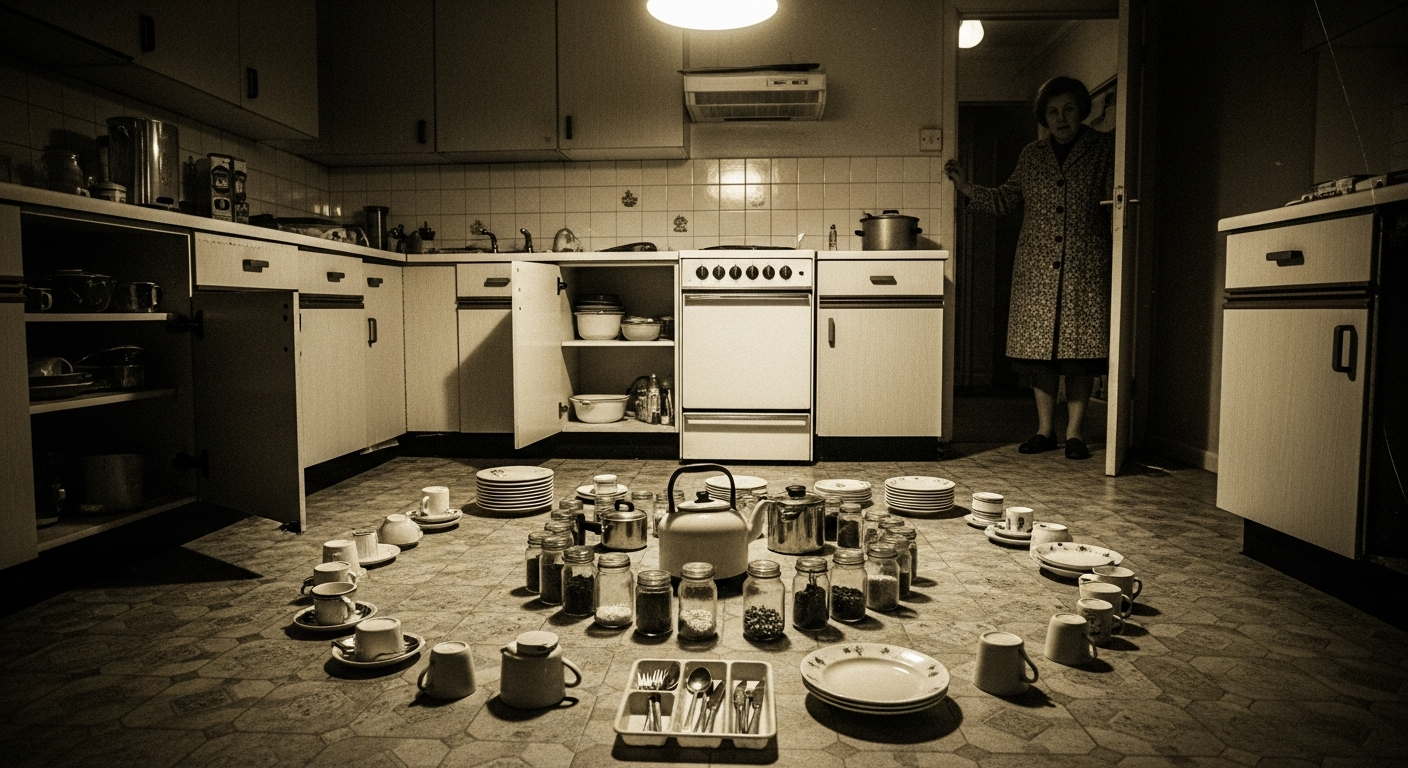
The most dramatic episode occurred on the night of 5th May 1969. Margaret's sister Patricia was staying for the weekend when, at around two in the morning, both women were woken by sustained crashing from the kitchen. Every item in the room — cups, plates, pots, the kettle, jars, even the cutlery tray — had been removed from its place and arranged across the linoleum in concentric circles spreading from a central point. Nothing was broken. Patricia described it to Holt as looking like something had been taking inventory.
She left the following morning.
Margaret was physically affected on two documented occasions: a blow to the back of her left hand severe enough to leave a bruise she showed to both Holt and her GP, and, in June, the unmistakable sensation of fingers closing around her left ankle while she sat reading in the living room. The grip lasted approximately ten seconds. She did not scream. She closed her book and sat very still.
Holt subsequently brought in Dr. Frances Whitmore, a researcher with a background in psychology, who interviewed each family member individually. Dr. Whitmore concluded that while the household carried genuine psychological stressors — the pressures of single parenthood, sustained fear, childhood disruption — these were insufficient to account for the physical phenomena that she and Holt had directly witnessed. She also noted that the activity showed no consistent correlation with any single family member's emotional state, undermining the most common psychological explanations.
The disturbances diminished through July and had effectively ceased by September 1969. There was no dramatic resolution. It was like a storm passing,
Margaret told Holt. You don't know it's over until you realise you haven't thought about it for a few days.
The family remained in the house for three further years. Minor incidents persisted — displaced objects, a persistent cold spot on the upper landing — but the sustained campaign of 1968 to 1969 did not return.
The case never appeared in the mainstream press. It circulated through the closed networks of British paranormal research and was included in an anthology of poltergeist cases in the early 1970s. Bernard Holt maintained contact with Margaret until his death in 1988. In a 1985 addendum to his original report he wrote that the Mapperley case remained, after thirty years of investigation, the most convincing evidence of genuine physical phenomena he had personally encountered. He offered no explanation. He wrote only that the family had been real, their fear had been real, and what he had watched move across a room had been, beyond any serious doubt, real as well.
EVIDENCE
- Physical bruising: Margaret Caldwell sustained a documented bruise to the back of her left hand, examined and confirmed by her general practitioner. Cause: a blow delivered while she stood alone at the kitchen sink.
- Researcher eyewitness testimony: Bernard Holt directly witnessed the ashtray incident during his second visit, including the object's subsequent self-propelled movement across the carpet while all occupants of the room were accounted for and stationary.
- Independent corroboration: Patricia (Margaret's sister), a self-described sceptic, witnessed the full kitchen arrangement incident of 5th May 1969 and provided a separate account to Holt consistent with Margaret's own.
- Holt's investigative report: Six visits producing contemporaneous notes, later circulated among paranormal researchers and published in an early 1970s British anthology. Considered among the more detailed East Midlands cases of the period.
- Dr. Frances Whitmore's psychological assessment: Independent evaluation ruling out psychological causation as a sufficient explanation for the observed physical phenomena.
- Thomas Caldwell's personal records: A school exercise book containing meticulous first-person logs of incidents across the investigation period, described by Holt as unusually precise and unsentimental for a fourteen-year-old witness.
- Window latch anomaly: Holt personally confirmed that Thomas's bedroom window latch required deliberate two-handed operation, undermining any accidental explanation for its repeated nocturnal opening.
FOX'S ANALYSIS
Right. Let me tell you, I've seen some cases in my time that made my ears go flat and my tail go straight, and this one — this one sits comfortably in my top shelf. Not because it's the most dramatic file we've ever run at Quirk Reports. It's because it's disciplined. And in this business, discipline is rarer than a friendly alien. (Don't get me started on aliens. I still have opinions about their approach to medical examinations. Specifically their failure to account for the size differential between a human and a small fox. Moving on.)
What strikes me first about the Mapperley case is what's missing. There's no single flashpoint, no obvious motive for fabrication, no bid for press attention — in fact, the family actively suppressed publicity. Margaret Caldwell refused to let her children become a spectacle. That's not the behaviour of someone who wants to be believed. That's the behaviour of someone who wants it to stop. There's a significant difference, and experienced reporters learn to feel it.
The escalation pattern is textbook, yes — but that cuts both ways. Sceptics will say it's too textbook, that someone familiar with poltergeist literature could construct exactly this arc. I say: the Caldwell family were a textile worker and three school children in 1968 Nottinghamshire. Bernard Holt himself, the researcher, found the family through an accidental chain of connections that Margaret tried to prevent. This is not a family who went looking for attention. The story came out despite them, not because of them.
The physical evidence is where I get serious. A bruise confirmed by a GP. A window latch requiring two-handed deliberate operation, found repeatedly open. Objects witnessed moving — not once but repeatedly — by a trained researcher who had every professional incentive to remain sceptical. You know what they say: seeing is believing, but in poltergeist cases, not seeing is usually the whole problem. Holt saw. Whitmore saw. Patricia the sceptical sister saw, and she was on a train home by breakfast. That detail alone? That's gold. Reluctant witnesses are the best witnesses.
I do want to raise the question of Thomas. In poltergeist research there's a longstanding theoretical focus on adolescent agents — the idea that a young person under emotional stress can somehow become a locus for physical disturbance. Thomas was fourteen, serious, under considerable pressure as the eldest child in a struggling single-parent household. It would be professionally negligent of me not to note that. However, Dr. Whitmore explicitly addressed this and found no consistent correlation between Thomas's — or any individual family member's — emotional state and the timing of incidents. The phenomena were scattered across the household and across all hours. I'm not ruling the adolescent agent theory out entirely, but I'm not ready to hang my flat cap on it either. If Thomas was unconsciously hurling crockery around Nottinghamshire through the sheer power of teenage feelings, I have to say, most fourteen-year-olds I've met would have started with something much more targeted.
The kitchen arrangement of 5th May is the detail I keep coming back to. Everything removed, nothing broken, arranged in concentric circles like a geometry lesson from something with no mouth and too much time. Like something had been taking inventory,
said Patricia. I don't know what that means. I don't think Patricia knew what it meant.