
The House That Bled Misery: How a Quiet Scottish Council Home Became a Battlefield of Invisible Forces
QUIRK REPORTS — OFFICIAL CASE FILE
Case Number: QR-2026-56016
WAIL, KNOCK, AND BARREL ROLL: THE SAUCHIE POLTERGEIST AND THE GHOST THAT WOULDN'T LEAVE A WEE GIRL ALONE
Classification: Poltergeist Activity — High Credibility
Date of Event: November–December 1960
Location: Park Crescent, Sauchie, Clackmannanshire, Scotland
Primary Witness: Margaret Calloway (name changed), age 11
Report Filed By: Fox Quirk, Founder & Senior Investigative Reporter, Quirk Reports
This report is based on documented paranormal accounts. Names and identifying details have been changed to protect those involved.
WITNESS STATEMENT
In the autumn of 1960, the Calloway family — Thomas, Annie, and their eleven-year-old daughter Margaret — relocated from Ireland to a modest council house on Park Crescent in the small Clackmannanshire mining village of Sauchie. The move was hard on Margaret. She had left behind her grandmother, to whom she was deeply attached, and a beloved family dog. By all accounts from those who knew her, she was a quiet, gentle child — inwardly grieving, but not a child given to drama or performance.
It started with knocking.
In the second week of November, rhythmic, deliberate percussive sounds began emanating from within the walls of the family home. The Calloways attempted rational explanations — old pipes, a settling structure, the particular cruelty of a Scottish November on plaster and timber. But the sounds grew more insistent, and were soon accompanied by something rather more difficult to rationalise away.
Objects began to move.
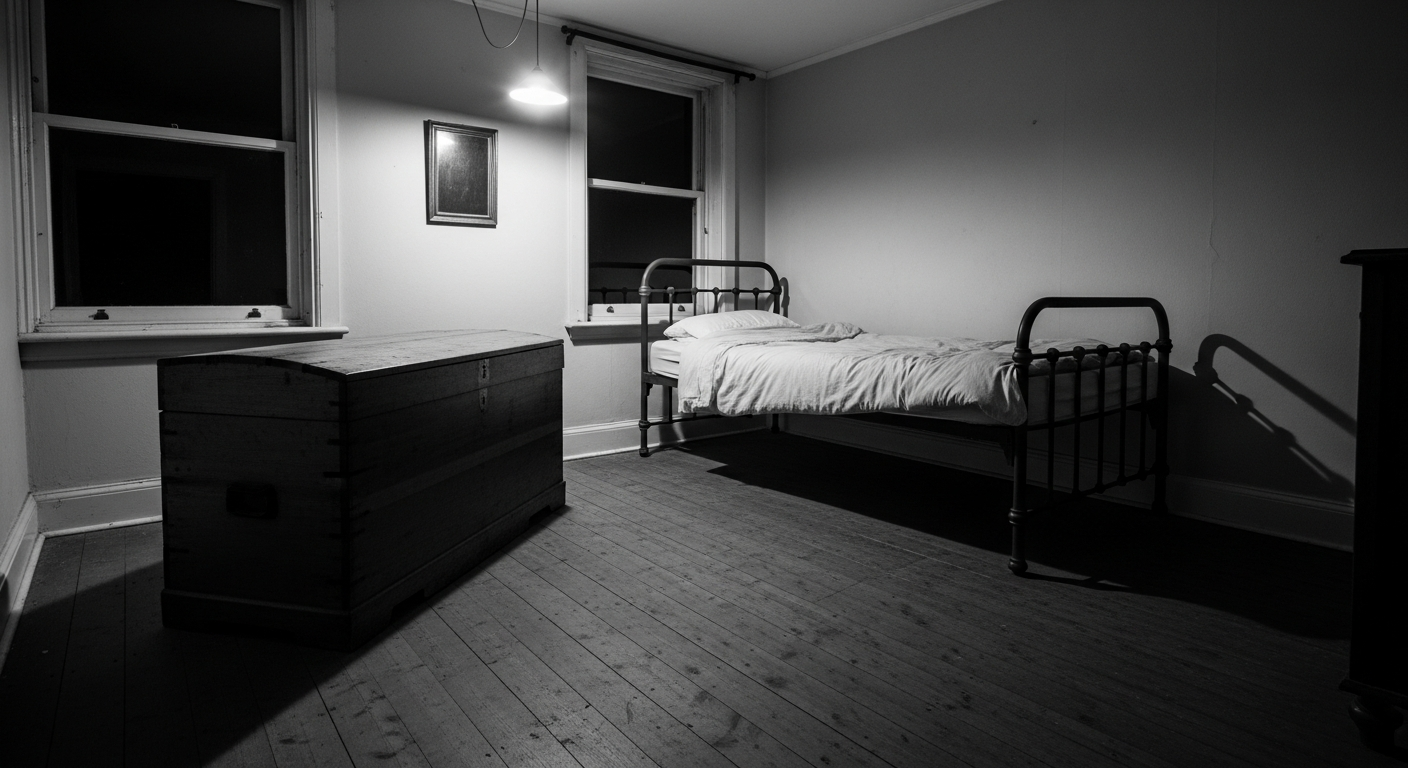
The first significant witnessed incident took place in the bedroom Margaret shared with her aunt. A large, heavy linen chest was observed to slide several feet across the floor, slowly and without any mechanical cause. Margaret was in bed at the time. Her aunt watched it happen. Both were reported to be terrified.
The family contacted their local Church of Scotland minister, Reverend Duncan Fraser — a man described by contemporaries as pragmatic, intellectually rigorous, and emphatically not given to sensationalism. He agreed to observe. Over several visits, he witnessed a sawing sound moving through the woodwork of Margaret's bed, a rippling vibration across an untouched pillow, and a large sideboard that rocked and shuddered as though gripped by unseen hands. A bowl of fruit moved across a table with no one near it. Reverend Fraser committed his observations to writing. He was categoric: he had seen these things. He could not explain them.
The family's GP, here called Dr. William Hendrie, was subsequently persuaded to attend. He arrived expecting to find a nervous child manufacturing incidents, or a household susceptible to collective suggestion. He left having seen a heavy wooden dresser move from the wall and return, having heard knocking sounds that followed Margaret from room to room, and having witnessed — most disturbingly — Margaret's pillow rotate beneath her head while she lay perfectly still.
"Not her head turning — the pillow itself, twisting as if in the grip of a slow, invisible force." — from Dr. Hendrie's written account
The phenomena were not confined to the home. At school, Margaret's class teacher, Miss Eleanor Pritchard, documented her desk lid rising and falling independently and a blackboard pointer rolling from the teacher's desk on multiple occasions when Margaret was present. Other pupils witnessed these events in full daylight, in a public building, with no investment in the supernatural.
Throughout, Margaret was described as deeply distressed. She wept. She begged for it to stop. By every credible account, she was not performing — she was enduring. The phenomena orbited her like a shadow, appearing wherever she went and quieting when she was absent. By December 1960, without ceremony or resolution, the activity subsided. The knockings faded. The house grew still. The Sauchie Poltergeist, having run its course, departed — leaving behind a shaken community, signed professional testimony, and one of the most thoroughly documented paranormal cases in British history.
EVIDENCE
- Physical phenomena: Movement of heavy furniture including a linen chest, a wooden dresser, and a sideboard; rotation of a pillow beneath a stationary subject; movement of a fruit bowl; rising and falling of a school desk lid; rolling of a blackboard pointer.
- Auditory phenomena: Rhythmic wall-knocking; sawing sounds within bedframe woodwork; sounds that relocated in correlation with Margaret's physical position.
- Corroborating witnesses: Reverend Duncan Fraser (Church of Scotland minister); Dr. William Hendrie (local GP, trained medical sceptic); Miss Eleanor Pritchard (schoolteacher); multiple pupils; Margaret's aunt.
- Documentary record: Written accounts submitted by Reverend Fraser, Dr. Hendrie, and Miss Pritchard; case formally published in the Journal of the Society for Psychical Research by paranormal researcher Dr. Archibald Owen (name changed), who noted the professional standing and initial scepticism of all key witnesses.
- Pattern consistency: All phenomena centred tightly on Margaret as poltergeist agent; activity ceased entirely in her absence; gradual escalation followed by natural subsidence — consistent with documented patterns in comparable cases.
FOX'S ANALYSIS
Right. Let me put my flat cap on straight for this one, because the Sauchie case deserves serious respect — and I am going to give it serious respect, right after I note that a poltergeist that follows a child to school and starts messing with the furniture is essentially the most extreme version of a kid not wanting to be there. Margaret, love, I feel you. I also found school haunting. Though usually it was just the smell of the canteen.
The thing that makes Sauchie stand apart — and I've read a lot of these files, friends, I've got filing cabinets that would give a health and safety inspector a small cardiac episode — is the quality of the witnesses. We are not talking about a family's word against the dark. We have a minister who arrived as a rationalist and left shaken. We have a medical doctor who came looking for hysteria and found a dresser rearranging itself. We have a schoolteacher documenting this in a classroom, in November daylight, with a roomful of children watching. Independent accounts. Consistent accounts. People with professional reputations on the line, choosing to commit their observations to paper anyway.
That's not nothing. That's, in fact, a great deal of something.
The psychokinetic theory — that Margaret's extreme emotional distress manifested physically in her environment — is the one I find most compelling, even if it raises questions I cannot begin to answer. She had lost her grandmother, her dog, her home, her country. She was eleven years old and adrift. If grief can break a heart, is it so impossible that, under certain conditions, it might also move a linen chest? I genuinely don't know. But I'll tell you this: I've covered poltergeist cases where the emotional profile of the central figure was mild, vague, unconvincing. Margaret Calloway's grief was documented, specific, and profound. That correlation matters.
I will note, in the spirit of healthy scepticism, that we are dealing with accounts from over sixty years ago. Cross-examination was not possible. The documentation, while unusually thorough by paranormal standards, is still second-hand records of first-hand experience. No physical trace evidence — marks on the floor, damage to furniture — was formally catalogued. These are not reasons to dismiss the case. They are reasons to hold our conclusions with appropriate humility rather than absolute certainty.
Still. A doctor watching a pillow rotate is not nothing. I've been probed by extraterrestrials — I know from invasive unexplained phenomena, believe me — and even I would be rattled by an autonomous pillow. You could say the whole case left everyone involved without a leg to stand on. Or, in Margaret's case, without a pillow to sleep on. I'll see myself out.
The Sauchie Poltergeist is, in my considered professional opinion, the real deal. Or as close to it as the historical record permits us to say with intellectual honesty. Whatever visited that council house on Park Crescent came for a child who was hurting, stayed long enough to terrify everyone around her, and then left. If there's anything more haunting than that, I haven't filed the report on it yet.
CREDIBILITY RATING
Rating: 9 / 10
Reasoning: Multiple independent witnesses of high professional standing, none of whom had any motive to fabricate or embellish. Written accounts submitted contemporaneously and formally published in a peer-reviewed paranormal research journal. Phenomena occurred in multiple locations including a public school, observed by unrelated witnesses including pupils. Central witness (Margaret) was consistently and credibly distressed rather than performative. Activity pattern — tight correlation with a single emotionally disrupted adolescent, gradual escalation, natural subsidence — is internally consistent and matches documented comparative cases. One point deducted for the absence of formally catalogued physical trace evidence and the impossibility of direct cross-examination at this remove in time. The Sauchie case is, by the standards of the field, as close to bulletproof as these things get.
CLASSIFICATION
Primary Classification: Poltergeist — Confirmed High-Credibility Incident
Sub-categories:
- Recurrent Spontaneous Psychokinesis (RSPK) — Probable
- Adolescent-Centred Poltergeist Agent Pattern
- Grief-Correlated Onset
- Multi-Location Activity (Domestic and Educational)
- Independently Corroborated by Professional Witnesses
CASE STATUS
Status: OPEN — HISTORIC / UNRESOLVED
Recommended Follow-Up Actions:
- Locate and archive all surviving documentation from the original Journal of the Society for Psychical Research publication for the Quirk Reports permanent record.
- Attempt to identify whether any school or church records from Sauchie, November–December 1960, survive in Clackmannanshire local archives.
- Consider a field visit to Park Crescent, Sauchie — not because activity is expected to persist, but because responsible documentation of the site is warranted for a case of this historical significance.
- If Margaret Calloway or any surviving witnesses can be identified and are willing to speak, a formal oral history interview would be of considerable value to the paranormal research record.
- Case to be flagged as Landmark Reference File — to be cited in any future Quirk Reports analysis of poltergeist phenomena or psychokinetic theory.
Filed by Fox Quirk, Quirk Reports. Press pass in the band. Notebook slightly damp from a November in Clackmannanshire that I am choosing to imagine vividly. The story's out there, friends. We just have to be brave enough to write it down.