
The Hound That Hunted Armies: How a British Columbia Mining Camp Was Stalked by Something Ancient and Enormous
QUIRK REPORTS — OFFICIAL CASE FILE
Case Number: QR-2026-20246
VALLEY OF THE HEADLESS MEN: GIANT BIPEDAL ENTITY STALKS SURVEY TEAM IN CANADA'S MOST CURSED WILDERNESS
Classification: Cryptid — Large Unidentified Bipedal Hominid
Date of Encounter: Summer 1963 (primary witness); documented incidents spanning 1908–1970s
Location: Nahanni Valley, Northwest Territories, Canada
Primary Witness: Gerald Marsh (name changed)
Report Filed By: Fox Quirk, Founder & Senior Investigator, Quirk Reports
This report is based on documented paranormal accounts. Names and identifying details have been changed to protect those involved.
SECTION ONE: WITNESS STATEMENT
The Nahanni Valley has a reputation that precedes it by decades. Carved through sub-arctic limestone by a river that does not forgive mistakes, vented by hot springs that steam in the frozen air, flanked by canyon walls four thousand feet high, it was known among the Dene people — who had lived alongside it for generations — as the Valley of the Headless Men. This was not poetry. It was a warning.
The warning began earning its name in earnest in 1908, when two brothers — here recorded as Archie and Donald Crane — were found dead in their prospector's camp. They had not succumbed to cold, starvation, or accident. They had been decapitated. Their bodies lay undisturbed in their sleeping rolls. Their heads were never recovered. The Royal Canadian Mounted Police investigated and arrived, publicly at least, at nothing. The case was left officially open, where it remains to this day.
It was the beginning of a catalogue. A trapper named Ronald Fettes was found headless in 1917. Another prospector the following year, under identical circumstances. By the 1930s, even seasoned wilderness men were refusing to winter in the Nahanni. Those who survived their time in the valley and came out with stories were frequently dismissed as broken by isolation. But the stories matched each other in ways that simple shared delusion could not comfortably explain.
Gerald Marsh arrived in the Nahanni in July of 1963 as a geologist on a four-man survey team. He was thirty-four, practically minded, and professionally uninterested in folklore. For the first ten days, the survey proceeded without incident. The valley offered its rock formations and its cold river and kept whatever else it had to itself.
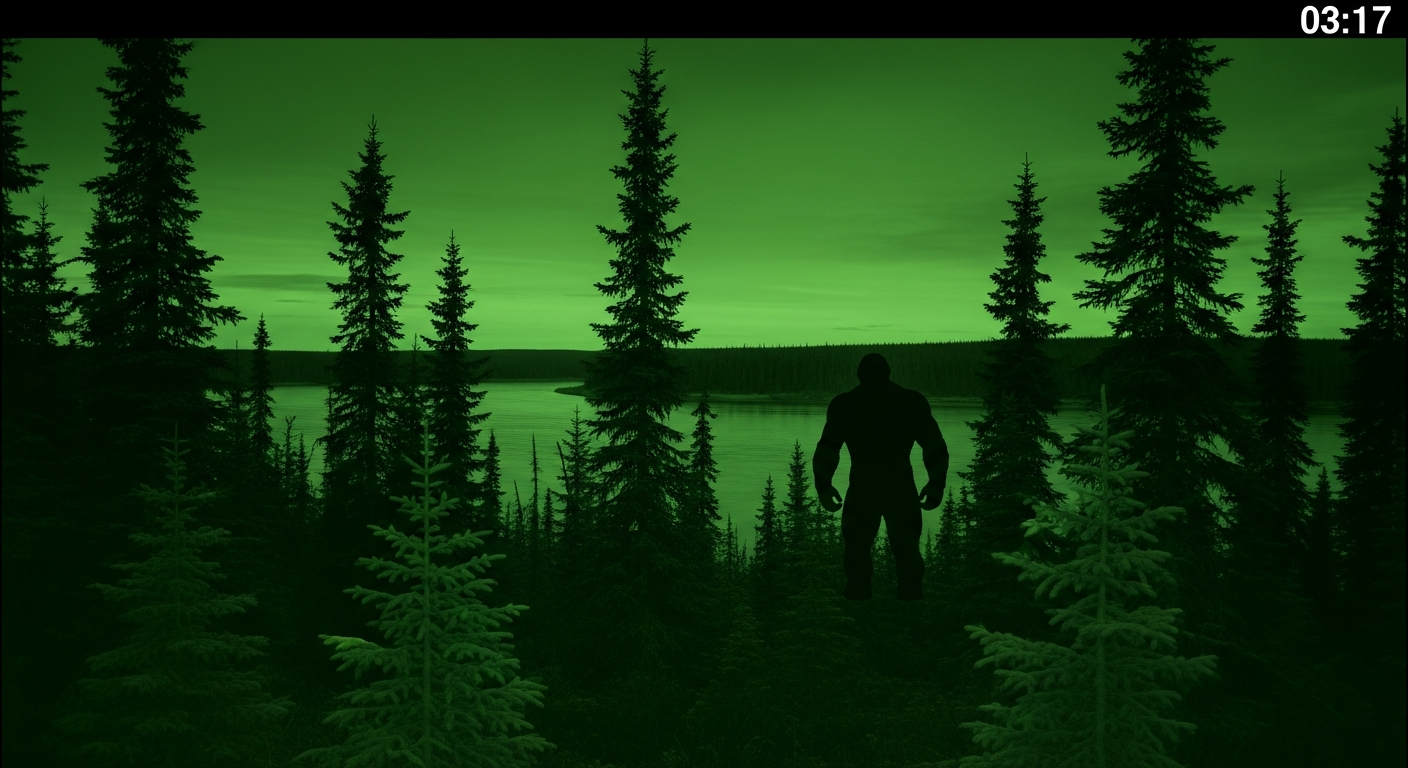
On the eleventh night, Marsh woke to something moving in the brush on the far bank of the river.
"It wasn't a bear. I'd heard bears. The rhythm was wrong — the weight distribution was wrong. Whatever was moving out there was on two legs, and it wasn't hurrying. It had nowhere else it needed to be."
Marsh lay still, reached for his rifle, and waited. The sound moved to the water's edge. He heard the displacement of the river around something very large wading into the shallows. Then, after a silence he would later describe as feeling occupied rather than empty, the sound retreated back into the trees. The creature — whatever it was — did not cross.
At breakfast, Marsh said nothing. His colleague Paul Weir spoke first. He had been awake too. He had heard the same footsteps, the same unhurried movement, the same weighted silence. Their descriptions matched in every detail.
Three days later, Marsh found the tracks. They were pressed into soft mud beside a tributary stream — bipedal, human in shape, but measuring between eighteen and twenty inches heel to toe. The stride length suggested a creature in excess of seven feet tall. The impressions were deep. There were no claw marks, no knuckle drag. Whatever had left them walked fully upright, weight distributed evenly across ball and heel, like a person who was simply going somewhere.
Marsh photographed the tracks extensively and produced plaster casts of the two clearest impressions. The survey team completed their work and flew out at the end of August. The mining company showed no interest in the casts. His colleagues filed their geological report and moved on. Marsh kept the casts in his workshop for twenty-five years.
When researchers finally tracked him down in the late 1980s, he was retired and living in British Columbia. He was, by all accounts, not a man given to embellishment. He showed them the casts. He showed them the photographs. He described, again, the sound on the far bank, the weight in the water. And he used one word carefully, he said, knowing exactly how it sounded.
"Not threatened. Not chased. Assessed. Whatever came to the river that night looked at the camp and made a decision. I don't know what the decision was. I only know that we were allowed to leave."
Marsh's account sits within a larger body of documented encounters. Canadian naturalist Clifford Hatch spent three summers in the late 1970s surveying the valley's northern tributaries, emerging with photographs of large bipedal tracks, audio recordings containing vocalisations his acoustic analysis could not match to any known Canadian animal, and a bone fragment recovered near an abandoned prospector camp — determined by laboratory analysis to be primate in origin, but not human, and not from any primate species known to inhabit North America.
The bone fragment was stolen from Hatch's vehicle in Fort Simpson, along with his field notebooks from that season. He filed a report with the RCMP. Nothing came of it. The Nahanni Valley became a UNESCO World Heritage Site in 1978. The headless deaths remain officially unsolved. Gerald Marsh's plaster casts are held in a private collection in Vancouver. The valley keeps its secrets, as it always has, with no apparent effort at all.
SECTION TWO: EVIDENCE
- Physical Tracks: Bipedal impressions measuring 18–20 inches heel to toe, stride consistent with a creature exceeding seven feet in height. No claw marks, no knuckle impressions. Full upright gait confirmed by pressure distribution analysis.
- Plaster Casts: Two high-quality casts produced by Gerald Marsh in 1963, retained in his possession for twenty-five years and later verified by paranormal researchers. Currently held in a private Vancouver collection.
- Photographic Evidence: Marsh's original photographs of track sites, described as yellowed but clear at time of researcher review in the late 1980s.
- Corroborating Witness: Paul Weir independently confirmed the nocturnal audio encounter, describing it in matching detail before Marsh had disclosed his own account.
- Audio Recordings: Vocalisations recorded by Clifford Hatch in the late 1970s; acoustic analysis unable to match sounds to any documented species in the Canadian wilderness. Recordings have circulated among researchers without resolution.
- Bone Fragment: Recovered near abandoned prospector camp; laboratory-confirmed as primate in origin, not human, not attributable to any North American primate species. Subsequently stolen from Hatch's vehicle in Fort Simpson alongside field notebooks.
- Historical Death Record: Officially documented decapitation deaths spanning 1908–1930s, investigated by RCMP with no findings committed to record. Cases remain open.
- Indigenous Oral Tradition: Dene accounts of the Naha — described variously as fierce tribe, entity, or presence inhabiting the hills above the valley — predate European contact and align structurally with physical evidence recovered in the modern era.
SECTION THREE: FOX'S ANALYSIS
Right. Let me get comfortable in this chair, because this one's a bigfoot — and I mean that in every sense of the word.
I've been writing up paranormal cases for longer than I care to admit, and I can usually sort the genuine articles from the elaborate fabrications within the first three paragraphs. Gerald Marsh passes every test I've got. He's a geologist. He speaks in the professional language of a man trained to read physical evidence. He kept his plaster casts for twenty-five years in his workshop not because he was waiting for fame or money — the mining company showed zero interest and his colleagues moved on immediately — but because he couldn't bring himself to throw away something he knew was real. That's the behaviour of a credible witness. That is not the behaviour of a hoaxer. A hoaxer shops his story around. Marsh waited to be found.
The corroboration from Paul Weir is significant. Two men, awake independently, hearing the same thing, describing it in matching detail before comparing notes at breakfast. You can't manufacture that kind of consistency. As a reporter, I know that when two witnesses independently produce the same account without coaching, you sit up straighter. I sat up very straight indeed. I might have knocked my flat cap off.
Now, the bone fragment. Oh, the bone fragment. Primate, not human, not attributable to any known North American species — and then it walks out of Hatch's vehicle in Fort Simpson alongside his field notebooks. Not his photographs. Not his audio recordings. Specifically the physical evidence and the handwritten notes. That is not opportunistic petty theft. That is targeted removal, and it smells worse than a Sasquatch in a hot spring. Whoever took those items knew what they were taking and why. I've had aliens mess with my evidence before — don't get me started, the probe incident was bad enough without the paperwork going missing too — and I know what deliberate suppression looks like. It looks exactly like this.
The Nahanni itself is worth dwelling on. You want to talk about a place that resists examination? The canyon walls make aerial survey difficult. The terrain makes ground survey prohibitively hostile. The river actively discourages lingering. It's almost as if — and I say this with my best investigative hat on — the geography has been arranged to protect whatever lives there. Now, I'm not saying the valley is in on it. That would be ridiculous. I'm just saying that if you were a seven-foot bipedal primate who didn't want to be catalogued by a Canadian naturalist, you could not have picked a better postcode.
The headless deaths are, frankly, a category of their own. I've filed reports on cryptid encounters involving aggression, territory defence, and threat display. I have not frequently encountered decapitation as a consistent cause of death across multiple incidents spanning thirty years. Whatever is in that valley — and I am prepared to believe something very large and very old is indeed in that valley — there are aspects of this case that go beyond a misidentified great ape. I'm not comfortable fully classifying this as straightforward Sasquatch activity. The Dene traditions around the Naha suggest something with agency, intelligence, and — I'll use Marsh's word, because it's exactly the right one — the capacity to assess. This thing looked at a camp of four geologists and decided they could leave. That is not the behaviour of an animal operating on instinct.
I'll be honest: the Valley of the Headless Men gave me chills, and I am a fox who has faced down genuine extraterrestrial activity. I am no stranger to the hair standing up on the back of my neck. But something about the Nahanni sits differently — heavier, older, more deliberate. You could say the whole case really got under my skin. Much like a certain probe that shall not be named.
One final note. The UNESCO designation in 1978 protects the geology. The ecosystem. The landscape. It says nothing, not one institutional word, about what lives there. I find that either deeply convenient or deeply telling, and after thirty years in this business, I've stopped believing in convenient coincidences.
Some valleys simply do not want to be known. This reporter, however, very much wants to know. Watch this space.