The Hollow Hands of Hexham: The Stone Heads That Woke Something Ancient
QUIRK REPORTS — OFFICIAL CASE FILE
Case Number: QR-2026-62830
SOMETHING WICKED THIS WAY DIGS: THE HEXHAM HEADS AND THE BEAST THAT FOLLOWED THEM HOME
Classification: Ghost/Spirit — Apparition (Entity-Linked Object)
Date of Event: February 1972
Location: Rede Avenue, Hexham, Northumberland, England
Primary Witness: Colin Robshaw (name changed)
This report is based on documented paranormal accounts. Names and identifying details have been changed to protect those involved.
WITNESS STATEMENT
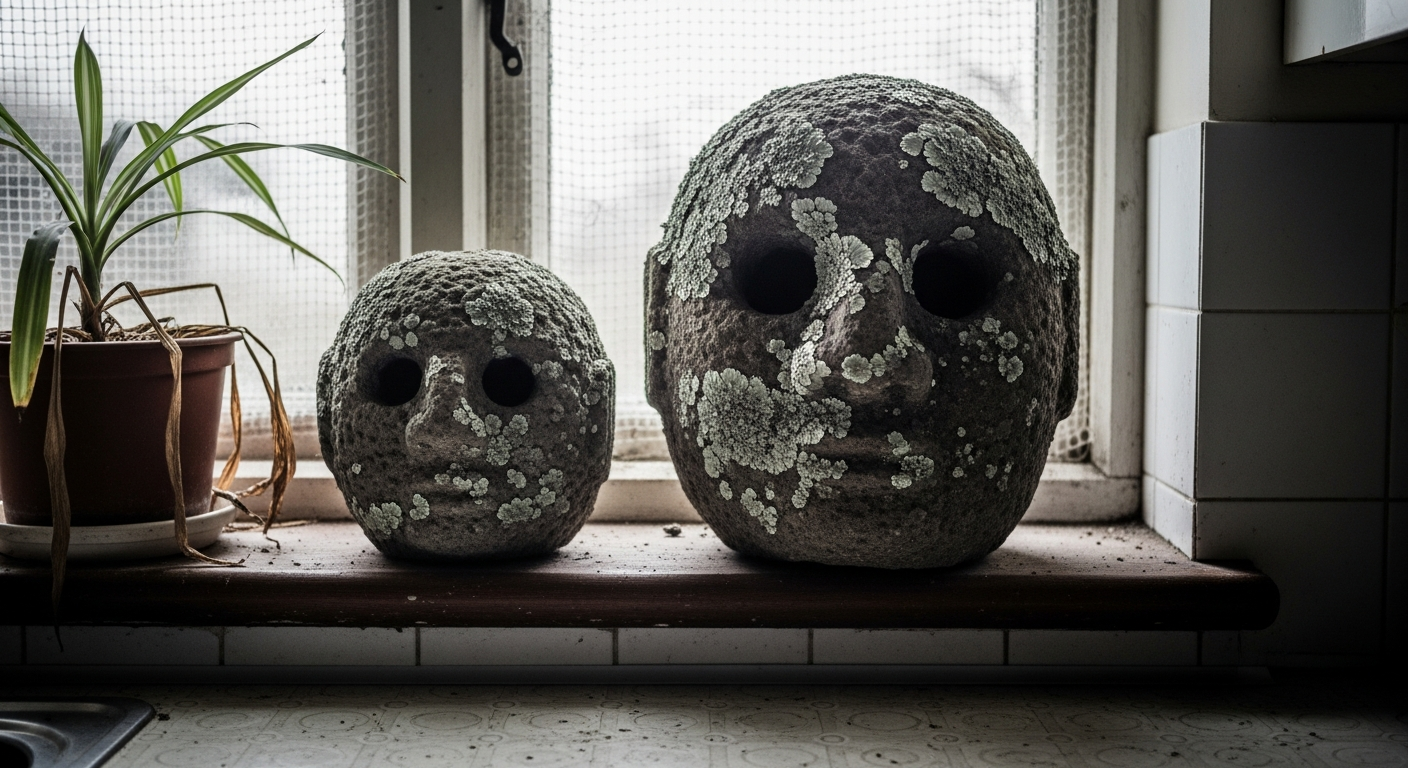
On a bitter February afternoon in 1972, eleven-year-old Colin Robshaw and his younger brother David were digging in the back garden of the family home on Rede Avenue, Hexham — not searching for anything in particular, as children rarely are when they stumble upon something they cannot explain. Colin's spade struck a hard object roughly a foot below the surface. Clearing the soil away, he found not a stone but a carved head, approximately the size of a cricket ball, bearing crude but deliberate features: hollow eyes, a gaping mouth, and a texture that felt ancient even beneath a child's fingers. Minutes later, David unearthed a second head nearby. The boys carried both inside and placed them on the kitchen windowsill, proud of their find in the uncomplicated way that only boys who have discovered buried treasure can be.
The household changed within days.
Ellen Robshaw, the boys' mother, was the first to notice. Ornaments that had sat undisturbed for years were found on the floor each morning, apparently thrown rather than fallen. One morning she descended to find the kitchen in disorder, as though something had passed through it violently in the night. She heard shuffling, dragging sounds from the boys' bedroom late one evening and opened the door to find nothing — only the heads sitting on the windowsill, which she could have sworn were now facing a slightly different direction than before. She did not mention it to the children.
The most alarming experience, however, befell the family next door.
Nancy Henderson, a practical and level-headed woman by all accounts, had come to examine the heads at Ellen's invitation — curious rather than credulous. She briefly took them home to show her husband Frank, who considered them interesting but unremarkable, and returned them the same evening. That night, Nancy woke to find something standing at the foot of her bed.
"It was looking at me. I could feel the attention of it in a way I had never felt anything before."
What she described — and what she would describe consistently for decades thereafter — was a figure nearly filling the space between floor and ceiling: bipedal, upright, but profoundly not human. The lower half was wolf-like, covered in grey-brown fur, the legs bent at wrong angles. The upper half was near-human in shape but with something badly wrong about the proportions of the face. She screamed. Her husband Frank woke. The thing was gone.
Nancy kept the experience to herself for several days before finally telling Ellen, by which point the Robshaw household had accumulated its own catalogue of disturbances: a water bottle overturning by itself, a chair found on its side, and a persistent smell of damp stone that came and went with no discernible cause. Ellen Robshaw, by this point, had no trouble believing her neighbour.
Word reached Dr. Anne Ross, a respected Celtic archaeologist based in Southampton, who travelled north to examine the heads. She identified characteristics consistent with Celtic votive pieces from the Iron Age or Romano-British period and arranged to take them south for further study. She was a professional and a rationalist. She did not believe in haunted objects.
She kept the heads in her home. Within a fortnight, she wished she had not.
Dr. Ross woke in the early hours to a certainty of presence she would later describe as entirely outside her prior experience. At the top of her staircase stood a figure — over six feet tall, bipedal, with the hindquarters and legs of a large animal and an upper body covered in dark fur. It was moving toward the stairs.
"Something in the quality of its movement made her press herself against the wall in terror."
She followed when she found the courage to do so. The hallway was empty. The front door was closed. Her fifteen-year-old daughter, in a separate part of the house, had simultaneously woken to hear heavy, irregular footsteps on the stairs and something dropping from the landing with a weight that seemed, as the daughter later described it, "too dense for ordinary acoustics — as though whatever was walking was too real for the floor to echo it properly." Mother and daughter did not compare accounts until breakfast.
Dr. Ross returned the heads shortly afterward. She never fully retracted her account. She gave interviews, appeared on television, and maintained with careful consistency that what she had seen was real. A competing theory emerged through Newcastle archaeologist Frank Hodgson, who proposed the heads were not ancient Celtic artifacts at all but twentieth-century carvings by a local stonemason, Desmond Dodd, who had lived near Rede Avenue in the 1950s and believed, on examination, that they were his own work. This debunking resolved the question of origin while explaining precisely nothing about what Nancy Henderson and Dr. Anne Ross had encountered.
The heads passed into the custody of the Shipley Art Gallery in Gateshead in the mid-1970s. Then they were lost — mislaid in storage, or simply gone. The paperwork surrounding them was found to be incomplete in unusual ways. No one at the institution could explain precisely when, or how, they disappeared.
Colin Robshaw, speaking as an adult, has been measured but unequivocal: "The weeks following the discovery were the strangest of my family's life. Whatever the heads were or were not, the house was never the same while they were in it."
EVIDENCE
- Physical Objects: Two carved stone heads recovered from approximately one foot below the surface of the Rede Avenue garden. Examined by Dr. Anne Ross (Celtic specialist) and Frank Hodgson (Newcastle archaeologist). Competing attributions — Iron Age Celtic votive objects vs. mid-twentieth century carvings by local stonemason Desmond Dodd — were never definitively resolved.
- Multiple Independent Witnesses: Disturbances reported across two separate households (Robshaw and Henderson). Dr. Anne Ross and her daughter reported identical entity encounters in a third location — Southampton — with no prior communication between them before comparing notes at breakfast.
- Corroborating Physical Disturbances: Displaced ornaments, overturned furniture, self-moving objects, and an unexplained smell of damp stone reported in the Robshaw home across several weeks.
- Consistent Entity Description: Both Nancy Henderson and Dr. Anne Ross described a large bipedal figure with animal hindquarters and near-human upper body. Their accounts were given independently, years apart, and did not materially deviate.
- Documentary Anomaly: Records pertaining to the heads at the Shipley Art Gallery, Gateshead, were found to be incomplete or missing. The heads themselves have not been located. No explanation has been provided by the institution.
- Academic Corroboration: Dr. Ross noted in her professional capacity that hollow-eyed Celtic votive heads were associated with chthonic ritual — objects buried as offerings to underworld deities, and buried, she implied, for a reason.
FOX'S ANALYSIS
Right. Pour yourself something strong, because this one is a stone cold classic — and I mean that both figuratively and literally.
Let me start with what makes this case exceptional, because a lot of so-called paranormal reports come down to one spooked person in a dark room at three in the morning. This one has layers. You've got household disturbances across two families on the same street. You've got a credentialed academic — not a ghost hunter, not a tabloid psychic, a real archaeologist who spent her career studying Celtic mythology without expecting to actually meet any of it — having the precise same class of encounter as her neighbour, in a completely different city, with a completely different head (no pun intended). You've got a teenager in Southampton corroborating her mother's account from a separate room without them having spoken first. That, ladies and gentlemen, is what we call convergent testimony, and it is the rarest and most valuable kind in this business.
Now, I have to address the Desmond Dodd problem, because it's genuinely interesting and it doesn't do what the sceptics think it does. If Dodd made those heads in the 1950s, then they're not two-thousand-year-old Celtic votive objects, and Dr. Ross's ritual significance theory collapses. Fine. But here's the thing about that theory: it was an attempt to explain the events. Dismantling the explanation does not make the events go away. Nancy Henderson still woke up with a wolf-man standing at the foot of her bed. Dr. Ross still flattened herself against a wall while something descended her staircase. Desmond Dodd's chisel work doesn't explain any of that. I've seen this move before — substitute the provenance argument for the encounter argument and hope nobody notices. I notice. It's my job to notice. You could say I have a nose for it.
The entity description is what really gets me, and I've interviewed enough witnesses across enough years to know what authenticity looks like. Nancy Henderson's account never wavered. Dr. Ross's account never wavered. Both describe something bipedal, large, with animal lower quarters and a wrongness about the face that resisted precise articulation. The daughter's observation — that the footsteps sounded too dense, too real for the floor to echo normally — is one of the most arresting sensory details I've encountered in a case report, and it's the kind of thing that simply does not get fabricated. Nobody invents acoustic anomalies as a creative flourish. That detail has the ring of genuine, frightened, very specific recollection.
The disappearance of the heads from the Shipley Art Gallery is a separate irritant. Institutions lose things; that's true. But incomplete paperwork in unusual ways, multiple curators unable to account for a gap, no transfer records? I've seen governments cover up extraterrestrial activity with more competence — and believe me, I have personal reasons to know how those operations run. The paperwork trail going cold on those heads is suspicious in a way that nags at me, the way a small stone nagging at a fox's paw nags at me. I cannot prove anything. But I can note it.
The Celtic connection — whether those heads were ancient or modern — points to something interesting about place rather than object. Hexham sits on the edge of Hadrian's Wall country. That land has been a site of ritual, conflict, burial, and offering for two thousand years. If something was sleeping in that soil, the heads may have been the lock, not the key. Dig up the lock, and you open the door. You might say Colin Robshaw really unearthed a problem. That one's free of charge, Colin.
As for the heads themselves — lost, mislaid, or simply gone — I'd like to say I hope they stay that way. But as a reporter, there's a part of me that absolutely, professionally, does not hope that at all.
CREDIBILITY RATING
Rating: 8.5 / 10
Reasoning:
- Multiple independent witnesses across three locations: The Robshaw household, the Henderson household, and Dr. Ross's Southampton residence all produced separate accounts without prior coordination. This is a strong credibility multiplier.
- Consistency over time