
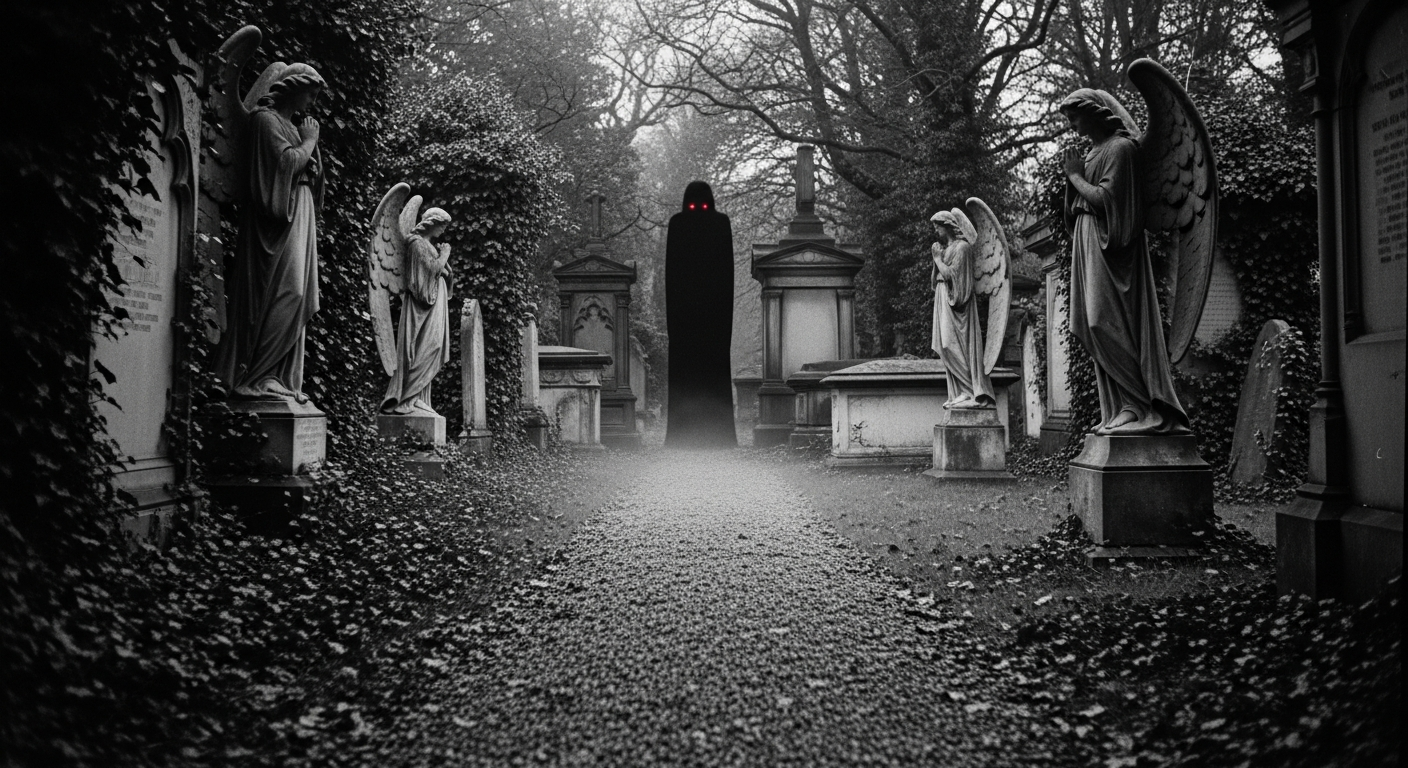
The Highgate Stalker: London's Most Terrifying Vampire Hunt and the Thing That Watched from the Graves
QUIRK REPORTS — OFFICIAL CASE FILE
Case Number: QR-2026-68073
🦊 DEAD MEN DON'T BLINK: THE HIGHGATE VAMPIRE AND THE EYES THAT WATCHED FROM THE DARK
Classification: Ghost/Spirit — Possible Undead Entity / High Strangeness
Date of Event: January 1969 – 1974 (sporadic reports continuing to 1982)
Location: Highgate Cemetery, Swain's Lane, North London, United Kingdom
Primary Witness: David Farrell (name changed)
Report Filed By: Fox Quirk, Founder & Senior Investigator, Quirk Reports
This report is based on documented paranormal accounts. Names and identifying details have been changed to protect those involved.
WITNESS STATEMENT
David Farrell was twenty-three years old and, by his own description, a practical man — not given to fancy, not particularly interested in ghost stories — when the night of the 13th of January, 1969, removed those qualities from him with surgical efficiency.
A local to the Highgate area, Farrell was familiar with the cemetery in the way that only those who grow up beside a place can be: fond of it, unafraid of it, accustomed to its particular atmosphere of grand Victorian melancholy. He had entered through a gap near the North Gate on Swain's Lane that evening, as he had done many times before, and had been walking the central path for approximately ten minutes when he became aware of a figure standing motionless between two large family tombs.
His initial assumption was mundane — another visitor, unusual at that hour but not impossible. Then he stopped, and the figure did not move. Farrell described it as substantially taller than any man he had encountered, dressed in dark clothing that read as old-fashioned even at a distance. Its face caught no light despite the pale winter moon above. And where its eyes should have been, there were two points of faint crimson light — dim, utterly still, and fixed entirely upon him.
Farrell ran. He later said he had no memory of deciding to run — only that he was suddenly outside the fence on Swain's Lane, breathing in ragged gasps. He told no one that night. He was not, he admitted, entirely certain he believed himself.
He was not alone in his uncertainty, nor in his experience. That same month, two young women walking home along Swain's Lane reported a dark figure appearing at the cemetery gate and staring at them with burning red eyes before seeming to dissolve back into the shadows. A man walking his dog near the eastern wall described his animal going rigid with terror, straining backward on its lead, eyes fixed on something invisible to its owner. The dog was found dead three days later — drained of blood, its body bearing no visible wound.
Reports accumulated quietly through 1969 and into 1970, circulating in local pubs and the letters pages of community papers, until they reached two very different investigators whose rivalry would define the case for decades. The first, referred to here as Marcus Ainsworth, was a meticulous, cautious occult researcher who had spent years documenting strange phenomena across London. The second, Patrick Hollis, was theatrical and unafraid of conclusions — his conclusion being that the entity at Highgate was, unambiguously, a vampire of the old European tradition, disturbed from centuries of sleep by the cemetery's long neglect.
In February 1970, Hollis appeared on local television and invited the public to join his investigation. The result was catastrophic and extraordinary in equal measure: hundreds of people descended on Highgate Cemetery, gates were forced, graves were broken open, and police made multiple arrests of individuals found within the grounds carrying wooden stakes. The story became a media spectacle. The cemetery became famous in an entirely new way.
Ainsworth, who had watched the events of that Friday with something close to despair, redoubled his own quiet work. He interviewed witnesses individually over many months, documenting at least a dozen cases of drained or mutilated animals found in and around the cemetery by 1971. He mapped the sightings and found they clustered consistently around the older western section — specifically near a sealed vault that local records showed had been locked and unregistered for more than a century.
Farrell, who had by now come forward publicly, accompanied Ainsworth on several night-time vigils during 1971. Both men reported seeing the figure on three separate occasions. The most significant encounter occurred in October of that year, when the entity stood motionless in the pathway directly ahead of them for an estimated four minutes. Neither man could bring himself to approach it. Both described a cold that seemed to radiate from the figure itself — not the chill of autumn air, but something directional, something intentional, like a signal being broadcast outward. When Ainsworth raised his camera, the figure was simply gone. Not observed leaving. Gone. The photograph showed an empty path.
By 1973, Ainsworth had collected forty-seven separate witness accounts, ranging from teenagers to a retired police officer. Many reported the same detail independently: not simply fear, but a profound sensation of wrongness — as though the mind itself refused to properly process what the eyes were presenting. Several witnesses reported days of exhaustion, disturbed sleep, and dreams that dissolved upon waking. Hollis, pursuing a more aggressive strategy, claimed in 1973 to have entered and ritually neutralised the entity, producing blurred, disputed photographs and a book-length account. The feud between the two investigators became as permanent a feature of the case as the figure itself.
Sightings grew less frequent after 1973 but did not cease. In 1980, a woman walking her dog on Swain's Lane described a tall figure standing motionless on top of the cemetery wall, watching the street below. In 1982, a group of students who had broken into the grounds reported hearing something they could only describe as slow, deep breathing — close to them in the darkness — that tracked them across the grounds before stopping abruptly at the gate.
In his final recorded interview on the subject in 1998, Farrell — by then in his early fifties — said he had not returned to the cemetery after dark since 1971. He could not categorise what he had experienced with confidence. Not a vampire in the literary sense. Not a ghost in any conventional sense. Something that had been there. Something that had looked at him and found him, in some obscure way, of interest.
"I have never been frightened in the same way since. Not of anything. Whatever capacity I had for that particular quality of fear — the kind that makes you absolutely certain you are looking at something wrong — that was used up entirely on that path in January 1969. There was nothing left for anything else after that."
EVIDENCE
- Physical traces: Multiple animal deaths in and around the cemetery grounds, 1969–1971. At least twelve documented cases of drained or mutilated small animals, including Farrell's neighbour's dog — found dead three days after its owner's sighting, drained of blood, with no visible wounds.
- Photographic evidence: Ainsworth's October 1971 photograph showing an empty path where both witnesses directly observed the figure standing moments before. The figure does not appear. The photograph has not been satisfactorily explained. Hollis's photographs from 1973 are blurred and independently disputed.
- Corroborating witness accounts: Forty-seven separate accounts collected by Ainsworth between 1969 and 1973. Witnesses include teenagers, adults, and a retired police officer. Multiple witnesses independently described the red-eye phenomenon and the radiating cold sensation without prior knowledge of other reports.
- Consistent geographical clustering: Sightings mapped by Ainsworth concentrate in the older western section of the cemetery, particularly near a sealed, unregistered vault of unknown age.
- Later corroborating accounts: 1980 sighting on Swain's Lane (woman with dog, figure on wall). 1982 student encounter (tracked by audible breathing across the grounds).
- Sealed vault: Local records confirm the existence of a vault in the western section that has been locked and unregistered for over a century. Access has not been formally investigated by any official body.
FOX'S ANALYSIS
Right. Pour yourself something stiff and sit down, because I've covered a lot of strange territory in my years at Quirk Reports — and the Highgate case is one that keeps me up at night. And I'm a nocturnal fox to begin with, so that's saying something.
Let's start with what I genuinely respect here: the structure of this case is unusually solid for something that sounds, on the surface, like it belongs in a penny dreadful. David Farrell's account is consistent, detailed, and — critically — he wasn't looking for attention. He told no one on the night itself. He sat on his experience. That's not the behaviour of someone fabricating for an audience. The accounts from the two women on Swain's Lane and the man with his dog emerged independently, in the same month, before the case had any public profile at all. The animal deaths are physical. The geographical clustering is methodologically interesting. Ainsworth — whatever one thinks of the field — appears to have conducted himself with genuine rigour. Forty-seven accounts is not a fringe curiosity. That's a data set.
Now, I've been in enough graveyards at enough ungodly hours to know that Victorian cemeteries are legitimately unnerving places even when nothing paranormal is happening. Highgate in particular is spectacular in its Gothic excess — overgrown, shadowed, full of the kind of architectural drama that makes your brain work overtime. The human tendency to pattern-match, especially in low light and high emotional arousal, is real and documented. I am not dismissing that.
But I can't dismiss the photograph, either. Two witnesses directly observe a figure standing on a path. One raises a camera. Figure is gone — not seen to leave, simply absent from the frame. That's not a trick of Victorian ambience. That's a data point, and it's the kind that keeps a reporter's ears flat against their skull in the best possible way. You could say it vanished into thin air — but I'd say the thin air had company.
The Hollis situation I find professionally maddening. The man had a genuine instinct — he was onto something real, I think — and then he held a press conference and invited the general public to go stake-hunting in a Grade I listed cemetery. I've made some questionable editorial decisions in my time, but even I have never accidentally caused a mob to break open Victorian tombs on a Friday night. That takes a special kind of charisma. Patrick Hollis was to paranormal investigation what a fox in a henhouse is to public relations: extremely energetic, extremely damaging, and very difficult to remove once established.
The rivalry between Ainsworth and Hollis is, frankly, a case study in how ego can contaminate evidence. One man working quietly, building a proper record. One man working loudly, building a media profile. You know what I call that? A grave mistake. And yes, I went there — you're reading a Fox Quirk report, you knew the puns were coming.
What strikes me most deeply about this case — and I'll be serious for a moment, because Farrell deserves that — is his 1998 statement. The man is in his fifties. He's had nearly thirty years to reconsider, reframe, or simply forget. Instead, he says with complete steadiness that whatever capacity he had for that specific quality of fear was entirely consumed on that path in January 1969. That's not the language of performance. That's the language of trauma. Something happened to David Farrell at Highgate Cemetery, and whatever it was, it left a mark that three decades hadn't touched.
I'm also intrigued by the sealed vault. An unregistered, century-locked vault in the precise sector where sightings cluster, never formally investigated by any official body? That's what we in the trade call a loose thread. And I have never in