
The Guest Who Never Checked Out: How a Yorkshire Inn Was Haunted by Its Most Faithful Regular
QUIRK REPORTS — OFFICIAL CASE FILE
CASE NUMBER: QR-2026-44856
THE GUEST WHO NEVER CHECKED OUT: YORKSHIRE INN HAUNTED BY ITS MOST FAITHFUL REGULAR FOR OVER A CENTURY
Classification: Paranormal Encounter — Ghost/Spirit (Recurring Apparition)
Date of Initial Event: 14th March 1953 (recurring through to the 1980s)
Location: The Black Swan Inn, Devizes Road, Pickering, North Yorkshire, England
Primary Witness: Margaret Holroyd, hotel staff member
This report is based on documented paranormal accounts. Names and identifying details have been changed to protect those involved.
WITNESS STATEMENT
Margaret Holroyd had spent her adult life in hotel work. She was not, by any measure, a fanciful woman. On the night of 14th March 1953, she was conducting a routine final check of the second floor rooms at the Black Swan Inn, carrying a handheld lamp because the second floor electrics — characteristically unreliable, as staff had long since accepted — had been malfunctioning for most of the week. What she encountered in the corridor that night was not something she had language for, at least not immediately.
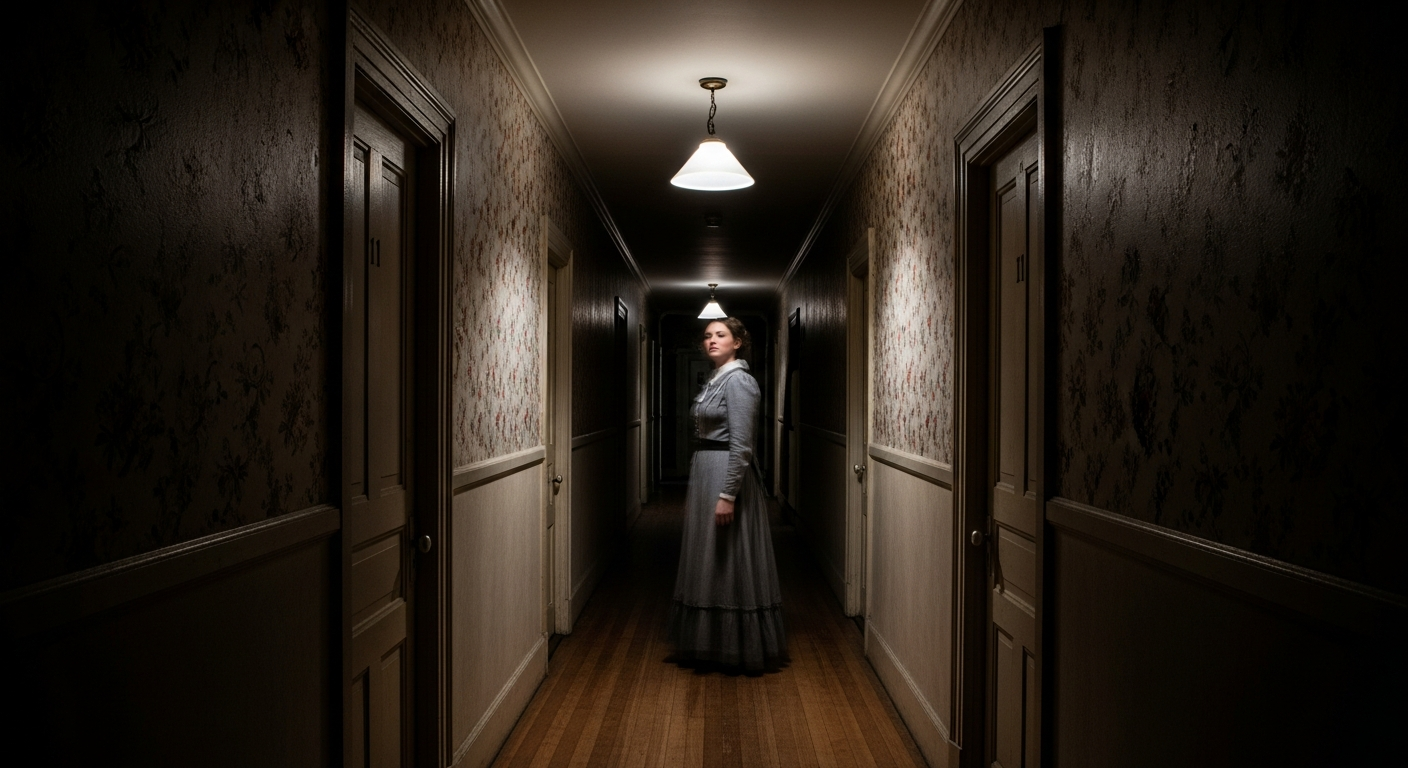
The cold came first. Not the ordinary cold of an unheated building in a northern English March, but something Holroyd later described with quiet precision as a cold that seemed to come from inside the air itself — a hollow in the atmosphere where warmth could not take hold. Her lantern flickered. There was no draught. And at the far end of the corridor, near the door to room eleven, which stood unbooked and empty that night, there was a woman.
The figure was dressed in grey — not the grey of any identifiable garment, but a flat, inert grey that Holroyd described to investigators from the Yorkshire Psychical Research Circle as less like a colour and more like the absence of one. The woman's face was turned slightly away, directed toward the wall beside the door frame, with a quality of stillness that Holroyd found deeply unnatural. Not the stillness of repose. The stillness, she said, of something that had forgotten motion was an option.
Holroyd estimated she stood frozen for between ten and twenty seconds. She did not scream. She later told investigators, in the sitting room of her daughter's house in Malton, her hands folded carefully in her lap, that she simply could not — that the cold had entered her lungs and held the sound inside her.
Then the figure turned its head. Slowly. Toward her.
Holroyd was firm on the next point whenever investigators pressed her over the years: there was a face. Not a blur, not a skull, not an impression. A woman's face, pale and composed, with dark eyes that registered nothing — no alarm, no awareness, no recognition. Then the figure stepped sideways, through the wall beside door eleven, and was gone.
"I knew what I had seen. I didn't try to explain it away. There was a woman there, and then she went through the wall, and I stood in that corridor for a long time before I could make myself walk back down the stairs."
Holroyd left the Black Swan's employ within six months, not from incapacitating fear — she was emphatic about this distinction — but from a settled conviction that the second floor corridor was not entirely hers to occupy. It belonged, in some way she could not satisfactorily articulate, to the woman who had died in room eleven and had simply declined, for reasons of her own, to leave.
She was not the first to reach that conclusion, nor the last. Former staff and long-term guests, canvassed by investigators in the years following Holroyd's encounter, produced a body of testimony reaching back to at least the 1910s. A former pot-man, identified in investigation records only as Mr. F., recalled seeing a grey woman on the stairs on two separate occasions during his tenure at the inn in the 1920s. He was a self-described sceptic with no interest in further involvement, and his matter-of-fact account was considered by investigators to carry particular weight for precisely that reason. Staff, he explained, had simply called the figure the Lodger and treated her as part of the building's fabric — unremarkable as the uneven floorboards, and considerably less trouble than a difficult guest.
In the summer of 1954, the Yorkshire Psychical Research Circle conducted a formal four-night investigation of the second floor. On the third night, a young female investigator seated near the stairwell end of the corridor reported seeing the grey figure emerge from the wall beside room eleven at approximately 1:40am, walk the length of the corridor toward her, and then cease to be present approximately four feet from where she sat. Her pencilled contemporaneous notes, later lodged with the Society for Psychical Research archive in London, recorded the experience with a restraint that investigators found more convincing than any dramatic account.
"The woman came toward me and then she was not there anymore. The temperature dropped sharply both before and after. I was frightened but I remained in my chair. I do not know why she stopped where she did."
A 1971 investigation by a Bradford-affiliated psychical research group produced one further account of note. A retired schoolmaster in the group claimed not merely to have seen the figure but to have received from her — not heard, he was careful to clarify, but received, in the way one receives a change in temperature — an overwhelming feeling of patient, exhausted waiting. He described it as the emotional quality of someone who has been sitting in a waiting room for a very long time and has ceased to expect their name will be called, but has not yet decided to leave.
Local historical research commissioned by the YPRC in 1954 identified a death certificate for an innkeeper's wife at the premises, dated to the winter of 1847. The cause of death was fever. The room in which she died, cross-referenced against a historical floor plan retrieved from the North Riding county archives, corresponded precisely to room eleven.
Margaret Holroyd gave her last known interview on the subject in the late 1980s. Her account had not changed in thirty-five years. She had seen what she had seen.
EVIDENCE
- Multiple independent witness testimonies: Sightings corroborated across at least six decades, from the 1910s through to the 1980s, by staff, guests, and trained paranormal investigators from three separate research groups.
- Contemporaneous investigator notes: Pencilled field notes from the 1954 YPRC investigation, subsequently archived with the Society for Psychical Research in London, documenting the apparition sighting in real time.
- Historical death record: Death certificate identified by YPRC-commissioned researcher in 1954, naming an innkeeper's wife who died of fever at the premises in winter 1847, with location corresponding to room eleven per archived floor plans.
- Recurring electrical anomalies: Persistent, unexplained failures of second floor electrics over a period of at least fifteen years, assessed by electricians on four separate occasions with no fault identified. Notable incident: simultaneous failure of all second floor lights at 2am in autumn 1948, with no mechanical explanation found.
- Temperature phenomena: Cold of an anomalous character reported independently by Holroyd, the 1954 YPRC investigator, and a long-term guest writing to the inn's owner in 1948.
- Consistent spatial pattern: Apparition sightings almost universally located on the second floor, in the vicinity of room eleven, between midnight and 3am, with a cluster of incidents during winter months.
- No photographic evidence obtained: Camera technology during the 1954 investigation was insufficient for the low-light conditions. A test photograph of the corridor produced only an image of an empty hallway.
FOX'S ANALYSIS
Right. Pull up a chair, pour yourself something warm — you'll want it after reading that — and let me give you my take on what is, frankly, one of the more quietly compelling cases to cross my desk this quarter.
First things first: the witness. Margaret Holroyd is, in the business, what we call a gold standard primary source. She never embellished. She never changed her story. She didn't run to the papers or the penny dreadfuls. She told the same account in 1954, in 1971, and in the late 1980s, sitting in her daughter's sitting room with her hands in her lap, and the three versions line up like they were typeset. In my experience — and I've been doing this long enough to have the press pass fraying at the edges — the witnesses who quietly insist on the plain facts and nothing else are the ones you pay attention to. The elaborators, the drama-merchants, the ones who add a little more spectral wailing every time they tell it? I can spot those from the other side of a notebook. Margaret Holroyd was not one of those people.
Now, the consistency of the sightings over seventy-plus years is what really gets my tail twitching. You've got a pattern here so reliable it's practically on a timetable. Second floor. Room eleven. Between midnight and three. Grey woman. Cold air. Exit through wall, stage left. Three independent research groups saw enough to keep coming back. The 1954 investigator's pencilled notes are exactly the kind of evidence that makes sceptics uncomfortable, because there's no theatrical flair in them, just a frightened young woman in a chair noting down what happened with the careful discipline of someone who'd been trained to observe. She came toward me and then she was not there anymore. Gives me chills every time I read it. And not just the temperature-drop kind.
The historical record is a nice piece of corroboration too. Look — I'm a fair fox, I'll acknowledge you could argue the floor plan identification was wishful thinking, that a researcher looking for a death in that building was always going to find one eventually. Fair. But an 1847 death certificate, a corresponding floor plan from county archives, and a figure seen near room eleven for at least seven decades? That's not a coincidence I'm willing to file under Probably Nothing. That's a booking confirmation.
I'll be honest: the 1971 retired schoolmaster claiming to have received an emotional transmission from the figure gave me a moment's pause. I have nothing against retired schoolmasters — half the best tip-offs I ever got came from retired schoolmasters — but uncorroborated telepathic impressions sit lower in my evidence hierarchy than a handheld thermometer. I'm not dismissing him. That description of patient, exhausted waiting is extraordinarily evocative, and I note that his fellow investigators didn't say he was lying, just that they couldn't confirm it. Fair enough. I'll log it under Interesting But Unverified, right next to my notes on a certain incident involving extraterrestrial visitors who I will not be discussing here because this is a professional document and also I'm still furious.
What strikes me most about this case, sitting back and looking at the shape of it, is what it isn't. It isn't a poltergeist. It isn't threatening. It isn't performing for anyone. The grey woman at the Black Swan doesn't rattle chains or terrify guests into lawsuits. She just stands near room eleven in the small hours of winter nights and waits, and occasionally walks through a wall. She's been doing it since before the First World War and possibly since before the Franco-Prussian War. She's the most regular guest the inn ever had, and she never once asked for a late checkout. You might say she's been inn-defatigable.
The electrical anomalies are worth noting too. Four separate electricians finding nothing wrong with wiring that keeps going dark at 2am. Now, I know what the sceptics will say