
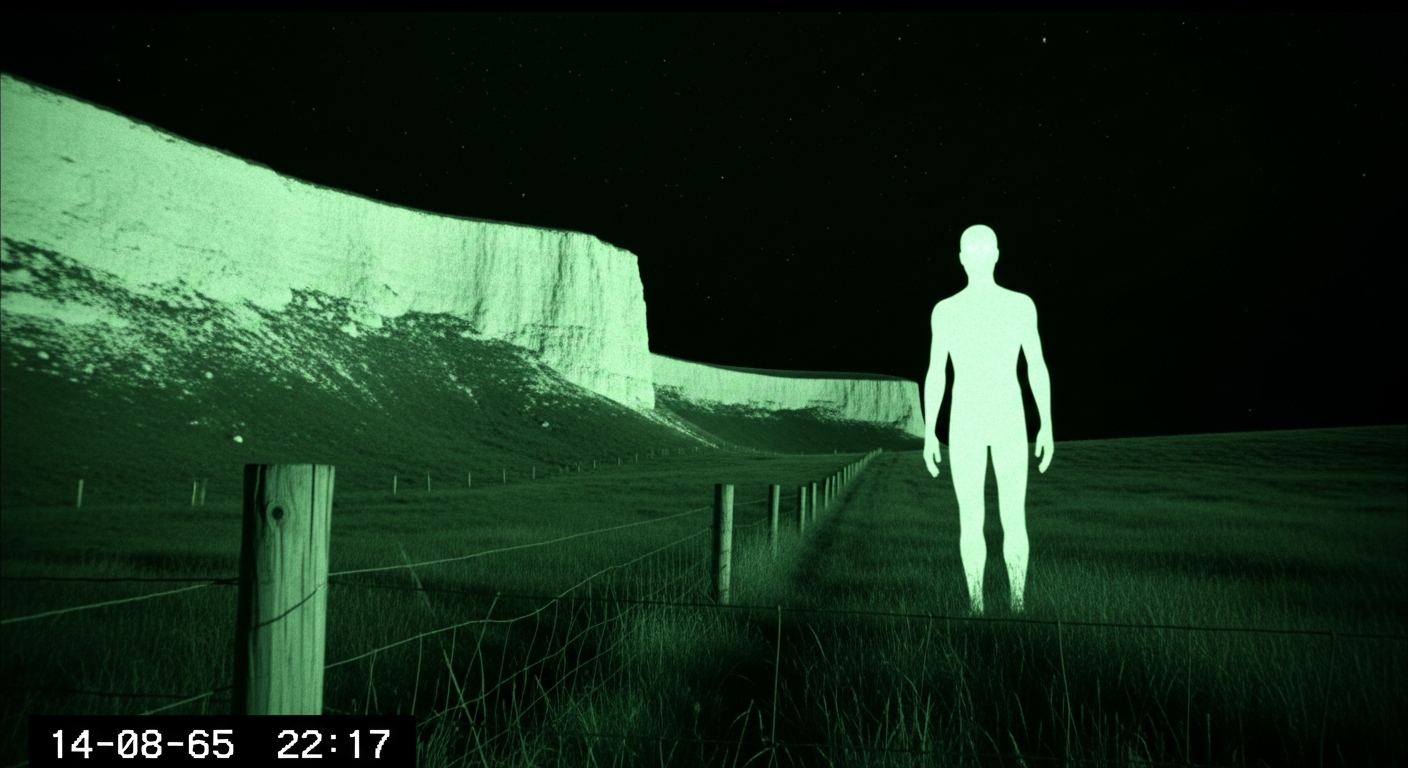
The Flatlands Fiend: How a Norfolk Farmer's Encounter with a Towering Silver Being Shook Rural England
QUIRK REPORTS — OFFICIAL CASE FILE
Case Number: QR-2026-25407
THE HILL HAD EYES: WARMINSTER'S GLOWING GIANT AND THE FARMER WHO WOULDN'T LIE
Classification: Strange Creature / Unidentified Humanoid Entity
Date of Event: 14th August, 1965
Location: Cley Hill, near Warminster, Wiltshire, England
Witness: Gerald Marsh (name changed)
Lead Investigator: Fox Quirk, Quirk Reports
Filed: Quirk Reports Archive, Case QR-2026-25407
This report is based on documented paranormal accounts. Names and identifying details have been changed to protect those involved.
WITNESS STATEMENT
By the summer of 1965, Warminster had already earned a reputation as the most unsettled town in England. Since Christmas of 1964, residents had been subjected to a sustained and deeply unnerving phenomenon: a droning, shrieking, clattering noise descending from the sky with no consistent warning and no identifiable source. Roof tiles cracked. Dead birds collected beneath silent trees. A woman on the high street had been driven to her knees by a sound that seemed to compress the very air around her skull. The local press had named it, simply and helplessly, the Thing. The national press was circling.
Gerald Marsh, fifty-one, was not a man who entertained the inexplicable. He had farmed the land at the foot of Cley Hill for the better part of his adult life — rising before dawn, working until dark, measuring the world in soil and seasons and things he could put his hands on. He had heard about the Warminster Thing. He had filed it, provisionally, under military testing or atmospheric oddity. Warminster sat close enough to the army ranges at Salisbury Plain to make that a reasonable hypothesis. He was a practical man. He held his judgement.
He revised it on the evening of the fourteenth of August.
The sun had been down for approximately an hour when Marsh walked out to inspect a section of fencing along his lower field, near the eastern chalk slope of Cley Hill. It was a rare, generous English summer night — clear and warm, the stars fully out, a thin crescent moon hanging low above the hill. He carried a torch he barely needed. He was forty yards from the fence line when the ground began to hum.
It was not the catastrophic shriek reported by Warminster residents. This was lower, deeper — a subsonic pulse that arrived first in his chest, then his teeth, then, by his own account, in the very fillings of his back molars. The grass around his boots trembled in the torchlight.
"I thought it was a vehicle of some kind. A tractor on the other side of the hill, or perhaps something on the road. I thought the ground was just carrying the vibration. Then I looked up at the hill and there was a light there that hadn't been there before."
The light sat at the crest of Cley Hill, roughly three hundred metres distant. It was neither the yellow wash of a lantern nor the hard beam of a vehicle lamp. Marsh described it as silver-white and steady, like something phosphorescent but stronger — illuminating the grass immediately around it. And then it moved. Not the light alone. Something within it. Something tall.
Marsh later estimated the figure at between seven and eight feet in height. It was bipedal, broadly humanoid in structure, but the proportions were wrong in ways he found difficult to name. The limbs were too long. The head was smooth and rounded, entirely featureless — no eyes, no mouth, no definition of any kind. And the form did not reflect the light. It was the light. The silver-white luminescence appeared to emanate directly from the surface of the figure, as though the light were its skin.
It was walking down the slope toward him.
What is notable in Marsh's account — taken in full by local investigator and Warminster chronicler Arthur Shuttlewood, and later corroborated in its details by two independent researchers — is its emotional precision. Marsh was not, he said, immediately afraid. For the first several seconds he experienced something closer to a total suspension of thought: a cognitive blankness, as though his mind had encountered a category for which it possessed no filing system and had simply stopped.
"It wasn't walking toward me specifically. It was walking down the hill as though it had a direction in mind. But its direction was mine. I couldn't tell if it had noticed me."
The vibration intensified. Marsh noted a secondary sensation — a pressure behind the eyes, not painful but insistent, like a headache held permanently on the edge of arriving. The air felt, in his words, thickened. Asked later whether he had experienced any loss of time, he paused for a long while before saying he did not believe so — but that the duration was genuinely difficult to assess. It had felt, he said, like being inside a moment that wouldn't move.
The figure descended approximately two thirds of the slope before it stopped. Marsh estimated the distance between them at eighty to one hundred yards. The smooth, featureless head was tilted very slightly in his direction.
And then the light went out.
Not dimmed. Not retreated. Gone. One instant: a luminous figure against a dark hillside. The next: stars, darkness, and a vibration fading slowly from the ground like the tail of a church bell, detectable long after logic suggested it should have ceased.
Marsh stood in his field for another five minutes. Then he walked back to his farmhouse, sat at his kitchen table with a cup of tea, and told no one until morning. His wife, it emerged, had heard the vibration from inside the house — had assumed a lorry on the road, and gone back to sleep.
Marsh gave his account once to Shuttlewood, permitted it to be used anonymously, and thereafter declined all further contact on the subject. A researcher from a London UFO group was turned away at his gate in 1967. He continued farming the same land until his death in 1989, and made no further public statements. Shuttlewood, in his private notes, wrote of Marsh: "He came to me. I did not seek him out. He was reluctant to be interviewed, reluctant for his name to be used, and showed none of the enthusiasm for the subject that you might expect from someone attempting to manufacture a sensation. He was a man who had seen something, and was trying to account for it rationally, and finding that he could not."
EVIDENCE
- Physical trace — discoloured grass: Approximately two days after the encounter, Shuttlewood and a colleague examined the relevant area of Cley Hill's eastern slope. They found a rough oval of yellowed, flattened grass at the approximate location where Marsh believed the figure had stood. The flattening was radial — outward from a central point — inconsistent with animal bedding or human foot traffic.
- Soil samples: Taken by Shuttlewood's team. Informal analysis returned no radiation readings but indicated localised desiccation inconsistent with the surrounding soil conditions.
- Corroborating vibration account: Marsh's wife independently reported hearing and feeling the subsonic vibration from inside the farmhouse at the approximate time of the encounter, without prior knowledge of what her husband had witnessed.
- Broader Warminster context: The encounter occurred within a sustained, multi-year phenomenon involving hundreds of witnesses, documented aerial lights, unexplained sounds, dead birds, and physical traces across the Warminster area — providing a substantial corroborating backdrop for the report.
- Investigator assessment: Arthur Shuttlewood, whose documentation of the Warminster events spanned the following decade and produced multiple published works, ranked Marsh among his most credible witnesses, specifically noting his reluctance to engage publicly and his absence of apparent motivation for fabrication.
FOX'S ANALYSIS
Right. Let's talk about Gerald Marsh. Because if you're looking for a hoaxer, a glory-seeker, or a man who wanted his name in the papers — you've come to the wrong farm. This is a fifty-one-year-old Wiltshire farmer who, upon witnessing what may have been one of the most extraordinary close encounters in British UFO history, went home, made a cup of tea, and went to bed. My kind of witness. Properly grounded. Literally — he spent his whole life in it.
The behavioural profile here is impeccable. He came to Shuttlewood. He requested anonymity. He gave one account, never embellished it, never went on the circuit, turned away researchers at the gate. When a man who could have sold his story to every newspaper in Fleet Street instead goes back to mending fences — sometimes quite literally — you sit up and pay attention. In thirty years of reporting the inexplicable, I've met plenty of people who wanted to be believed. Gerald Marsh just wanted to be left alone. That's practically a credibility certificate.
Now, the entity itself. Seven to eight feet tall, self-luminous, featureless face, wrong proportions, apparent teleportation-style disappearance. I've seen a lot of case files. This description doesn't read like a man who absorbed too many science fiction comics — it reads like a man carefully describing something for which he genuinely didn't have language. The detail about the luminescence emanating from the figure rather than being reflected by it? That's not a theatrical flourish. That's a specific, considered observational distinction. You don't invent that particular nuance when you're making something up. You reach for the easy stuff — glowing eyes, metallic suit, the usual theatrical props.
The subsonic vibration is also worth sitting with. Multiple independent witnesses across the Warminster area described similar sensations over the same period — chest-pressure, dental vibration, the peculiar grinding feeling in fillings that makes absolutely no sense but keeps appearing in these accounts with suspicious consistency. I've always said there's something filling-ing about a good UFO case. You really sink your teeth into the evidence. (I'm not sorry. I have a notebook to fill and puns don't write themselves.)
The physical traces are modest but present. Radial grass flattening with localised soil desiccation isn't conclusive — but it's something. It's the right kind of something. It doesn't prove a seven-foot luminous entity stood on that hill. It does prove something was on that hill, and that something was unusual enough to leave a mark. In paranormal investigation, you take your somethings where you can find them.
Could this have been a military asset of some kind — an experimental suit, a drone prototype, a psychological testing exercise conducted on an unsuspecting civilian population? The proximity to Salisbury Plain means I'm professionally obliged to leave that door ajar. I leave it ajar. But I note that no military programme, acknowledged or otherwise, has ever produced anything that blinks out of existence without trace, leaves no sound of departure, and desiccates a patch of Wiltshire grass in a radial pattern. If it did, I want a very long conversation with whoever was in charge of it. And I expect they probed more than just the local wildlife. Trust me, I know how that particular story ends.
The thing I keep returning to — and I mean this — is that phrase of Marsh's: like being inside a moment that wouldn't move. That's not a prepared line. That's a man who spent weeks trying to find words for something and finally landed on the closest approximation available. That kind of linguistic struggle is, in my experience, a marker of genuine encounter. Fabricators are fluent. Real witnesses are fumbling. Marsh fum