
The Farmer Who Lost Four Hours: Canada's Most Baffling UFO Landing Case
QUIRK REPORTS — OFFICIAL CASE FILE
CASE NUMBER: QR-2026-24880
TITLE: THE MAN WHO TOUCHED THE SAUCER: CANADA'S MOST RADIOACTIVE CLOSE ENCOUNTER
Classification: UFO/UAP — Close Encounter of the Second Kind (Physical Evidence) / Possible Close Encounter of the Third Kind (Missing Time)
Date of Event: 20 May 1967
Location: Falcon Lake, Manitoba, Canada
Reporting Officer: Fox Quirk, Founder & Senior Correspondent, Quirk Reports
File Status: OPEN
This report is based on documented paranormal accounts. Names and identifying details have been changed to protect those involved.
WITNESS STATEMENT
On the morning of 20 May 1967, Gerald Machin — a 51-year-old amateur prospector and former miner from Winnipeg — drove out to the wilderness near Falcon Lake, Manitoba, for what he expected to be an unremarkable long weekend of geological survey work. Methodical, practical, and by all accounts constitutionally allergic to dramatics, Machin was precisely the kind of witness investigators dream about: a man who kept receipts, double-checked measurements, and had spent twenty years quietly tramping through Canadian wilderness without incident. He was, as his wife Dorothy would later confirm, someone who simply did not make things up.
He set out from his motel shortly after 9 AM and hiked north into the bush along a creek bed he had been working for two seasons. By mid-morning he had settled into the familiar rhythm of prospecting work — marking, chipping, noting, moving on. He was eating his packed lunch on a flat granite outcropping when the encounter began.
He heard it first: a sharp displacement of air, a 'whoosh' at high pressure, accompanied by a flock of geese erupting from the treeline in sudden, panicked flight. He looked up to find two disc-shaped objects descending from the south in a slow, controlled spiral — silent now, and moving in a manner entirely unlike any aircraft he had ever observed.
One disc halted its descent and hovered approximately 100 feet above the ground. The second continued downward and landed on the flat granite surface roughly 160 feet from where Machin sat, still holding his sandwich. He did not flee. He would later struggle to articulate exactly why, settling on the explanation that the craft simply did not feel threatening — at least not immediately.
Machin approached the landed object on foot. He described it as approximately 35 to 40 feet in diameter, dull gunmetal grey, and shaped like two saucers placed rim to rim with a raised centre section. Around its midsection ran a band of what appeared to be vents or ports, radiating heat. The surface was entirely seamless — no rivets, no joins, no visible windows. The air around it carried a sharp, sulphurous smell, like ozone and electrical burning combined.
The hovering craft then departed — accelerating away to the north at what Machin estimated as near-instantaneous speed, leaving only a faint shimmer above the treeline. Alone now with the landed object, Machin noticed that a hatch or gap had opened in the craft's lower section. By his own later admission, he was fully aware that approaching further was not sensible. He approached anyway.
He placed his hands against the hull. The metal was warm and faintly textured. He pressed closer and looked into the opening.
He remembered a burst of intense heat, a flash of light, and then nothing coherent.
His next clear memory was of standing on the road back to the motel, approximately two kilometres from the encounter site. His compass was gone. His shirt felt damp. His hands and chest were burning with a pain that was already becoming difficult to ignore.
He arrived back at the motel at approximately 6:15 PM. He had left his lunch spot at approximately 12:15 PM. Nearly four hours were entirely unaccounted for.
Dorothy was waiting. She knew immediately that something was seriously wrong. Her husband — a man she described as someone who 'never made a fuss about anything' — was shaking. The palms of both his hands were blistered in a pronounced grid-like pattern consistent with directed, intense heat exposure. His chest bore similar markings, with a circular burned area approximately five inches in diameter that was already blistering severely. He vomited twice before morning.
The following day, the couple attended the nearest medical facility, where the attending physician documented the burns as consistent with severe radiation or intense directional heat exposure, with no identifiable conventional cause. A subsequent specialist confirmed radiation-type injuries: the burn pattern, the blistering, the later hair loss in affected areas, and abnormalities in Machin's white blood cell count that were monitored with clinical concern over the weeks and months that followed.
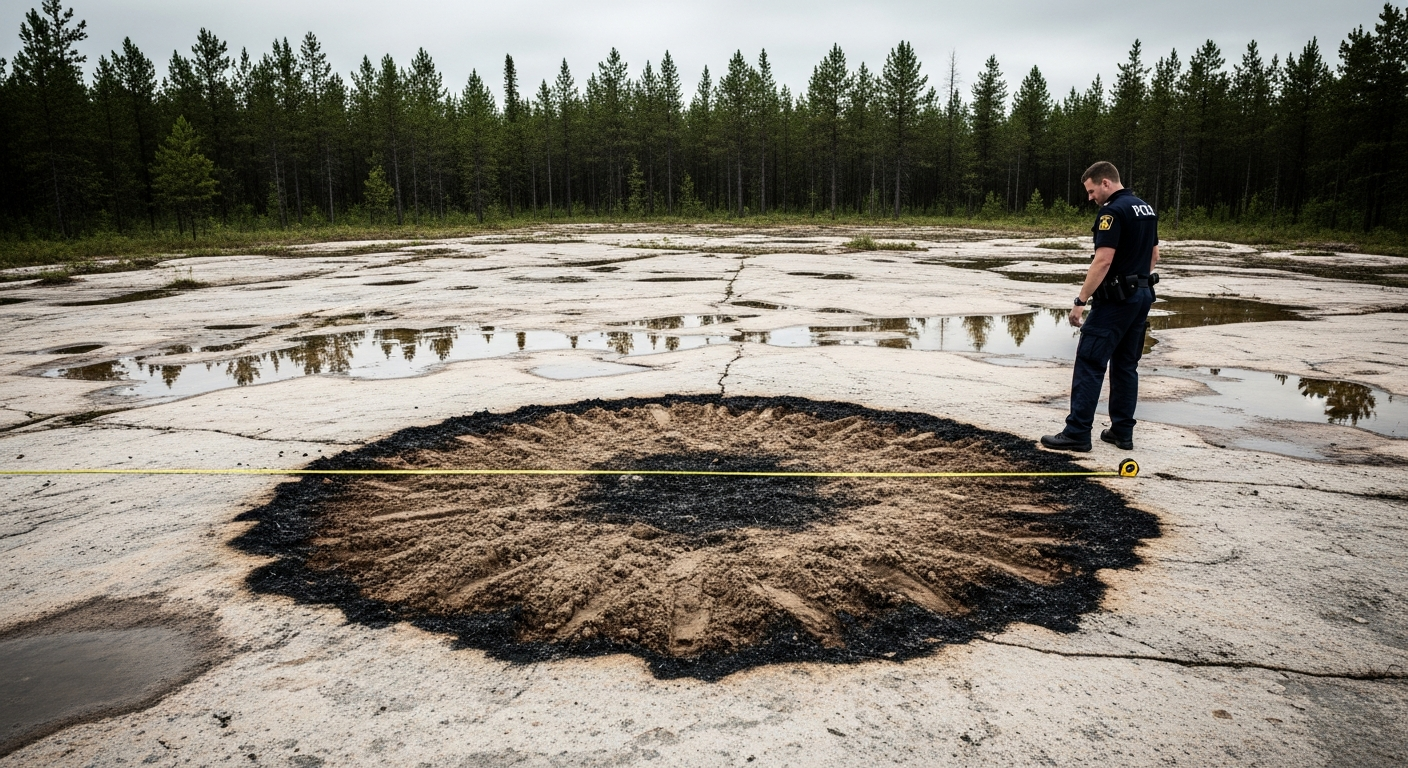
Machin reported the incident to the Royal Canadian Mounted Police within 24 hours. He and an RCMP officer returned to the site and found it immediately: a ring burned into the flat granite, approximately 15 feet in diameter, with disturbed soil showing elevated radiation levels. Vegetation around the ring had been flattened outward, consistent with a powerful downdraft. Small, irregular metal fragments were scattered nearby — fragments that later analysis suggested bore isotopic compositions inconsistent with known industrial processes, though the chain of custody for these samples became significantly compromised.
The case was investigated by the Canadian government's UFO study programme, by the United States Air Force through Project Blue Book, and by numerous independent researchers. The physical evidence was confirmed by the RCMP. When the Canadian government declassified its files in the late 1990s, internal documents revealed that officials who were publicly dismissive had privately treated the case with considerable seriousness. One senior departmental memo described it as 'the most significant [incident] this department has encountered to date.'
Machin's subsequent years were difficult. The burns healed slowly and imperfectly. He lost weight, suffered recurring nightmares, and by autumn of 1967 had largely ceased going outdoors — a profound change in a man who had spent two decades in the Canadian wilderness. His wife documented a prolonged withdrawal and anxiety that persisted well into 1968. He gave interviews only reluctantly in later years, and his account never wavered in any material detail. When pressed on the four missing hours, he was consistent and unambiguous: 'Some things you're better off not knowing. I can tell you what I saw and what happened to my hands. What happened in those four hours — I have to leave that alone.'
Gerald Machin died in 1999. His son, responding to the release of the government files, issued a brief statement: 'My father was not a liar and he was not a fool. He saw what he saw, and it cost him. That's all we've ever had to say about it.'
EVIDENCE SUMMARY
Physical Traces at Site
- Burned ring on granite: Approximately 15 feet in diameter, confirmed on-site by the RCMP and independently inspected over the following decade.
- Elevated radiation readings: Soil samples from within the ring returned above-normal radiation levels.
- Displaced vegetation: Growth around the ring was flattened radially outward, consistent with a significant downdraft event.
- Metal fragments: Small irregular pieces recovered near the site; preliminary analysis suggested anomalous isotopic composition. Samples were subsequently absorbed into institutional custody and were never made available for independent re-analysis.
Medical Documentation
- Burns to both palms and chest documented by attending physician and specialist within 48 hours of the incident.
- Burn pattern, blistering type, and subsequent hair loss confirmed as consistent with radiation-type exposure.
- White blood cell count abnormalities monitored over following months.
- Post-mortem release of partial medical records by family confirmed chronic health complications attributed, at least in part, to radiation exposure.
Corroborating Accounts
- Dorothy Machin: Independently confirmed timeline of husband's return, his physical condition, and progressive deterioration of burns — interviewed separately from the witness.
- RCMP: Confirmed presence and nature of physical evidence at the site.
- Canadian Government Files (declassified late 1990s): Internal memos confirmed the burn ring, radiation readings, metal fragments, and medical findings were taken seriously at senior official level, directly contradicting public dismissal of the case.
FOX'S ANALYSIS
Alright. I've been doing this job long enough to know the difference between a story that wants to be true and a story that simply is true, and the Falcon Lake case lands — if you'll forgive the pun — very firmly in the second category.
Let me start with the witness, because the witness is everything. Gerald Machin is the paranormal investigator's holy grail: a sober, experienced, outdoors-competent adult male with no history of instability, no financial motive, no apparent desire for notoriety, and a pre-existing professional context — amateur prospector, former miner — that makes him more credible in this specific type of environment, not less. This is a man who knows what granite looks like, what a burn mark in rock means, and how to assess physical evidence in the field. When he says the ring was there, he knows what a ring in the ground looks like and how granite behaves. That matters.
The medical evidence is where this case really separates itself from the pack. You can fabricate a story. You cannot fabricate radiation burns documented within 48 hours by multiple independent physicians, corroborated by subsequent blood work abnormalities, and further confirmed by partial post-mortem release of medical records decades later. Either Gerald Machin was exposed to a powerful radiation source on 20 May 1967, or he deliberately irradiated himself — and I've been in this business long enough to tell you that nobody, nobody, takes a radiation dose to the chest and palms as a publicity stunt. That's not scepticism. That's just common sense.
Now, I do have questions. The missing four hours is the element I find simultaneously most compelling and most frustrating. No memory, no physical evidence of what occurred in that window, no independent witness to the gap. I want to know what happened in those four hours more than I've wanted to know anything since I discovered whoever designed alien medical instruments apparently never considered scaling. But Machin's own instinct — 'some things you're better off not knowing' — is the response of a man who has genuinely considered the question and arrived somewhere troubling. That's not evasion. That's a man who looked into something and decided the view wasn't worth it. I respect that. I also find it deeply unsettling.
The metal fragments are a significant frustration for this investigation. The suggestion of anomalous isotopic composition is extraordinary if confirmed — extraordinary enough that the disappearance of those samples into institutional custody without independent re-analysis is, to put it in technical reporter terms, extremely suspicious. Governments don't lose interesting evidence. They lose boring evidence. When the chain of custody gets 'muddied' on potentially anomalous extraterrestrial metal fragments, my flat cap goes on straight and my notepad comes out. You could say the evidence really... took off.
The declassified memos are the detail that closes this one for me. When the officials who publicly dismissed a case privately describe it in writing as the most significant incident their department has encountered — that's not a coverup movie cliché. That's a paper trail. Paper trails are what reporters live for. Gerald Machin reported to the RCMP within 24 hours, cooper