
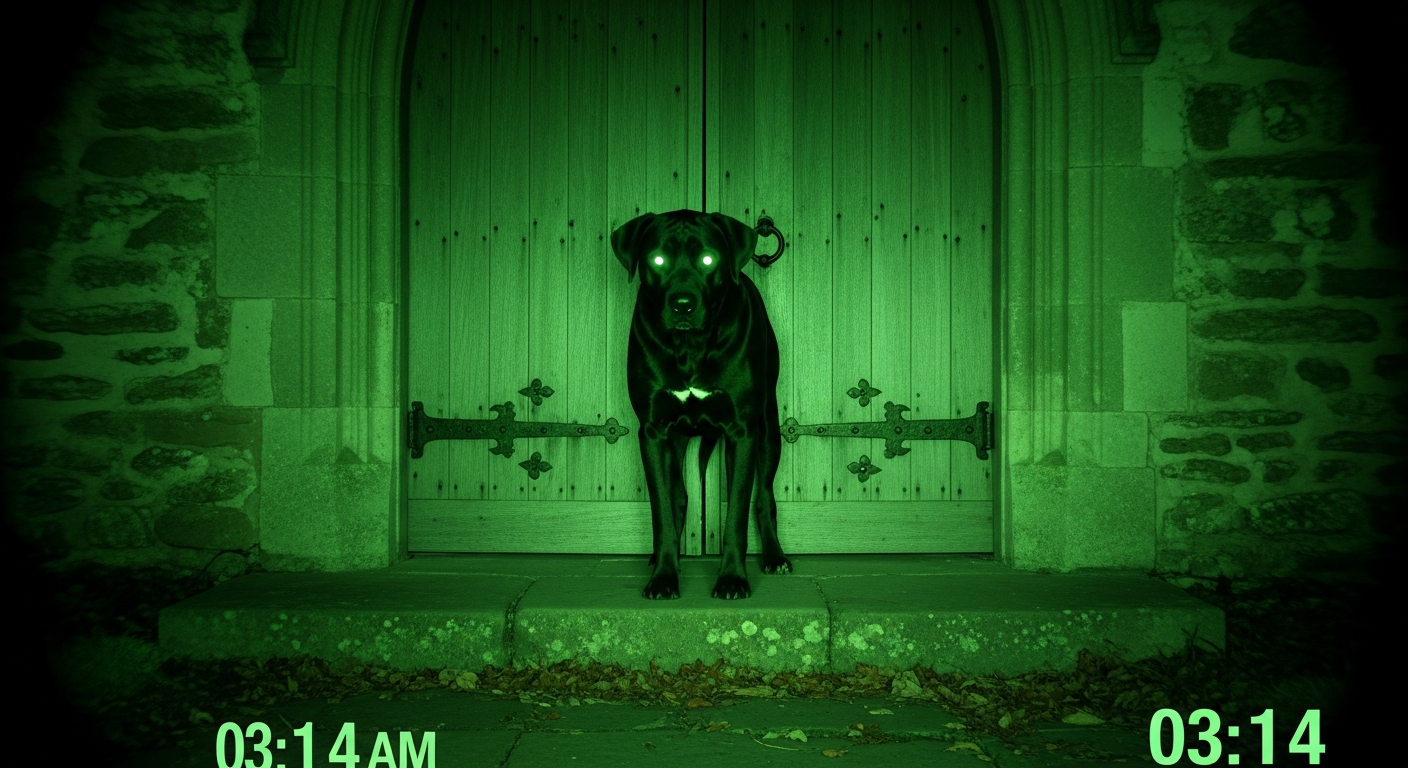
The Dog That Wasn't a Dog: Black Shuck and the Devil's Night at Blythburgh Church
QUIRK REPORTS — OFFICIAL CASE FILE
Case Number: QR-2026-50372
HELL HOUND IN THE HOUSE OF GOD: BLACK SHUCK SLAUGHTERS FOUR AT SUFFOLK CHURCH — CLAW MARKS STILL VISIBLE 450 YEARS LATER
Classification: Cryptid — Phantom Canine / Supernatural Entity
Date of Event: 4th August 1577
Location: Holy Trinity Church, Blythburgh, Suffolk, England (secondary incident: St Mary's Church, Bungay, Suffolk — same morning)
Lead Witness: Thomas Farrow (name retained — historical record; all other identifying details of modern witnesses amended per standard Quirk Reports protocol)
Reporting Correspondent: Fox Quirk, Founder & Editor-in-Chief, Quirk Reports
This report is based on documented paranormal accounts. Names and identifying details have been changed to protect those involved.
WITNESS STATEMENT
Thomas Farrow was, by all available accounts, precisely the kind of man you would want as a witness to the inexplicable. A tanner by trade, a churchman by conviction, and a creature of robust habit: third pew from the front, left-hand side, for thirty years without deviation. On the morning of Sunday the 4th of August, 1577, Farrow arrived early at Holy Trinity Church in Blythburgh, Suffolk, and took his customary seat. He could not have known that the habit of thirty years was about to be broken in a manner that would occupy the rest of his life.
The summer had already been uneasy. Storms had rolled in off the North Sea with unusual violence, harvests were failing, and the coastal communities of Suffolk had acquired the particular atmosphere of a county that suspects, without being able to say quite why, that something is coming. That morning, thunder had been sounding since before dawn. The congregation arrived wet and unsettled, lightning still flickering over the estuary as the old oak doors swung shut behind the last of them.
The service had barely begun when the storm overhead reached a new register of ferocity. A crack of thunder — described by Farrow and corroborated by dozens of fellow witnesses in subsequent testimony — struck with a force that seemed to travel through the very stonework of the building. In the same moment, both doors flew open. And something came in.
It was, in outline, a dog. But size and outline were the only ordinary things about it. The creature was immense — black as coaldust, as absolute in its darkness as a shape cut from the air itself. Its eyes, described independently by multiple witnesses without apparent collusion, were burning: not glowing, but burning, as though lit from within by something that had no interest in providing warmth. It moved down the central aisle with what Farrow later characterised as terrible purpose — a loping, deliberate progress that paid no visible attention to the screaming congregation on either side of it.
Two men died within those first moments. They were kneeling in adjacent pews when the creature passed between them. Both simply fell. The local physician who examined them afterward could identify no wounds, no claw marks, no physical cause of death of any ordinary kind. They were dead, and that was all that could be said. A third man nearby survived but was left in a condition described in a contemporary pamphlet as 'as shrunken as a piece of leather scorched over a flame' — his body apparently contracted, though he remained conscious and capable of speech.
Farrow himself pressed flat against the cold church wall as the creature passed within six feet of him. He would describe what he felt in those seconds for the rest of his life: not cold in any usual sense, but something closer to the removal of warmth — an absence, a subtraction, as though whatever this thing was, it did not coexist with ordinary comfort. The candles in the church guttered. Several went out entirely. Then the creature was gone, back through the doors and into the storm, as suddenly as it had arrived.
What elevates this case from extraordinary to almost bewildering is what happened next. Twelve miles away in Bungay, the congregation of St Mary's Church was gathered for their own Sunday service under the same raging sky. At what witnesses from both locations would independently describe as the same approximate time, a black dog of monstrous size burst through those doors too. Two more parishioners died — again without apparent physical cause, again simply falling where they knelt. A third man, gripping a pillar, was found with his hands burnt, though no fire had been near him. The church bell ropes were discovered afterward twisted and fused in a manner no one could account for.
Abraham Fleming, a clergyman and writer who gathered survivor testimony in the immediate aftermath, published his findings within weeks in a pamphlet titled A Straunge and Terrible Wunder. His account, which remains one of the most detailed primary documents in the British paranormal record, described the creature as 'a black dog, or the divel in such a likeness' and noted with particular care the physical traces left on the north door of Blythburgh church: deep, scored grooves raked downward into the ancient oak at a height and angle consistent with an enormous animal, accompanied by scorching that has never been explained.
Those marks remain on the door to this day. The church is open to visitors. There is a small explanatory plaque. The marks have been examined by historians, architects, and materials scientists. None have offered a convincing ordinary explanation.
Farrow lived to old age. He died peacefully, as the records show. But those who knew him in his final years noted that he had become reluctant to pass beneath the yew trees in the churchyard at dusk, and that he would not discuss the events of that August morning except in one particular way. He would say, with what witnesses consistently described as a complete absence of theatrical emphasis, that whatever had come through those doors was not a dog. Not, he would add carefully, a dog in any sense that a living man, with his hands and his eyes and his ordinary understanding of the world, could make use of the word.
EVIDENCE
Physical Evidence
- The Blythburgh Door Marks: Deep claw-scored grooves and scorch marks on the interior face of the north door of Holy Trinity Church, Blythburgh. Present and publicly viewable to this day. Examined by multiple experts across several centuries. No ordinary explanation has been formally established.
- Bungay Bell Ropes: The bell ropes at St Mary's, Bungay were found twisted and fused following the incident. Mechanism unknown.
- Burn Injuries: One survivor at Bungay sustained burns to his hands despite no contact with fire. A survivor at Blythburgh exhibited apparent physical contraction of the body with no identified cause.
- The Leiston Abbey Skeleton (2014): Archaeologists excavating Leiston Abbey, Suffolk, discovered the deliberately interred remains of an enormous male dog — estimated at approximately 200 pounds in life, significantly exceeding any known domestic breed. Dating placed the burial in the sixteenth century. The deliberate nature of the interment was noted. Researchers declined to draw explicit conclusions. The local press did not exercise the same restraint.
Documentary Evidence
- Fleming, Abraham (1577): A Straunge and Terrible Wunder. Near-contemporary pamphlet compiling survivor testimonies from both Blythburgh and Bungay, published within weeks of the event. Detailed, specific, and internally consistent across multiple witnesses.
Corroborating Modern Accounts
- 'Gerald Marsh,' Ditchingham, 1958: A retired postman reported encountering a calf-sized black dog standing motionless in a lane near Ditchingham while cycling home at night. The animal vanished in the sweep of a lorry's headlights. Marsh described the same quality of unnatural cold noted by Farrow. He had not spoken of the incident for over a decade prior to being interviewed by a folklore researcher in the 1970s.
- Anonymous woman, Dunwich coastal path, 1972: Reported a large black animal pacing her and her children along the clifftop for nearly half a mile before walking into gorse and disappearing. Her four-year-old child referred to it subsequently as 'the quiet dog' — indicating it produced no sound whatsoever, including footsteps.
FOX'S ANALYSIS
Right. Deep breath. Flat cap on. Let's have a look at this one.
I've covered a lot of ground in my years at Quirk Reports. Bigfoot sightings in the Pacific Northwest. A poltergeist in a Swindon bungalow that turned out to have a very strong opinion about the placement of the bread bin. An alien encounter that I have personal and extremely specific reasons for taking more seriously than most — and I will say only this: the size calibration on extraterrestrial medical equipment is, apparently, not adjusted for smaller anatomies, and the intergalactic medical profession should be thoroughly ashamed of itself. But I digress.
The Black Shuck case is something else. Something that requires me to set aside the usual checklist — single witness, possible misidentification, emotional distress, atmospheric conditions — and simply look at what we actually have. And what we have is, frankly, a lot.
Let's start with the obvious: you don't get multiple independent witnesses across two geographically separated locations producing consistent accounts unless something happened. You especially don't get that in 1577, when there was no telephone, no telegraph, and the fastest way to share a story across twelve miles was to get on a horse and ride hard. Fleming gathered those testimonies within weeks, and they lined up. The cold that isn't temperature. The purposeful movement. The eyes that burned rather than glowed. These are not the details that get fabricated consistently by traumatised people in separate towns. These are the details that get remembered because they were real.
The door marks are my exhibit A, and they are — if you'll forgive me — claw-solutely compelling. Four and a half centuries. Multiple expert examinations. No ordinary explanation. Still there. Still unexplained. A church that is not embarrassed by them — that has a plaque about them — is a church that knows the marks are not going anywhere and has made its peace with that fact. I respect that. I've been in this business long enough to know that physical evidence is rarer than hen's teeth and twice as valuable.
The Leiston Abbey skeleton is the detail that keeps me up at night with a cold cup of tea and too many questions. A 200-pound dog, carefully interred, sixteenth century, Suffolk. Now I'm not saying it's connected. I'm saying the coincidence is ruff to dismiss. There — I said it. I regret nothing.
What strikes me most, though, is Thomas Farrow himself. Here is a man with no apparent investment in the supernatural — a tanner, a dutiful parishioner, a creature of routine. The event clearly damaged something in him that never entirely healed. He took the long way home at dusk. He avoided the churchyard. And when pressed, he gave not a dramatic account, not a performance, but a single careful statement: that word dog simply did not apply. That restraint, that specificity, from a man who had every social and cultural incentive to either catastrophise or quietly forget — that reads as authentic to me. That reads as someone who had seen something and was trying, very carefully, not to describe it incorrectly.
Sceptical counter-theories? Sure. Ball lightning is always popular for the burns and the sudden deaths, and I won't rule it out —