
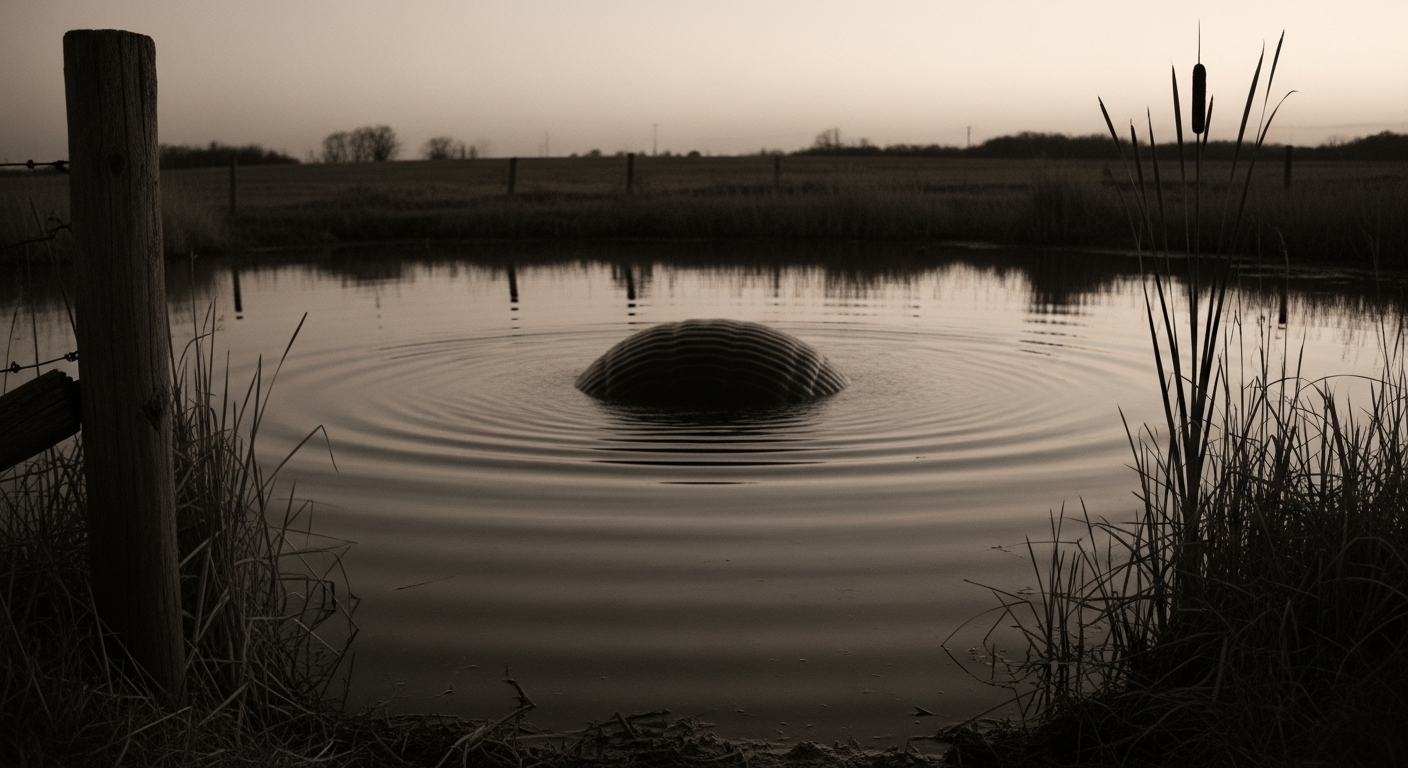
The Dog That Walked on Two Legs: The Beast of Busco Woods and the Night Indiana Held Its Breath
QUIRK REPORTS — OFFICIAL CASE FILE
Case Number: QR-2026-69874
🐢 SHELL OF A STORY: THE BEAST OF BUSCO AND THE TURTLE THAT SWALLOWED A TOWN'S SANITY
Classification: Cryptid — Anomalous Fauna
Date of Event: March 1948 (ongoing sightings through 1980s)
Location: Churubusco, Indiana, USA
Witness: Gerald Marsh (primary), multiple corroborating witnesses
Reported By: Fox Quirk, Quirk Reports
This report is based on documented paranormal accounts. Names and identifying details have been changed to protect those involved.
WITNESS STATEMENT
In March of 1948, Gerald Marsh — a lifelong farmer and by all credible accounts a man of sober, practical temperament — was walking the fence line at the rear of his Churubusco, Indiana property when he encountered something that would consume the remainder of his year and shadow the rest of his life. Near the bank of the murky farm pond that sat at the back of his land, he observed what he initially mistook for a boulder. The object moved. Slowly, deliberately, with the unhurried authority of something ancient and unbothered, it turned — and Marsh found himself looking at a snapping turtle of dimensions that defied reasonable expectation. He would later estimate the shell alone at nearly two metres across. Other witnesses who caught subsequent glimpses suggested it was larger still.
The pond had a history. Local families had been passing down stories of something large in that water since at least the early twentieth century. A neighbour's grandfather claimed to have seen a massive shell surface and sink back into the dark decades before Marsh's encounter. The creature had even acquired a name through the slow alchemy of regional legend: Oscar. Nobody could quite account for the name. It had simply always been Oscar.
Marsh told his wife. His wife told her sister. By sundown, Churubusco knew. By the following week, the newspapers had it.
What followed was one of Indiana's stranger spectacles. Reporters arrived from Indianapolis, Chicago, and as far as New York. Photographers staked out the pond banks with telephoto lenses. Visitors drove hours on poor roads to stand at a fence and stare at brown water that, more often than not, showed them absolutely nothing. Capture attempts escalated from nets and baited lines to wading parties with wire cages — one participant reportedly exited the water with considerable urgency after feeling something large and hard-edged brush against his leg. Oscar was not caught.
By summer, the operation had reached its most ambitious phase: the pond would be drained entirely. A pump was brought in and the slow, laborious work began in the July heat. Mud flats appeared around the edges. The crowds swelled. And then the pump broke down. By the time it was repaired, the water had partially refilled. The attempt was abandoned.
Throughout the chaos, the sightings continued. Marsh himself saw the creature surface twice more in the late evenings. A farmhand on the neighbouring property reported a massive dark shape moving beneath the surface at dawn. A woman from town — a visitor with no investment in the legend — described seeing the creature's broad, blunt head emerge clearly for several seconds before sliding back without so much as a ripple.
"He had seen what he had seen, and that, as far as he was concerned, was that."
Gerald Marsh never recanted. His farm was trampled by visitors, his fences broken, his days consumed by curiosity seekers. He stood to gain very little from the story and lost a great deal to it. He maintained his account with quiet, consistent conviction until his death. The most recent reported sighting of something large moving beneath the surface occurred in the 1980s, described by a local resident with no stake in the town's tourist economy and who, by most accounts, was genuinely shaken by the experience.
Oscar was never caught. The pond is still there.
EVIDENCE
- Primary eyewitness account: Gerald Marsh, a farmer of established local reputation, with no prior history of fantastical claims and demonstrably little to gain from fabrication.
- Multiple corroborating sightings: A farmhand on the neighbouring property, a female visitor from town, and Marsh himself on two subsequent occasions all independently reported observations consistent with a very large submerged creature.
- Pre-existing folklore: Accounts of something large in the pond predate Marsh's 1948 encounter by several decades, with at least one neighbour's family describing sightings from the early twentieth century — ruling out Marsh as the origin of the legend.
- Physical disturbance reported: A member of the wading capture party reported physical contact with a large, hard-edged object beneath the surface during the second capture attempt.
- Biological context: Scientists who examined the case confirmed that while standard snapping turtles (Chelydra serpentina) in Indiana rarely exceed forty kilograms, alligator snapping turtles (Macrochelys temminckii) can reach shell lengths of eighty centimetres and weights over one hundred kilograms. Whether a specimen of the dimensions described could exist remains, per the scientific record, an unanswered question.
- 1980s sighting: A local resident with no connection to the town's tourist industry reported a large submerged shape in the pond, consistent with earlier accounts.
FOX'S ANALYSIS
Right. Let me just say upfront: I have covered alien encounters, ghost infestations, interdimensional hitchhikers, and one very suspicious incident involving a toaster in Queens that I'm still not allowed to discuss for legal reasons. I have seen a lot. And yet Oscar the giant snapping turtle of Churubusco, Indiana has genuinely got me leaning forward in my chair with my notebook out and my ears pricked, and I am not ashamed to admit it.
Here is what I like about this case. Gerald Marsh is, by every account, the opposite of your typical cryptid witness. He's not a thrill-seeker. He's not a publicity hound. He's a farmer who had other things to do, whose land got comprehensively destroyed by the attention his sighting generated, and who never once changed his story or dressed it up for the crowd. In my considerable experience of talking to people who've seen things they can't explain, the ones who are quietly, stubbornly consistent — the ones who sound more inconvenienced than excited — are the ones worth listening to. Gerald Marsh sounds like a man who saw a very large turtle and spent the next several months wishing he hadn't.
The pre-existing folklore is the detail that really snaps at my ankles, if you'll forgive the expression. Stories of Oscar were circulating decades before 1948. You cannot retroactively fabricate generational legend to support a hoax you haven't committed yet. Something — whether it was the same creature or the same stretch of deep, dark, unrevealing water doing what deep dark water does to human imagination — had been accumulating stories around that pond for a very long time.
Now, I want to be a responsible reporter here, so let's shell out the sceptical case. Could it have been a large but ordinary snapping turtle, its dimensions inflated by cold water, murky visibility, and the natural human tendency to make things bigger when they scare you? Possibly. Could the pump breaking down during the draining attempt have been a coincidence rather than the universe protecting its secrets? Almost certainly. Could the entire episode have been sustained by the very human desire for a good story, a town's unconscious investment in being interesting? Sure. I've seen stranger feedback loops.
But here's the thing. The scientist who says "a two-metre snapping turtle is impossible" is making a claim about an animal we have never fully catalogued in every isolated, deep, cold, sediment-rich midwestern pond in North America. That's not science. That's a guess with good posture. I have a lot of respect for biology. I have less respect for certainty dressed up as expertise. You might say the scientific consensus on Oscar is... a bit of a stretch-neck.
And what about that 1980s sighting? Thirty-plus years after the media circus has packed up and gone home, a local resident with zero financial incentive — no festival merchandise, no tourist dollars, no fame to be gained — sees something large beneath the surface and is genuinely rattled. That, to me, is the detail that keeps this case alive. Hoaxes have a shelf life. Whatever is in that pond apparently does not.
I'll tell you what I think. I think Gerald Marsh saw something real. I think Oscar — or whatever Oscar is, or was, or the thing the name got attached to across the decades — is an animal operating at the extreme end of its biological possibility, in a body of water that has consistently resisted examination. I think the town of Churubusco accidentally stumbled onto something genuine and then, in the way of towns everywhere, turned it into funnel cakes and souvenir stalls before anyone could properly look at it. You could say they really came out of their shell about the whole thing — just not far enough.
I'd love to go back there with a proper sonar rig, a waterproof camera, and considerably better boots than I currently own. The pond is still there. Oscar's file, as far as I'm concerned, is still very much open.
Just... don't ask me to wade in. I have a thing about things that are bigger than they should be and entirely unbothered about it. Occupational trauma. Don't get me started.
CREDIBILITY RATING
Rating: 7.5 / 10
Reasoning:
- Primary witness reliability: Exceptionally high. Marsh was a consistent, unexcitable reporter of events with no discernible motive for fabrication and significant personal cost from the attention. (+3)
- Corroborating witnesses: Multiple independent witnesses across different time periods, including a farmhand, a visiting woman, and a 1980s local resident, all describing consistent phenomena. (+2)
- Pre-existing folklore: Decades of local legend predating the 1948 incident substantially reduce the likelihood of a single-source hoax. (+1.5)
- Physical evidence: Limited but present — the reported physical contact with a submerged hard-edged object during the capture attempt is notable, though unverifiable. (+0.5)
- No captured specimen or photographic confirmation: The absence of conclusive physical evidence prevents a higher rating. (-0.5)
- Possible perceptual distortion: Murky water and fear are reliable enlargers of things. A large but ordinary turtle cannot be entirely ruled out. (-0.5)
CLASSIFICATION
Primary Classification: Cryptid — Confirmed Sighting, Unverified Specimen
Sub-classifications:
- Anomalous Fauna — Oversized Known Species
- Folkloric Entity — Multi-Generational Regional Legend
- Persistent Phenomenon — Multiple Witness, Extended Timeline
CASE STATUS
Status: OPEN
Recommended Follow-Up Actions:
- Sonar survey of the Churubusco pond to map depth, structure, and any anomalous submerged mass consistent