
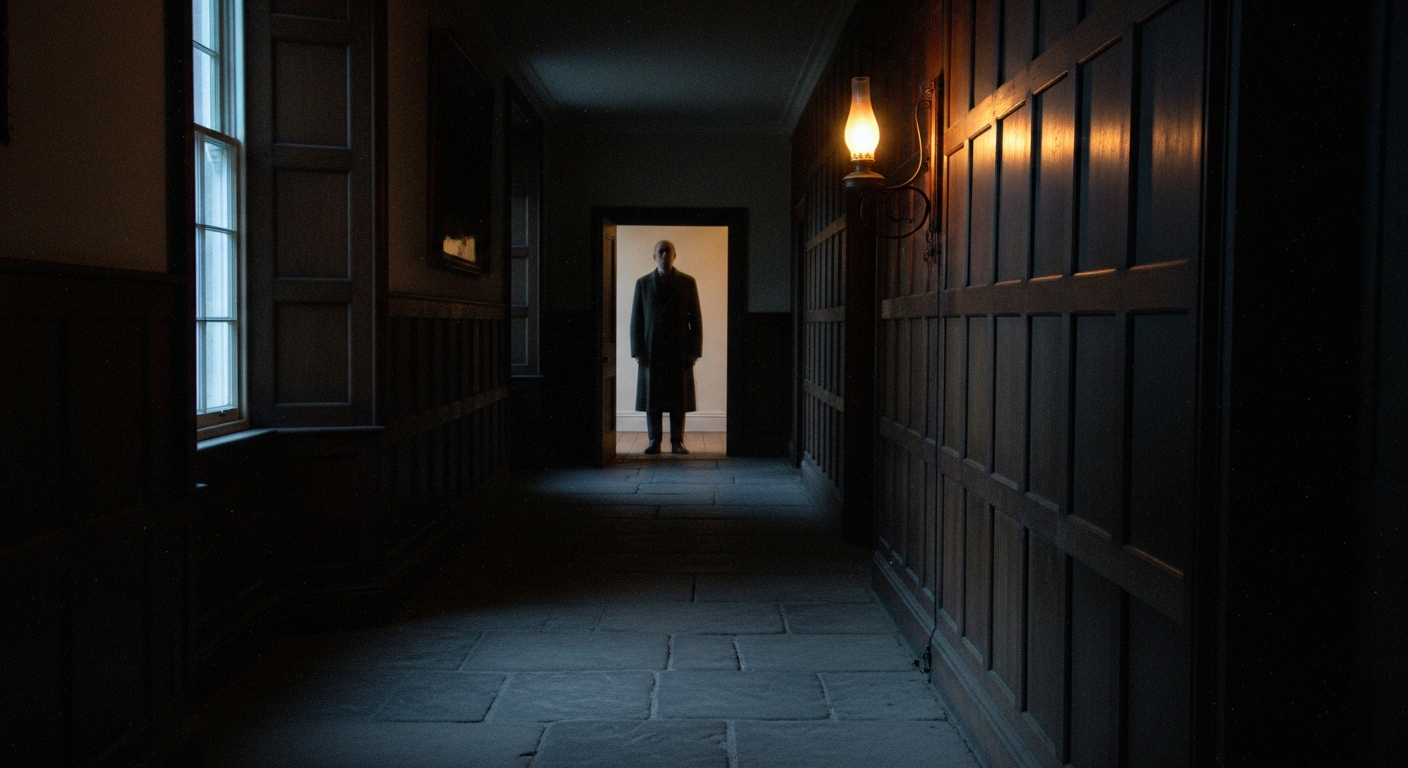
The Dead Man's Footsteps: How a Lincolnshire Manor Has Been Walked by the Same Ghost for Three Hundred Years
QUIRK REPORTS — OFFICIAL CASE FILE
Case Number: QR-2026-80985
DEAD MAN WALKING: THE GHOST WHO NEVER LEARNED TO USE THE STAIRS PROPERLY
Classification: Ghost / Residual Haunting with Apparent Intelligence
Date of Event: December 1, 1716 – Early February 1717
Location: Epworth Old Rectory, Lincolnshire, England
Date Filed: 2026
Reporting Officer: Fox Quirk, Founder & Senior Investigator, Quirk Reports
This report is based on documented paranormal accounts. Names and identifying details have been changed to protect those involved.WITNESS STATEMENT
The winter of 1716 arrived early and hard in Lincolnshire, and with it came something that the Holford family of Epworth Old Rectory would spend the rest of their lives struggling to explain. What began on the night of December 1st as a single sharp knock from an unidentifiable source would escalate, over the course of nearly two months, into one of the most thoroughly documented hauntings in the history of the British Isles.
Reverend Arthur Holford, the family patriarch — a Church of England clergyman in his early fifties — was by all accounts a pragmatic and methodical man. When the disturbances began, his first response was not panic but documentation. He suspected rats. He set traps. The traps caught nothing. The footsteps continued.
And the footsteps were, from the beginning, the defining feature of the haunting: heavy, measured, unhurried, ascending the staircase each night as if belonging to a man in no particular rush. They always stopped at the landing. They never came back down.
The first visual sighting was made by the Holfords' eldest daughter, Constance, aged twenty. Coming downstairs before dawn to fetch a candle, she pushed open the kitchen door and found herself face-to-back with a figure in a long dark coat, standing at the far end of the room with its head turned slightly aside. Its feet, she noted with the particular precision of shock, did not quite touch the floor.
"I felt no fear at first — only a cold, as though the cold came from inside me rather than the air. I watched it for perhaps four seconds. Then it was simply gone."
She told her father over breakfast. He wrote it down.
Over the weeks that followed, every member of the nine-person household reported encounters. Seven-year-old Margaret described being prodded awake by invisible fingers. The Holford sons, Thomas and James, endured nightly rattling of their bedroom door — violent, sustained, purposeful — that revealed an empty corridor every time they opened it. Their mother, Dorothea, investigated a sound like an iron pot being dragged across the cellar floor at three in the morning and found the cellar entirely undisturbed. The family dog refused to enter the house for the full duration of the haunting, taking up permanent residence against the garden wall in temperatures that tested even a Lincolnshire hound.
The entity — nicknamed Old Jeffrey by the household — demonstrated what Reverend Holford noted with evident unease was apparent responsiveness. On December 14th, he struck the wall three times and received three knocks in return. When he addressed the presence directly, the noises would momentarily cease before resuming with what he described as renewed intensity, as though being acknowledged had agitated rather than appeased it.
The most charged encounter came on the evening of December 28th. Holford was alone in his study when the temperature dropped sharply, his candle began to gutter without any discernible draught, and heavy footsteps crossed the room and stopped within six inches of his feet.
"I felt a presence. It was not malicious, but it was angry. I could not account for why I was certain of this — it was a pressure behind the eyes, a conviction as clear and sourceless as any I have ever experienced. Whatever stood before me was furious about something it could not communicate."
He asked it, aloud, what it wanted. The candle went out.
Through January, the activity intensified further. A heavy oak chest was found each morning displaced by a clear foot from its overnight position. An empty cradle in the nursery rocked unaided for twenty uninterrupted minutes while the family sat below and listened. Two visiting clergymen — invited by Reverend Holford to observe and record — both left the rectory visibly shaken, each producing written accounts corroborating the family's testimony. One, identified in Holford's papers only as 'my brother in Gainsborough,' reported hearing something resembling a voice — not words, but the cadence and texture of speech — emanating from a distant room, heard three times across a single sleepless night.
The haunting ended as it had begun: without ceremony. Through the latter weeks of January the phenomena faded — furniture stayed put, footsteps grew infrequent, knocking fell silent — until one morning in early February, Constance came down to the kitchen before dawn and found it cold, still, and entirely empty. Old Jeffrey, apparently, had concluded his business.
Reverend Holford compiled his notes into a single comprehensive document spanning nearly nine weeks: a near-daily record, dated and named, of every incident, every witness, and every rational explanation he had attempted and ultimately rejected. It was this document — rigorous, reluctant, and deeply human — that would eventually be studied by Victorian psychical researchers and identified as one of the earliest cases in British history to meet their criteria of evidential value.
The rectory still stands. Visitors still report, on the upper landing, a cold that does not match the building's temperature. And late in the afternoon, when the old house is at its quietest, some still hear footsteps on the stairs.
They always stop at the top. They never come down.
EVIDENCE
- Primary Documentation: Reverend Holford's contemporaneous journal, maintained daily across approximately nine weeks, including dates, times, named witnesses, and systematic rejection of natural explanations.
- Multiple Independent Witnesses: Nine household members (Reverend Holford, Dorothea Holford, Constance Holford, Thomas Holford, James Holford, Margaret Holford, and additional household members) plus two visiting clergymen, each producing independent written accounts.
- Physical Phenomena: Displaced furniture — specifically a heavy oak chest moved approximately one foot nightly — and an unoccupied cradle observed rocking unaided by multiple simultaneous witnesses.
- Animal Behaviour: The family dog refused to enter the property for the full duration of the haunting.
- Apparent Intelligence: Phenomena demonstrated responsiveness to stimulus — three knocks returned for three given — suggesting agency rather than residual mechanical cause.
- Ongoing Reported Activity: Visitors to the present-day museum report persistent cold on the upper landing and the sound of ascending footsteps, consistent with the original 1716-17 accounts across three centuries.
- Published and Circulated Account: Holford's record was published and studied by Victorian-era psychical researchers, who identified it as satisfying criteria for evidential value.
FOX'S ANALYSIS
Folks, I've been doing this job long enough to know when a case has got the goods — and Old Jeffrey has got the goods, the furniture, and apparently a very strong opinion about staircases.
Let me be straight with you: I came into this one with my sceptic's hat firmly on. Old house, cold winter, sleep-deprived clergy family, overactive imaginations? It's a reasonable starting point. But then you actually read Holford's documentation and the sceptic's hat starts to feel a bit tight. This is not a man who wanted to believe in ghosts. This is a man who set rat traps, wrote down his failures, invited outside witnesses, and still couldn't make it add up. You've got to respect that. That's good journalism. That's my kind of source.
The detail that gets me — and I mean genuinely gets me, not professionally gets me — is the moment in the study on December 28th. Holford describes a conviction that whatever stood before him was furious. Not frightened. Furious. He can't explain where the certainty came from, but he's certain. That kind of specific, unverifiable emotional impression, recorded by a man who was actively trying to debunk his own experience, carries more weight with me than a hundred blurry photographs. You could say he had a lot of spirit in his investigative approach — I know, I know, but I had to.
The responsive knocking is fascinating from an investigative standpoint. Three given, three returned. We see this pattern in more modern cases too — it suggests something capable of perceiving and reacting, which rules out a fair chunk of the mundane explanations. Old Jeffrey isn't just noise; Old Jeffrey is, apparently, listening.
Now, the cradle. An empty cradle rocking for twenty minutes while the entire family sits downstairs and listens to it through the ceiling? I've investigated some unsettling things in my career — and I will not be elaborating on the probe incident, we've discussed this — but the image of nine people sitting in silence while something rocks an empty cradle above their heads is the kind of detail that separates a genuinely chilling case from a forgettable one. That's not a detail someone invents. That's a detail someone survives.
The continuity of reported phenomena across three centuries — the same landing, the same cold, the same footsteps on the same stairs — adds an intriguing dimension. If this were pure fabrication or legend-building, the details would have drifted and inflated over time. Instead, they've stayed remarkably consistent. Old Jeffrey, it seems, is a creature of dead habits. (I'm not sorry.)
My investigative instinct says this case deserves its reputation. The quality of documentation here is exceptional for the period — exceptional for any period — and the convergence of independent testimony, physical phenomena, animal response, and apparent intelligence makes this one of the more credible historical hauntings on my desk. Whatever was in that rectory in the winter of 1716, it wasn't nothing. I'd stake my press pass on it.
Which, given the probe incident, I consider genuine commitment to the cause.
CREDIBILITY RATING
Rating: 9 / 10
Reasoning: The Holford case scores exceptionally high across virtually every credibility metric. Multiple independent witnesses (eleven in total, including two external clergy with no prior stake in the events) produced contemporaneous written records. Physical phenomena — displaced furniture, an unoccupied rocking cradle — were observed by multiple simultaneous witnesses and not merely reported after the fact. The primary documenter was actively sceptical and recorded his failed attempts at natural explanation in detail. Apparent intelligence and responsiveness to stimulus rules out the most straightforward environmental causes. The sole point withheld from a perfect ten is the unavoidable gap of three centuries: we cannot cross-examine the witnesses, access the original documents directly, or conduct physical testing of the site at the time of occurrence. That is not a flaw in the case — it's simply the nature of history. For a 1716 haunting, this is as good as it gets.
CLASSIFICATION
Primary Classification: Apparition / Full-Bodied Ghost Sighting
Sub-Classifications: