
The Day the Street Disappeared: How a Liverpool Businessman Stepped Into a City That Hadn't Existed for Sixty Years
QUIRK REPORTS — OFFICIAL CASE FILE
Case Number: QR-2026-66585
BOLD STREET BLUES: LIVERPOOL MAN TAKES A THURSDAY STROLL AND ENDS UP IN THE 1950S
Classification: Temporal Anomaly — Time Slip (Type I: Environmental Displacement)
Date of Event: July 1996 (exact date unconfirmed)
Location: Bold Street, Liverpool, England
Reported By: Frank Alderton (name changed)
Filed By: Fox Quirk, Senior Investigator, Quirk Reports
This report is based on documented paranormal accounts. Names and identifying details have been changed to protect those involved.
WITNESS STATEMENT
Frank Alderton was, in the summer of 1996, a forty-one-year-old procurement manager for a Liverpool-based shipping firm — a practical, grounded man whose recreational interests ran to canal boat restoration and supporting Everton Football Club. He had no prior interest in the paranormal, no history of unusual experiences, and no particular reason to be standing on Bold Street on a warm Thursday afternoon in July except that his wife Carol was home with a summer cold and he had agreed to run a few errands in her place.
He had come up from Liverpool Central underground station into what appeared to be an entirely ordinary afternoon. The station had been warm and busy. The steps had delivered him onto the street in the usual way. He was thinking, by his own account, about nothing more unusual than whether the second-hand bookshop on the street would have anything worth browsing.
Then something changed.
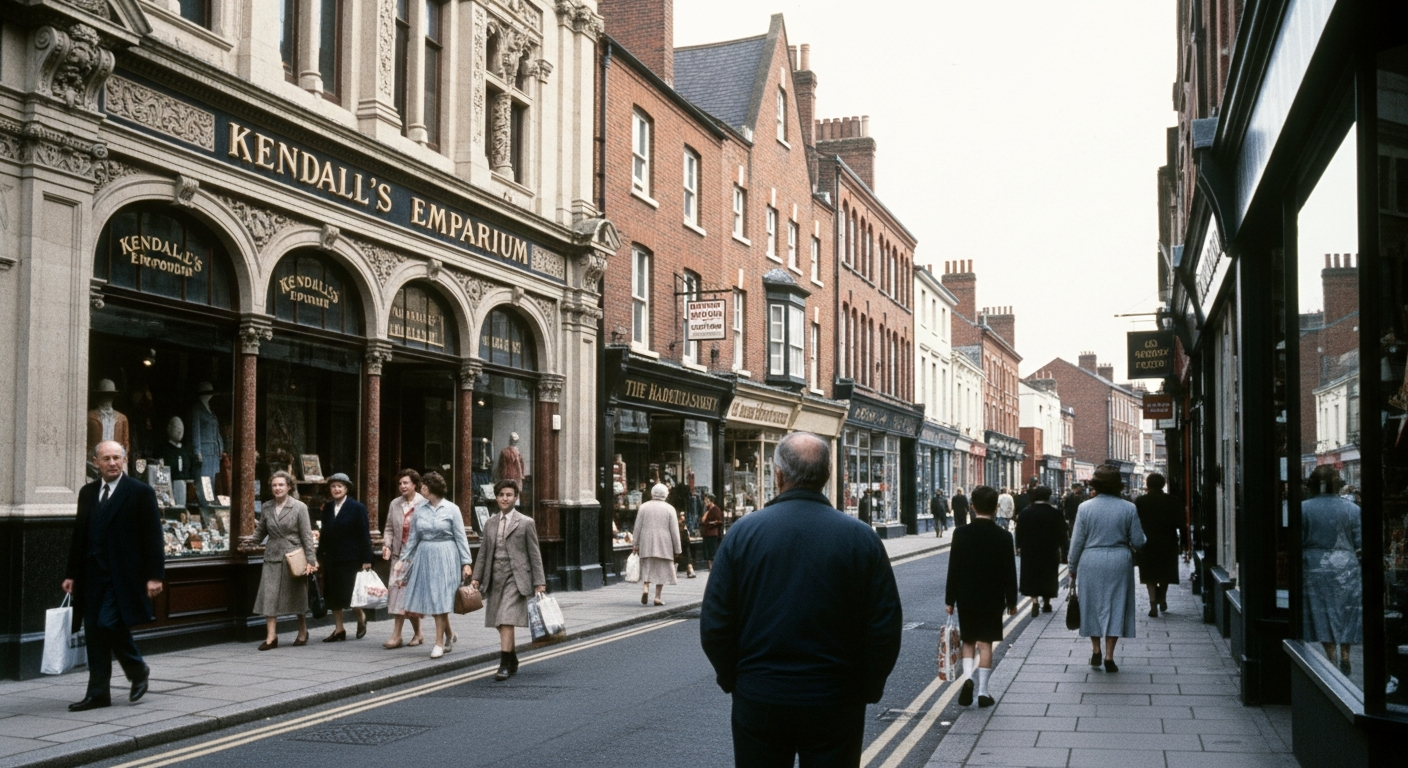
There was no dramatic transition — no flash of light, no physical sensation, no sound of any kind. Frank simply became aware, as he walked, that the street around him was wrong. The cars were gone. In their place, occupying the road with the comfortable authority of things that belonged there, were low-bodied, rounded automobiles from a vanished era — chrome headlamps, running boards, the visual grammar of immediate post-war Britain. A delivery van sat outside a shopfront bearing livery Frank described as resembling footage from a public information film: faded, institutional, unmistakably mid-century.
The pedestrians matched. Women in A-line skirts and belted coats wore hats as a matter of course. Men carried or wore felt hats with brims. The clothing was, without exception, consistent with the 1950s.
Frank's initial response was practical rather than panicked. Liverpool had served as a period film location before, and his first instinct was to look for cameras and production equipment. He found none. The street was simply going about its business — unhurried, purposeful, entirely indifferent to the presence of a man in a modern jacket and trainers standing motionless on the pavement.
That indifference was, he noted, almost total. When a woman carrying a shopping basket walked toward him, she adjusted her course without making eye contact — navigating around him the way a person navigates around street furniture, without acknowledgement or curiosity. Frank felt, he said later, less like a ghost than like a piece of the environment: present but uncategorised.
He turned his attention to the shopfronts. The fashion retailer he passed regularly — a thoroughly 1990s establishment he knew well — was gone. In its place stood a shop bearing a name he recognised immediately, though imprecisely: Cripps, a Liverpool department store that had traded on Bold Street for much of the twentieth century before closing long before 1996. The name surfaced from the kind of casual urban memory that long-term residents accumulate — pub photographs, overheard conversations, the sediment of a city's commercial history. It was real. It had been real. And here, impossibly, it was open, with customers walking in and out in the unhurried way of shoppers on an ordinary afternoon.
Frank walked on. He cannot fully explain the decision — he believes his legs simply continued because stopping felt more alarming than moving. He covered perhaps forty yards, past a bakery, past a gentleman's outfitter, past a young woman in a yellow coat who smiled at nothing in particular and whose cheerful, mundane presence he found, strangely, comforting.
"It wasn't frightening. It was more like the feeling in a dream when you know something is wrong but you can't say what. The colours were slightly off. The air smelled different — heavier, less petrol, more like coal smoke."
Then a young man stepped out of a doorway directly into Frank's path.
Unlike every other person Frank had encountered in this displaced street, this young man — early twenties, white shirt, rolled sleeves, braces — appeared to see him. They nearly collided. They made direct eye contact. Frank registered genuine mutual surprise: the ordinary, startled recognition of two people who have almost walked into each other. For a second, perhaps two, they simply looked at one another.
Then the young man's expression changed. Frank has described it as confusion shading toward alarm — the look of a person confronted with something that doesn't fit any available category. As though Frank appeared to him exactly as wrong as everything around Frank appeared to Frank.
The young man stepped back.
And Bold Street came back.
The cars were modern. The shopfronts were modern. The people were in jeans and summer clothes. Cripps was gone, as it had been gone for decades. The air smelled of diesel and takeaway food. Frank stood on the pavement and, by his own account, nearly fell over.
A passer-by asked if he was all right. He said he was. He walked to a nearby café, ordered tea, and sat with it untouched for forty minutes.
He went home and told Carol, who grew up in Liverpool and knew that Bold Street had a reputation. She encouraged him to write everything down immediately. He did. He still has the notes.
"I keep thinking about that young man. Whether he went home and told someone. Whether he sat down and described the strange figure he'd nearly walked into — the man in the peculiar clothes. I wonder if he was as shaken as I was."
EVIDENCE
- Contemporary written notes: Frank made written notes on the same evening as the incident at his wife Carol's suggestion. These notes, which he retains, represent among the most immediate documentation of any time slip report in the British archive and significantly strengthen the case for internal consistency.
- Historical corroboration — Cripps department store: The shop Frank identified by name — Cripps — was a genuine Liverpool commercial institution that traded on Bold Street for decades before closing. Frank's identification of it is consistent with the period he appeared to have entered. He describes his prior knowledge of the name as vague and incidental, making deliberate fabrication around this specific detail less plausible.
- Corroborating testimony — the Bold Street corridor: Frank's account joins a documented body of time slip reports associated with Bold Street and the surrounding Lime Street area. Multiple independent witnesses across several decades have described broadly similar experiences: period vehicles, period clothing, altered shopfronts, and a characteristic sense of semi-visibility in which witnesses are largely ignored by the people around them. The consistency across independent accounts — particularly the detail of navigating around witnesses rather than engaging with them — has attracted serious attention from paranormal researchers.
- The young man as potential second witness: The moment of apparent mutual recognition between Frank and the young man in the rolled shirtsleeves represents a unique feature of this case. If the encounter was in any sense real rather than hallucinatory, it implies a second witness existing in the 1950s timeline who also experienced something anomalous. No corresponding account from that period has been identified.
- Carol Alderton's corroboration: Frank's wife can confirm his state on returning home and his immediate desire to document the experience. While not a direct witness to the event, her account supports the authenticity of his emotional response.
FOX'S ANALYSIS
Right. Deep breath. Pour the tea. Here we go.
I have been filing paranormal case reports for long enough to know that the accounts which should worry you most are not the dramatic ones. Not the lights in the sky, not the figures at the end of the bed, not the things that go very loudly bump in the night. The accounts that should worry you — as a reporter, as a sceptic, as a fox who takes the unexplained seriously while reserving the right to doubt — are the ones like this. The quiet ones. The ones where an ordinary man walks up an ordinary street and comes home shaking, clutching notes he wrote because he was afraid he would forget.
Frank Alderton is not performing. Every detail of this account — the practical first response, the search for cameras, the instinct to keep walking because stopping felt worse, the tea he couldn't drink — reads as psychologically authentic in ways that fabricated accounts typically fail to replicate. Invented stories tend toward the dramatic. They tend toward clear transitions and satisfying conclusions. This account is full of uncertainty, incompleteness, and the specific texture of genuine bewilderment. He doesn't know exactly when it started. He can't recall all the shopfront names. He doesn't have a tidy explanation. These are not the features of a confected story. These are the features of a real experience imperfectly remembered.
Now, I am not in the business of telling you that time slips are scientifically established. They are not. The theories on offer — geological fault lines, electromagnetic anomalies from underground infrastructure, residual temporal energy in historically dense urban areas — are speculative at best and frankly a bit wobbly at worst. But here is what I can tell you: Frank Alderton's account is internally consistent, historically grounded, emotionally authentic, and corroborated by a body of independent testimony from the same geographical location that is, frankly, difficult to dismiss. The Bold Street corridor is not a one-witness phenomenon. It is a pattern. And patterns, in this business, are what you pay attention to.
The Cripps detail is, for my money, the heart of this case. Frank doesn't claim a sharp, encyclopaedic knowledge of the store — he knows the name vaguely, the way you know the names of shops that used to exist in your city without having studied them. That vagueness is actually more convincing than total recall would be. If he were fabricating, he would surely have done his research and given you chapter and verse. Instead he gives you the honest fuzziness of a memory that arrived unexpectedly and lodged imperfectly. I'll take imperfect and honest over polished and suspicious every time.
And then there's the young man. The mutual recognition. The shared, impossible moment of incomprehension between two people standing in the same place sixty years apart. I have to say — and I do not say this lightly, or without my customary ironclad journalistic detachment — that detail makes me feel things I was not expecting to feel when I sat down with this file. That young man went home too. He went home to a world where it was still the 1950s and told someone about the stranger who didn't look right. I am a professional. I am a sceptic. I have been probed by entities with no apparent sense of proportion and emerged with my critical faculties intact. And yet I find myself genuinely moved by the idea of two people reaching across six decades and almost — almost — touching.
You could say Frank got stuck between a rock and a hard timeline. You could say he really took the phrase "going back to basics" a little too literally on that Thursday. You might even say that when it comes to Bold Street, history has a habit of repeating itself — you just don't usually get to watch. I'll be here all week, please tip your investigator.
In all seriousness: this case is one of the cleaner and more compelling time slip reports I have encountered in years of filing. It does not prove that time slips are real. Nothing in this file proves that. But it makes the question worth asking with considerably more rigour than it usually receives.
Bold Street, Liverpool. Something is happening there. Has been happening there for decades. And one