
The Dark Thing on the Stairs: How a Family in Pontypridd Lived with a Visitor Made of Nothing But Darkness
QUIRK REPORTS — OFFICIAL CASE REPORT
Case Number: QR-2026-94909
Classification: Shadow Entity / Recurring Residential Haunting
Title: SOMETHING IN THE DARK: THE SHADOW THAT ATE THE LIGHT ON A WELSH TERRACE
Date of Events: October 1998 – Summer 2001 | Location: Cwmgelli Terrace, Pontypridd, Rhondda Cynon Taf, Wales | Primary Witness: Nerys Bowen (name changed) | Report Filed: Quirk Reports Archive, Case QR-2026-94909
This report is based on documented paranormal accounts. Names and identifying details have been changed to protect those involved.
WITNESS STATEMENT
The Bowen family — Nerys, her husband Gethin, and their teenage children Rhiannon and Cai — had lived without incident in their mid-terrace home on Cwmgelli Terrace for eleven years before the autumn of 1998. The house was unremarkable by every measure: a 1930s two-up, two-down on the outskirts of Pontypridd, net curtains intact, old pipes doing what old pipes do. Nothing strange had ever happened there. Then October arrived, and something arrived with it.
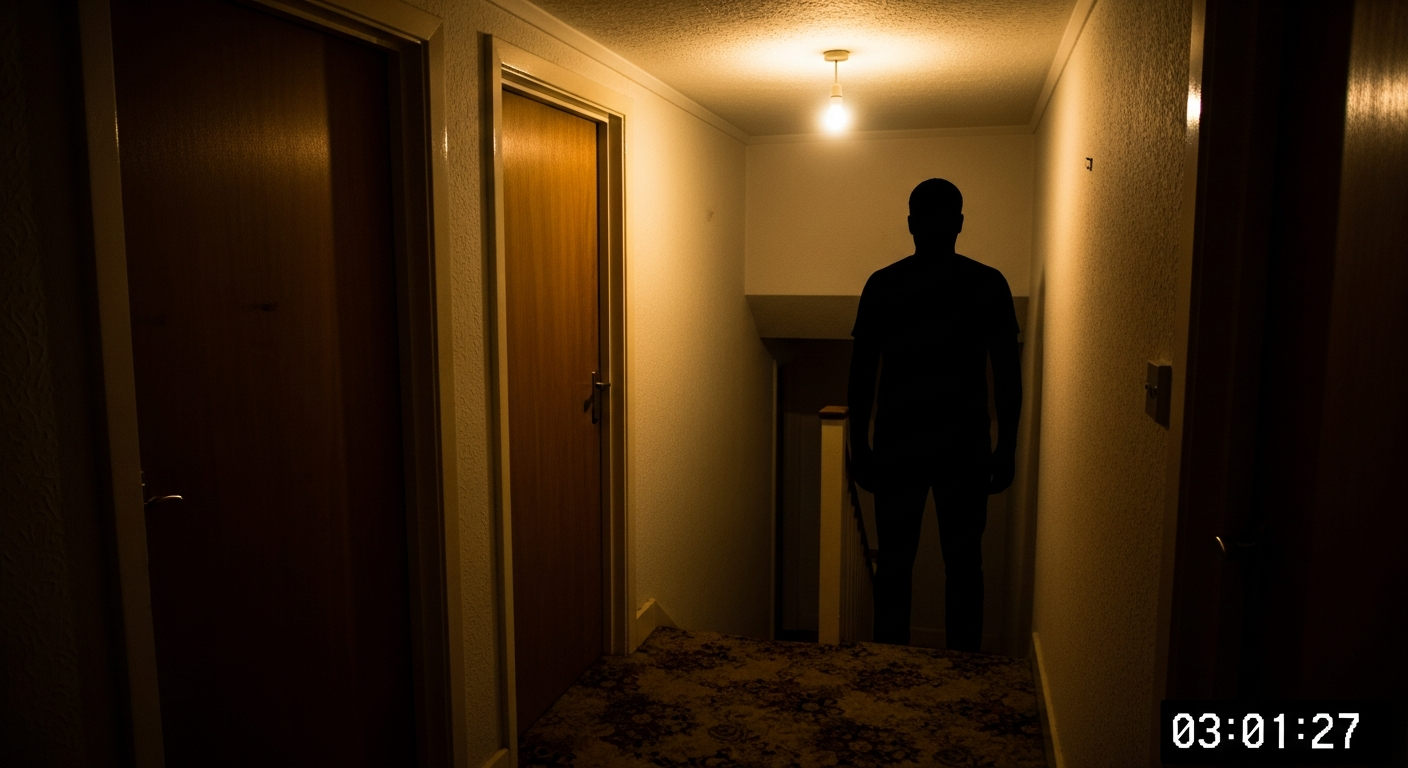
Nerys was the first to see it. Waking at approximately 2:30 a.m., she found a figure standing in her bedroom doorway. Her mind, sensibly, reached first for the ordinary explanation — a child come in from a bad dream. But the figure was too tall. Taller than either of her children. Taller than Gethin, who stood six feet. More troublingly, it was too dark. The landing light — left on nightly for years out of deference to Rhiannon's old fear of the dark corridor — illuminated the space around the figure. It did not illuminate the figure itself. The darkness that comprised it was not a shadow cast by something solid. It was, Nerys insisted to investigators, absolute. Self-contained. As though light itself had made a private decision to keep its distance.
The figure stood without sound, without breath, without the microscopic shifts of weight that betray a living body at rest. Its head — a rounded mass where a head belonged — gave nothing back. No eyes. No features. Just darkness arranged into the approximate shape of a man. It remained for two to three minutes, then did something that Nerys would return to repeatedly in her interviews with the Ponty Paranormal Research Group: it did not leave. It simply became less. Reduced itself, degree by degree, back into the landing dark, leaving the light unchanged and the doorway emptied.
Nerys told no one for three weeks. She understood, instinctively, the particular logic of keeping an inexplicable thing contained within silence. "If you say nothing," she explained to investigators, "it stays a private aberration. Something that might, given enough time, sand itself smooth." She called it a dream. She almost believed herself.
Then Rhiannon saw it.
Coming upstairs from the kitchen at around midnight on a Thursday in November, mug of tea in hand, Rhiannon encountered the figure on the landing. She described it in terms identical to her mother's account — and crucially, she did so before Nerys had breathed a single word of her own experience to anyone. Tall. Featureless. A dark that the landing light simply declined to touch. Rhiannon dropped the mug. It shattered on the top stair. She told investigators that the figure seemed to look at her, though she could not explain how she knew this given the total absence of visible eyes, before moving sideways along the landing wall and disappearing directly into the solid plaster between two doorframes.
Gethin, practical and sceptical — a telecoms man, a facts man, someone with no patience for what he called "ghost story nonsense" — held his ground for two months. He offered tiredness, suggestion, passing car headlights, and the general persuasive power of a worried family's collective imagination. He offered these things firmly. His certainty lasted until a Saturday afternoon in January, when he was alone in the house and went upstairs to the airing cupboard.
It was two in the afternoon. Grey winter daylight. Not dark. Not ambiguous. He turned from the airing cupboard and found the figure standing at the top of the stairs in full view. "I tried to speak to it," he told Rhodri Parry's team later. "I said hello. Which is not what you'd plan. But it was the word that came." The figure gave no response. After approximately thirty seconds, it moved sideways into the wall, exactly as Rhiannon had described, and was gone. Gethin called the Ponty Paranormal Research Group that same evening.
The group, led by retired schoolteacher and veteran Welsh paranormal investigator Rhodri Parry, attended the property the following weekend with recording equipment, temperature gauges, and motion-activated cameras covering the landing and stair head. The first night yielded nothing. On the second night, at approximately 3:20 a.m., the landing motion sensor activated with no corresponding thermal signature. Simultaneously, the analogue landing light — connected to no automated system and subsequently found to have no electrical fault — visibly dimmed for a sustained period before returning to normal. No figure was captured on camera. The motion activation and light dimming were logged as recorded anomalies.
The Parry team returned six further times over the following year. Between them, Nerys and Rhiannon reported four additional sightings during this period. Gethin had one further encounter, this time in the downstairs hallway. Cai, who had remained the sole family member without a sighting, woke one night to find the figure in his bedroom doorway. He was nineteen, a veteran of two years in the Army Cadets, and he slept with the light on for the next six months.
Investigation of the property's history revealed nothing immediately notable. No recorded deaths, no violence, no local legend attached to the land or street. The figure offered no origin and no explanation. It simply continued to appear, always between midnight and four in the morning, always tall, always featureless, always impossibly dark — and always, Nerys noted, preceded by a particular quality of air. A thickening. A sense of the room becoming more of itself.
The family moved out in the summer of 2001. The reasons were practical as well as paranormal — a job offer in Bridgend, Rhiannon at university, a house grown too large for those left in it. But Nerys was candid with investigators. She was not sorry to go. "I had been tired," she said, "for three years, of checking the landing before I went upstairs." By the end, she had reached a kind of cold accommodation with the thing that shared her home. Not acceptance. Not peace. Simply the particular endurance of a person who has learned that some things cannot be removed and cannot be explained, and that the only remaining option is to close your eyes and wait for morning.
Rhodri Parry published a summary of the case in a Welsh paranormal research newsletter in 2003, describing it as one of the most internally consistent shadow figure cases he had encountered in twenty years of investigation. The house on Cwmgelli Terrace was sold that summer. Whether the landing light still dims, for no reason an electrician could explain, is a question that belongs to whoever lives there now.
EVIDENCE
- Multiple independent witness accounts: All four family members reported sightings independently, with no prior comparison of descriptions. Every account was consistent: tall, featureless, absolutely dark, absorbed rather than blocked ambient light, disappeared laterally into walls.
- Corroborating investigative data: On the second night of the Ponty Paranormal Research Group's initial investigation, the landing motion sensor activated with no corresponding thermal signature. Simultaneously, the analogue landing light dimmed measurably for approximately four minutes with no electrical fault identified before or after.
- No counter-explanation identified: Investigation of the property's history found no recorded deaths, violence, or structural anomalies. No power fluctuations were detected in the rest of the house during the anomalous dimming event.
- Published case documentation: Rhodri Parry's 2003 summary in a Welsh paranormal research newsletter constitutes a contemporaneous third-party record, with the case described as among the most consistent of its type in Welsh paranormal research history.
- Behavioural corroboration: Cai, the most resistant witness, sleeping with a light on for six months following his sighting constitutes a significant behavioural indicator of genuine distress.
FOX'S ANALYSIS
Right. I'll be straight with you: I've looked at a lot of shadow people cases in my time, and most of them fall apart the moment you push on the details. Inconsistent descriptions between witnesses. One person saw a shape, another saw a face, a third saw a hat — and suddenly you've got three different entities or one very fashion-forward hallucination. The Bowen case does not do this. The Bowen case does the exact opposite, and that is what has my tail bristling.
Four witnesses. Four independent sightings before any formal comparison of accounts. Identical descriptions across all of them, including details — the lateral disappearance into solid plaster, the way the darkness absorbed rather than blocked the landing light — that are genuinely unusual even within the shadow people literature. You can coach a family to tell the same story. You cannot easily coach four people who haven't spoken to each other to independently arrive at the phrase the light didn't want to touch it. That's not suggestion. That's something.
I also want to give proper credit to Gethin Bowen, who is frankly my spirit animal in this case. Sensible, sceptical, telecoms-adjacent. Held the rational line for months. Then walked into broad daylight, saw the thing with his own eyes, and called the paranormal investigators the same evening. That is not the behaviour of a man playing along with his family's anxiety. That is a man whose worldview just took a hit and who responded by doing the most competent thing available to him. Respect.
The investigative data is modest but real. A motion sensor activating with no thermal signature and a light dimming with no electrical fault are not, individually, extraordinary. Together, on the second night of an investigation into a property with an active, multi-witness shadow entity case, they're at least worth noting. I've seen reports built on much less. Rhodri Parry sounds like exactly the kind of meticulous, undramatic investigator I'd trust — a retired schoolteacher who's been doing this since the mid-eighties has nothing left to prove and no reason to exaggerate.
Now, do I have concerns? A few. No figure was captured on camera, which is disappointing — though shadow entities have a long and irritating history of being camera-shy. The entity never interacted, never communicated, never presented any evidence of intent. It just stood there and looked without eyes. Which is creepy, obviously, but it does make classification difficult. We're dealing with an observer. A watcher. Something that apparently found a Welsh terrace house sufficiently interesting to hang around in for three years without ever introducing itself. Rude, frankly. You'd think it could at least knock.
The location has no history that explains the presence. No tragedy, no legend, nothing attached to the land. This is actually consistent with the wider shadow people literature, which suggests these entities may not be residually tied to place at all — they may be tied to something else entirely. People, perhaps. Energy. Something the Parry team didn't investigate and that this reporter would love to have pressed further. Were there any significant life events in the Bowen household around October 1998? Because timing-wise, something opened a door, and I'd very much like to know what turned the handle.
The