
The Claws That Came from the Lake: How a Quiet Ontario Shoreline Became the Scene of Canada's Strangest Creature Encounter
QUIRK REPORTS — OFFICIAL CASE FILE
Case Number: QR-2026-15523
THE CLAWS THAT CAME FROM THE LAKE: MONSTER AT THE WATERLINE — KELLY LAKE'S MIDNIGHT VISITOR
Classification: Cryptid Encounter — Unidentified Bipedal Entity
Date of Event: August 14, 1976
Location: Kelly Lake, Northern Ontario, Canada
Reporting Investigator: Fox Quirk, Founder, Quirk Reports
Filed: Quirk Reports Active Archive
This report is based on documented paranormal accounts. Names and identifying details have been changed to protect those involved.
WITNESS STATEMENT
Gerald Ashford had been visiting Kelly Lake since childhood. By the summer of 1976, the thirty-four-year-old had accumulated more than two decades of familiarity with its shores, its moods, and its rhythms. He knew the lake the way a man knows his own neighbourhood — intimately, instinctively, and with the quiet confidence of long acquaintance. What he did not know, and could not have anticipated, was that the lake had its own long-standing resident. One that was considerably larger than anything in his fishing almanac.
Ashford arrived at Kelly Lake on August 13th alongside three companions: his childhood friend Denis Colbeck, Denis's younger brother Martin, and a work colleague named Ray Tench. They made camp on the eastern shore — a site Ashford had used a dozen times before — thirty feet from the waterline, sheltered by dense spruce, and four miles from the nearest road. It was, by every measure, exactly the kind of quiet wilderness retreat that northern Ontario does so well.
The first indication that something unusual shared the lake arrived just after seven in the evening. Ray Tench returned from washing cookware at the water's edge visibly pale and uncharacteristically silent. When pressed, he described hearing something large moving in the shallows approximately forty metres north of camp — not splashing with the casual indifference of local wildlife, but wading with slow, deliberate weight. Each step, he said, was accompanied by a deep, sucking pull as whatever it was extracted its feet from the lakebed mud. The group offered the sensible explanation: moose. Ashford privately noted the rhythm seemed heavier than any moose he had heard, but kept the thought to himself. Dinner was made. The fire was kept. By nine-thirty, the northern Ontario darkness was absolute.
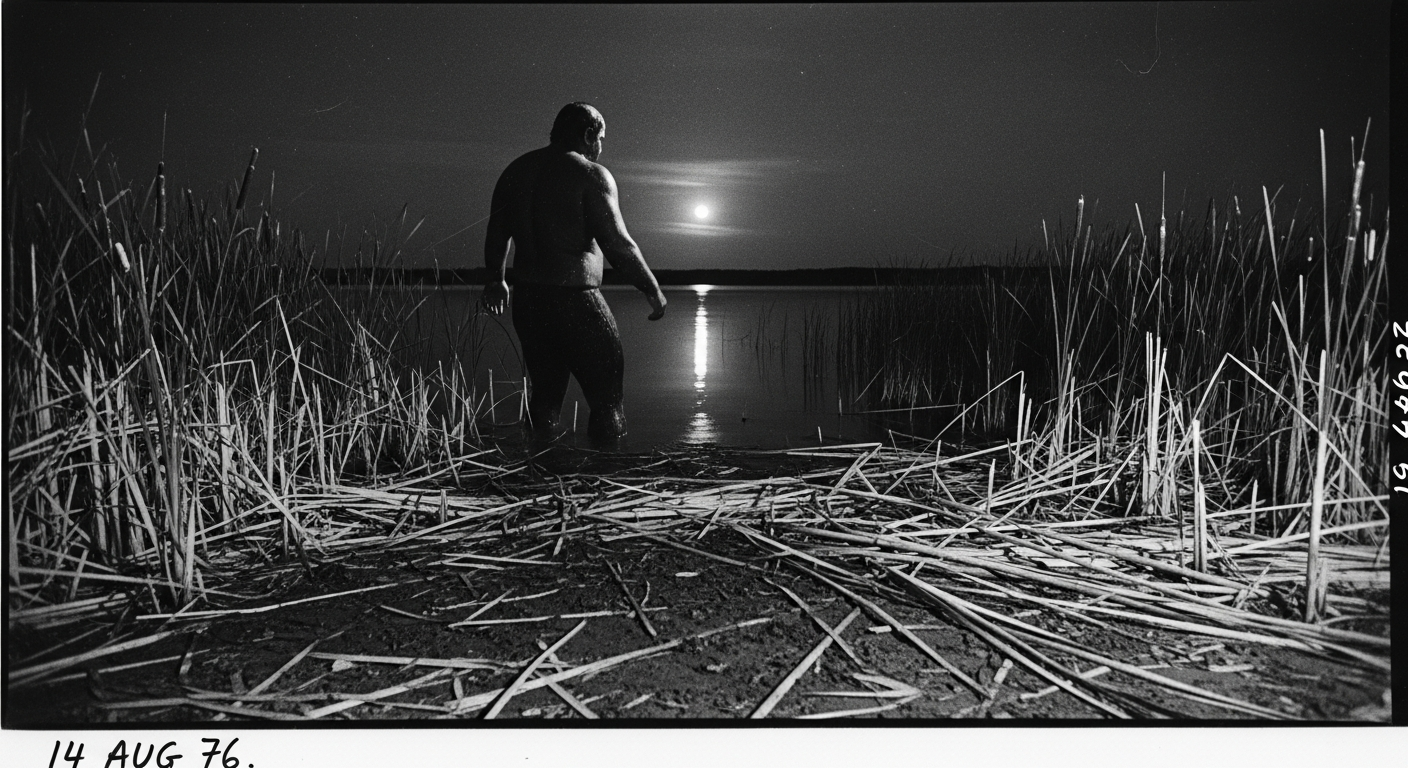
It was Denis Colbeck who brought the night to a halt just before midnight. Having stepped away from camp, he returned in a state of controlled but unmistakeable agitation. He had seen something at the waterline in the moonlight — a figure standing approximately twenty-five metres away, partially obscured by reeds. His account, consistent across every subsequent retelling, was precise. The figure stood upright on two legs. It was enormous — Denis estimated seven to eight feet in height. Heavily built across the shoulders and chest. Dark-hided, and visibly wet. He was categorical, in every interview that followed, that it was not a bear. He had encountered black bears throughout his hunting and camping years and understood their posture, their proportions, and their particular quality of animal presence. This was none of those things. What unsettled him most, he said, was the way it stood:
"Still. Aware. Like it knew exactly where it was and had every right to be there."
All four men assembled at the camp edge with a torch. The beam reached the waterline just in time to catch the suggestion of something large moving back into the water — a heavy displacement, a low and significant splash, and then silence. The reeds where Denis had seen the figure were flattened and pushed aside. The following morning, the men found impressions in the mud that none could attribute to any known local species: broad, roughly humanoid depressions with a splayed quality at the front suggesting wide, separated toes. Ashford photographed these with a disposable camera. The images, while not forensic in quality, show clearly defined depressions inconsistent with regional fauna.
Nobody slept. The fire was kept high and a watch was maintained. At approximately two in the morning, Tench reported hearing the wading sounds again — the same slow, deliberate passage through the shallows, moving north and gradually fading. He described the quality of the sound as considered. Purposeful. As though whatever moved through that water knew precisely where it was going and felt no urgency whatsoever about getting there.
They broke camp at first light.
Ashford made a formal report — not for attention, but because Denis's experience had demanded acknowledgement. A conservation officer took statements without visible scepticism. A regional naturalist visited the site eleven days later, noted the reed damage, and confirmed that the impressions in Ashford's photographs were unlike anything he could attribute to a known Ontario species. He declined to speculate in writing. Verbally, he told Ashford plainly that he had no explanation.
A Toronto-based paranormal research group later interviewed all four witnesses separately, across sessions months apart. The consistency across those interviews was remarkable. Tench, the most reluctant to discuss the event, reproduced his description of the wading sound without variation across every session. Denis's physical description of the figure never altered in any meaningful detail. Ashford remained, by every account, direct, consistent, and entirely without embellishment.
Ashford subsequently sought out an elder from a nearby First Nations community. He went quietly, without reporters. The elder listened to the full account without surprise and told Ashford that such beings were known — had always been known — as figures occupying the boundary between water and land, bound to their territories in ways that predated human settlement. The respectful course, the elder said, was to leave when they made themselves visible and not return to that specific site.
Gerald Ashford has not camped at Kelly Lake since.
Denis Colbeck, in the final interview on record, was asked whether he believed what he saw had been dangerous. He paused for a long time.
"No. I don't think it meant us any harm. I think we were just there, and it was there too, and we didn't have any business being on the same piece of shoreline at the same time. I think it was as inconvenient for it as it was for us."
He smiled when he said it. The interviewer noted it as the smile of a man who had made his peace with something he could not explain — and had stopped needing to.
EVIDENCE
- Physical Impressions: Broad, roughly humanoid footprint depressions found in lakeshore mud the morning after the encounter. Splayed at the front, inconsistent with any identified regional species. Photographed by Ashford.
- Photographic Record: Disposable camera images showing clearly defined depressions in lakeshore mud. Not forensic quality, but sufficient to confirm unusual impressions.
- Reed Damage: Flattened and displaced reeds at the waterline, at the precise location where Denis Colbeck observed the figure. Confirmed by visiting naturalist eleven days post-incident.
- Naturalist Assessment: A regional naturalist confirmed both the reed damage and the unusual nature of the impressions, verbally stating they could not be attributed to any known Ontario species.
- Four Corroborating Witnesses: All four men present — Ashford, Denis Colbeck, Martin Colbeck, and Ray Tench — gave consistent, independently verified accounts across separate interviews conducted months apart.
- Indigenous Cultural Corroboration: A First Nations elder from a nearby community confirmed that beings matching the description are part of established regional tradition, associated specifically with lake and forest margins.
FOX'S ANALYSIS
Right. Let me straighten my flat cap and give this one the full Quirk treatment, because this case deserves it.
I have been doing this job long enough to develop a fairly reliable nose for the cases that matter — the ones where four human beings saw something real at the edge of a cold lake and had the integrity to say so for decades afterwards, regardless of the social cost. This is one of those cases. This one smells genuine, and I don't just mean the campfire smoke and algae bloom.
Let's start with the witnesses. Gerald Ashford is not the type to fabricate. He reported the incident reluctantly, sought out the naturalist follow-up himself, and actively avoided the press. Ray Tench — the most sceptical and reticent of the group — gave identical descriptions of the wading sound across every interview session without a single embellishment. You cannot coach that kind of consistency. Denis Colbeck's account didn't grow. It didn't shrink. It didn't acquire dramatic new details over time the way that fabricated stories almost always do. I've interviewed enough witnesses in this business to know the difference between a man performing his experience and a man reporting it. Denis Colbeck was reporting it. So were all of them.
Now, the entity itself. Seven to eight feet. Bipedal. Heavy-set. Dark, wet hide. Moving with deliberate, unhurried intelligence. This is not a bear standing up in a moment of startled curiosity. Bears don't wade with methodical purpose through shallows at two in the morning covering ground along a specific route. Whatever this was, it had somewhere to be. You could say it was taking things one step at a time — and those steps, according to the mud, were impressively large.
The indigenous context here is not incidental. It is, in my professional opinion, one of the most important elements of the whole case. When Ashford sought out that elder — quietly, privately, without any audience — and the elder responded not with shock but with the calm recognition of something long understood, that is a data point that demands serious weight. These accounts don't emerge from a cultural vacuum. They have roots. Deep ones. The kind that don't wash away in eleven days of northern Ontario rain the way footprints do.
Could there be a rational explanation? In the spirit of proper reportorial balance, I am obliged to consider alternatives. Unusual moose behaviour? The proportions and sustained bipedal posture rule that out. A bear, repeatedly? Denis Colbeck was categorical and experienced. A hoax perpetrated on four grown men camping four miles from a road on a site one of them had used for twenty years? I've heard more convincing punchlines. You might say the hoax theory just doesn't hold water — and neither, apparently, did whatever was standing in that lake.
The element that stays with me most, professionally and personally, is the quality Denis and Tench both described in the creature's movement and presence: considered, deliberate, aware. Not aggressive. Not fleeing. Simply occupying its territory with the unhurried authority of something that has been there considerably longer than the humans with their disposable cameras and strong coffee. It wasn't threatening them. It was, if Denis Colbeck's final assessment is to be believed, merely inconvenienced by them. Which, honestly, I find deeply relatable. I too am often inconvenienced by the presence of others in places I consider mine. Though I at least have the decency to wade away quietly rather than leave the campsite as a complete running joke in the Canadian cryptozoological record for fifty years.
Kelly Lake, northern Ontario. Something large, ancient, and apparently territorial lives there or passes through it. The evidence says so. Four credible witnesses say so. Fifty years of regional folklore says so. And one First Nations elder, who didn't need any of our interviews to tell him what it was, says so too.
File this one under: real until conclusively proven otherwise.
CREDIBILITY RATING
Rating: 8.5 / 10
Reasoning:
- Multiple Witnesses (4): All present, all independently