
The Cat That Could Not Be Caught: The Phantom Predator That Terrorised the West Country
QUIRK REPORTS — OFFICIAL CASE FILE
Case Number: QR-2026-43743
⚠ THE CAT CAME BACK: BODMIN'S PHANTOM PREDATOR AND FIFTY YEARS OF OFFICIAL DENIAL
Classification: Cryptid — Alien Big Cat (ABC) / Large Exotic Felid
Date of Events: 1978–present (peak sightings 1983–1995; active ongoing)
Location: Bodmin Moor, Cornwall, England
Primary Witness: Gerald Hocking (name changed), farmer
Report Filed By: Fox Quirk, Founder & Chief Investigator, Quirk Reports
This report is based on documented paranormal accounts. Names and identifying details have been changed to protect those involved.SECTION ONE: WITNESS STATEMENT
On a grey February morning in 1989, Gerald Hocking — a Cornish farmer with four decades of experience on Bodmin Moor — walked up to his top field expecting to find the familiar, depressing aftermath of a dog attack on his livestock. What he found instead changed the way he understood the land he thought he knew.
A ewe lay dead. The throat had been opened in a single, precise incision. The ribcage had been peeled back from the inside with a thoroughness and efficiency that no collie or pack of terriers could account for. And pressed into the rain-softened earth around the carcass were prints — four toe pads, a heel as wide as a cricket ball, and a span across the paw that matched Gerald's fully outstretched hand. He stood slowly, surveyed the moor, and felt, for the first time in his working life, that something out there was watching him back.
Gerald was neither the first nor the last. The Beast of Bodmin Moor had been generating reports since the late 1970s, belonging to a broader class of phenomena researchers term Alien Big Cats — large, dark felids sighted in areas of the British Isles where no such animal is known to live. By the early 1990s, the Ministry of Agriculture had logged more than sixty livestock incidents across the Bodmin and Camelford districts. Attending veterinarians consistently described wounds incompatible with any known British predator: clean kills, throat-first, in the manner of an ambush felid, not the ragged opportunism of a dog attack.
The eyewitness testimony was, by any standard, remarkable. In the summer of 1992, a schoolteacher named Patricia Trelawne was driving at dusk on the B3266 when a large animal crossed the road some twenty metres ahead of her headlights. She braked and watched it move.
"It was the size of a large dog, but it was absolutely nothing like a dog. It moved like a cat — that rolling, liquid walk. It was jet black, and its tail was enormously long, thick at the base, curling up at the end. It stopped and looked at me. Its eyes caught my headlights and they shone orange. I sat there shaking for a full five minutes after it had gone."
Patricia was the forty-third person to report a sighting along that specific road corridor in four years. The following year, a farm labourer named Roy Curnow had an even closer encounter on the eastern edge of the moor, approaching what he initially mistook for a large black dog sitting in long grass near the Fowey River. At fifty metres, he stopped.
"It was a cat — but not like any cat I'd ever seen. The head was too big, the ears were too small and round, the body was too long and too low. It was watching me the whole time, very still, very calm. Then it just stood up, turned around, and walked into the hedge."
The flattened grass where the animal had been sitting was consistent with a body mass of between sixty and ninety kilograms.
Gerald himself saw the creature — or something very like it — on three separate occasions: in 1989, 1991, and 1994. Never close. Never certain. A shape at the far edge of the field in the last light of a winter afternoon, low to the ground, fluid as smoke, gone before his eyes could properly settle on it. He lost eleven sheep across eight years. He installed motion-sensitive lights. He kept his dogs in at night.
"People ask me if I believe in the Beast. I don't know what I believe. I just know what I've seen. And whatever it is, it's still out there."
SECTION TWO: EVIDENCE
Physical Traces
- Paw prints (1989): Pressed into rain-softened soil around Gerald Hocking's mauled ewe. Four toe pads, heel width consistent with a large felid. No claw marks consistent with retractile claws.
- Flattened grass (1993): Site where Roy Curnow's observed animal had been resting. Compression pattern consistent with an animal of 60–90kg.
- The Golitha Falls Skull (1993): A schoolboy named Marcus Trefusis recovered a large skull from the River Fowey. Submitted to the Natural History Museum, London. Confirmed as Panthera pardus — a leopard. Undamaged adult canine teeth. The Museum concluded, cautiously, that it had likely been imported as a trophy and dumped. Whether it had ever been alive in Cornwall was not addressed.
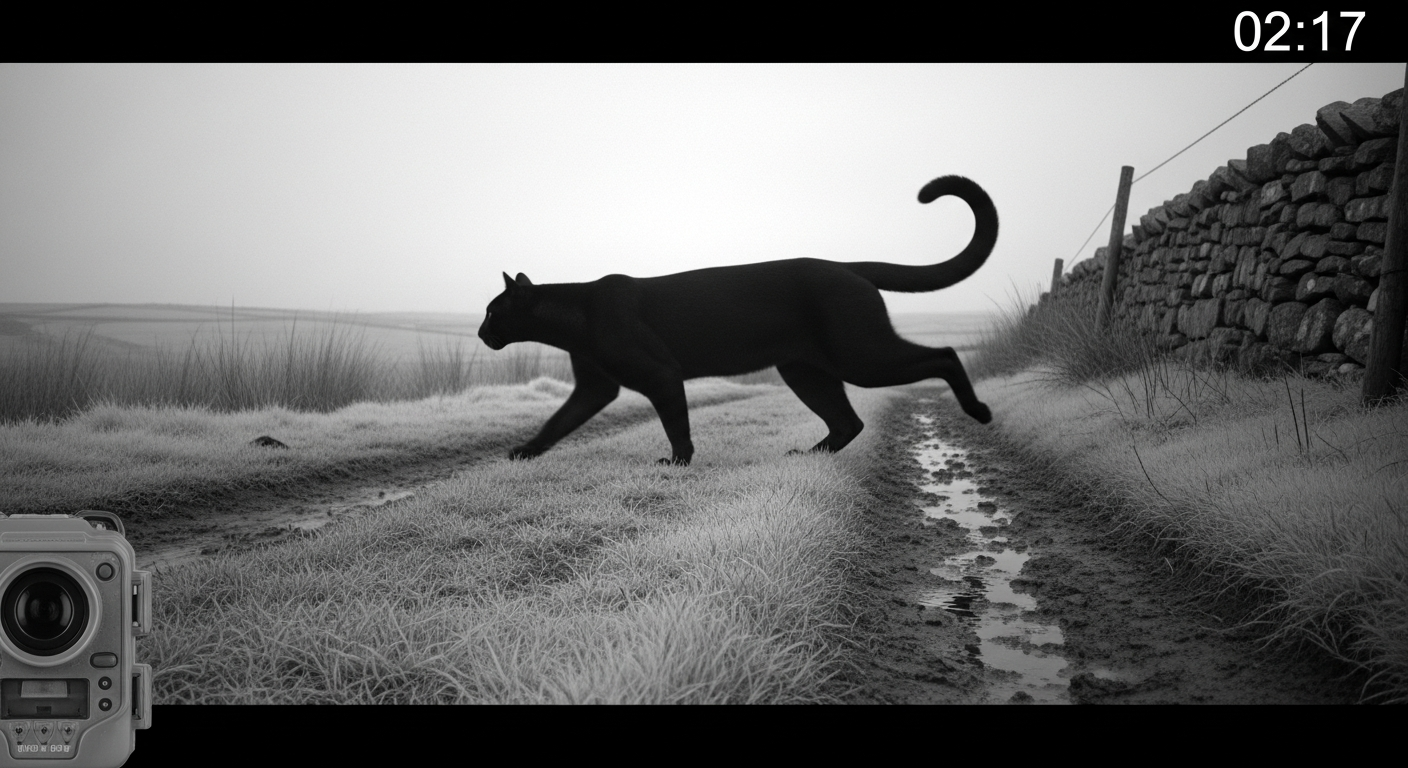
- Wildlife Camera Footage (2016): Trail camera footage captured a large dark feline crossing a field near Bodmin at 2am. Big cat specialists estimated shoulder height at approximately 60cm — exceeding any domestic cat and consistent with a small leopard or large puma. No consensus reached.
Institutional Records
- Ministry of Agriculture logged 60+ livestock incidents across Bodmin and Camelford districts by the early 1990s.
- 1995 government investigation concluded no verifiable evidence of exotic felid presence. Report disputed by two independent veterinarians who examined the same carcasses.
Corroborating Accounts
- 43+ sightings along the B3266 corridor over four years.
- Witnesses include farmers, a schoolteacher, a farm labourer, and members of the public — spanning decades and demographics.
- Sightings have continued into the 2010s and beyond.
SECTION THREE: FOX'S ANALYSIS
Right. Deep breath, ears flat, notebook open. This is one of the cases that makes a paranormal reporter feel something rarer than a government report with actual conclusions in it — genuinely conflicted.
Let me say at the outset: I cover alien encounters regularly, and I have my feelings about extraterrestrials and their inexcusable disregard for species-appropriate equipment. But the Beast of Bodmin Moor? This one feels different. This doesn't smell like little green men or interdimensional shenanigans. This smells like a very large, very real cat that someone irresponsibly let go in the 1970s and which has since been living its absolute best life at the expense of Cornish sheep farmers.
The Dangerous Wild Animals Act hypothesis is, frankly, the most boring and therefore probably the most accurate explanation available to us. Rich person gets a leopard. Government says, license it or lose it. Rich person thinks, I'm not paying for that — the moor's right there. And just like that, Bodmin acquired a resident it never asked for and has never managed to evict. You could say the British government let the cat out of the bag — and then spent thirty years pretending the bag was empty.
The 1995 Ministry report is the detail that really sets my tail bristling. Two independent vets disputed the findings in writing. In writing, people. That is not the behaviour of hysterical locals seeing housecats in the heather. That is the behaviour of trained professionals who examined the same evidence and reached categorically different conclusions. When the government says "nothing to see here" and the scientists say "actually, hold on" — a good reporter knows which room to stand in. I am standing in the scientists' room. I have brought biscuits.
The skull is extraordinary. A confirmed Panthera pardus, recovered from a Cornish river, undamaged, real as granite. The Museum's conclusion — that it was probably a dumped curio — is the academic equivalent of finding a penguin in your living room and deciding it probably blew in through the letterbox. Possible? Technically. Satisfying? Not remotely. I've seen more convincing explanations on the back of a crisp packet.
Patricia Trelawne's account, in particular, rings absolutely true to me. She wasn't looking for something strange. She was driving home. She stopped and watched. She sat shaking for five minutes. That is not the testimony of someone who has misidentified a large tabby in bad light — that is the testimony of someone whose nervous system received information it did not know how to file. I've been there, friend. I've been there.
And then there's Gerald. Forty years on that land. Eleven sheep. Three sightings he couldn't even commit to. There's something in his measured uncertainty that I find more compelling than any dramatic declaration. The man is not claiming a monster. He is claiming an animal. A real one. An inexplicable one. That distinction matters enormously in this line of work.
My gut — which has a reasonably good track record, excepting that one time in Roswell I won't discuss — says this is a genuine ABC case with a mundane origin and an extraordinary persistence. Is the Beast supernatural? Almost certainly not. Is it real? Almost certainly yes. Which means the real story isn't a monster on the moor. It's a government that failed its farmers, an ecosystem quietly hosting a predator it wasn't designed for, and an animal so perfectly adapted to survival that it has spent fifty years being the cat that got away. Again, and again, and again.
I'll be honest: I find that equal parts maddening and magnificent. Mostly maddening. I do not like things that don't want to be found. I have enough of that with my car keys on a Monday morning.
SECTION FOUR: CREDIBILITY RATING
Rating: 8.5 / 10
Reasoning: The volume, consistency, and demographic spread of witness testimony across nearly five decades is exceptional. Livestock evidence examined by qualified veterinarians produced findings the Ministry of Agriculture's own commissioned report failed to convincingly refute. The Natural History Museum's confirmed leopard skull — whatever its origin — establishes that at least one large exotic felid was physically present in Cornwall. The 2016 trail camera footage, while inconclusive, is consistent with every prior witness description. Points deducted only for the absence of a living specimen and the inherent ambiguity of long-range sightings. This case is among the most credible in the Quirk Reports archive.
SECTION FIVE: CLASSIFICATION
Primary Classification: Cryptid
Sub-classification: Alien Big Cat (ABC) — Probable Exotic Felid, Likely Panthera pardus (Leopard) or Puma concolor (Puma), or interbred descendants thereof
Supernatural Element: Low — phenomenon most consistent with naturalised exotic animal population following illegal release post-1976
Threat