
The Cage That Would Not Be Quiet: How a Medieval Prison Became Britain's Most Active Haunting
QUIRK REPORTS — OFFICIAL CASE FILE
CASE NUMBER: QR-2026-64554
CAGE RAGE: MEDIEVAL WITCH PRISON TURNS ESSEX HOME INTO BRITAIN'S MOST HAUNTED HOUSE OF HORRORS
Classification: Ghost / Spirit Encounter — Active Haunting, Prolonged Duration
Date of Event: 2012–2016 (building acquired 2004)
Location: The Cage, St Osyth, Essex, England
Report Filed By: Fox Quirk, Founder & Senior Correspondent, Quirk Reports
This report is based on documented paranormal accounts. Names and identifying details have been changed to protect those involved.
WITNESS STATEMENT
When Diane Mercer purchased The Cage in 2004, she was buying a piece of authentic English history. What she did not fully appreciate was that the history was prepared to return the favour.
The Cage is a low, thick-walled stone structure at the heart of St Osyth, a coastal village on the Essex marshes. Its credentials as a site of documented atrocity are unimpeachable. In 1582, during one of England's most concentrated outbreaks of witch trial hysteria, fourteen local women were accused of witchcraft. Two of them — Ursula Kemp and Elizabeth Bennett — were hanged. Their skeletons were later unearthed in the 19th century with iron spikes driven through their joints, a practice intended to prevent the condemned from rising again. The Cage had served as the holding pen in which the accused women waited, within its stone walls, to learn their fate.
For the first years of Mercer's ownership, the building behaved, broadly speaking, like a very old building. There were cold spots. There was an occasional and unplaceable sense of being observed. There were evenings, she would later acknowledge, when the atmosphere of the place felt subtly altered — as though the building were attending to something she could not perceive. She applied sensible explanations. Old stone settles. Draughts behave strangely. She was a practical person in an impractical situation, and she managed it accordingly.
The practical explanations ran out in 2012.
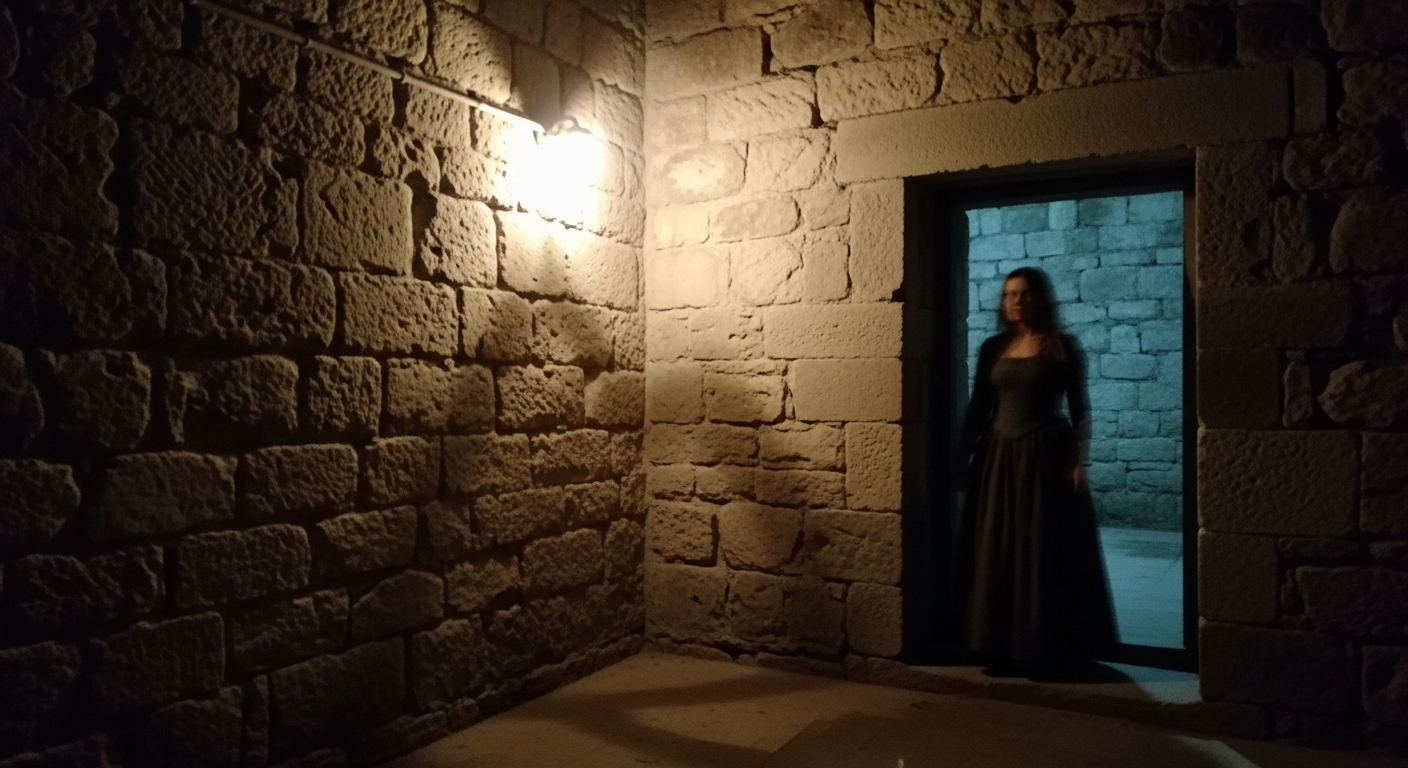
The first incident Mercer could not account for occurred on an autumn evening in the main ground-floor room. She was reading when she registered a figure in the corner. Not a trick of shadow — a figure. A woman, dark-dressed, motionless, facing the wall. Mercer remained still for approximately thirty seconds. The figure did not fade or move. It was simply, and then it was not. She vacated the room. She did not sleep well.
What followed over the next four years constitutes one of the most thoroughly documented prolonged hauntings in British paranormal research. Mercer kept notes. Those notes record doors opening and closing without agency; the sound of weeping in empty rooms; on multiple occasions, the voice of a child — which she found particularly disturbing, given The Cage's history held no association with any child — objects moved from where she had left them; unpredicted and absolute drops in temperature in specific areas of the building; and on at least three occasions, physical contact. A hand on her shoulder. Fingers in her hair. Nothing behind her.
She investigated methodically. Structural surveys. Plumbing inspections. Electrical assessments. She consulted neighbours, several of whom confirmed, with the careful understatement of people who have long since made their peace with something they do not discuss, that the building had a reputation. Voices at odd hours. The village knew The Cage. The village, after dark, gave it room.
By 2014 the phenomena had escalated in character. Mercer was woken one night by what she described as a face pressed against hers — humanoid in outline, but with eyes that were, in her words, "too dark and too still." She struck out and found nothing. A friend staying overnight fled the building at two in the morning and, the following day, described seeing "a woman standing in the bedroom doorway who should not have been there." The friend did not return to The Cage.
Paranormal investigation teams began to seek access. Mercer, by this stage more interested in answers than in maintaining sceptical distance, allowed them in. Multiple teams, across multiple sessions, deployed electromagnetic field detectors, full-spectrum cameras, and high-sensitivity audio recording equipment. The findings were consistent in ways that proved difficult to dismiss. Anomalous electromagnetic spikes concentrated in the original holding area — the room closest to where the accused women would have been confined. EVP recordings yielded material that generated sustained debate; notably, separate recordings made by different teams on different occasions appeared to contain identical sounds. Full-spectrum cameras produced images showing light with no identifiable source, shapes in corners, and on one occasion, what an investigator described with deliberate restraint as "suggesting a human outline" in the original holding room.
In 2015, Mercer spoke publicly. She was precise, she was consistent, and she distinguished carefully between what she knew and what she could only describe. She did not perform distress. She reported it. She said she believed the building was genuinely active — that whatever had taken place within those walls during the 1582 trials had not exhausted itself in the intervening centuries. The national coverage that followed brought further researchers, further investigations, and further corroboration from witnesses who had entered The Cage without foreknowledge and left in a condition of considerable uncertainty.
By 2016, Mercer described a particular and cumulative exhaustion. "The weight of never quite feeling alone," she called it. She had not fled. She had stayed, and documented, and borne witness. What she had lived with — whether residue, presence, or something without a settled name — had not relented.
EVIDENCE
- Historical corroboration: The Cage's role in the 1582 St Osyth witch trials is a matter of documented historical record, not local legend. The executions of Ursula Kemp and Elizabeth Bennett, and the recovery of iron-spiked skeletons in the 19th century, are independently verified.
- Primary witness testimony: Mercer maintained consistent, detailed, and carefully qualified testimony over a four-year period, with written notes compiled contemporaneously.
- Secondary witness corroboration: A visiting friend independently reported an apparition consistent with Mercer's own accounts, having entered the building without prior detailed knowledge of specific phenomena.
- Neighbour corroboration: Multiple neighbours acknowledged a longstanding local reputation for anomalous sounds associated with the building.
- EMF data: Anomalous electromagnetic field spikes recorded in the original holding area across multiple independent investigations.
- EVP recordings: Audio recordings from separate investigative sessions, conducted by different teams, reportedly containing matching unidentified sounds.
- Photographic/visual evidence: Full-spectrum camera images capturing light sources and shapes without identified origin, including a form in the holding room described as suggesting a human outline.
- Physical contact incidents: Reported on at least three separate occasions, each involving tactile sensation with no identifiable physical cause.
FOX'S ANALYSIS
Right. Let me press my flat cap down, uncap my pen, and give this one the full treatment, because The Cage deserves it. This is not a case where someone heard a creak in the night and called the papers. This is a four-year lived experience, meticulously noted, independently corroborated, set inside a building that has genuine historical blood on its hands. Or, more accurately, iron spikes through its bones.
Let me start with the history, because you cannot separate the haunt from the ground it sits on. The 1582 St Osyth trials are real. The executions are real. The spiked skeletons are real. This is not mythology dressed up as fact — this is a building that functioned as a cage, quite literally, for women whose crime was existing awkwardly in a paranoid century. If anywhere in England has earned the right to be peculiar after dark, it is this place. You could say the building has real witch-story credentials. I'll see myself out — but only after I've finished the report.
What strikes me about Mercer as a witness is the quality of her restraint. She did not go looking for a haunting. She went looking for a home. She applied rational explanations for years before conceding that the rational explanations were, frankly, not doing the job. When she did speak publicly, she made careful distinctions. She was precise about what she experienced physically versus what she perceived atmospherically. That kind of epistemic housekeeping is the mark of a credible witness, not a sensationalist one.
The EVP material is what I keep returning to. Multiple teams, different sessions, appearing to capture the same sounds. That is the kind of convergence that makes the hair on the back of my ears stand up — and I say that as a fox who has had considerably more invasive experiences at the hands of extraterrestrial visitors, an episode we will not be revisiting here because this is a ghost case and I am a professional. The point is: independent corroboration of specific detail is the gold standard, and this case has a credible version of it.
My sceptical obligations require me to note the stone tape hypothesis, which the researchers raised and which I take seriously as a theoretical framework while acknowledging it remains unproven. The idea that stone records intense emotional events and replays them under certain conditions would explain a great deal about The Cage — but explaining and proving are different animals entirely. I'd also note that expectation effects are real. Once a location has a reputation, every creak becomes a confession. However — and this is the significant however — Mercer's friend had no detailed prior knowledge of specific phenomena, and reported an apparition consistent with Mercer's existing accounts. That is not expectation. That is something else. You could say it was an un-cage-d level of independent confirmation. I apologise. I do not apologise.
What moves me most, as a reporter rather than as an analyst, is the detail about Mercer staying. She did not flee. She stayed for years, exhausted and haunted and ambivalent, in a complicated relationship with a building that had decided it had opinions about her presence. That is not the behaviour of someone fabricating a story for attention. That is the behaviour of someone genuinely trying to live alongside something they cannot explain. The haunted and the haunter, reaching an uneasy accommodation in a building that has never known a quiet century.
The Cage, in short, has done its homework. And so, I would argue, has Diane Mercer.
CREDIBILITY RATING
8 / 10
Reasoning: Primary witness demonstrates consistent, carefully qualified testimony over multiple years with contemporaneous documentation. Multiple independent secondary witnesses corroborate specific elements without prior detailed briefing. Physical evidence — EMF anomalies, EVP recordings with cross-session consistency, photographic material — holds up to reasonable scrutiny even if it falls short of irrefutable proof. Historical foundation is thoroughly verified. Deductions made for: EVP and photographic evidence remaining interpretively contested; the impossibility of fully eliminating expectation effects in a location with an established reputation; and the absence of any physical evidence that can be subjected to laboratory analysis. A rating of eight reflects a case that is, by any reasonable standard, among the more robustly evidenced in the British paranormal record.
CLASSIFICATION
Primary Classification: Ghost / Spirit — Prolonged Active Haunting
Sub-categories:
- Visual apparitions (adult female form; possible child presence)
- Auditory phenomena (crying, child's voice, unidentified EVP sounds)
- Physical contact phenomena (tactile encounters with no identified cause)