
The Airmen Who Walked Into Yesterday: How a British Military Pilot Flew Back Through Time Over the Scottish Lowlands
QUIRK REPORTS — OFFICIAL CASE FILE
Case Number: QR-2026-40796
✈️ YESTERDAY'S AIRFIELD: THE RAF PILOT WHO SAW FOUR YEARS INTO THE FUTURE
Classification: Time Slip / Precognitive Vision / Atmospheric Anomaly
Date of Event: Summer, 1935
Location: Drem Airfield, East Lothian, Scotland
Witness: Flight Lieutenant Edward Carlisle, Royal Air Force
Report Filed By: Fox Quirk, Founder & Senior Correspondent, Quirk Reports
This report is based on documented paranormal accounts. Names and identifying details have been changed to protect those involved.
WITNESS STATEMENT
The afternoon of that summer day in 1935 was not, by any measure, an unusual one for Flight Lieutenant Edward Carlisle. An experienced Royal Air Force pilot with hundreds of logged hours and a reputation for cool-headed professionalism, Carlisle had departed Andover, Hampshire, on a routine cross-country navigation flight heading north to his home station. He was at the controls of a Hawker Hart — a reliable, standard-issue light biplane — and the aircraft was performing without fault. The weather, however, was not.
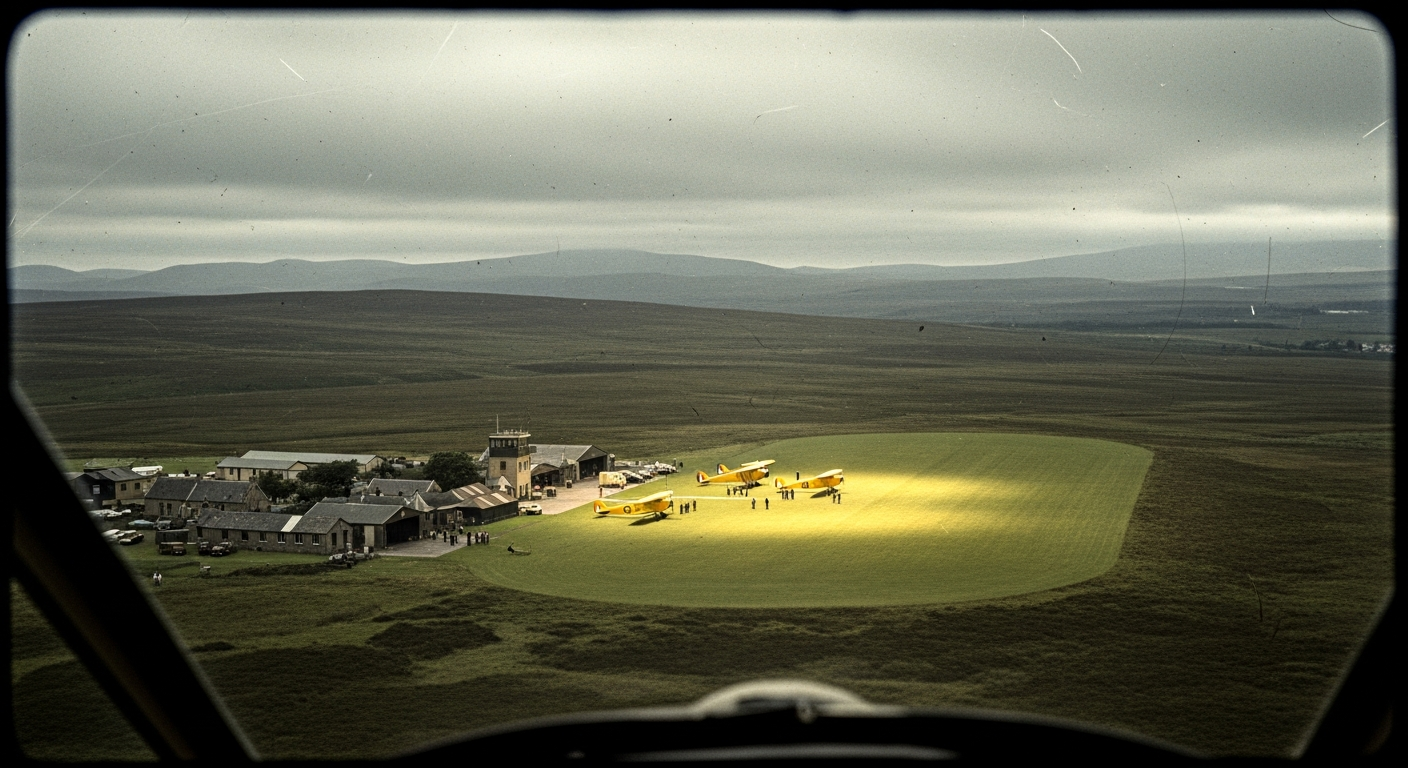
As Carlisle crossed into East Lothian, cloud banks rolling in off the Firth of Forth began closing in with unusual speed, descending in grey curtains that stripped visibility down to a few hundred feet. Making the pragmatic decision to drop below the overcast and reacquire a visual reference, he pushed through the cloud and broke into clearer air at low altitude over the Scottish lowlands. Below him, with sudden and unmistakable clarity, lay Drem airfield.
Carlisle knew Drem. He had been there. By 1935, it was a derelict relic of the First World War — abandoned since the Armistice of 1918, its grass strips overgrown, its hangars crumbling, slowly dissolving back into the East Lothian landscape. What he saw beneath his wings bore no resemblance to that ruin.
Drem was operational.
Mechanics in unfamiliar overalls moved briskly between aircraft on maintained, flat landing strips. The hangars stood whole and purposeful. Most striking of all were the aircraft on the apron: four low-wing monoplanes of a design Carlisle did not recognise, painted in a vivid, unmistakable yellow. The light, he later noted, was deeply wrong — golden, warm, and still, entirely inconsistent with the grey overcast pressing down around him at altitude, as though the airfield occupied its own private pocket of atmosphere lit by a sun that wasn't shining on the rest of Scotland that day.
Carlisle circled once. Not one of the mechanics below looked up. His aircraft went entirely unacknowledged. Then the cloud sealed around him once more, and when he descended a second time to look, Drem was as it had always been in 1935: abandoned, overgrown, and silent.
"It was the most vivid thing I had ever seen from a cockpit. It had the quality of hard, physical reality — not of dream, not of hallucination. I saw what I saw."
Carlisle landed deeply unsettled and, as a career officer disinclined to invite professional ridicule, said nothing publicly for several years. The memory refused to dim, as ordinary memories do. He described it privately to colleagues — and those private descriptions included a specific, repeated detail: yellow monoplane aircraft, on the apron at Drem, attended by mechanics in modern-style overalls.
In 1939, four years after Carlisle's flight, the RAF reopened Drem as a fully operational wartime station. Among the first aircraft allocated to it were Miles Magister training monoplanes — low-wing, ab initio trainers. Painted yellow. The mechanics wore the newer-style overalls adopted later in the decade. Colleagues who had heard Carlisle's account before 1939 confirmed that the description of yellow monoplanes had been present in his story from its earliest tellings, predating any association between that aircraft type and Drem — predating, in fact, the Miles Magister's existence in RAF front-line service altogether.
Carlisle eventually committed his account to a published memoir under his own name, describing the encounter with the measured precision of a trained observer: altitudes, durations, aircraft details, the quality of that anomalous golden light. He never revised it. He never embellished it. He maintained it, with quiet, steady consistency, until his death in the 1960s.
EVIDENCE
- Published memoir account: Carlisle documented his experience in his own name, in print — an unusual level of personal accountability for a paranormal account, and one that rules out anonymous embellishment.
- Pre-1939 corroboration: RAF colleagues confirmed privately that Carlisle's description of yellow monoplane aircraft at Drem was part of his account before 1939, before the Miles Magister was deployed there or associated with the station in any public way.
- The Miles Magister match: The aircraft deployed to Drem upon its 1939 reopening — low-wing monoplanes, painted training yellow — correspond precisely to Carlisle's 1935 description of unrecognised aircraft on the apron.
- Uniform detail: Carlisle noted the mechanics wore unfamiliar overalls. The RAF updated its ground crew uniforms later in the decade, consistent with what he described seeing.
- Geomagnetic context: Researchers have noted that Drem sits within a zone of moderate geomagnetic variation in East Lothian, a detail cited in electromagnetic theories of time slip phenomena, though this constitutes a direction of inquiry rather than an explanation.
- Structural parallels: The case shares documented features — altered light quality, unaware figures, brief duration, vivid memory retention — with other independently recorded time slip accounts including the 1901 Versailles case and the 1996 Liverpool Bold Street incident.
FOX'S ANALYSIS
Right. I'll be straight with you. I walked into this case file fully primed to start poking holes, because that's my job and I'm good at it. I came out the other side with considerably fewer holes than I started with, and a distinct feeling that someone had rearranged my notebook while I wasn't looking.
Let's start with the obvious: Edward Carlisle is, by every measure, an ideal witness. He's a trained military aviator. Observation is literally his profession. He's describing specific, technical details — aircraft types, altitudes, uniform styles — not vague impressions of lights and feelings. He puts his name on the account. He doesn't seek publicity. He tells colleagues before the facts can possibly confirm his story, and then the facts confirm his story. That's not the profile of a fantasist. That's the profile of a man who saw something he couldn't explain and spent decades quietly baffled by it.
The yellow monoplanes are the thing that keeps this reporter's ears flat against his skull in full attention mode. You can argue memory is reconstructive. You can argue he unconsciously revised the details after 1939. Except — his colleagues say he was describing yellow monoplanes before 1939. Before the Magister existed at Drem. Before it was meaningfully in RAF service at all. Either those colleagues are also confabulating, or Carlisle described the future and the future showed up on schedule. I've covered some strange cases in my time, but that's a headline even by my standards. Time keeps on slipping — quite literally, into the future.
The altered light is worth dwelling on. It's not a throwaway atmospheric detail. It appears in case after case in the time slip literature — Versailles, Bold Street, and a dozen smaller accounts that never made the mainstream press but sat in my files collecting dust until cases like this one put them in context. A warm, golden quality, inconsistent with the surrounding weather, localised to the anomalous scene. Carlisle was above grey overcast. The airfield was sunlit. That's not a perceptual quirk. That's a boundary condition — the edge of something. What something, I couldn't tell you with any confidence, and I'd be fibbing if I pretended otherwise.
The fact that the mechanics didn't look up is the detail I keep returning to. He was in a biplane. Biplanes are not quiet. Any working ground crew would have glanced skyward at the sound of an engine overhead. The silence from below — the complete absence of acknowledgement — is consistent with the idea that whatever Carlisle was seeing, it wasn't seeing him back. He was, in the most literal sense, a ghost from their perspective. A visitor from four years in their past, entirely invisible.
Now, I'll be honest: I wanted to dismiss this one. I tried. I couldn't. You know what they say about time travel — it's always a matter of seconds... or in this case, years. Ba-dum-tss. I'll see myself out.
My reporter's instinct, sharpened over many years of covering cases that range from the genuinely baffling to the aggressively ridiculous, says this one sits at the serious end of the spectrum. The corroboration is real. The witness is credible. The predictive detail matched. Whatever door opened above Drem in 1935, it opened for a man with the training to describe exactly what was on the other side — and the integrity not to dress it up. I'd have bought him a drink if I'd had the chance. You don't get many like Carlisle in this business. He was, you might say, ahead of his time.
CREDIBILITY RATING
Rating: 8.5 / 10
Reasoning: The Drem case scores exceptionally high for a paranormal account. Witness credibility is outstanding — trained military observer, named, published, technically specific. The pre-1939 corroboration from colleagues is the single most significant evidentiary factor: the predictive detail was on record before events could validate it. The structural consistency with other well-documented time slip cases adds contextual weight. Points are withheld only for the inherent limitation that pre-1939 colleague testimony is retrospective confirmation rather than contemporary documentation, and for the absence of any physical trace evidence from the airfield itself. Nonetheless, by the standards of this classification, this is among the most robustly evidenced cases in the Quirk Reports archive.
CLASSIFICATION
Primary Classification: Time Slip — Precognitive / Forward Temporal Displacement
Sub-categories:
- Atmospheric Anomaly (altered light quality, localised weather divergence)
- Non-interactive Observation (witness observed scene; scene did not register witness)
- Verified Predictive Detail (described future operational state of location with specific accuracy)
- Military / Aviation Context
CASE STATUS
Status: OPEN
Recommended Follow-up Actions:
- Cross-reference Carlisle's published memoir against RAF records from Drem's 1939 reopening for additional corroborating specifics.
- Locate and interview any surviving descendants or colleagues of Carlisle who may hold unpublished correspondence predating 1939.
- Commission geomagnetic survey of the Drem airfield site to establish baseline readings for comparison with other time slip locations.
- Review meteorological records for East Lothian, summer 1935, for evidence of unusual