
The Airman Who Touched the Craft: Britain's Most Astonishing UFO Landing
QUIRK REPORTS — OFFICIAL CASE FILE
Case Number: QR-2026-67500
LIGHTS IN THE PINES: THE AIRMAN WHO TOUCHED THE IMPOSSIBLE
Classification: UFO/UAP — Close Encounter of the Third Kind (Physical Contact Reported)
Date of Event: December 26–28, 1980
Location: Rendlesham Forest, Suffolk, England (Adjacent to RAF Woodbridge / RAF Bentwaters)
Report Filed: Quirk Reports, 2026
Reporting Officer: Fox Quirk, Founder & Senior Paranormal Correspondent
This report is based on documented paranormal accounts. Names and identifying details have been changed to protect those involved.SECTION ONE: WITNESS STATEMENT
In the early hours of December 26th, 1980 — Boxing Day, no less, when any sensible airman might reasonably have expected his greatest adversary to be a cold turkey sandwich — Corporal James Harwick was conducting routine security patrol along the eastern perimeter of a twin NATO air installation in Suffolk, England. What he observed that night, and over the two nights that followed, would become the most extensively documented UFO encounter in British history.
Harwick first noticed flickering, coloured lights descending through the treeline of Rendlesham Forest, approximately three hundred metres beyond the base perimeter. His initial assessment was procedurally sound: a downed aircraft, perhaps. A civilian emergency. He radioed it in and, accompanied by Airman First Class Danny Prewitt and Staff Sergeant Lenny Morse, moved into the frozen forest to investigate.
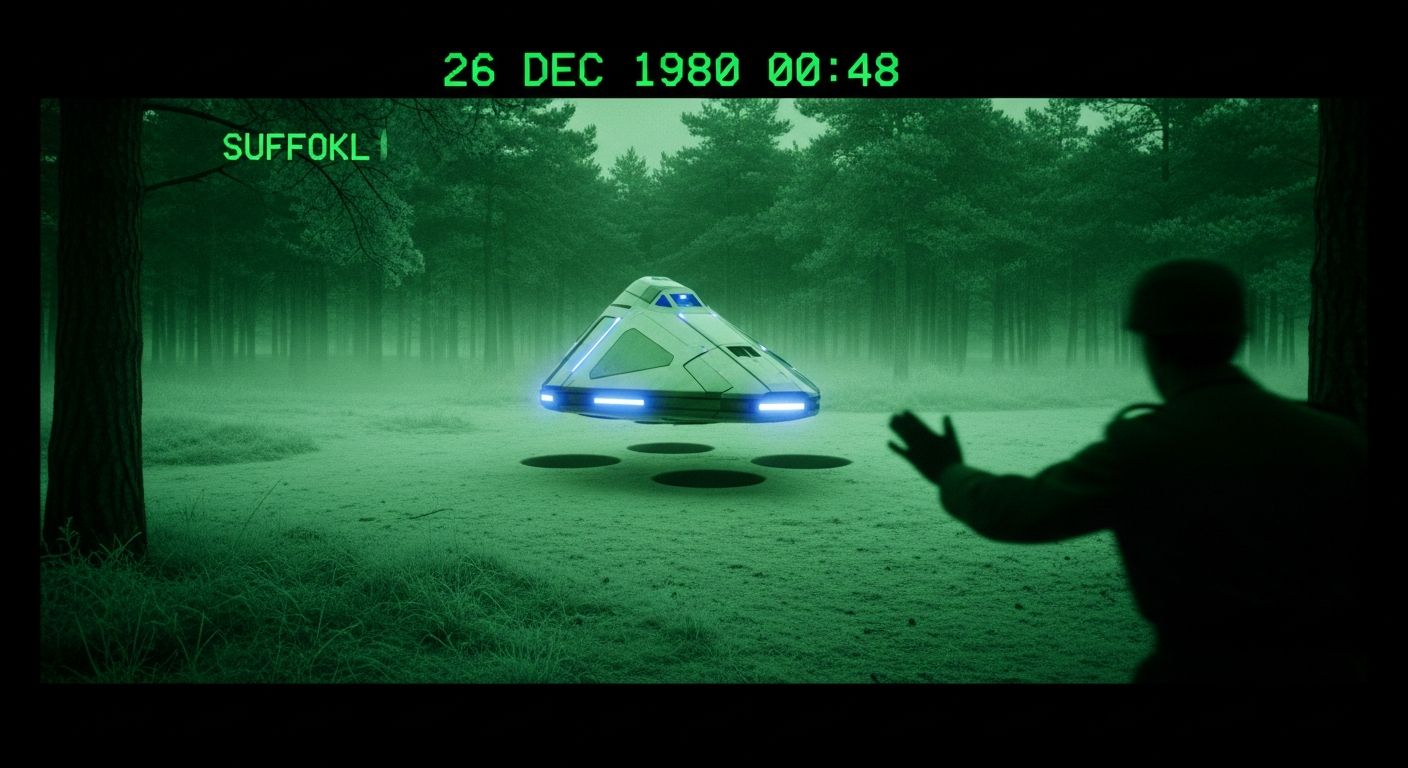
What the three men reported finding in a small natural clearing defied the vocabulary available to them. The object was roughly triangular. It sat slightly elevated above the ground, constructed — if that word even applied — from a material none of them could identify: smooth, dark, and possessed of a reflective quality that made it appear almost liquid. Coloured lights pulsed at its edges. It produced no sound. Harwick described the sensation of proximity as "pressure — not physical pressure, but something more interior, like the moment before a very loud noise."
Then Corporal Harwick reached out and touched it.
Both Harwick and Morse — independently, and without prior consultation — reported that the craft appeared to respond. The lights intensified. The object rose slowly at first, then with a speed and trajectory impossible for any conventional aircraft, clearing the treeline and vanishing at an angle that left the three airmen standing in silence in the frozen clearing, breathing hard, with no adequate words between them.
Their reports were filed before dawn. Senior officers initially suggested the nearby Orford Ness lighthouse as a probable explanation. The three airmen, trained observers who had been stationed adjacent to that lighthouse beam throughout their posting, rejected this categorically. As Harwick himself stated plainly in subsequent accounts: "This was not the lighthouse."
The forest, however, was not finished with them.
On the night of December 28th, a larger team returned — this time under the command of Lieutenant Colonel Richard Salter, the deputy base commander. Salter was a career officer of exemplary record, not given to fancy, and he entered the forest equipped with a geiger counter, a cassette recorder, and what he later described as a settled intention to find a rational explanation. He did not find one.
Salter's audio recording — later leaked and confirmed as authentic — documents a methodical officer in a state of controlled but unmistakable agitation. He narrated three distinct ground impressions arranged in a triangular pattern, each approximately four inches deep and seven inches across, pressed into soil that had been frozen solid. The geiger counter spiked sharply at the landing site and at surrounding trees, where bark had been broken or abraded at consistent heights — damage that, crucially, faced inward toward the clearing, as if the force had originated at ground level and moved outward, not downward from above.
Then, at the most extraordinary moment on the recording, Salter's voice drops to something close to a whisper.
"It's coming toward us now. It is coming this way."
Ninety seconds of indistinct audio follow — a low, oscillating hum; background voices; what may be movement in frozen leaves — before Salter resumes in an entirely normal tone, reporting that the lights have moved away toward the coast.
Salter's subsequent memo to the British Ministry of Defence described the lights, the physical evidence, and the reactions of his personnel in the careful, clipped language of the official military report. The Ministry's response was a document of what this reporter can only describe as magnificent institutional deflection: no threat to national security, no extraterrestrial vehicle, the lighthouse again, radiation levels merely "slightly above background." The memo was classified.
It remained classified for three years, until a Freedom of Information request brought it into public view — and the story passed in hushed tones among researchers suddenly became front-page news. Dozens of additional personnel came forward with corroborating accounts: unexplained instrument interference, strange lights above the eastern fence, informal warnings from superior officers not to discuss what they may or may not have witnessed.
Harwick, by then out of service, spoke to civilian investigators without anger and without a particular investment in what the object had been. "I had touched it," he said. "I know what I touched. Whatever it was, it was real, it was manufactured, and it was not anything human hands had made. That knowledge had been enough."
SECTION TWO: EVIDENCE
- Physical Ground Impressions: Three triangular indentations in frozen soil, approximately four inches deep and seven inches across, consistent across multiple witness observations and documented in Salter's real-time audio recording.
- Radiation Readings: Geiger counter spikes recorded at the landing site and in surrounding trees. While officially described as "slightly above background," the pattern of readings was notably consistent and localised.
- Tree Damage: Bark damage on surrounding trees at consistent heights, oriented inward toward the clearing — a pattern investigators confirmed was inconsistent with lightning, wind, or animal activity.
- Salter's Audio Recording: A real-time narrated cassette recording made during the December 28th investigation. Leaked, independently verified as authentic, and the subject of extensive acoustic analysis.
- Salter's Declassified Memo: An officer-level written report addressed to the Ministry of Defence, confirmed authentic following its release under Freedom of Information legislation.
- Multiple Corroborating Witnesses: Dozens of base personnel reported peripheral encounters — anomalous lights, instrument interference, and informal suppression of discussion — across the nights of December 26th and 27th.
- Radio Interference: A communications officer reported unexplained interference with base radio systems during the relevant hours.
SECTION THREE: FOX'S ANALYSIS
Right. Deep breath. Tail fluffed. Here we go.
I have covered a lot of cases in this job. I have sat in draughty village halls listening to people describe green men in their vegetable patches. I have staked out a barn in Minnesota for six hours in February because a farmer thought his tractor had been spiritually interfered with. I have, personally and to my very great displeasure, had a close encounter of my own — and let me tell you, those visitors did not exactly leave me feeling warmly toward the extraterrestrial community. Their probe was sized for a human, not a fox. That is not a small grievance.
But I try to be professional. And professionally, I have to say: this case is something else entirely.
What strikes me first — and I cannot stress this enough — is the quality of the witnesses. These are not enthusiastic amateurs. These are trained military observers, stationed adjacent to an active NATO air base, who knew every light source in that area the way I know every diner in lower Manhattan. The lighthouse argument is, and I will be charitable here, illuminating in what it reveals about the people making it — specifically, that they have never met anyone who has actually seen both a lighthouse and an unidentified craft and is being asked to choose between them. These men knew what a lighthouse looked like. It was rotating over the estuary every night of their posting. Suggesting they confused it with a landed, triangular, touchable object is, to use the technical term, a lot.
Then there is Salter's audio recording. A deputy base commander. A career officer. Narrating a geiger counter sweep of a forest clearing at night because he genuinely expects to find a mundane explanation — and instead recording his own voice dropping to a whisper as something approaches. That is not the behaviour of a man performing a story. That is the behaviour of a man who has just had the floor pulled out from under his worldview and is holding on to his professional vocabulary by his fingernails. I have interviewed a lot of people who were frightened. I know what frightened sounds like when it's trying not to.
The physical evidence is where this case really takes root. The indentations. The radiation pattern. And most compellingly to me — those tree marks facing inward. I spent twenty minutes just sitting with that detail. Whatever happened in that clearing, the energy moved outward from the ground up. Not sky-down. Ground-up. That is not consistent with any misidentification of a known phenomenon. That is consistent with something being there.
Now, do I know what it was? No. Do I think the Ministry of Defence knows? I think the Ministry of Defence knows exactly as much as it is comfortable knowing, which is different. Their response — that memo of magnificent institutional non-answers — is not the response of an organisation that investigated thoroughly and found nothing. It is the response of an organisation that decided how it wanted the conclusion to read and then worked backward. You might say they were deflecting at the speed of light.
I will also note, with the weary familiarity of a reporter who has seen this pattern more times than he can count, the informal warnings given to personnel. The career implications. The carefully calibrated vagueness. You don't warn people not to discuss what they may or may not have seen if what they saw was a lighthouse. You just don't. That detail — quiet, unofficial, deniable — is sometimes more revealing than anything on record. You could say it's the cover-up that came in from the cold.
And Harwick. The man who touched the craft. I keep coming back to him. Not angry. Not campaigning. Just carrying the knowledge of what he touched and not asking anyone to carry it with him. There is a particular kind of credibility that lives in that kind of quiet. I have interviewed people who want you to believe them. Harwick reads like a man who stopped needing that a long time ago. Whatever he touched, he touched it, and it was enough.
Whatever was in Rendlesham Forest in December 1980 — and I have spent considerable time with this case, my flat cap metaphorically tipped to every researcher who got there before me — it was real, it was physical, and it left marks on the ground and marks on the people who encountered it that no lighthouse rotation cycle has ever, in the history of human observation, managed to produce.
Something landed in that forest. And no, I am not branching out into certainty — I am a sceptic to the last. But the evidence here is not thin. The evidence here has roots.
SECTION FOUR: CREDIBILITY RATING
Rating: 9 / 10
Reasoning:
- Multiple independent witnesses (+2): From enlisted men to